
 This is Post 2 of 4.
At this moment, the club is holding its annual Super Sci-Fi Book Sale at our downtown meeting locale. As such, there is no interactive ZOOM-chat component included with this month’s MonSFFA event.
But for our out-of-town club members and friends, we do offer today, here online, a few Halloween-themed items of interest, culled from our meeting archives of these past few years.
The Horror, The Horror…
For your perusal, then, we offer this comprehensive overview of the life and career of filmmaker William Castle, known to genre fans for his B-picture horror movies and the many wild marketing gimmicks he employed to promote them.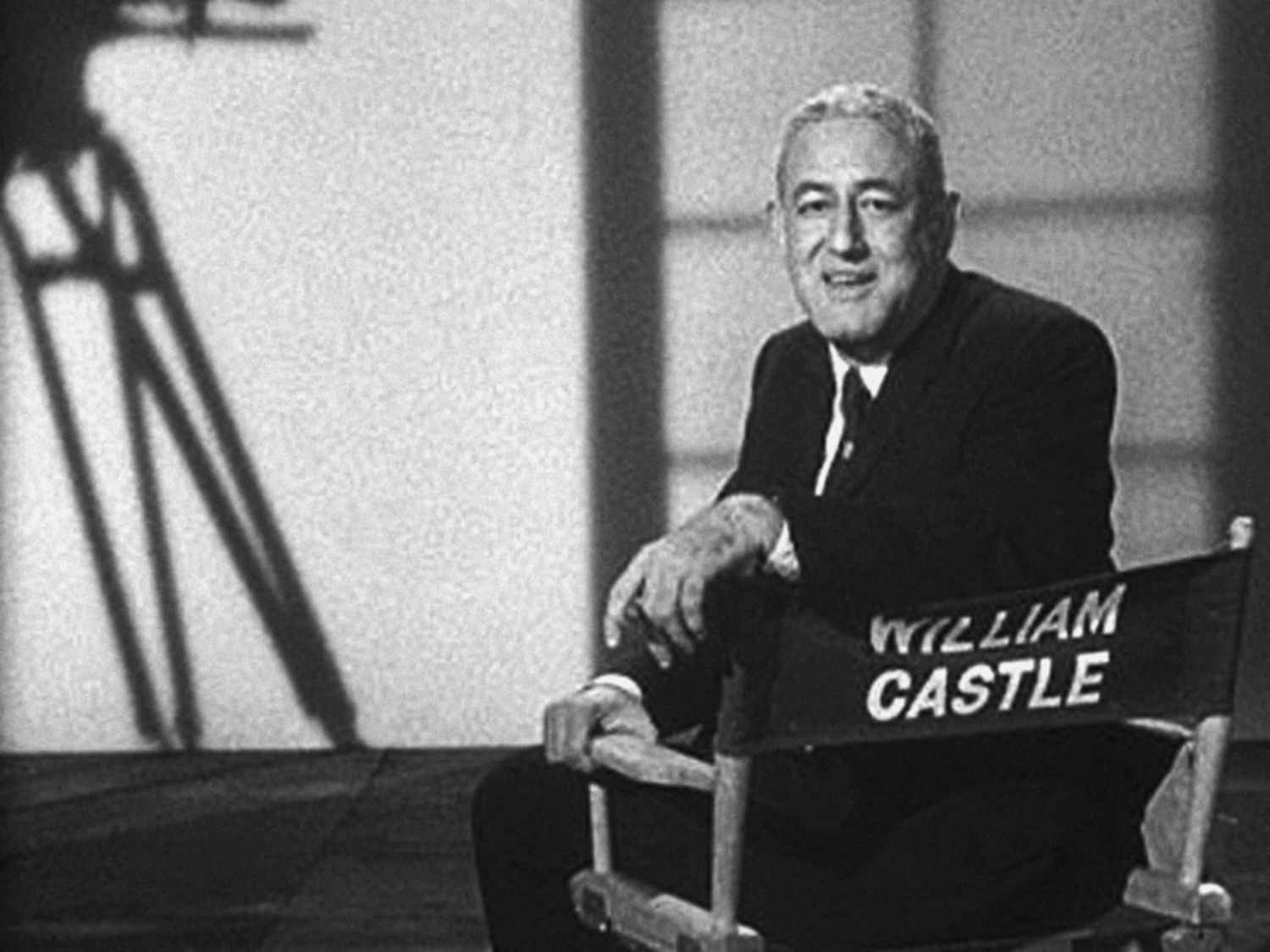
William Castle was a film producer and director, and occasional screenwriter and actor, almost exclusively working in B-movies. His career spanned four decades, from the 1940s through the 1960s and into the ’70s. Castle’s resumé lists some 100 or more films. He also worked in television. But of particular interest to us this afternoon are his dozen or so horror and fantasy/sci-fi films, and the sometimes over-the-top publicity stunts that he employed to promote his movies, crazy marketing gimmicks with names like “Emergo,” “Percepto,” and “Illusion-O.”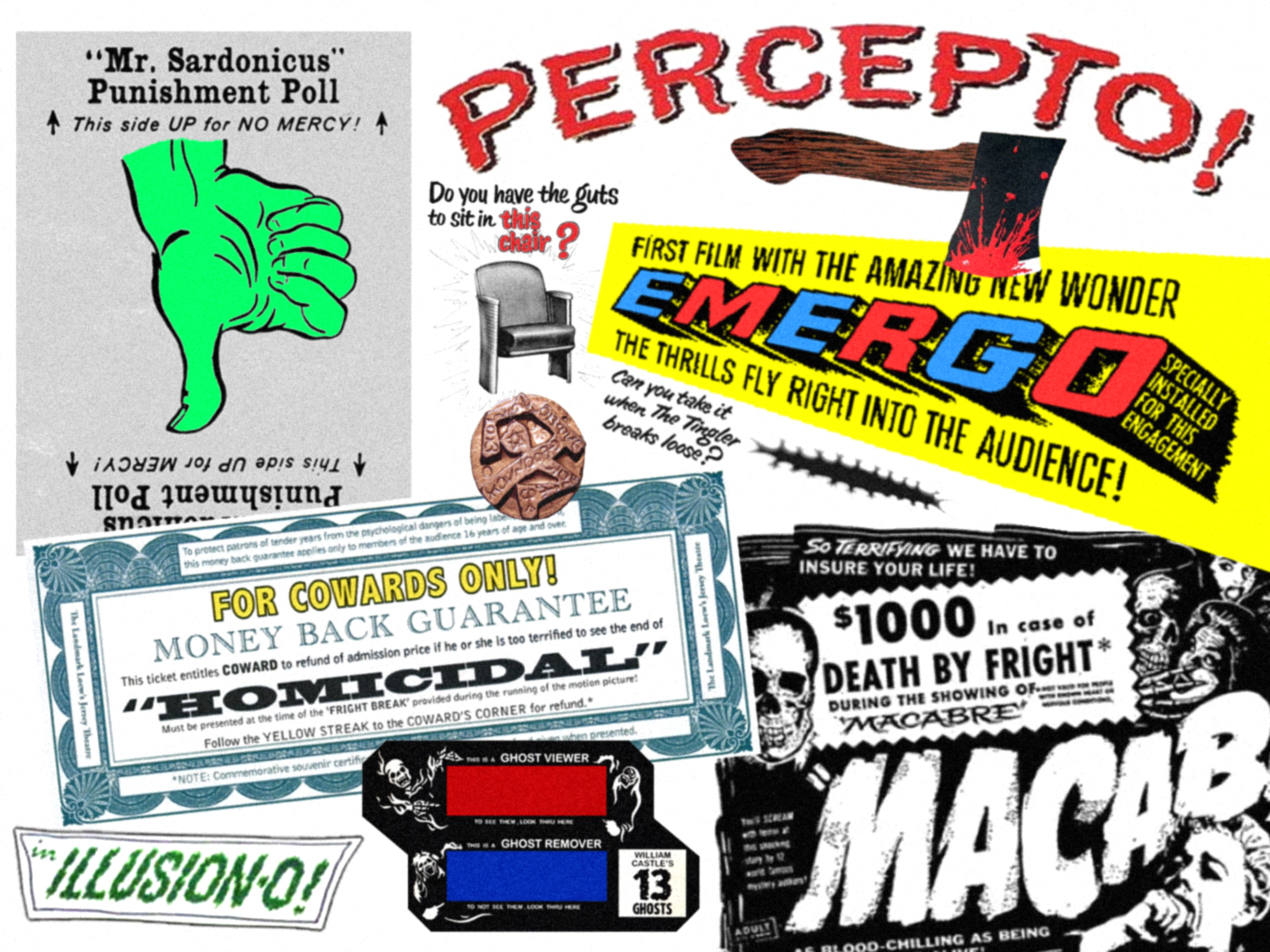
Castle has was born William Schloss, Jr. in 1914, to a Jewish-American family living in New York City. He suffered the tragic loss of his mother when he was just 9 years old, his father soon after, leaving the young William an orphan at age 11. Thereafter, he was raised by his older sister.
THEATRE YEARS: DRACULA, BROADWAY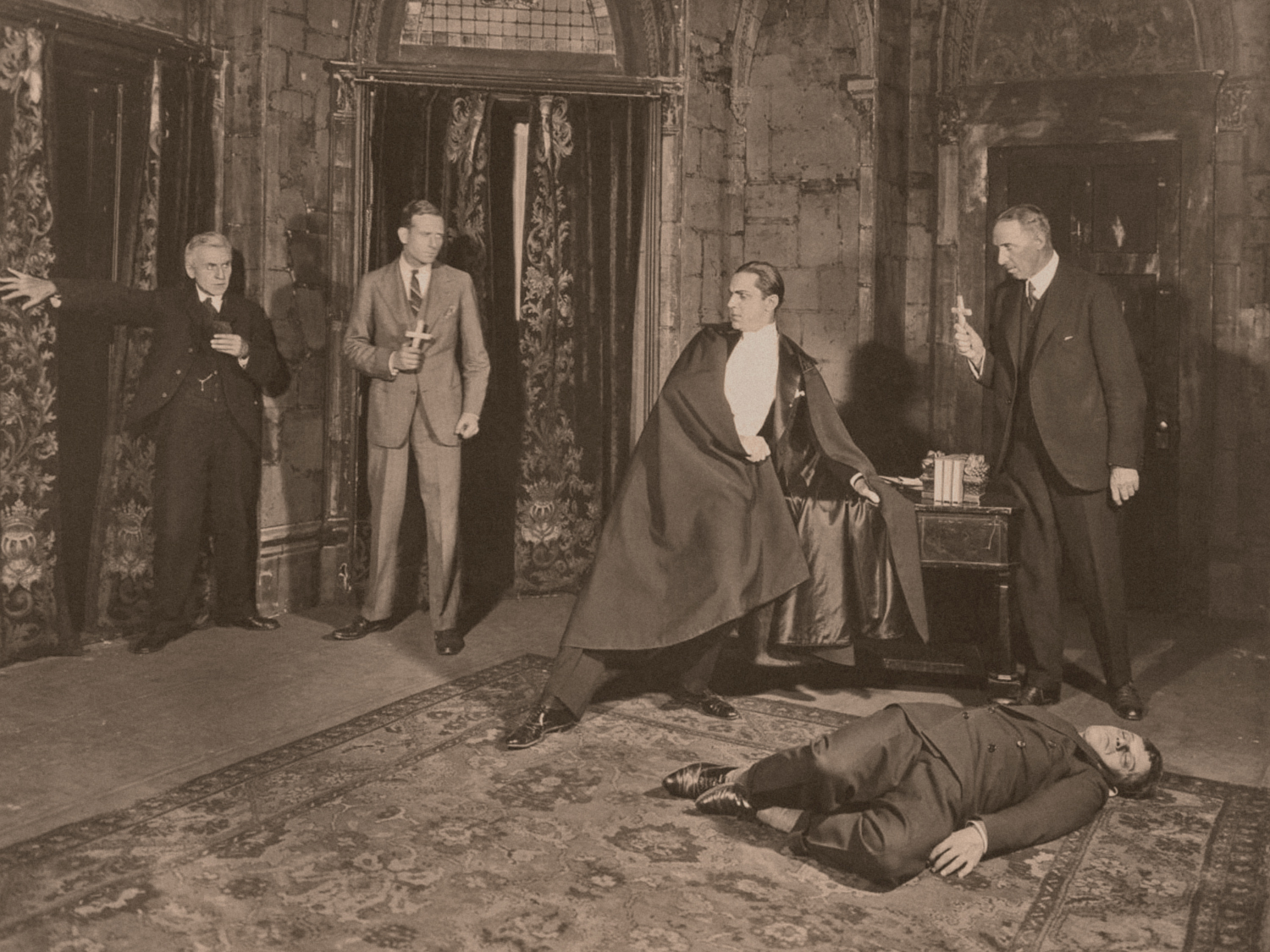
At age 13 he became captivated by one of horror fiction’s most famous characters after seeing a performance of a new Broadway play. The year was 1927 and the play was “Dracula.”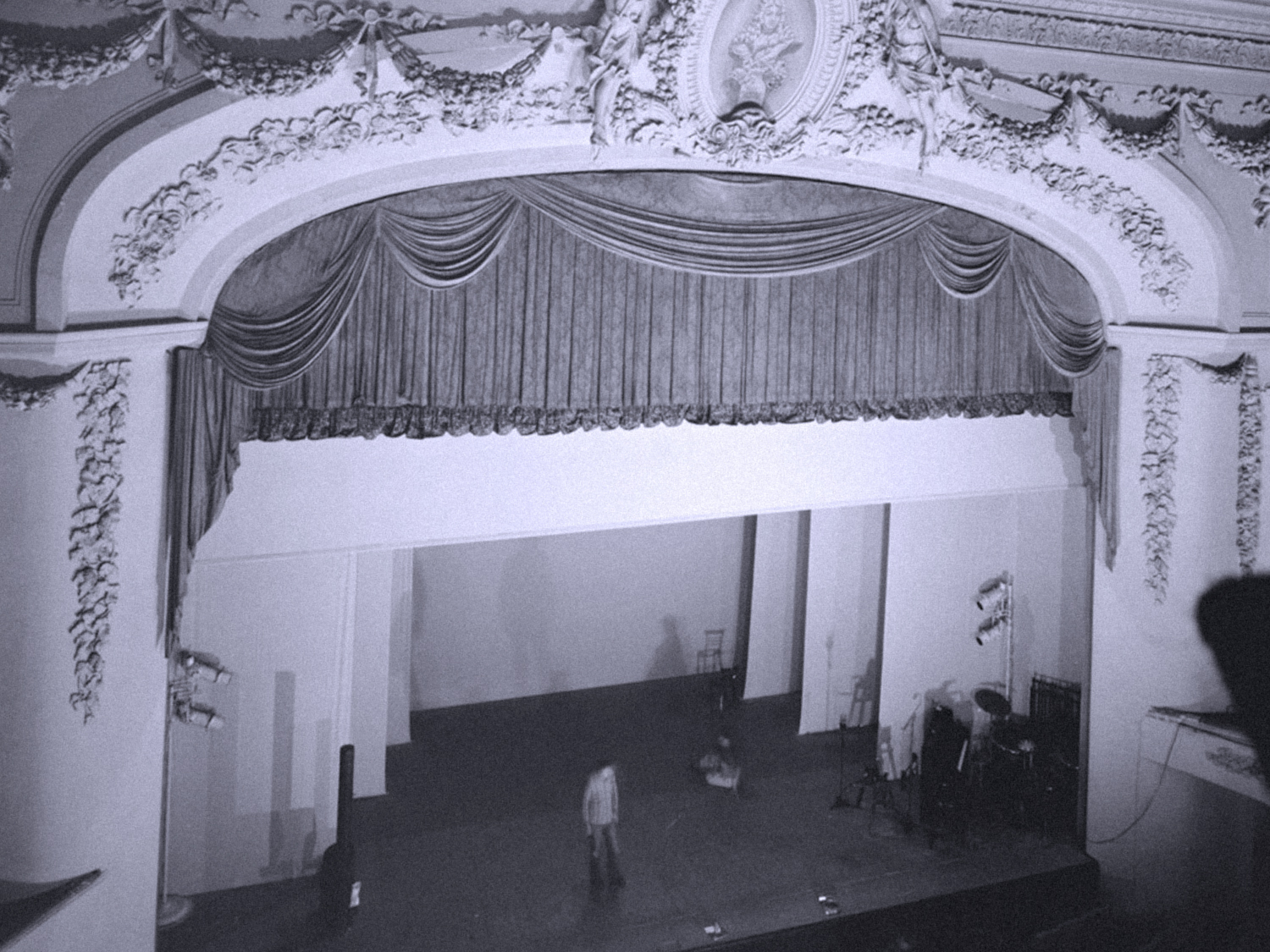
Pictured here is the original Helen Hayes Theatre prior to its demolition in the early 1980s. In 1927, it was known as the Fulton Theatre, to which Castle returned over and over again to see Dracula.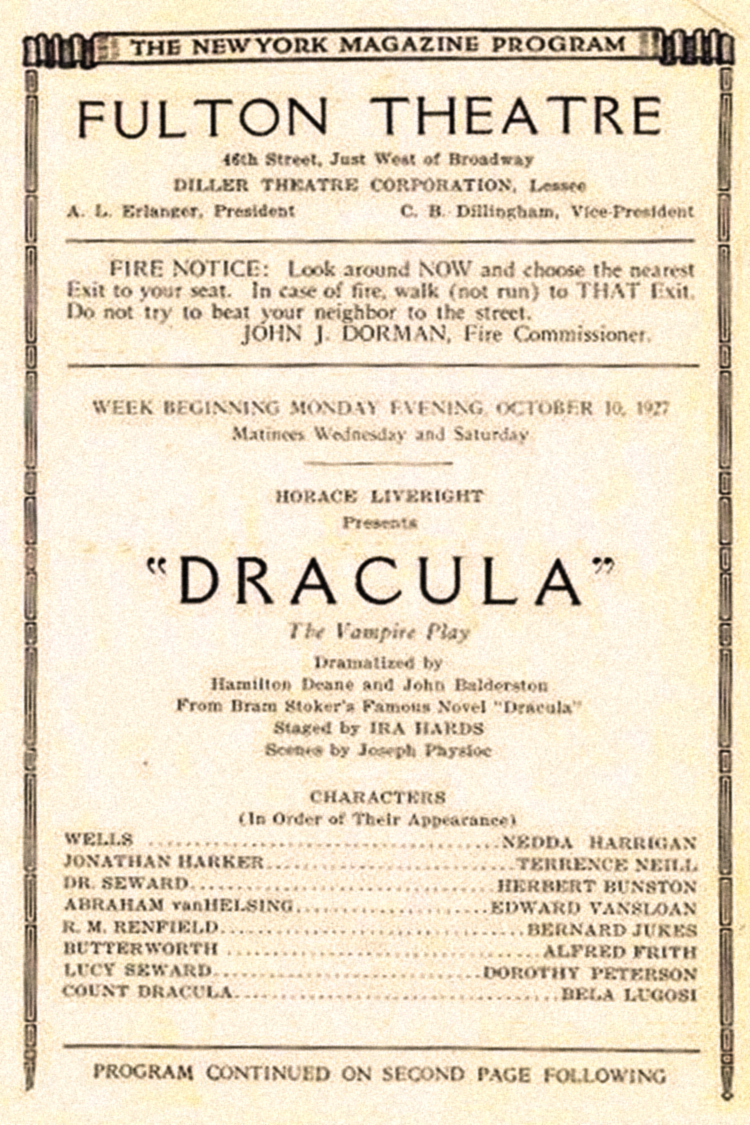
“I knew then what I wanted to do with my life,” he wrote in his autobiography. “I wanted to scare the pants off audiences.” His path was set, but it wasn’t going to be a quick or an easy one!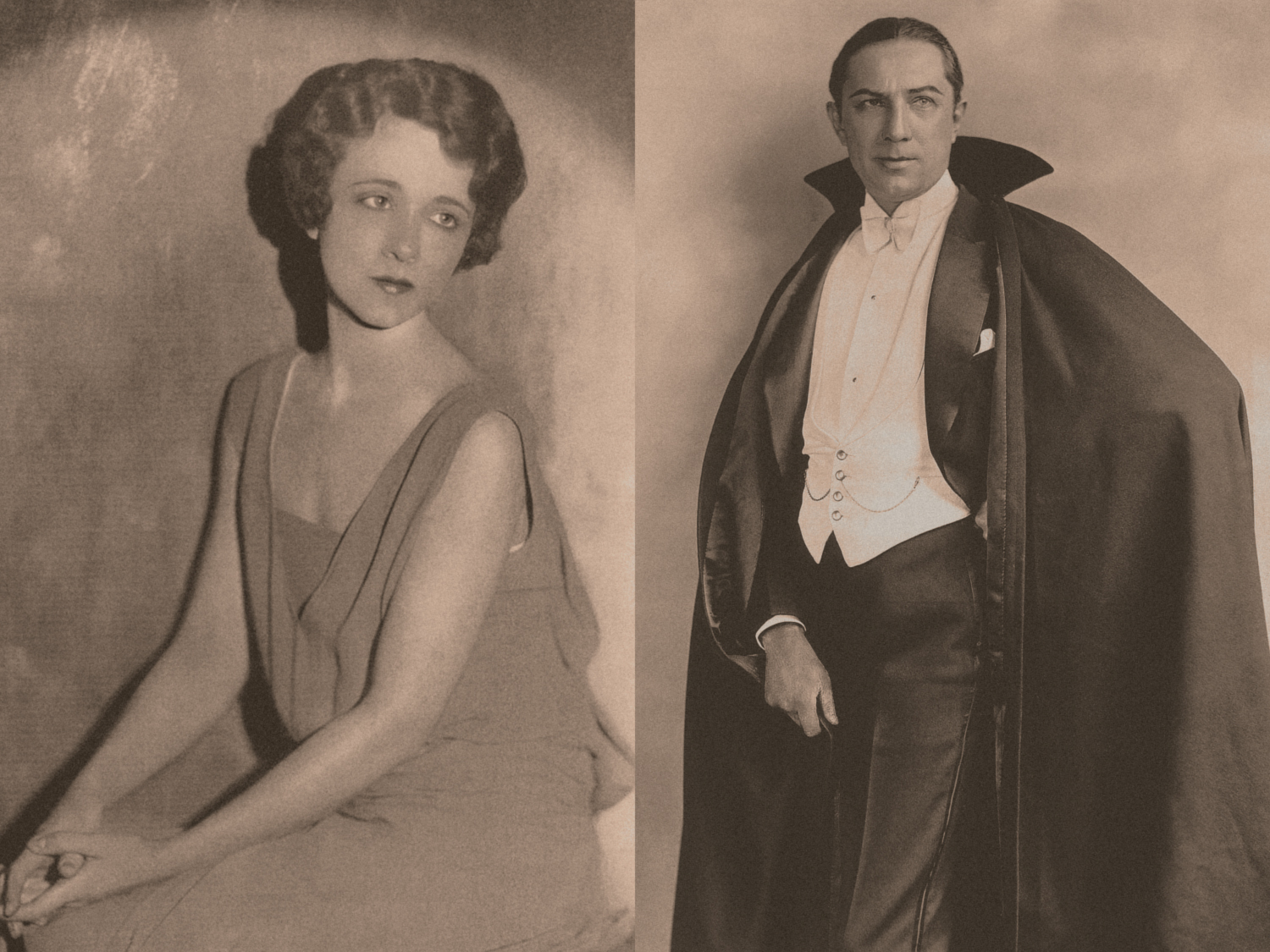
Cast as Dracula in the play was a Hungarian actor, Bela Lugosi, starring in his first major English-speaking role; his co-star was the lovely Dorothy Peterson. Lugosi and another of his castmates, Edward Van Sloan, who played Van Helsing, would go on to star in Universal’s film adaptation of Dracula, released in 1931.
Before too long, through a combination of bold bluff and chutzpah, Castle met and befriended Lugosi, who invited the youngster to watch the play from backstage. This vantage point permitted Castle to take in the workings of putting on a stage play. Later, Lugosi recommended the boy for the position of assistant stage manager with the production’s touring company. Castle quit school at age 15 to take the job and soon demonstrated a knack for showy promotion, arranging for coffins in lobbies and hearses parked outside theatres. He would spend his teenage years working on Broadway in a variety of functions, from set-building to acting to directing. His first directing assignment came at age 18, helming a production of Dracula!
All of this helped ready him as a future filmmaker. It was during this period that he adopted his stage name, simply translating the surname, Schloss, from German to English; schloss is German for castle or manor, hence, he became William Castle.
THEATRE YEARS: STONY CREEK, ELLEN SCHWANNEKE
In late 1938, Orson Welles and his famous Mercury Theatre company were staging a summer stock production at this venue, the Stony Creek Theatre in Connecticut, prior to Welles departing for Hollywood to shoot Citizen Kane.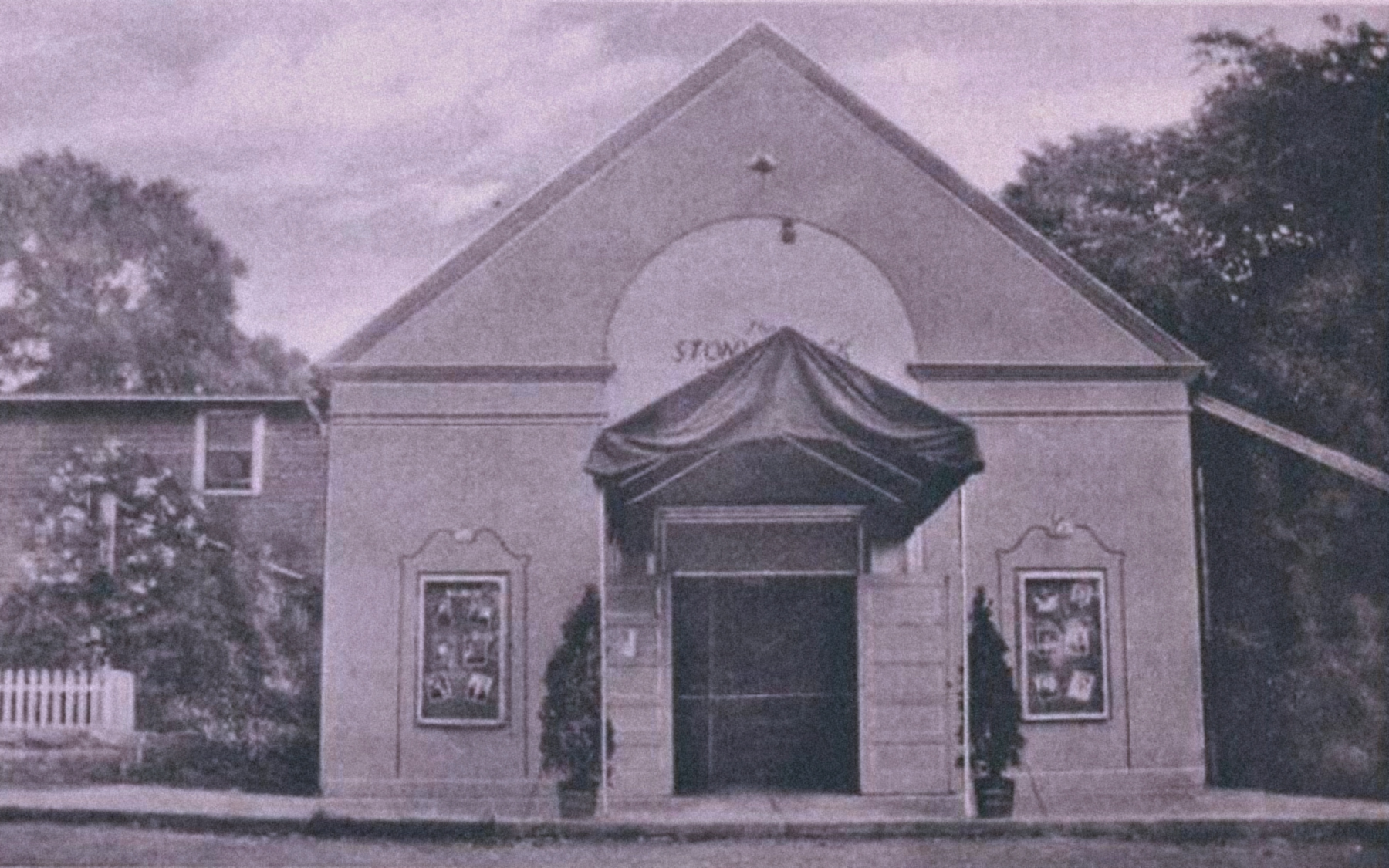
Made aware by one of the Mercury Theatre players that Welles was soon leaving for Hollywood and planned to close the theatre, Castle again drew upon luck and his aptitude for creative misrepresenta-tion in order to get hold of Welles’ private phone number. He convinced Welles not to close the theatre, but instead, lease it to him. Castle had capitalized on circumstances to secure himself a theatre from which to produce stage plays.
His next move was to hire German actress Ellen Schwanneke as his leading lady. Castle and Schwanneke had earlier met at a party and he found himself rather taken with this beautiful woman, who had fled her native country to escape the Nazis and was having difficulty finding acting work in America. Castle quickly propositioned her with an offer to star in a play at his freshly acquired theatre. Schwanneke was a stage and screen star in Germany famous for her role in Mädchen in Uniform (Girls in Uniform, 1931), a movie about young girls at a strict boarding school. The film explored subtle but unmistakable lesbian themes and was, at the time, well received in much of Europe. Today, Mädchen in Uniform is considered a pioneering LGBTQ+ movie for its positive portrayal of Sapphic relationships. Schwanneke was 15 when she appeared in the film, pictured here with co-star Herta Thiele.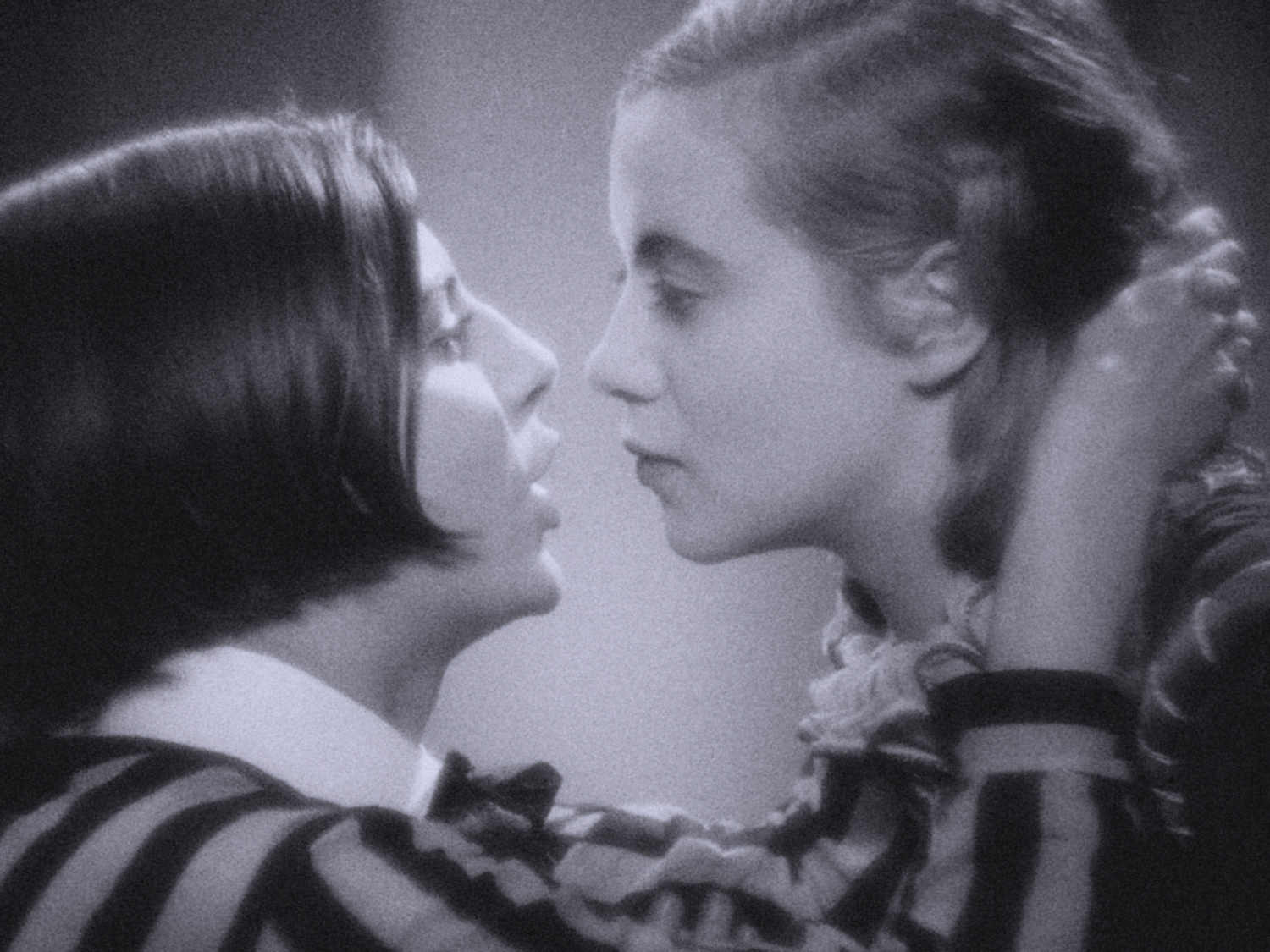
But despite a reworked edit featuring an alternate ending tailored to National Socialist ideals, the ruling Nazis had eventually labelled Mädchen in Uniform decadent and banned screenings in Germany.
Castle, meanwhile, ran afoul of Theatre Guild regulations in effect at the time favouring American actors and prohibiting the Berlin-born actress from appearing on stage in any but a play originally performed in Germany. Castle countered that he had hired Schwanneke for “Das ist nicht fur Kinder” (Not for Children), a play that he conjured up on the spot so as to get around the rules! He spent a weekend writing the play and having it translated into German. Castle is pictured, here, with Schwanneke and another actor rehearsing on the theatre’s lawn, circa 1939.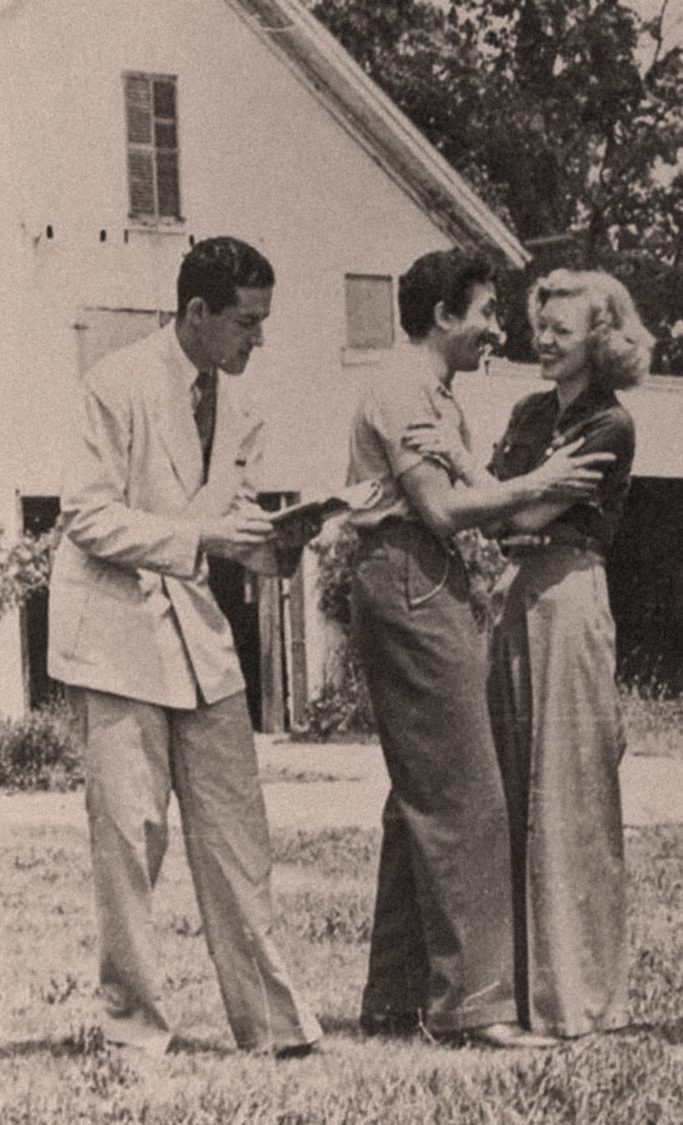
When the public learned that Welles and the Mercury Theatre were not involved, however, interest in the upcoming play, its unknown producer, and star Schwanneke proved tepid. Advance box office activity was decidedly weak, until fate suddenly presented Castle with an unexpected and mighty marketing opportunity!
It happened that the Nazi regime issued a gold-embossed invitation to Schwanneke to return to her homeland and perform again on the German stage in Munich for a grand reunion of the country’s stage and film stars. She despised the pall of creative conformity the Nazis had imposed on the arts and while she was not Jewish, many of her friends and colleagues in the arts were, and she found their persecution by the Nazis abhorrent. She had no desire to return to a Germany under Hitler. Her story was later capsulized in this 1945 newspaper report on the occasion of her becoming an American citizen.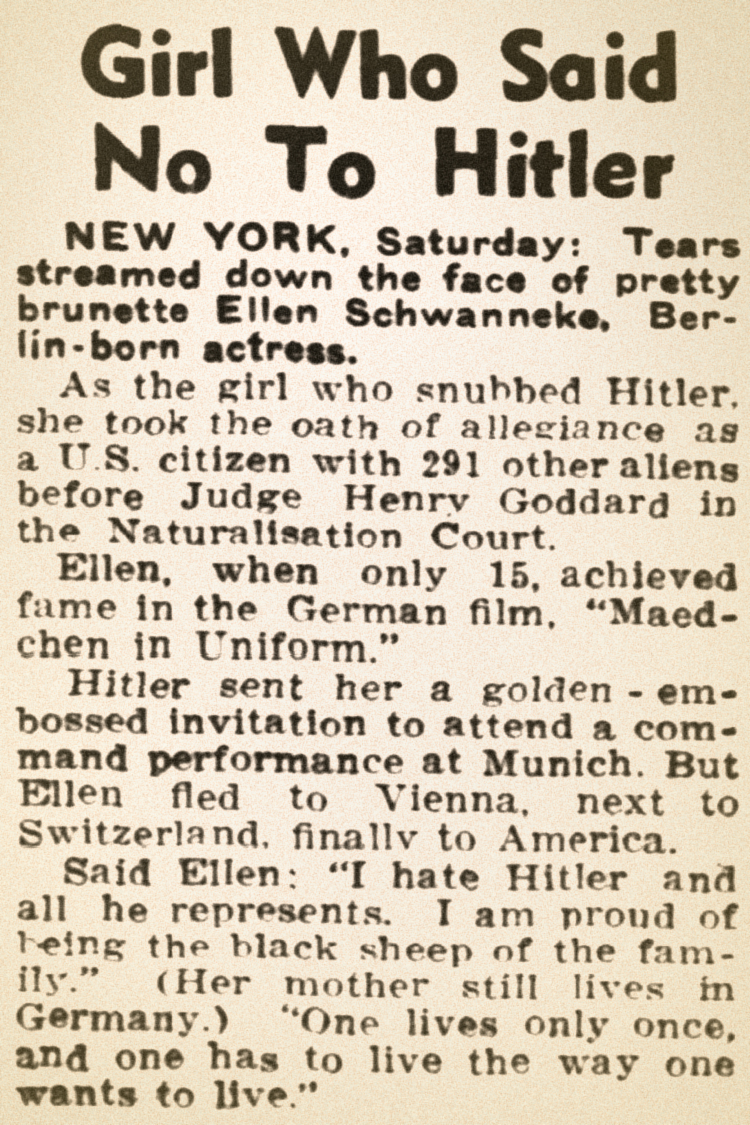
Castle seized the moment to release to the press what he claimed was a telegram he had sent to Hitler categorically turning down the invitation, trumpeting Schwanneke as the star of a new play opening soon at the Stony Creek Theatre, and touting her as “The Girl Who Said ‘No’ to Hitler.” Interest in Schwanneke and the play ballooned overnight, as did the box office, and just to ensure that the hype remained at a maximum, Castle, late at night, surreptitiously “vandalized” his own theatre, painting swastikas and Nazi slogans on the building. The following morning he defiantly avowed that the show would go on, and that the intimidation tactics of Nazi thugs would not deter the scheduled opening of the play! The crowning touch was to request State Militia protection for opening night, which was granted. The torrent of publicity surrounding this whole episode guaranteed the play’s success.
HOLLYWOOD STUDIO YEARS: COLUMBIA
In 1939, Castle left the theatre behind and headed west to Hollywood to work for notoriously cold-blooded studio boss Harry “King” Cohn at Columbia Pictures. Cohn was fond of B-movies and well after the other major studios had abandoned the form, Columbia continued to produce them. It was in this B-movie milieu that Castle developed as a filmmaker.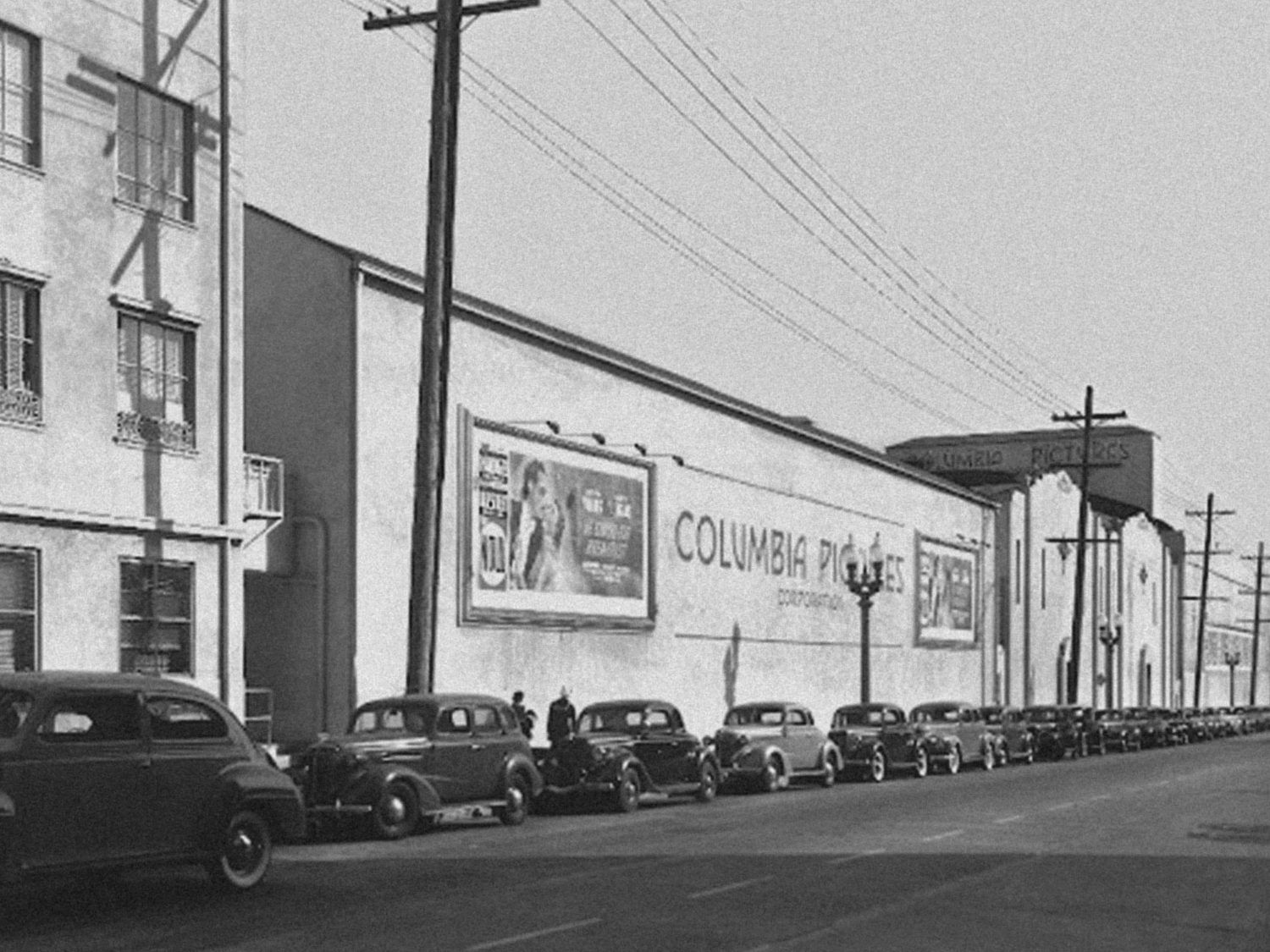
He began as a dialogue director, soon graduating to other assignments and learning everything he could about the film business as he progressed. He was one of the few people Cohn liked and in 1943, the studio boss gave him a chance to direct, handing him the reigns on Chance of Lifetime (1943), the sixth of 14 Boston Blackie films produced by Columbia in the 1940s.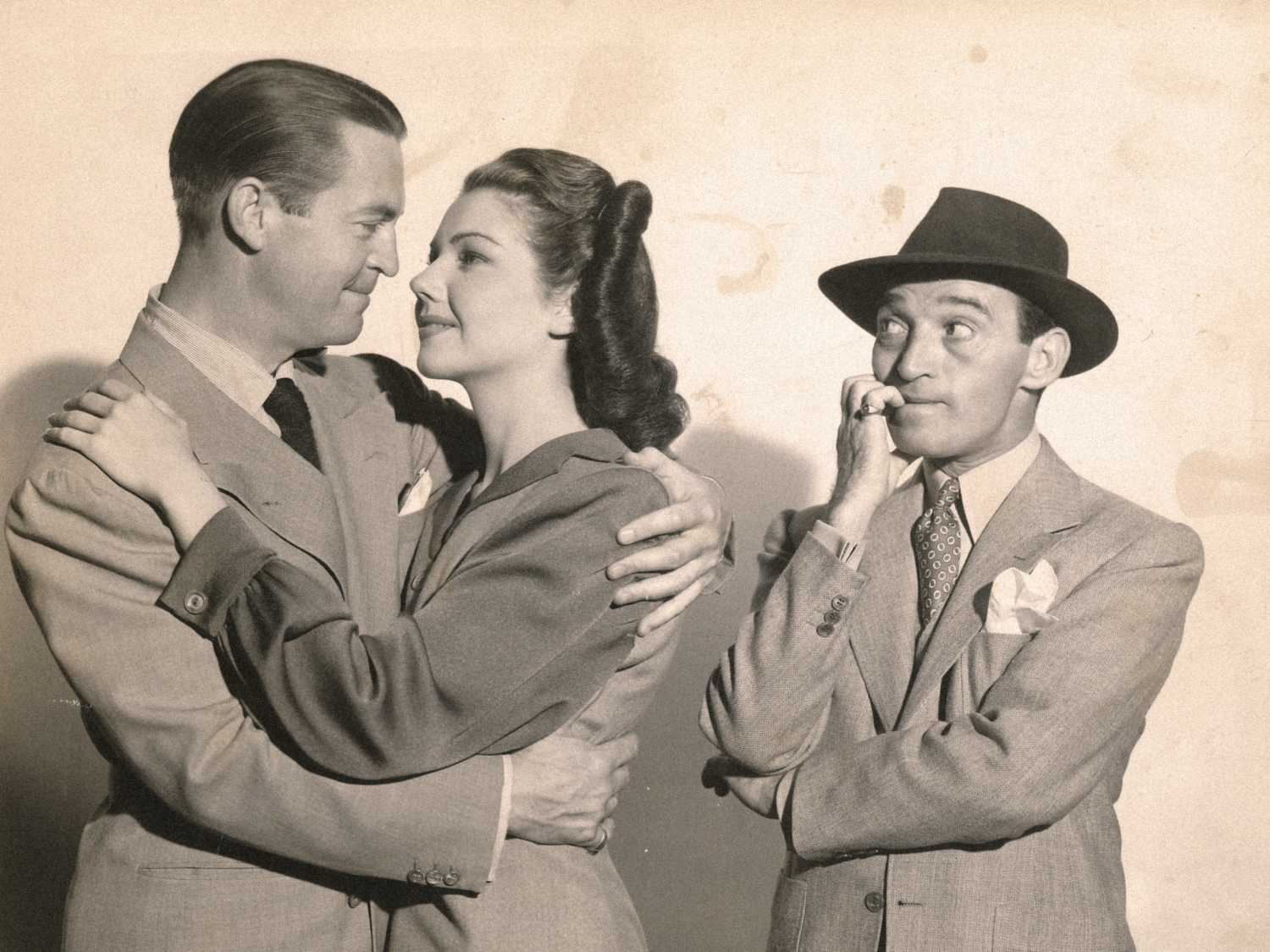
Boston Blackie, played by Chester Morris in all 14 films, was a reformed jewel thief who solved daring crimes to avoid being fingered as a suspect himself. Castle recalls that Chance of a Lifetime’s script was “lousy, dull, contrived,” and peopled with wooden characters speaking unbelievably bad dialogue. Shot in just 12 days, Castle fretted that his first film as a director was a real turkey!
But Cohn saw something in Castle that prompted him to give the novice director another chance. The Whistler (1944), based on the popular radio series of the day, was a film noir mystery, the first of eight produced by Columbia. This time, Castle scored a hit. He would ultimately direct four of those eight Whistler films (the other three being The Mark of the Whistler, 1944; Voice of the Whistler, 1945; and Mysterious Intruder, 1946).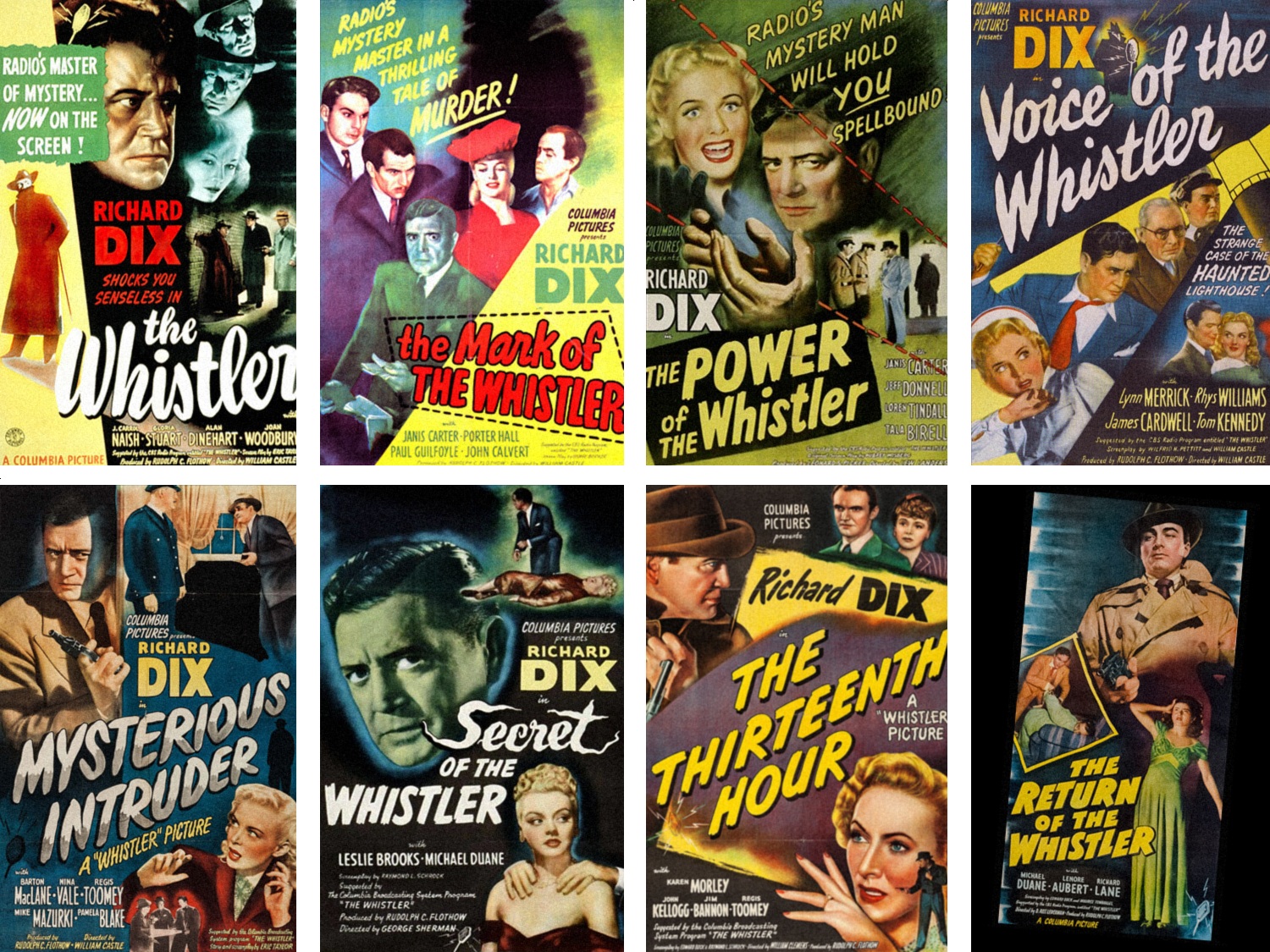
During the 1940s and 1950s, Castle directed a variety of B-movies—noir crime and mysteries, westerns, sword and sandal epics, family dramas, adventure films, romances—earning a reputation as a director who could bring in a picture quickly and under budget.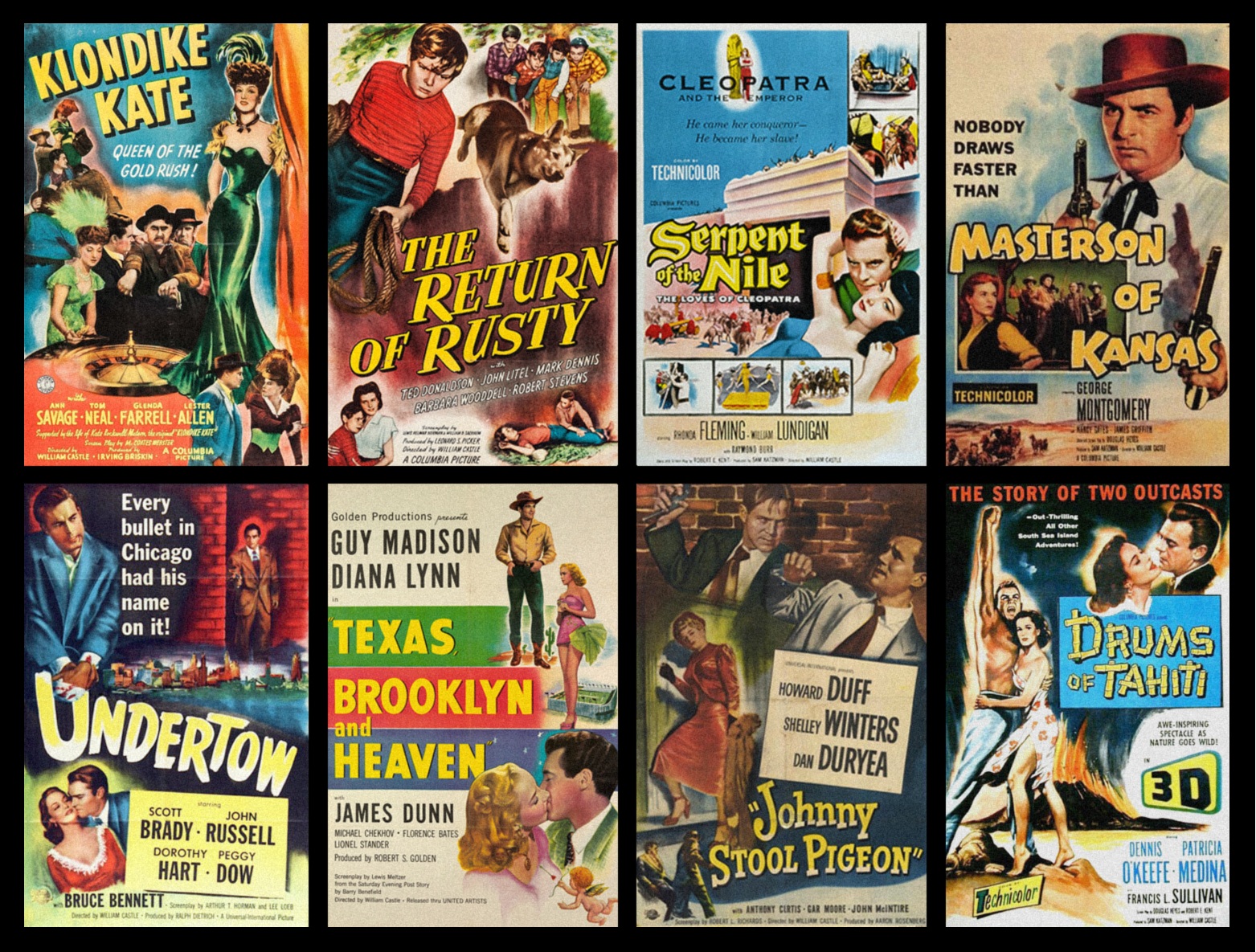
He was among many unsung filmmakers of this era, plying their trade, learning from each other and honing their craft. Castle worked, at one point, with Sam Katzman’s serial unit; he was photographed, here, with producer Katzman (center), who later, in the 1950s, made bargain-basement genre films like Creature With the Atom Brain (1955), Zombies of Mora Tau (1957), The Night the World Exploded (1957), and The Giant Claw (1957). The third fellow in the photo is director Spencer Gordon Bennet, who has presided over more serials than any other director.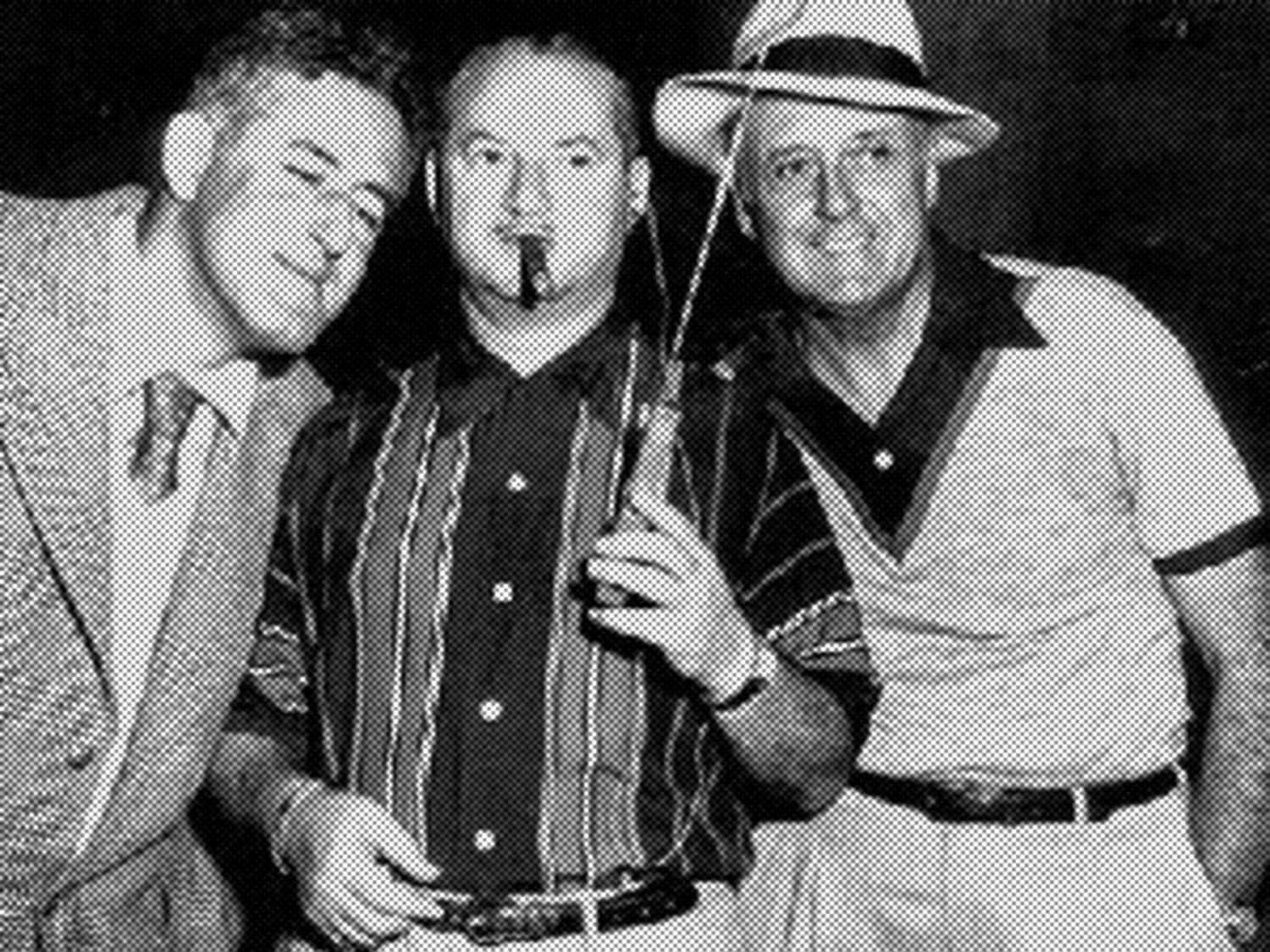
HOLLYWOOD STUDIO YEARS: WELLES AND THE LADY FROM SHANGHAI
Castle crossed paths again with Orson Welles for the noir classic The Lady from Shanghai (1947).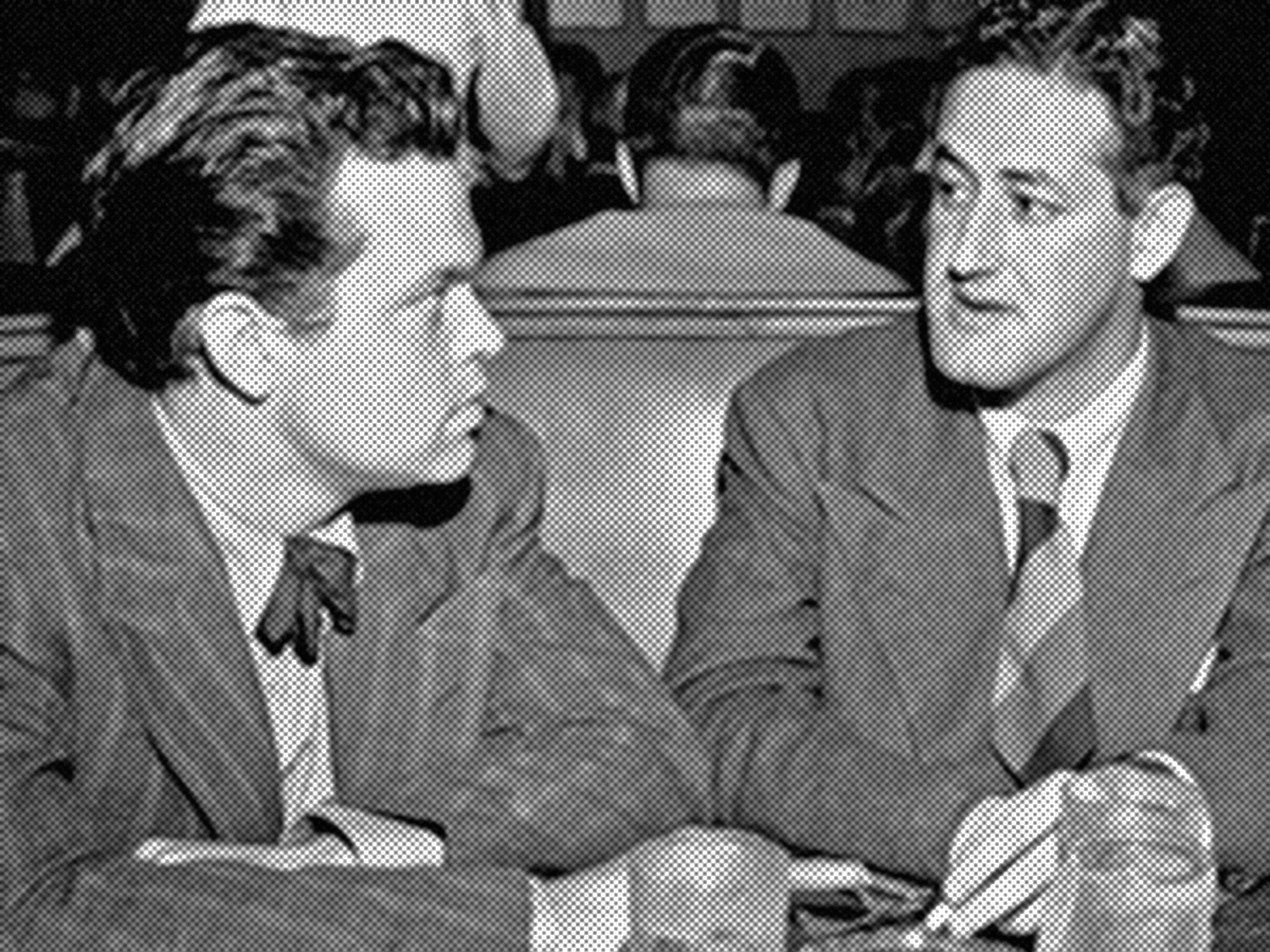
Welles had run out of money on a theatrical production he was preparing and called Harry Cohn from the theatre to appeal for a cash bail-out, promising to write, produce, and direct a film for Cohn at no fee. Cohn agreed and according to Welles, while on the phone with Cohn, he happened to notice a book laying on the table and told Cohn that the film would be based on that novel, which a woman working in the theatre’s box office had been reading. Welles had never read the book.
But Castle’s daughter, many years later, told a different story. She claims Castle had purchased the film rights to the book and asked Welles to pitch the idea of a film adaptation to Cohn, hoping to get the nod as director himself. While Castle greatly admired Welles’ talents and respected the man, he was understandably disappointed to be tasked with assistant-director duties under Welles on the project, which would star Welles and his soon-to-be-ex-wife, Rita Hayworth, whom the Hollywood press had dubbed “The Love Goddess.”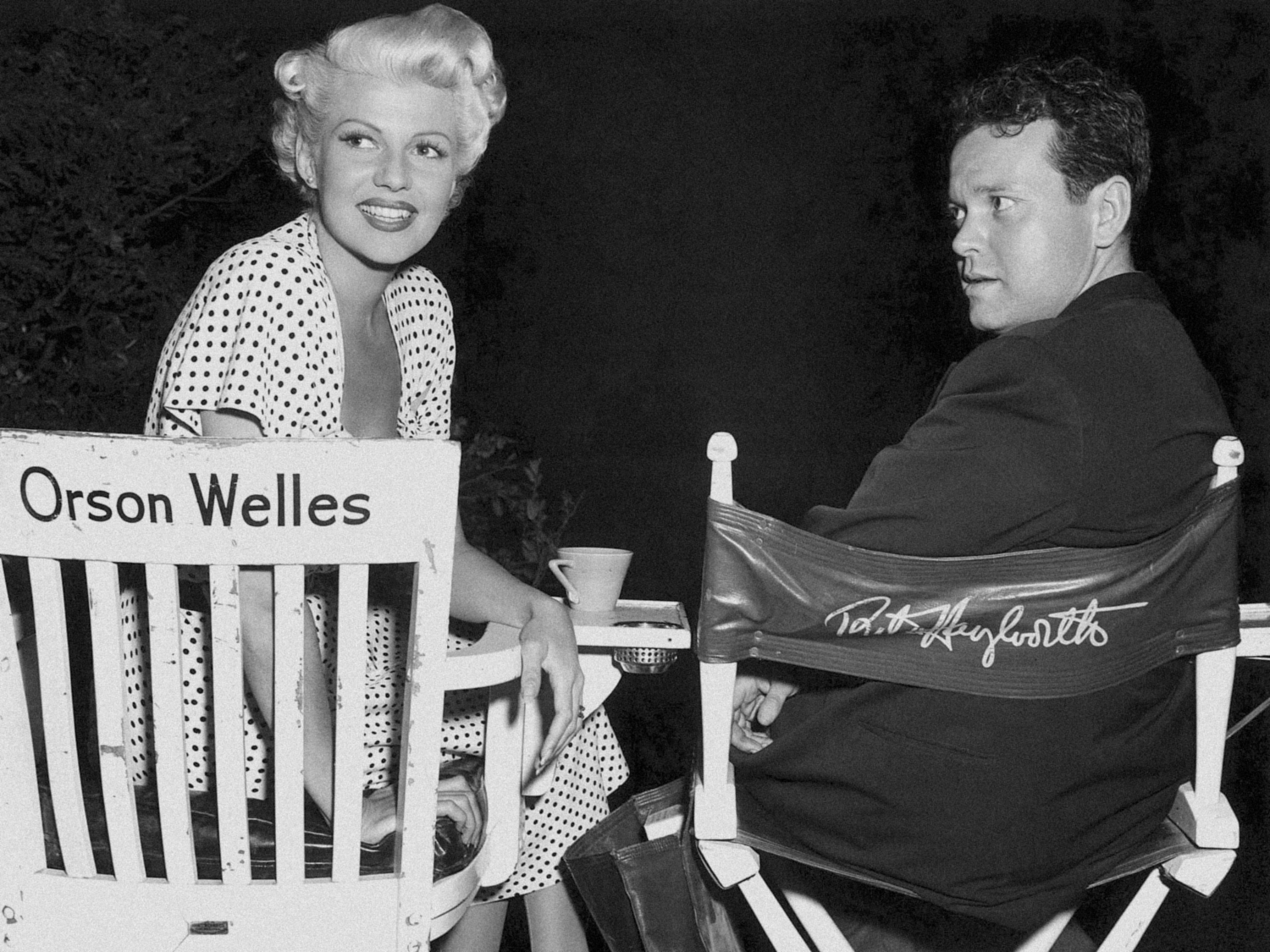
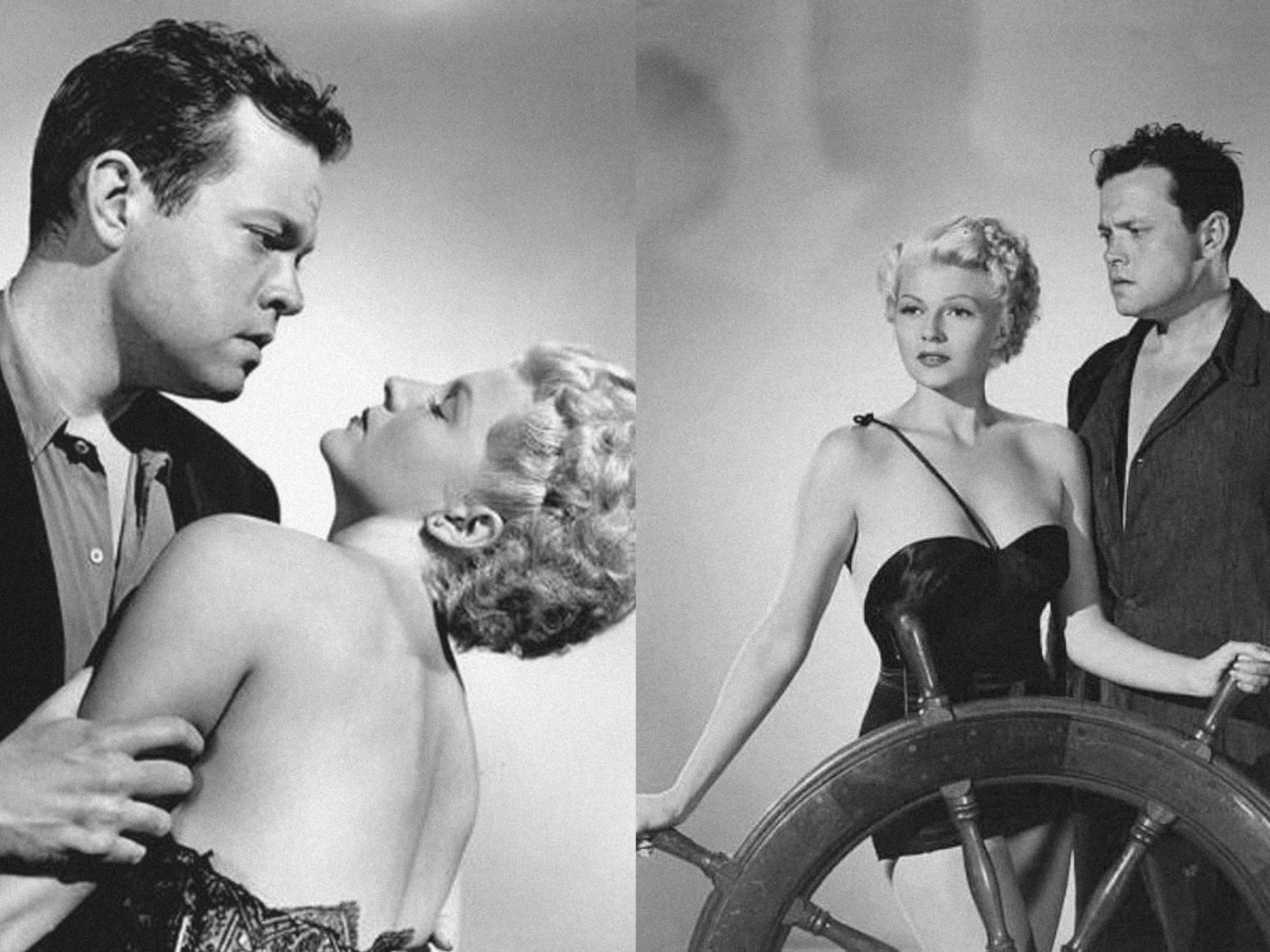
Her performance as the piece’s femme fatale coupled with Welles’ inspired visual style cemented the film as a masterful noir classic, despite it having received mixed reviews upon initial release.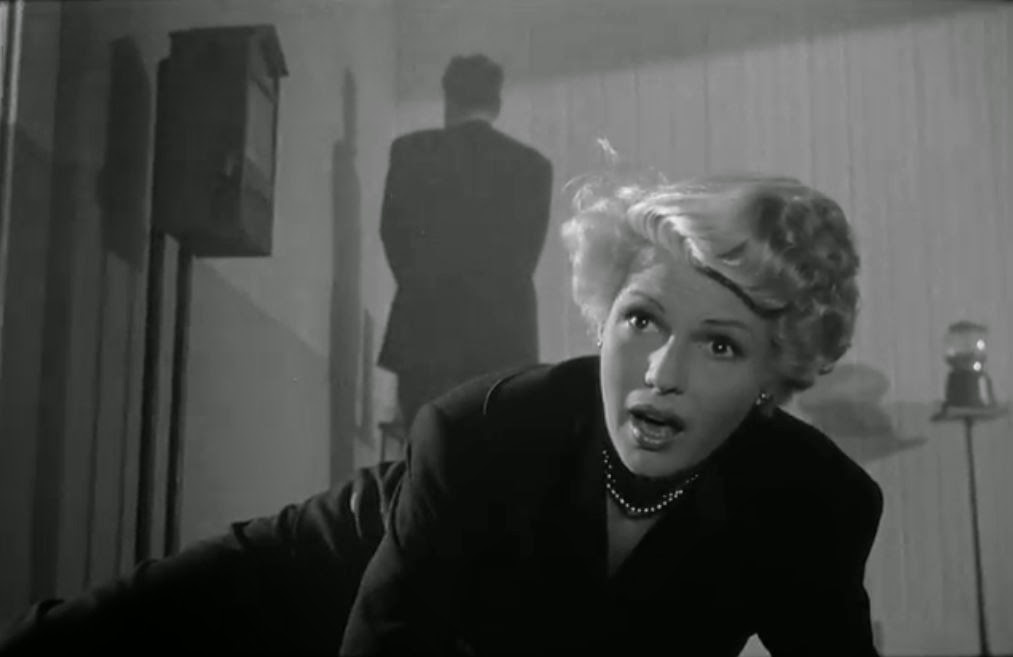
Castle, credited as an associate producer, directed much of the second unit location work uncredited and helped Welles write the script, also without credit.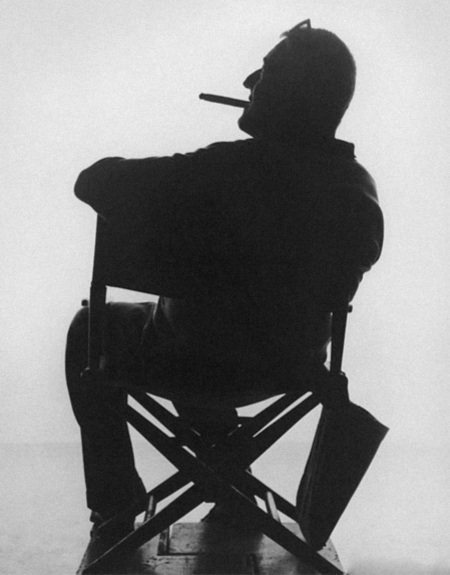
Castle’s signature pose, incidentally, cigar jutting from his mouth, was something he picked up from Welles, who often paced back and forth on set smoking a Cuban.
In 1948 Castle married Ellen Falck; they would go on to have two children. By the late 1950s, Castle’s ambitions had yet to be satisfied and he decided to strike out on his own so as to be free to make the movies he wanted to make.
THE INDEPENDENT YEARS: LES DIABOLIQUES INSPIRES MACABRE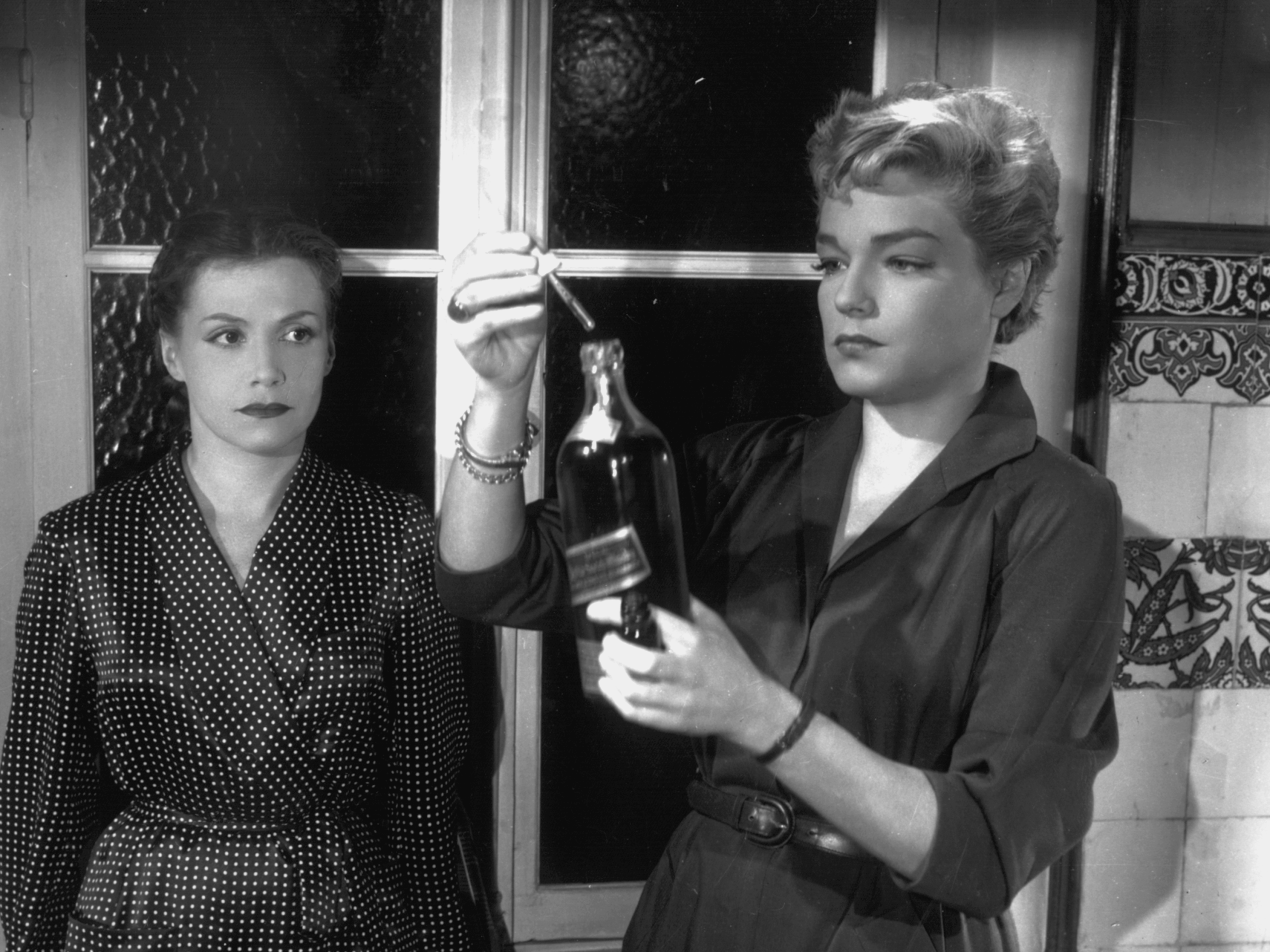
The French film Les Diaboliques (1955), a psychological thriller, was showing in the U.S. at about this time and provided Castle with inspiration for his first independent production, which he financed by mortgaging his house! He partnered with screenwriter Robb White to form a production company, with plans to produce five films over 16 months.
An exercise in grim horror and suspense, Macabre (1958) is about a wealthy, dysfunctional family, including two sisters who ultimately meet with tragedy, their lovers and acquaintances, and a dastardly plot in which a kidnapper telephones to relate that the young daughter of one of the sisters has been buried alive!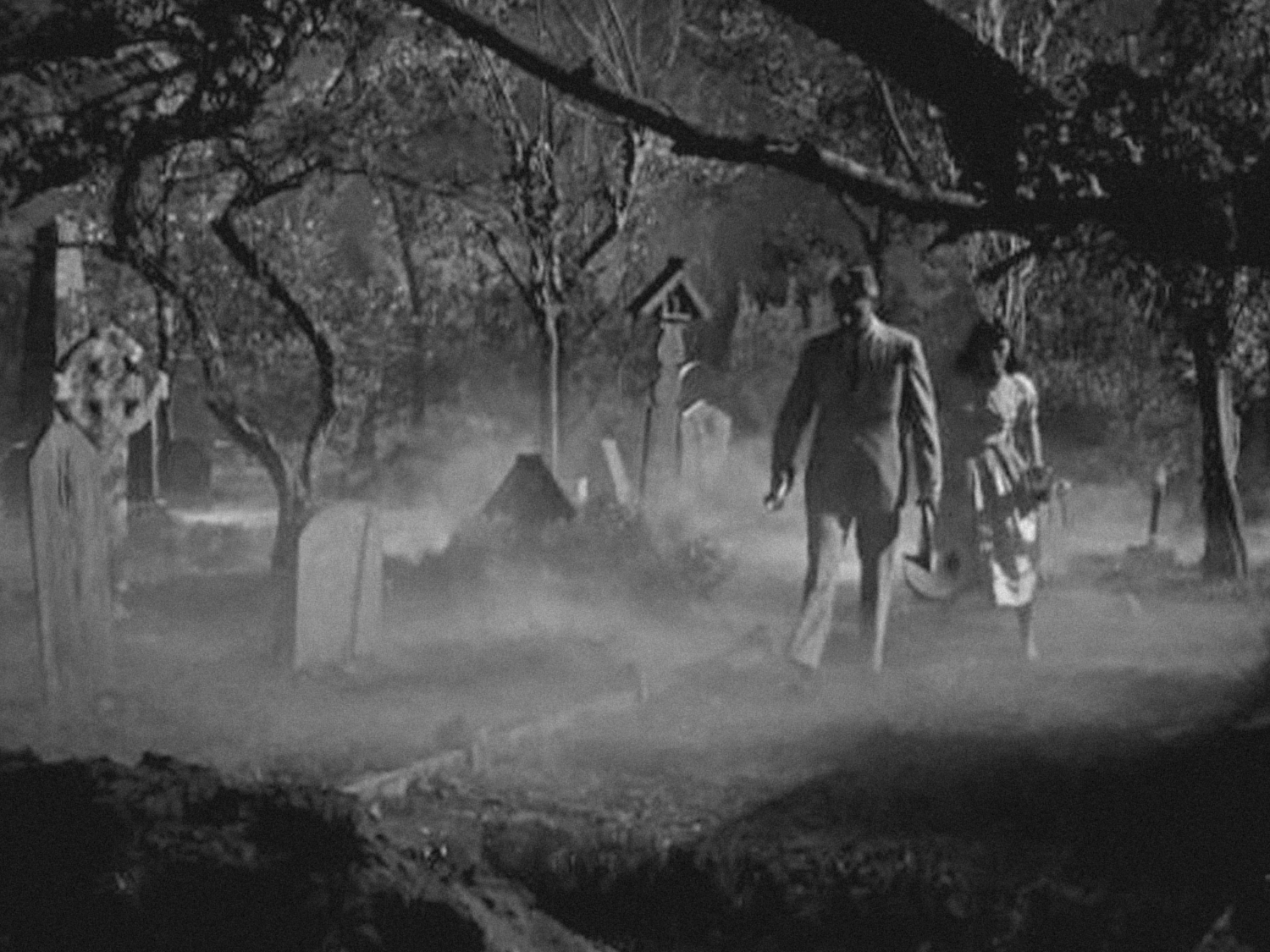
The cast included Jim Backus and Ellen Corby, later to star in TV’s Gilligan’s Island and The Waltons, respectively, and Susan Morrow, who genre fans will recognize as Lambda, from Cat-Women of the Moon (1953).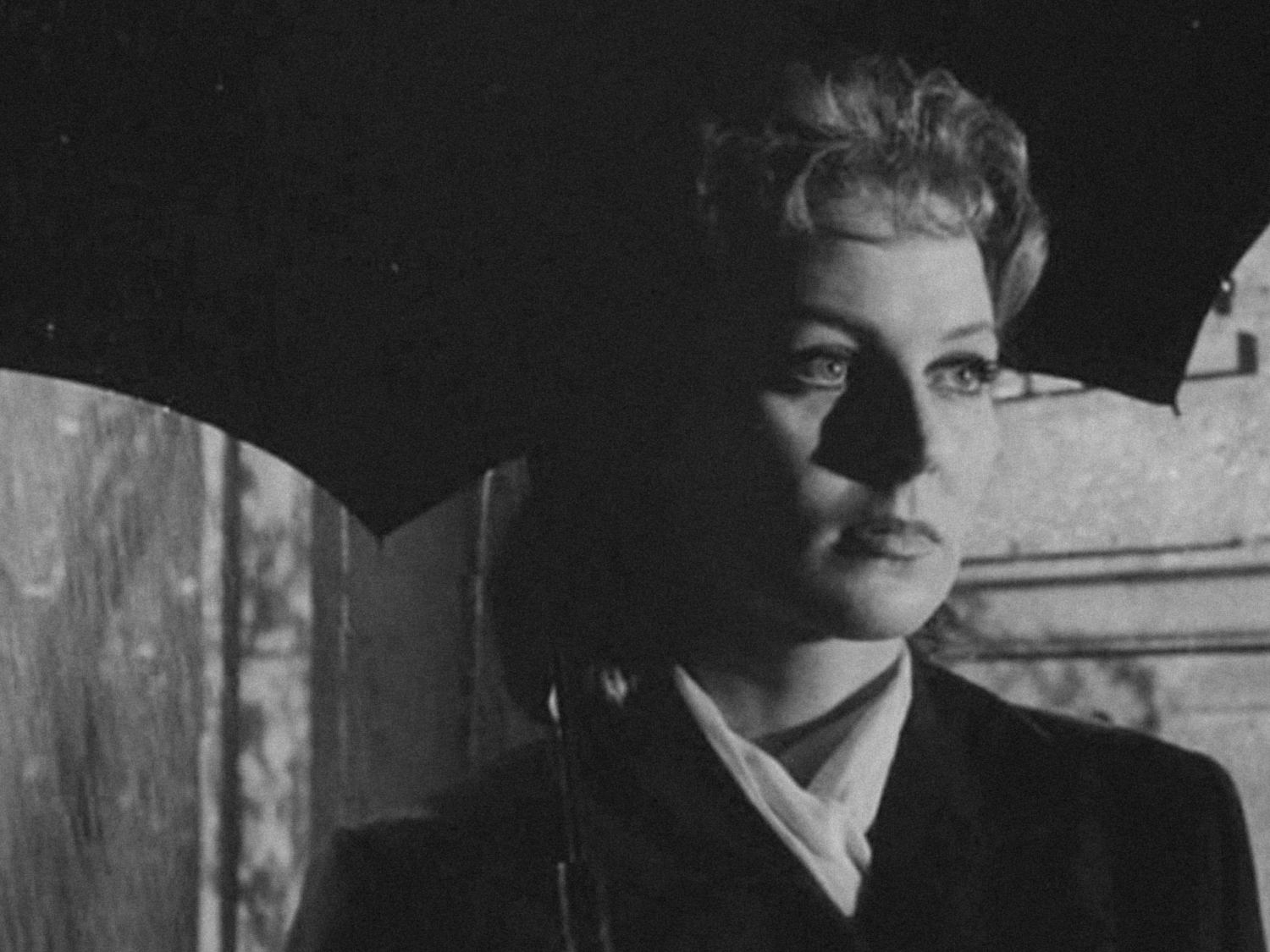
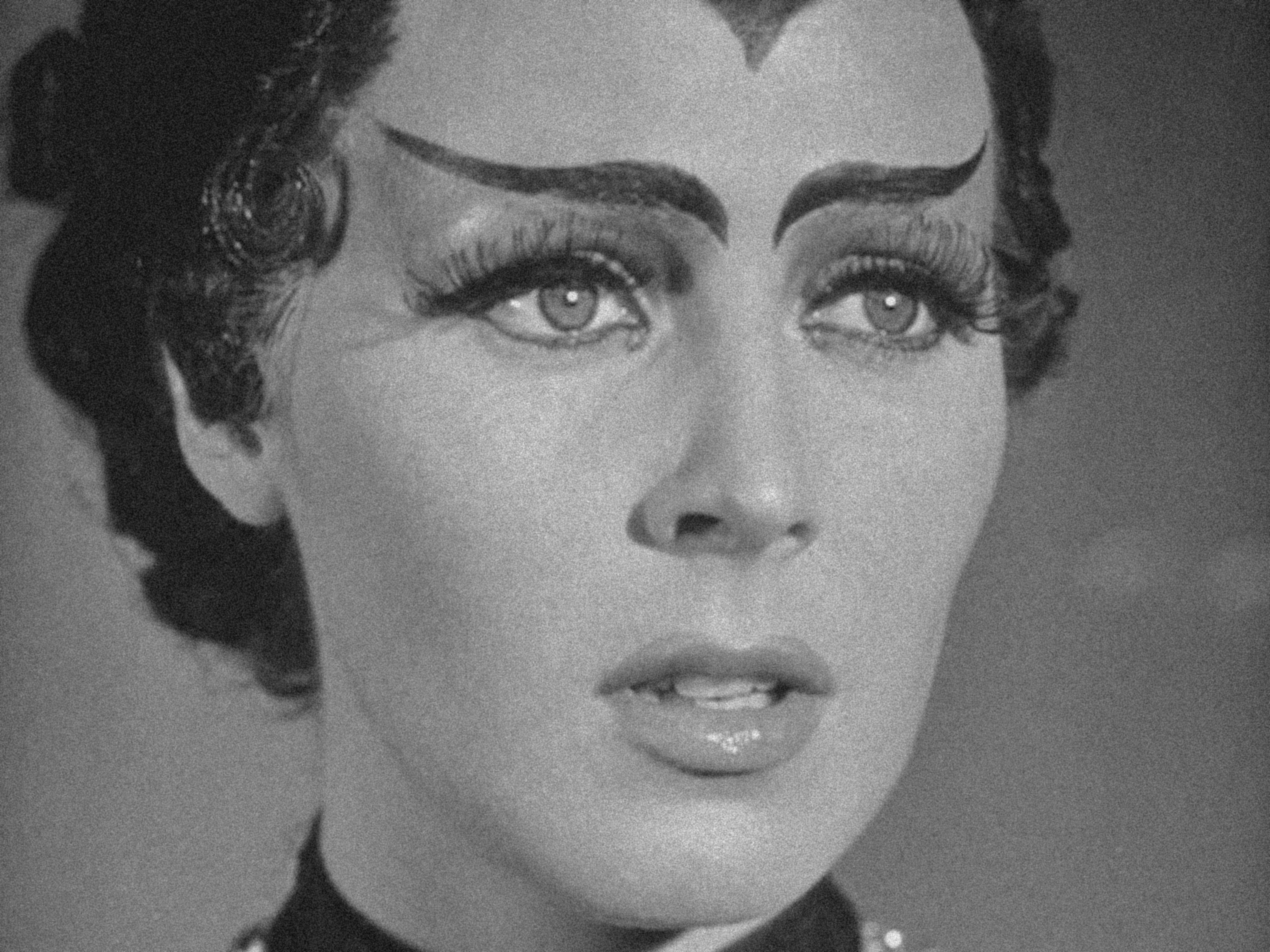 Everything was on the line and Castle vigorously promoted the film by what is called “barnstorming”—that is, accompanying the film to different markets and promoting it along the way with publicity stunts like parking hearses outside movie theatres and positioning fake nurses inside, ready to “look after” anyone overcome by fright. Castle made personal appearances at local premieres to talk up his picture and schmooze with audiences, arriving in a hearse or emerging from a coffin.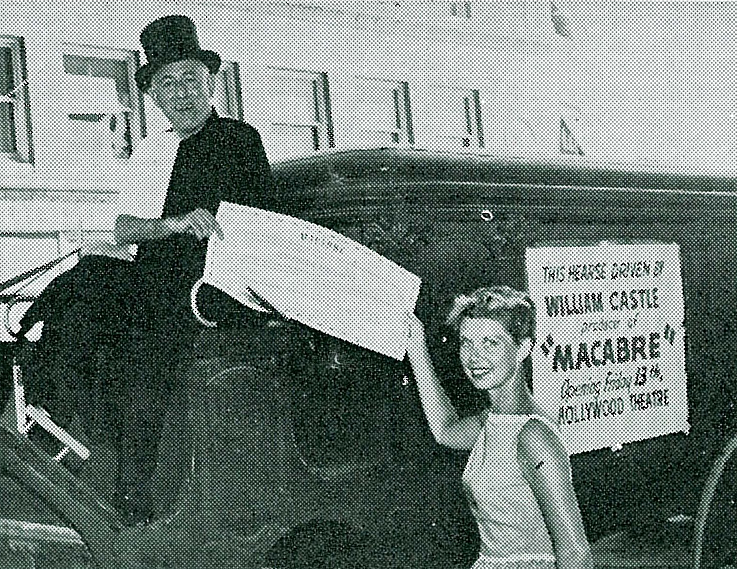
But the utmost PR gimmick deployed was a genuine insurance policy from Lloyd’s of London that would pay $1000 to the beneficiaries of anyone, excepting those with known heart or nervous conditions, who died of fright while watching Macabre! Movie-goers would be handed their bona fide policy when they purchased a ticket.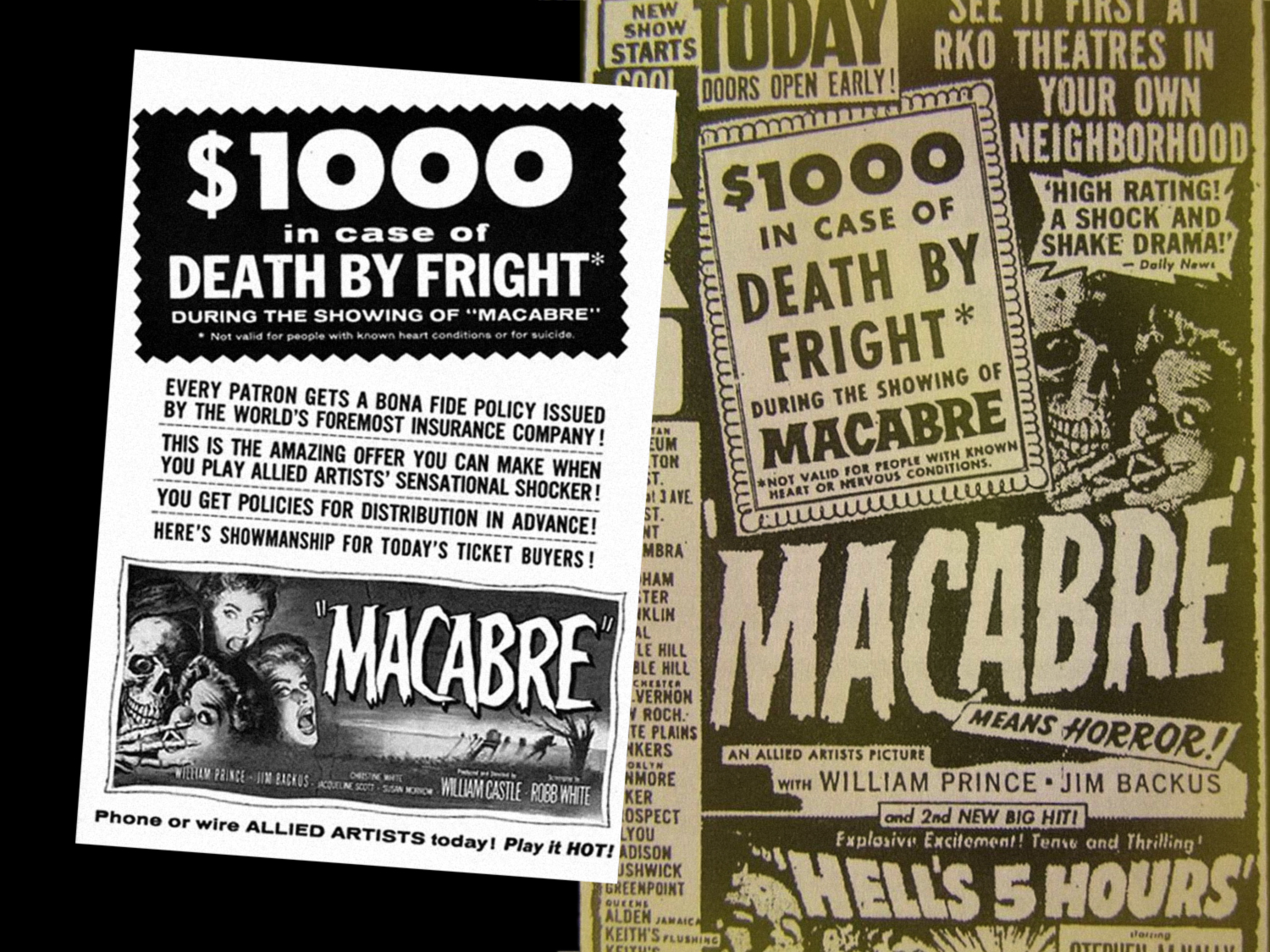
It all worked swimmingly and the film grossed a million dollars in its first year of release against a budget estimated at about $90,000. Box office receipts over the years amounted to some $5,000,000.
THE INDEPENDENT YEARS: CASTLE HELPS HOLLYWOOD COUNTER THE LURE OF TELEVISION
Next was House on Haunted Hill (1959), with White again scripting and future horror icon Vincent Price starring. There was a lot of screaming!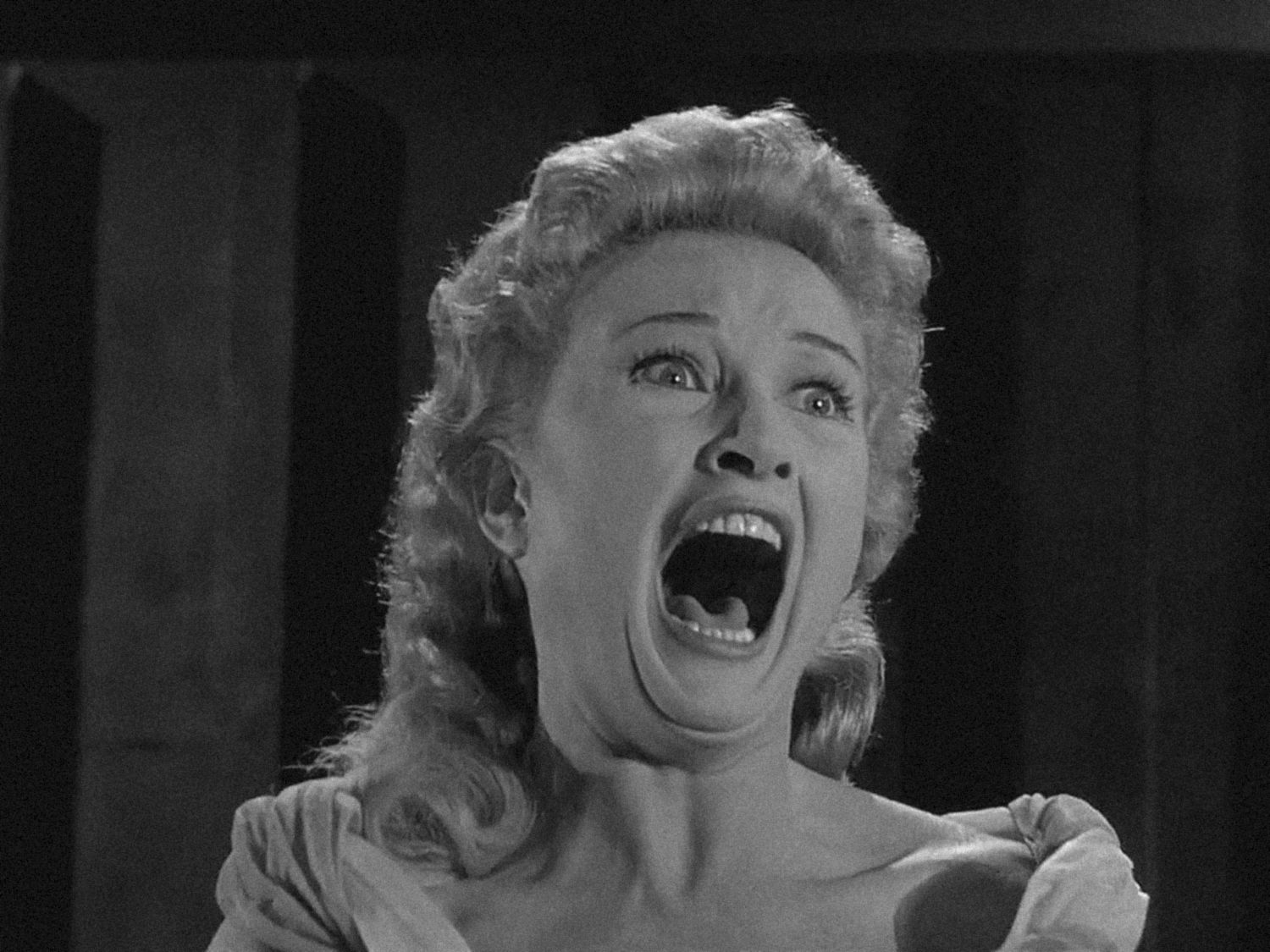
The gimmick, here, was “Emergo,” heavily promoted at theatres as the “New Electronic Process.” While that sounds like some kind of revolutionary method of film projection, or image enhancement, the only thing electronic about Emergo was a this: a pulley motor and the red lightbulbs that illuminated the eyes of a plastic skeleton that emerged from behind a curtain and flew out over the theatre audience at a critical moment during the film!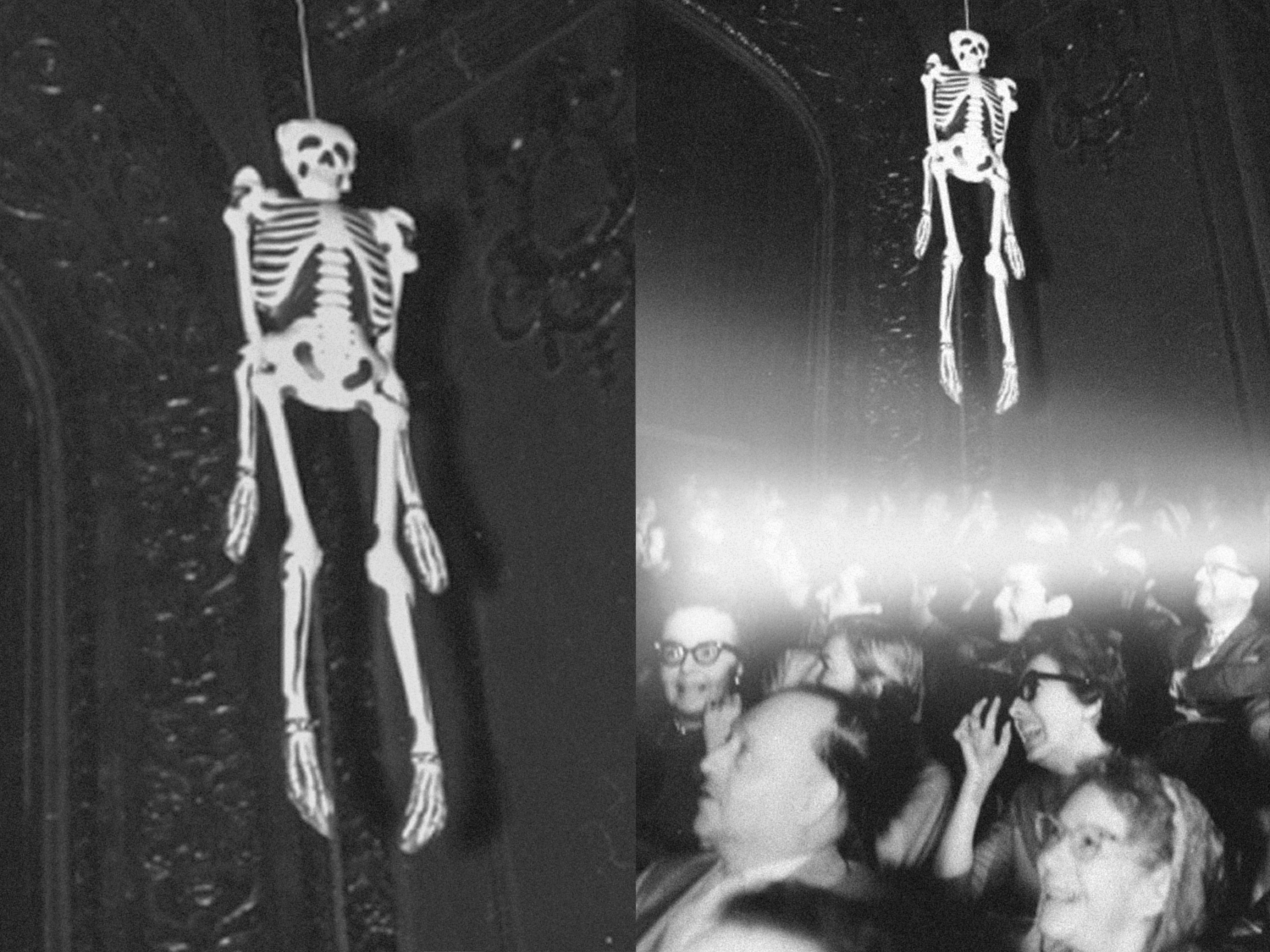
Pictured here is a technician installing the Emergo system.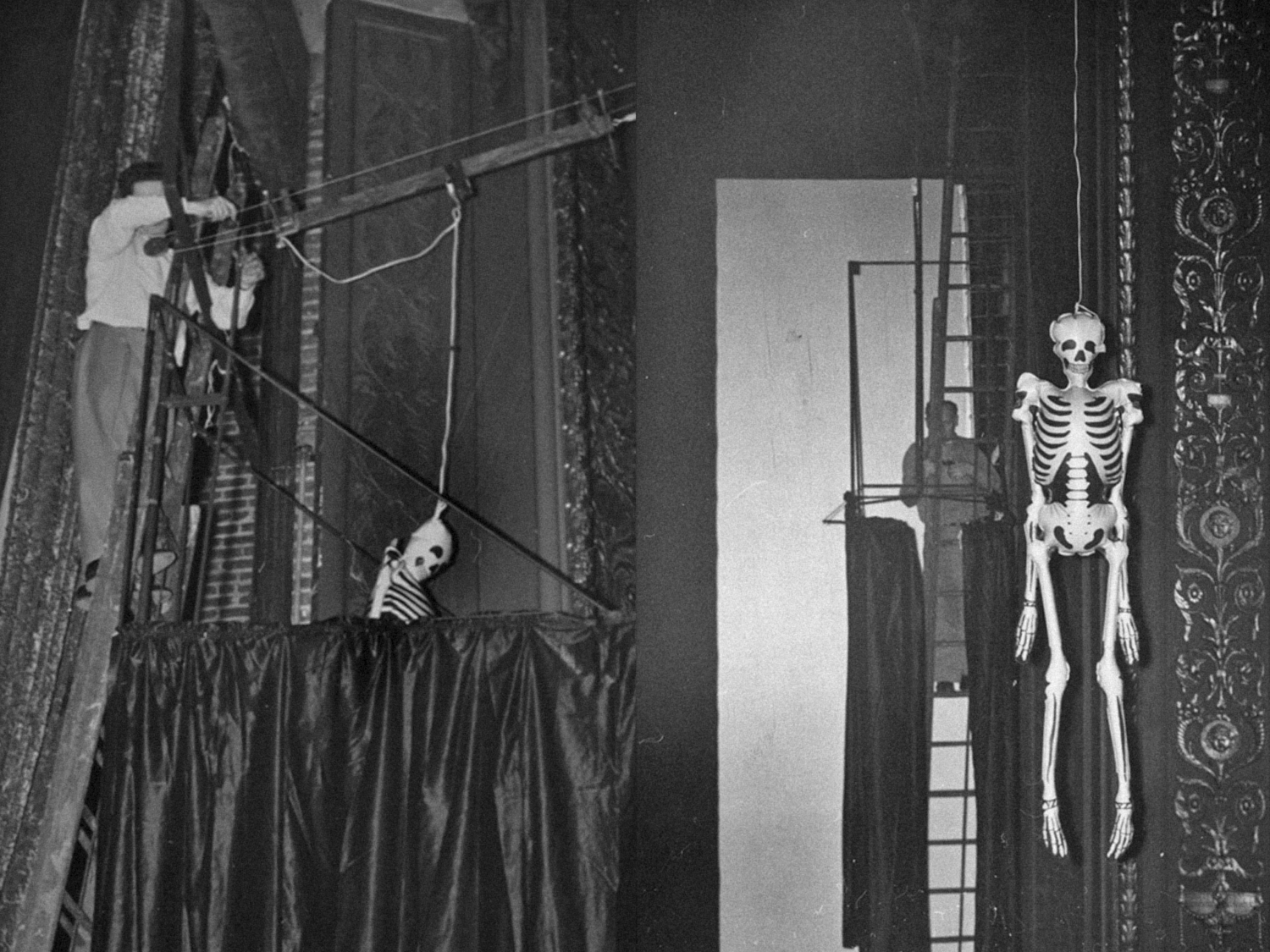
Once word spread, the flying skeleton became the target of youngsters throwing popcorn and balled-up candy wrappers. But many were doing so during their second and third screening of the movie, to which they had brought along their friends! All good for the box office, and the fun, travelling carnival haunted house-like gimmick quickly became that which was most talked about, not so much the movie itself.
The 1950s was a time during which the motion picture industry was competing for audiences with that new-fangled invention, television. Movie theatre ticket sales were in decline and so, larger screen formats—CinemaScope, Cinerama, VistaVision—and premium colour and sound systems—TechniColor, hi-fidelity stereo—were deployed, as well as 3-D technology, to entice people away from the TVs in their living rooms and back into movie theatres. Castle’s instincts, then, were not off-beam; he had the right idea.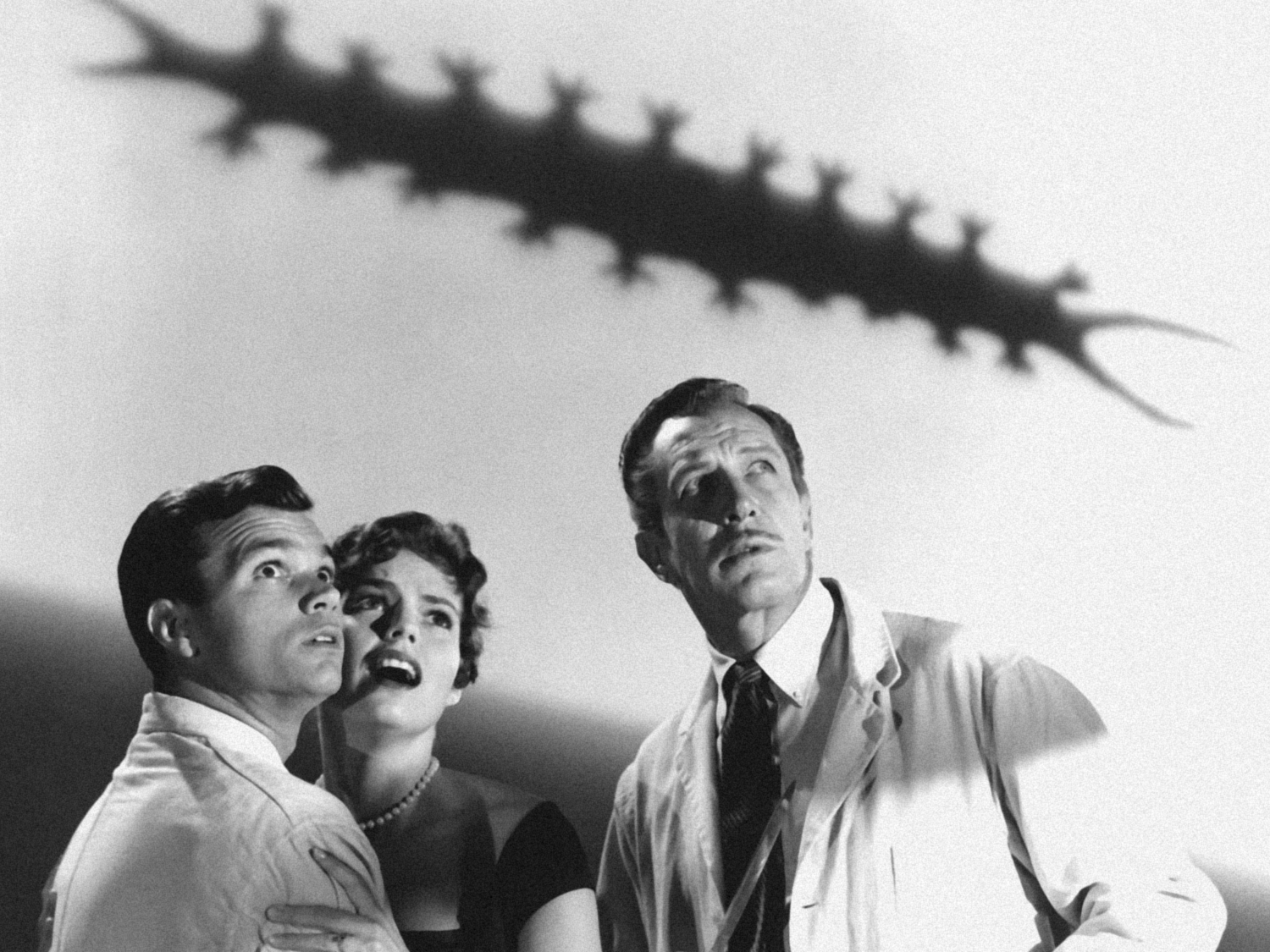
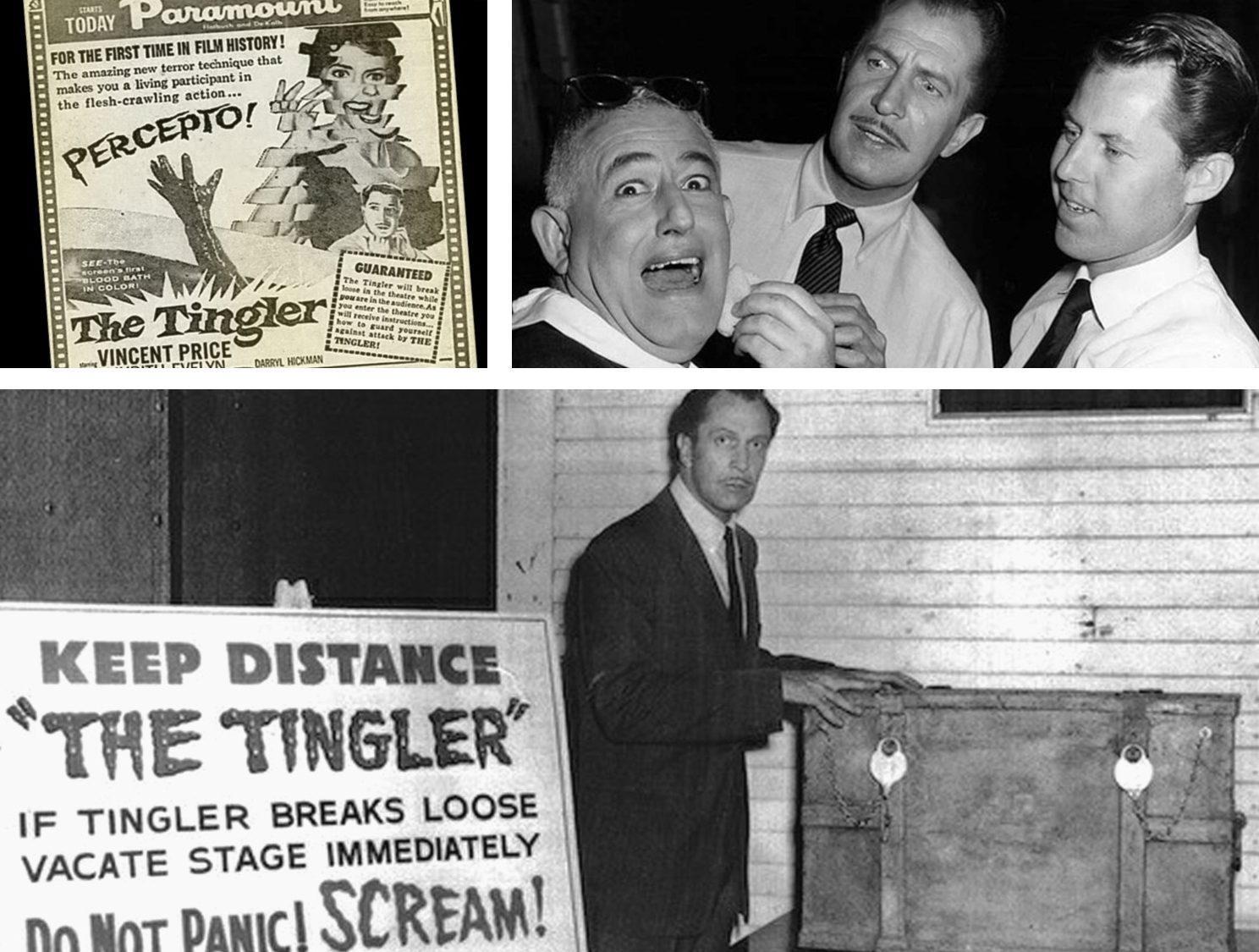
Also in 1959, Castle brought audiences The Tingler, with Robb White and Vincent Price again contributing their talents. The gimmick devised to promote this film was dubbed “Percepto.” Promotional material was prepared for the press and movie exhibitors touting the gimmick as a sure-fire marketing tool.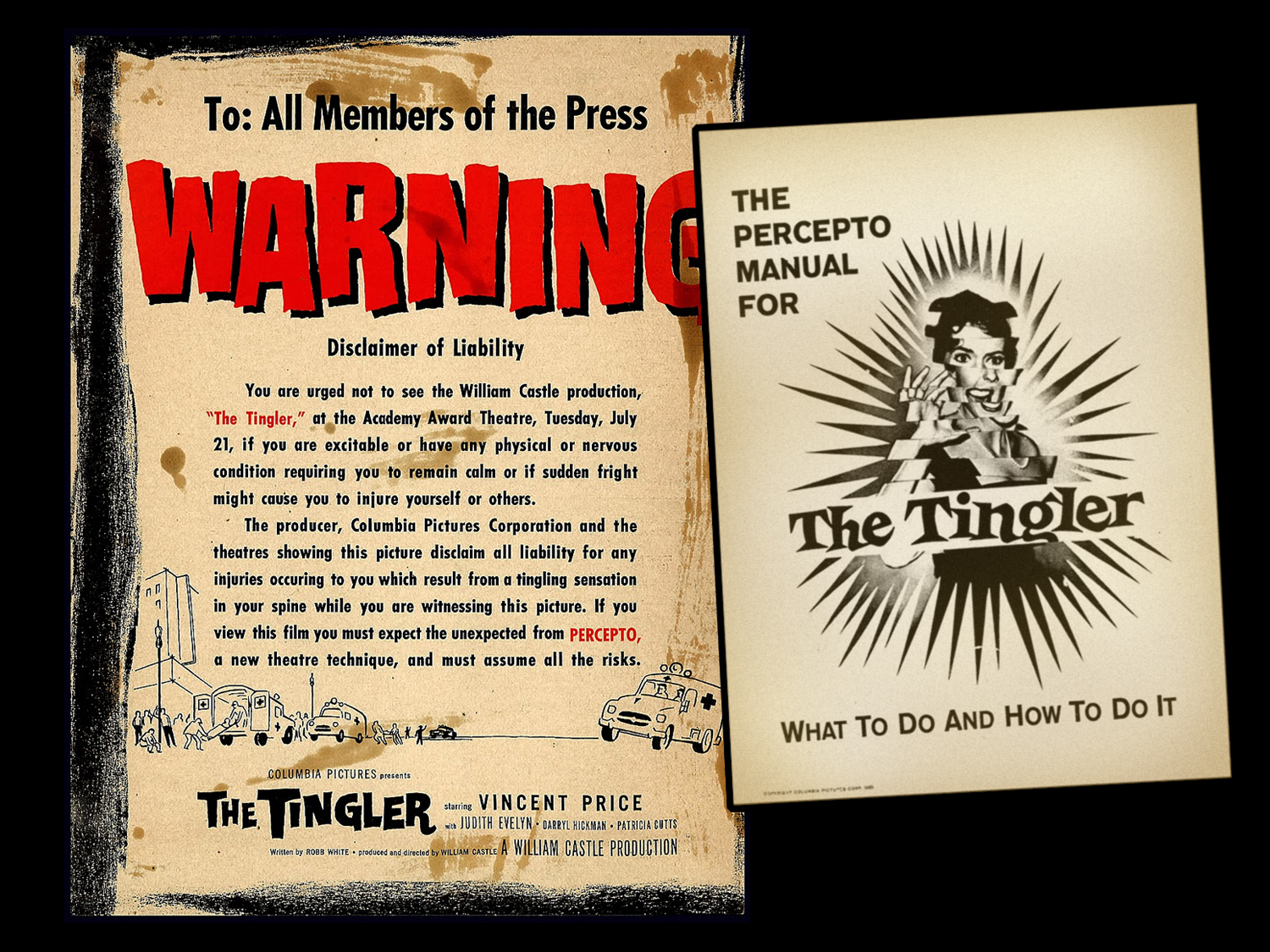
Percepto consisted of small vibrating motors, used as de-icers on aircraft, installed under a handful of theatre seats and triggered at a critical moment during the screening of the film. At one point, the movie breaks the fourth wall to involve the audience in a climactic scene.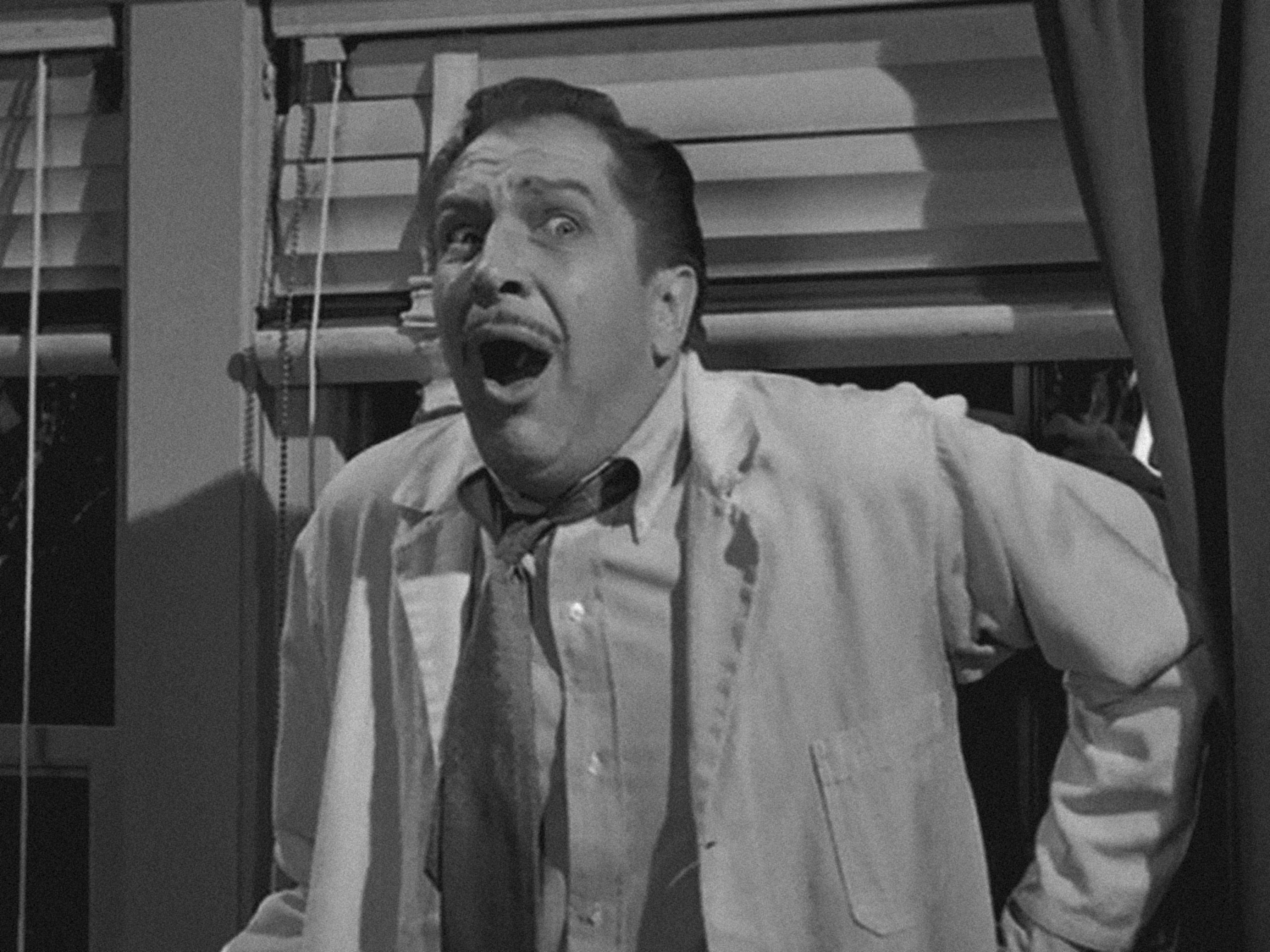
The Tingler was the first major motion picture to depict the use of LSD—colloquially, “Acid”—which screenwriter White had experimented with after hearing about the psychedelic hallucinogen from Aldous Huxley, author of the dystopian SF novel Brave New World (1932). Price’s character uses the drug in an attempt to provoke in himself extreme fear as part of his research on the parasitic Tingler. Here, the prop Tingler “grips” Price’s arm.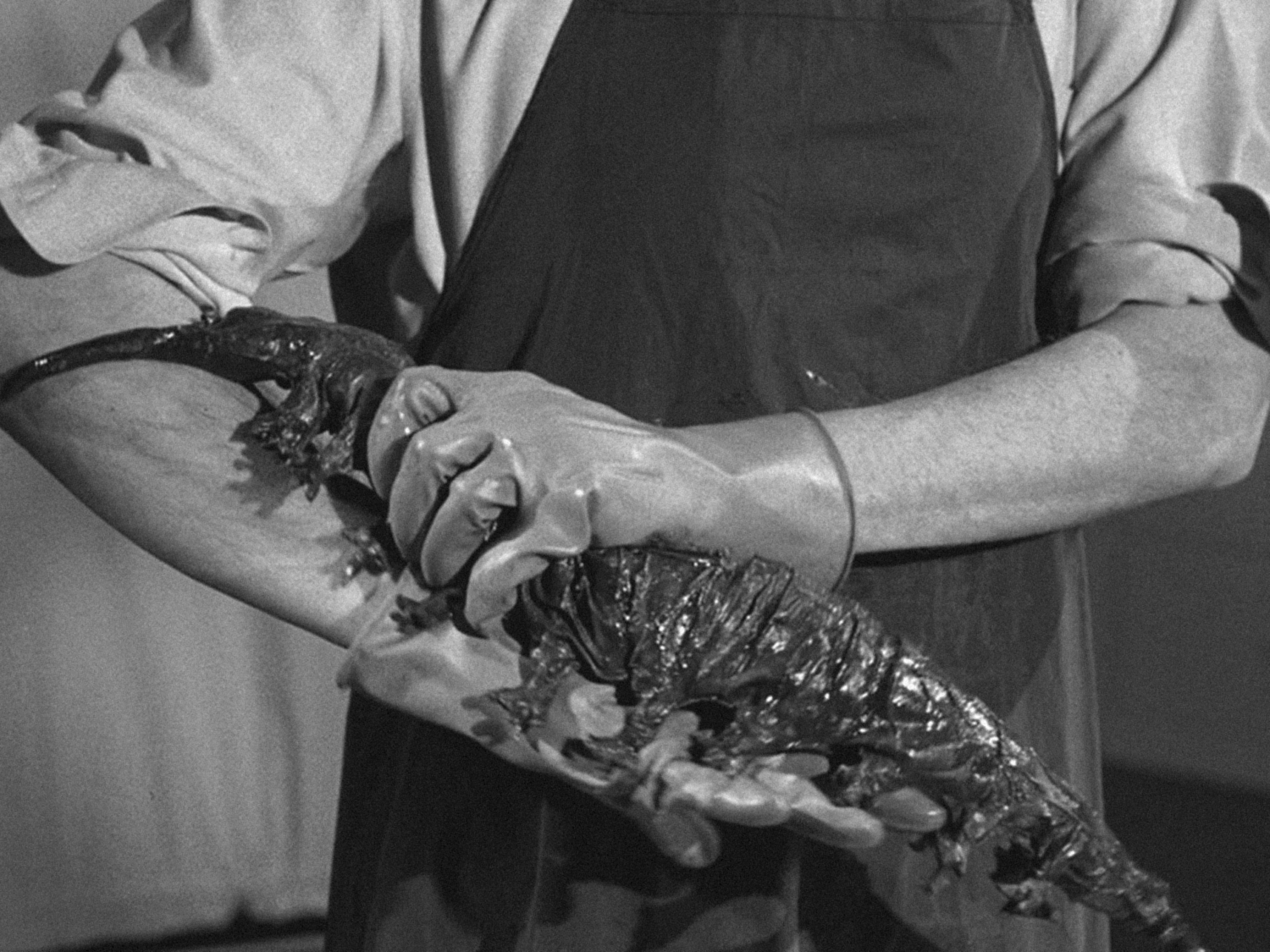
Promotional material challenged movie-goers to experience Percepto, and Castle and his stars pushed the film at theatres. Lobby displays provided directives should the Tingler break loose in the theatre, which of course, it most certainly would!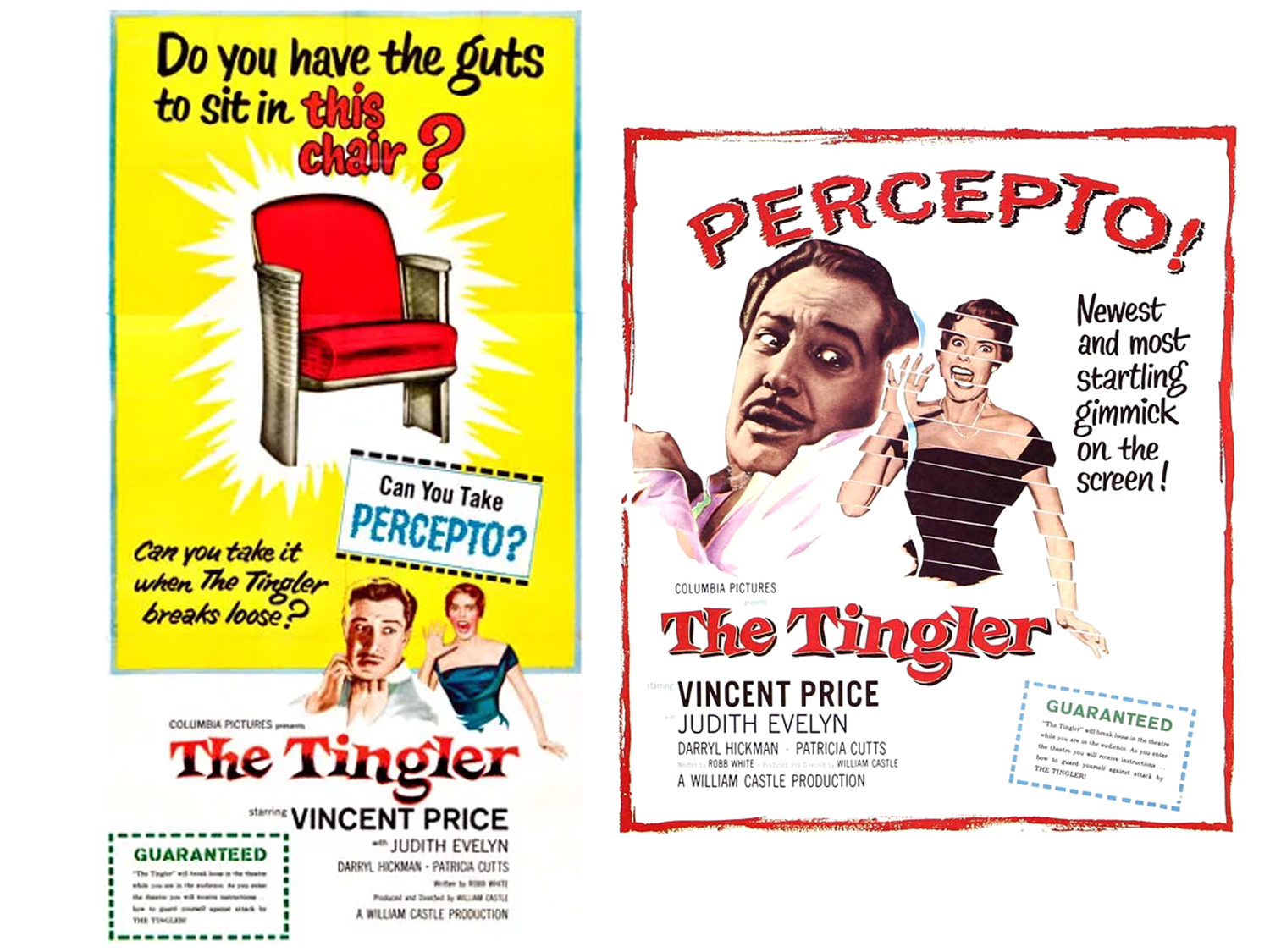
Castle was not averse to including a gimmick in the film itself. In one scene of the black-and-white film, we see a bathtub filled with vibrant red blood to give the sequence an extra kick. This was achieved by shooting the scene in colour, for which the set was painted in shades of grey and the costuming sewn of grey fabrics, with the actress wearing white make-up.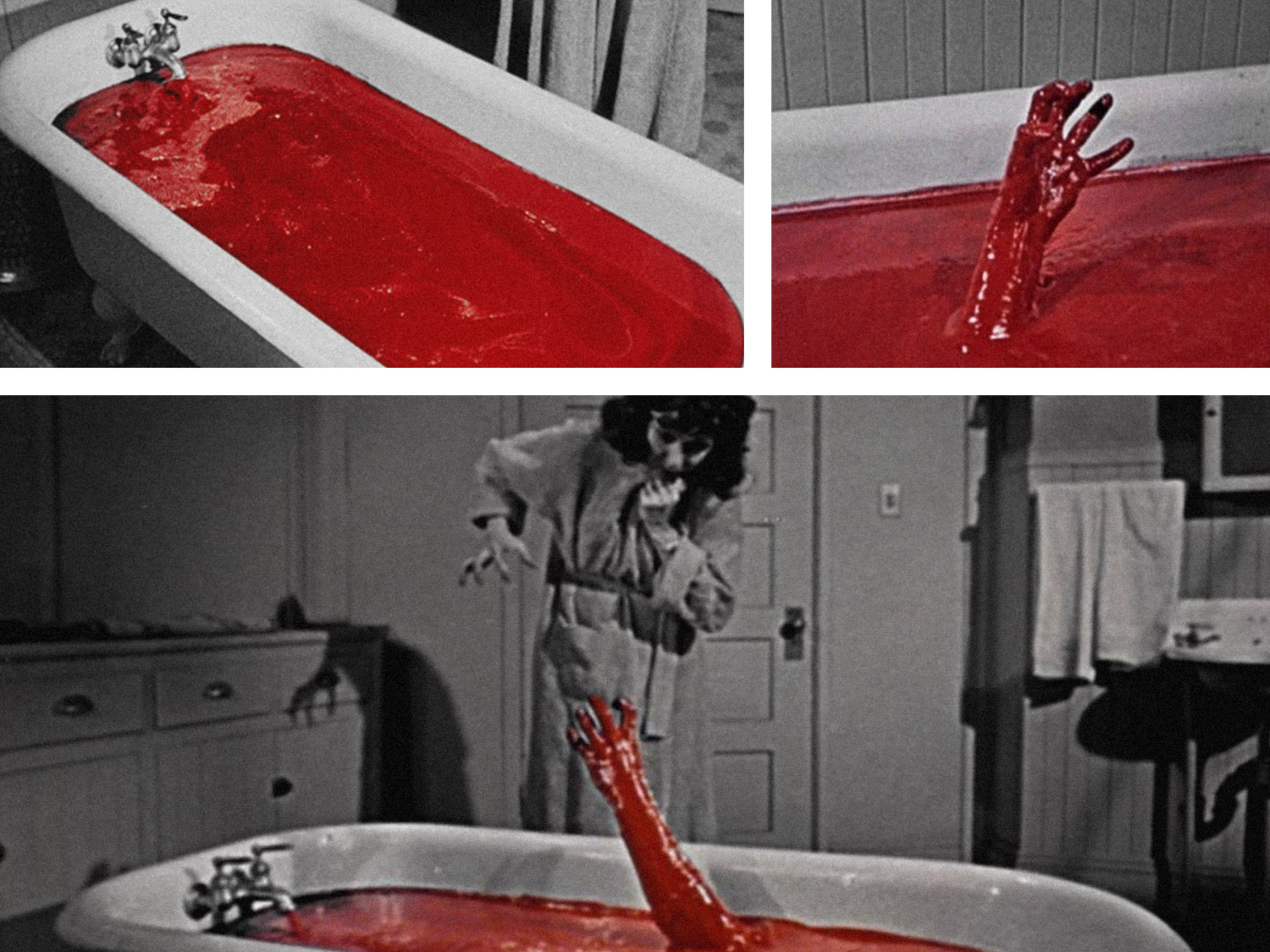
Castle and White opened the sixties with 13 Ghosts (1960), a supernatural horror movie about a mansion full of spectres and the family that is bequeathed the house, provided they live in and do not sell the property.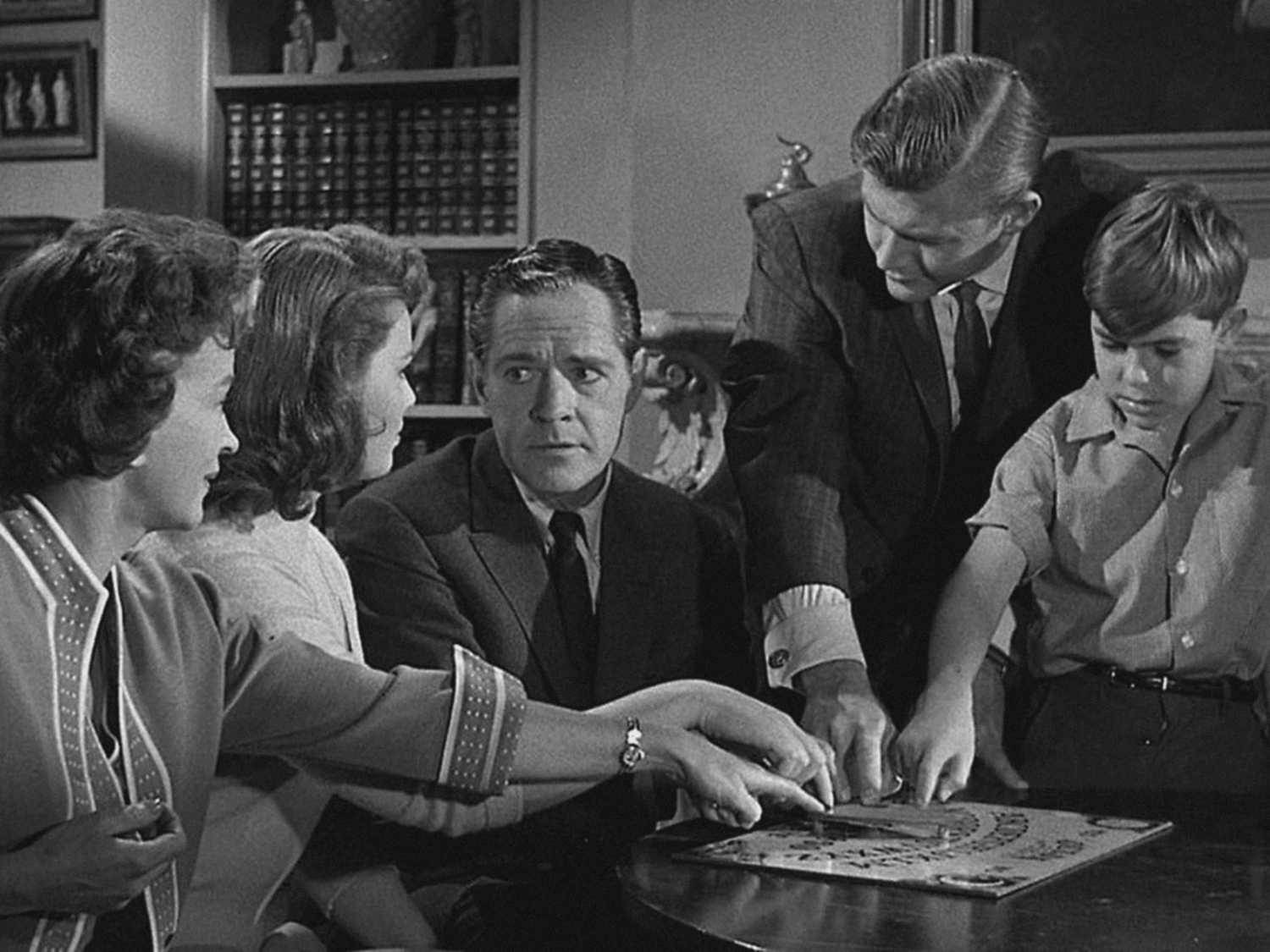
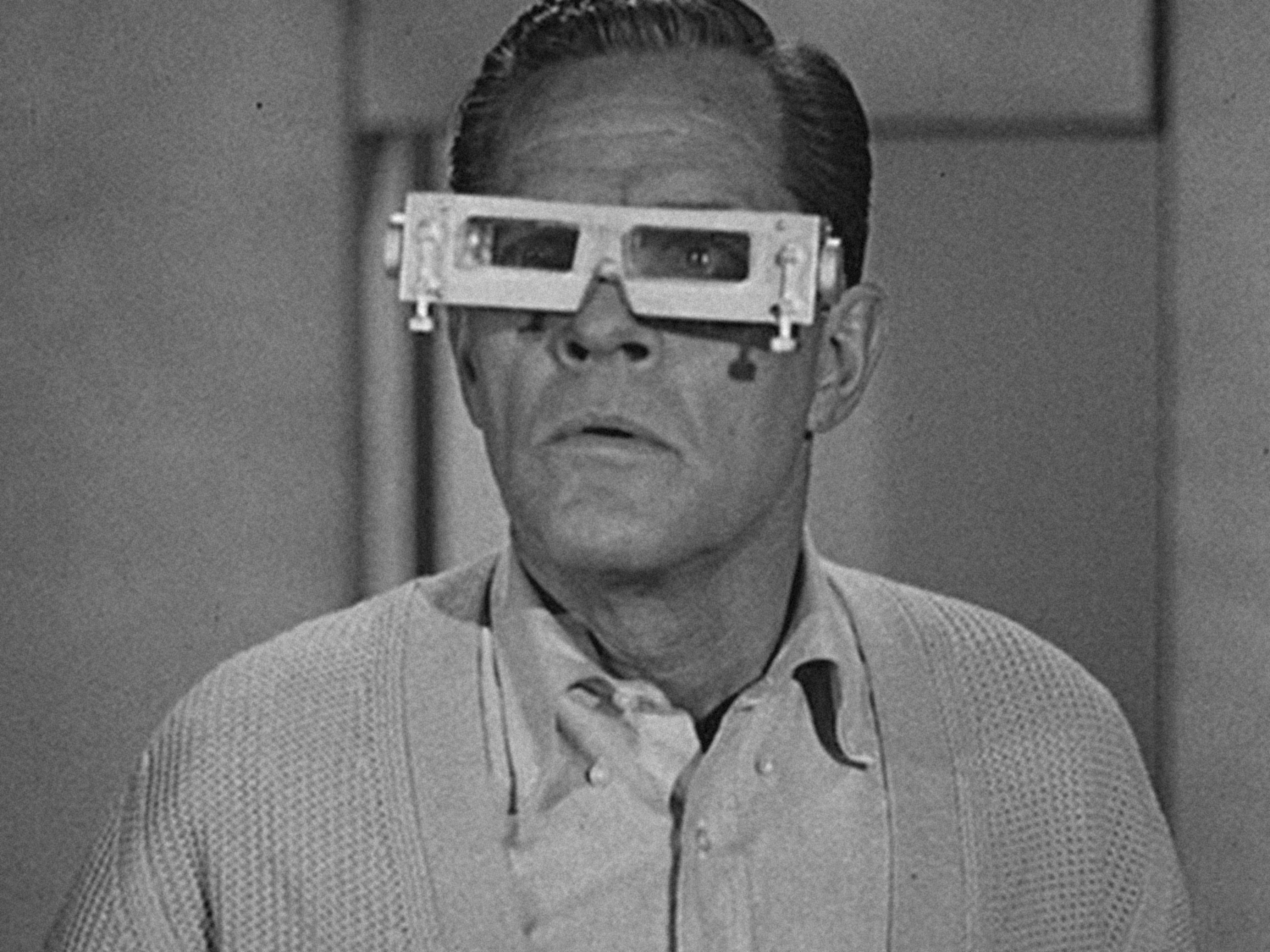 The fully-furnished mansion includes a fortune hidden somewhere within the premises, a special pair of glasses that permits one to see the ghosts haunting the place, and a weird housekeeper who conducts séances, played by Margaret Hamilton, The Wizard of Oz’s Wicked Witch of the West.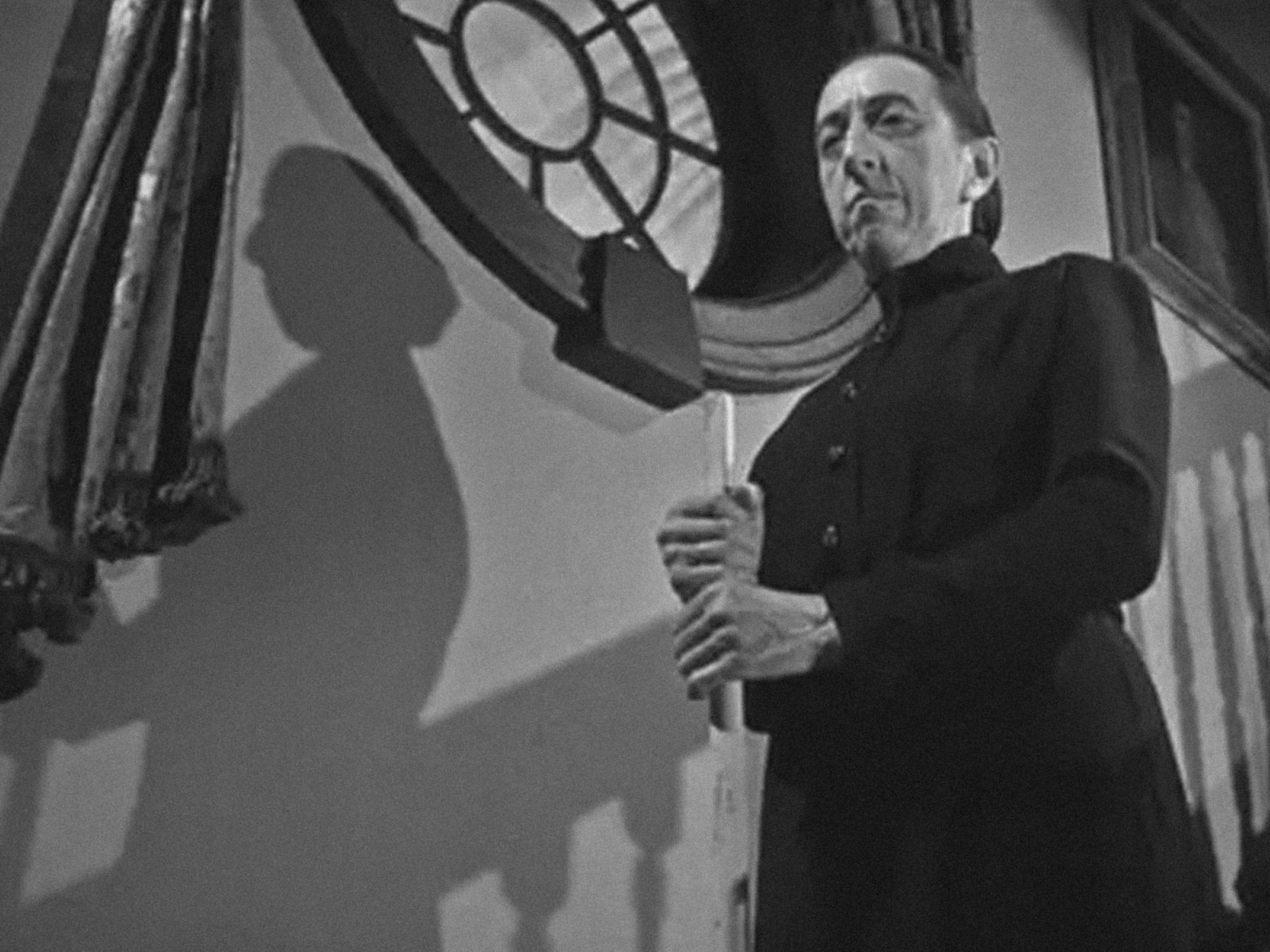
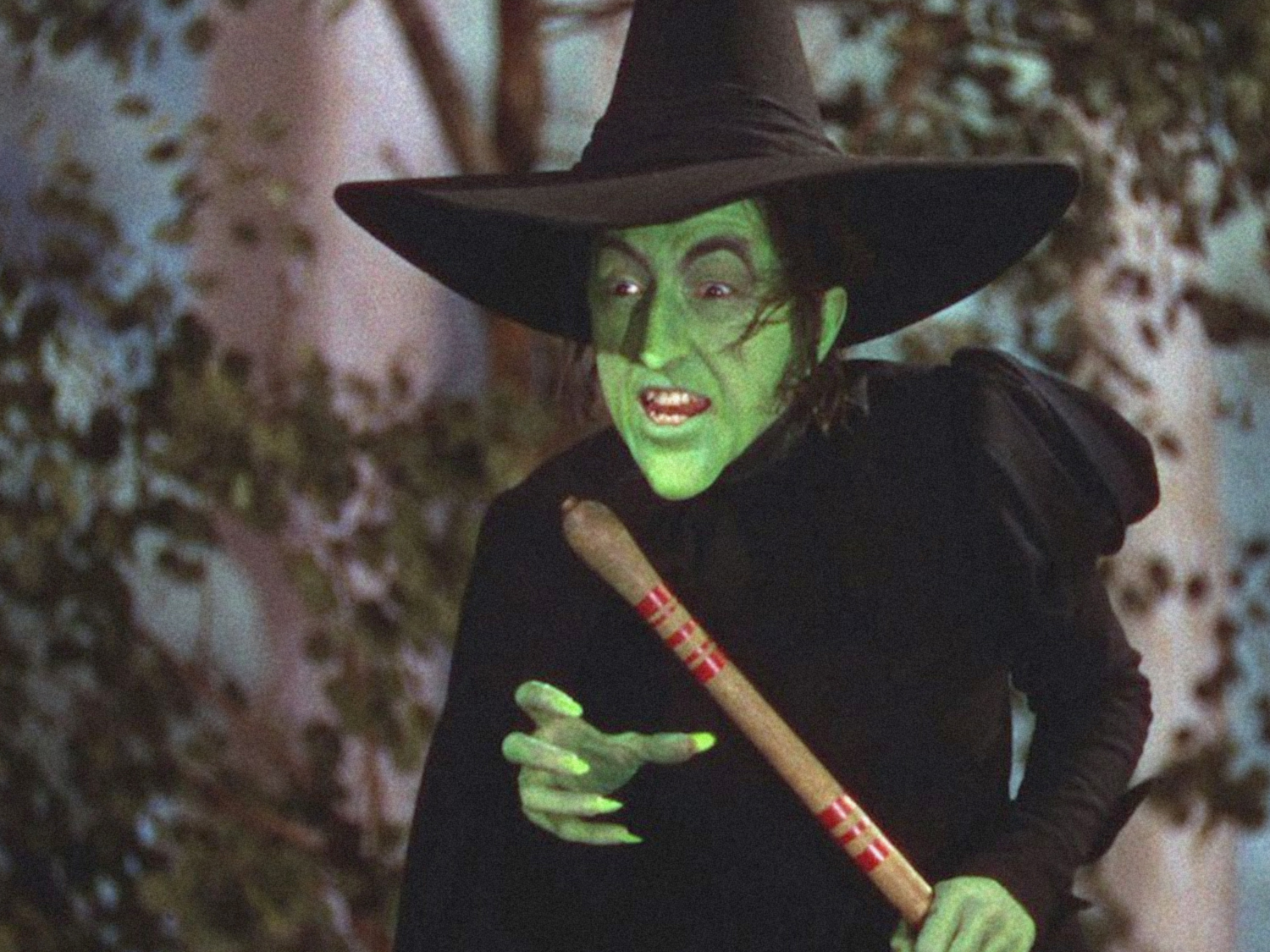
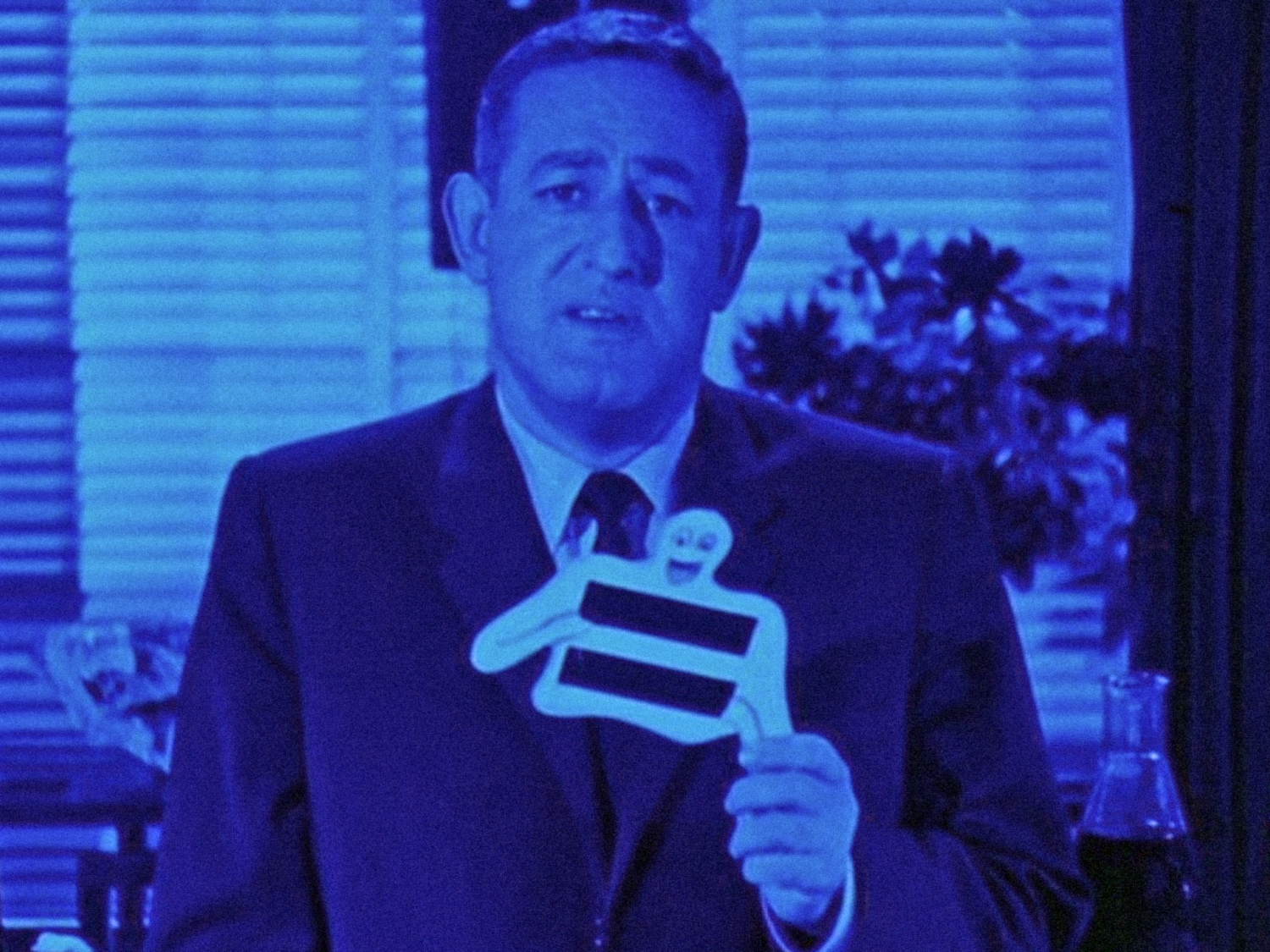 Castle himself provides instructions on how to use the Ghost Viewer in an opening sequence and Hamilton breaks the fourth wall at the end of 13 Ghosts to suggest that her housekeeper character and the Wicked Witch are one and the same!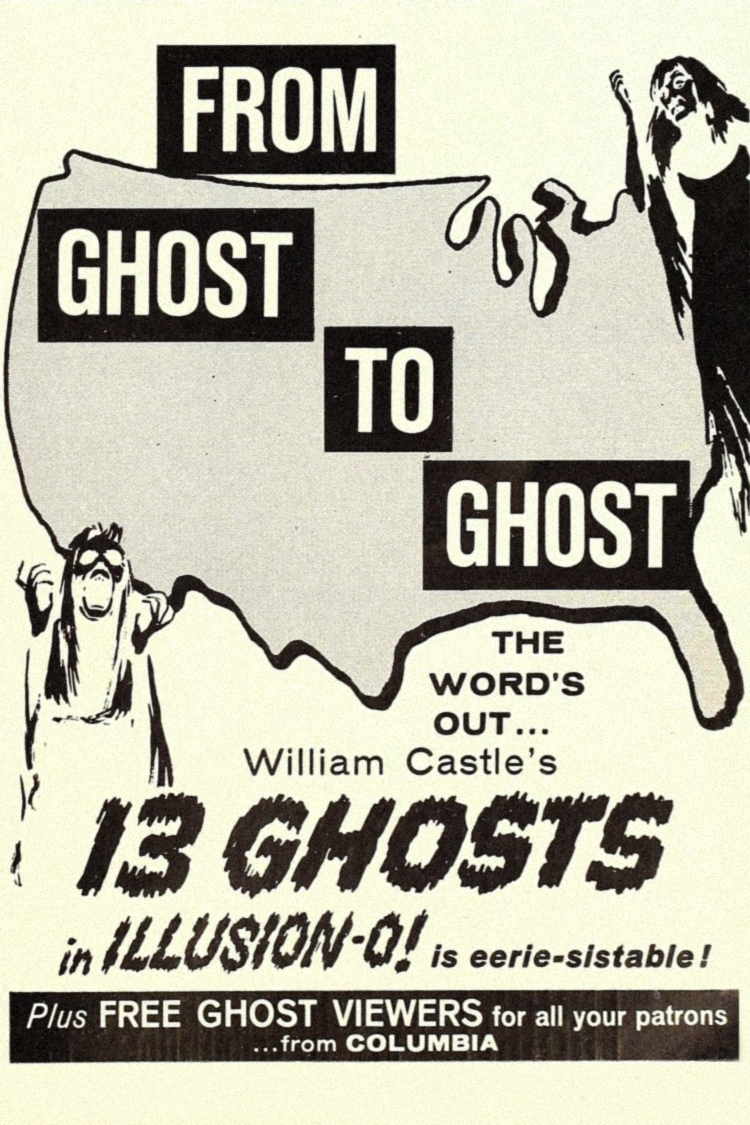
Promoted as “eerie-sistable,” the gimmick, here, was “Illusion-O,” a photographic process that allowed audiences, when prompted on-screen, to see the ghosts in “Ectoplasmic Colour,” despite this being a black-and-white movie.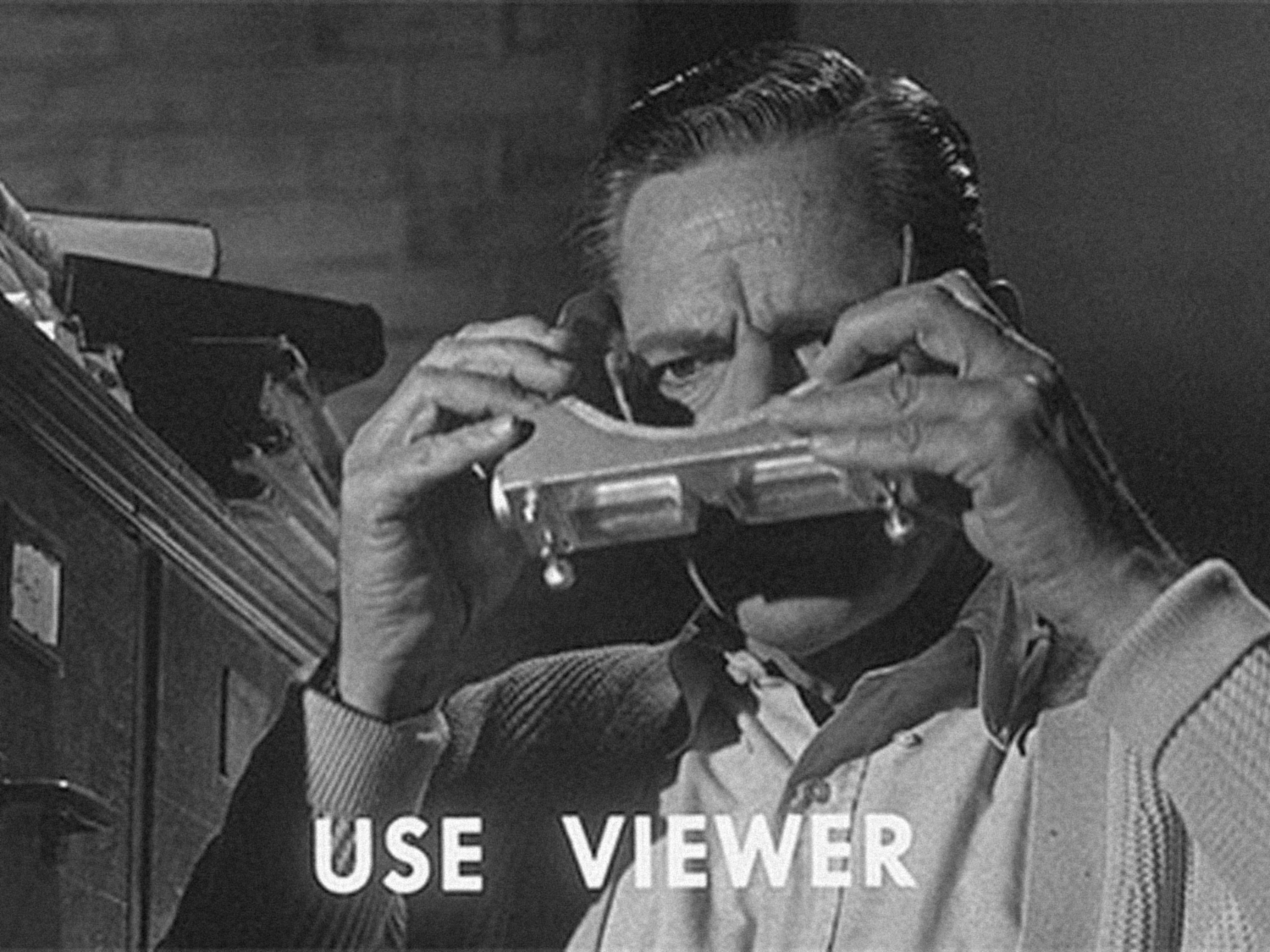
Patrons were handed a free “Ghost Viewer” as they entered the theatre, with which they might either see the ghosts on the screen, or remove them from the picture.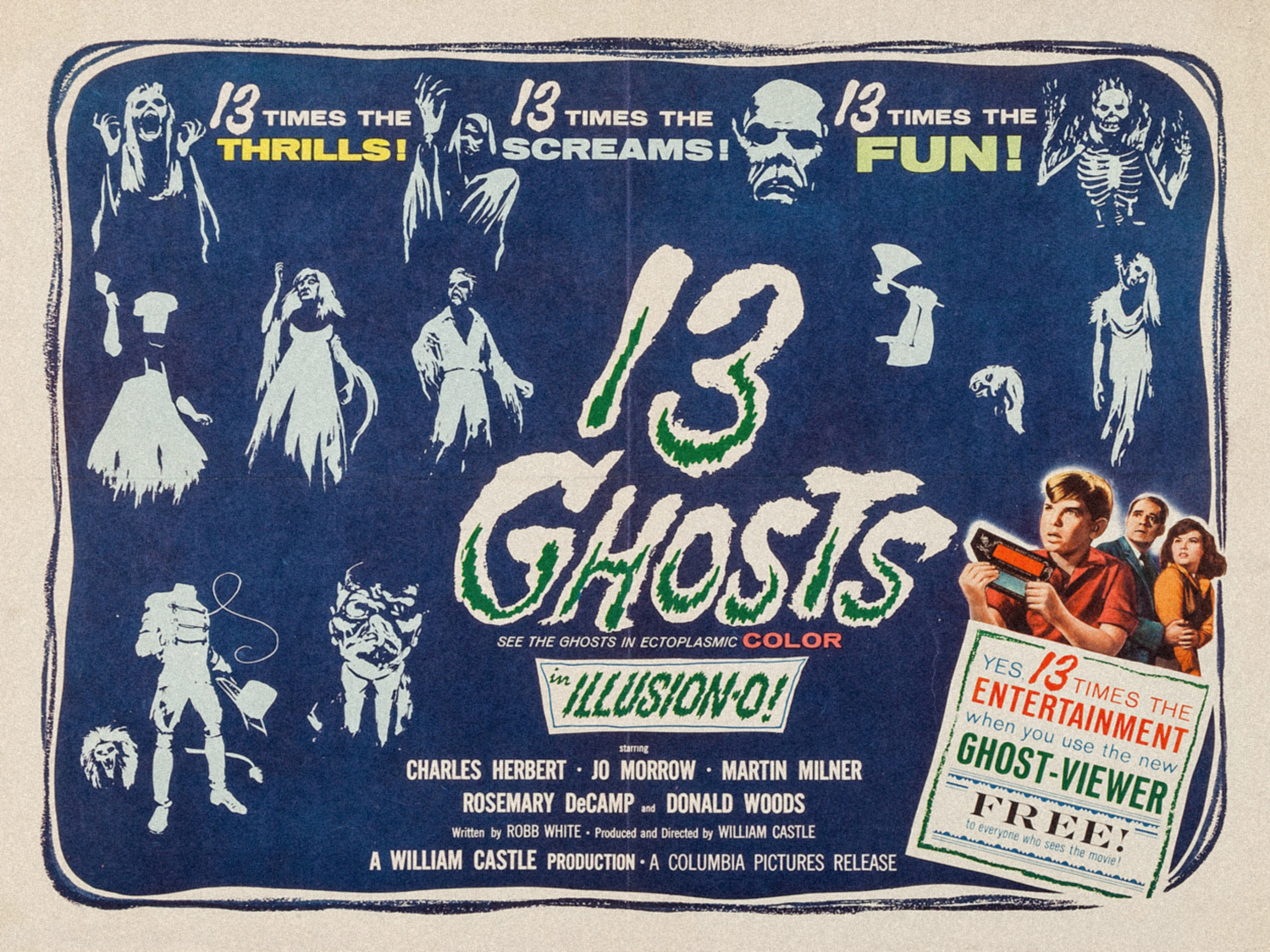
Shown here is some of the printed publicity material for the film; additional promotions were in place at some theatres, like these “Lucky Ghost Cards.”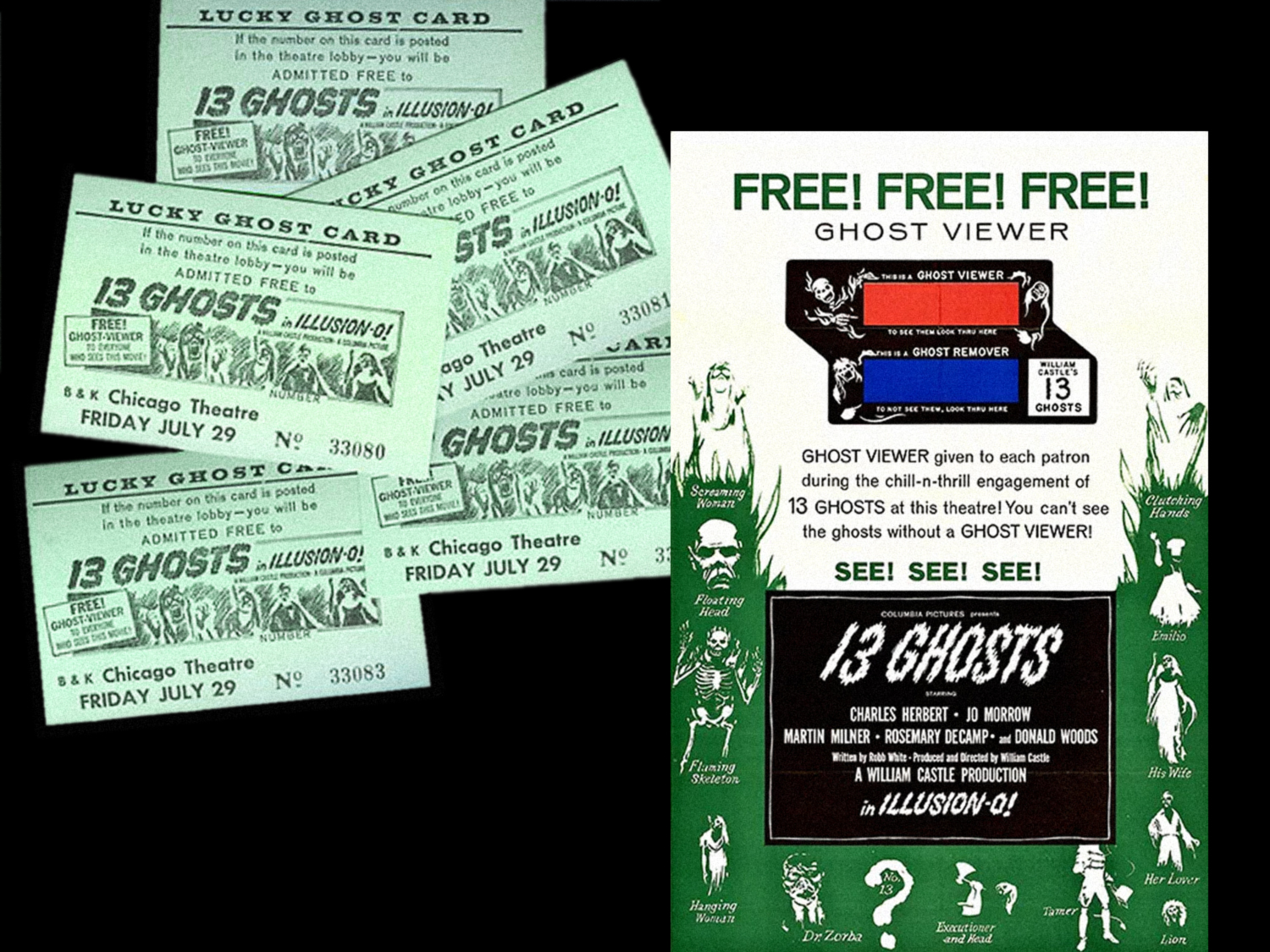
The ghosts were simply actors in various ghoulish costumes filmed separately, that footage tinted red, and superimposed over blue-tinted footage of the “living” actors and sets. The Ghost Viewer, thus, either visually intensified or desaturated the ghosts appearing on screen. 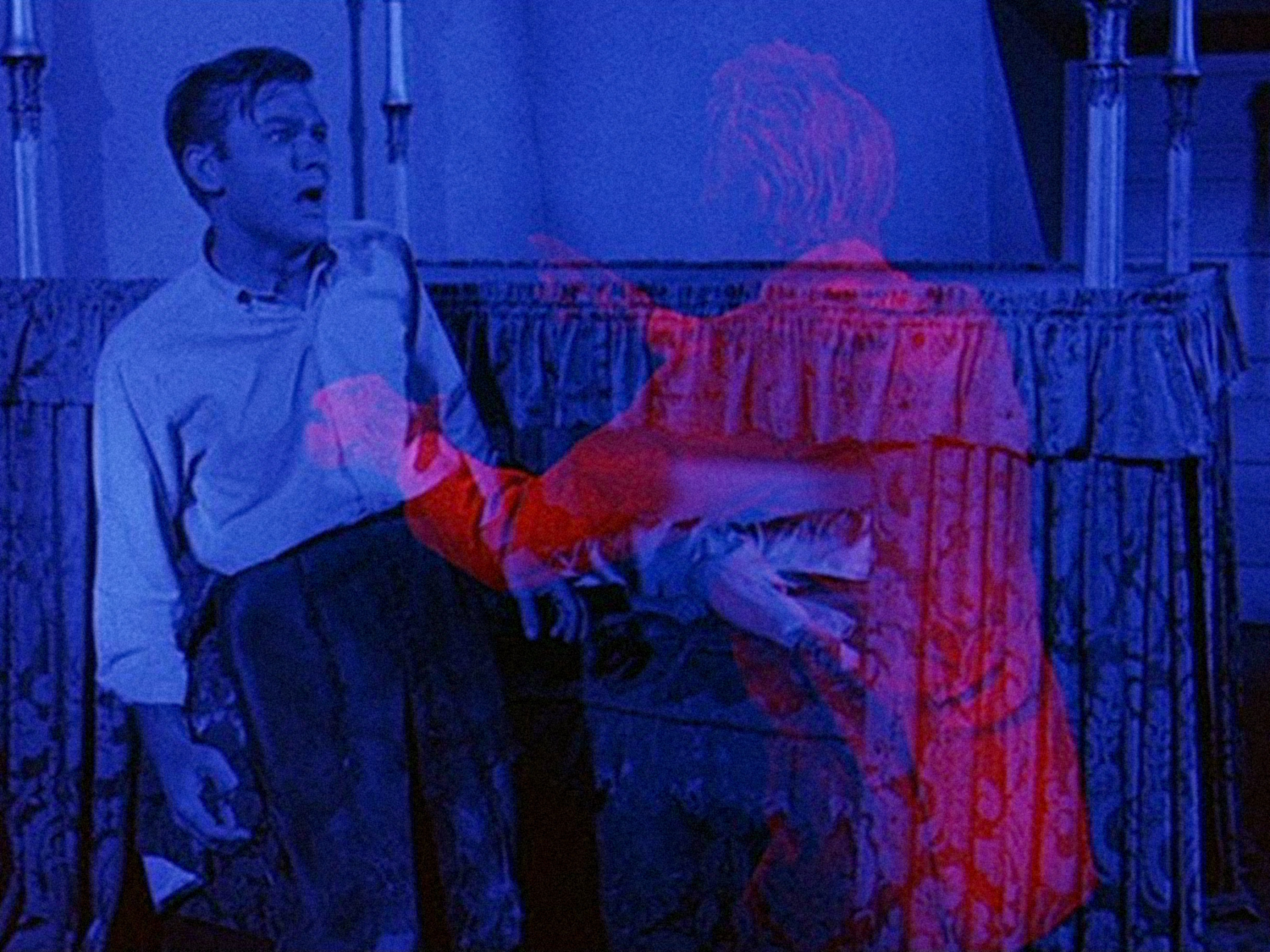
Vincent Price did not appear in 13 Ghosts, but did visit the set, as evidenced by this publicity photo.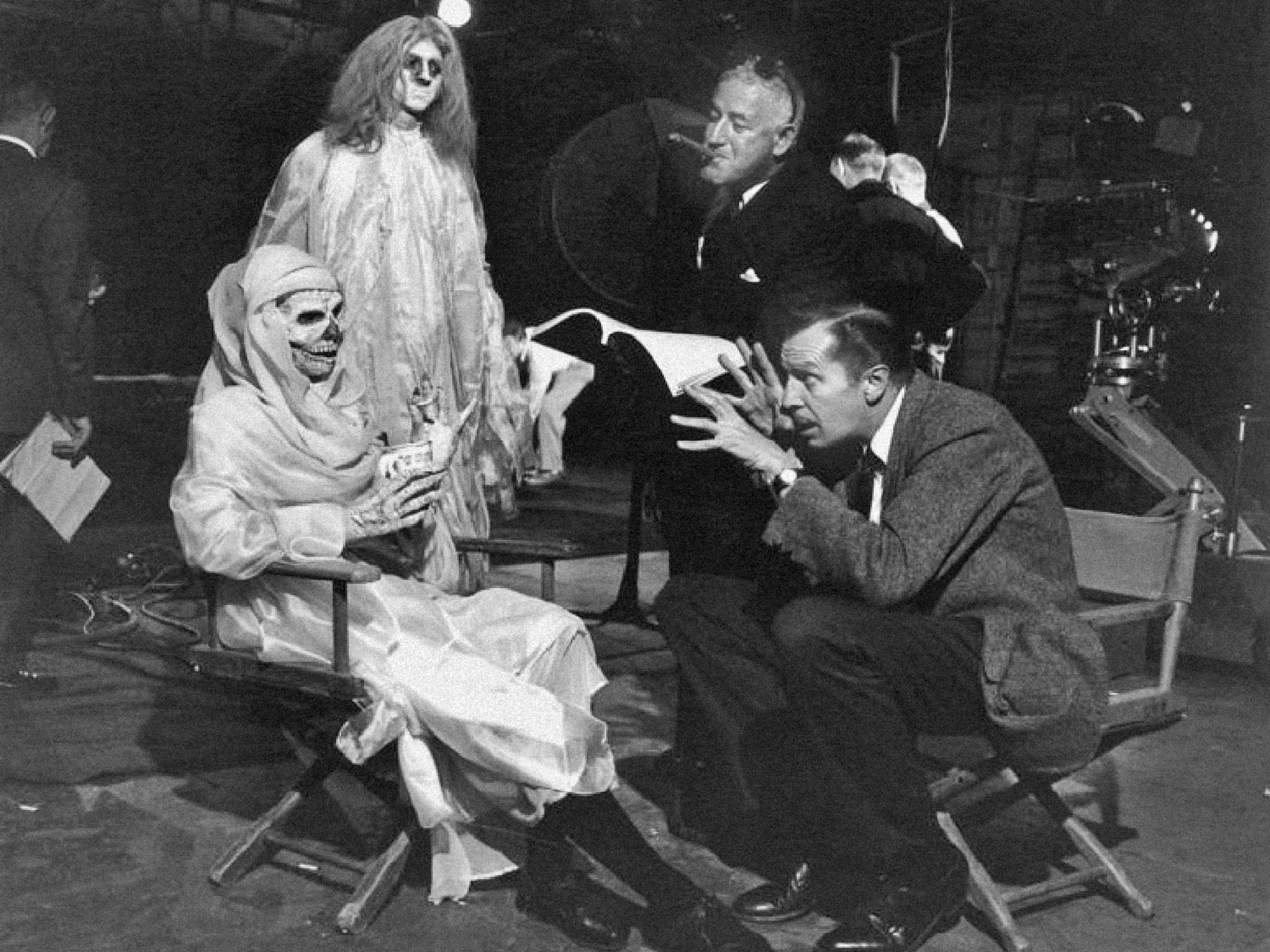
And the spinning ghostly flame optical effect used in 13 Ghosts was later repurposed to represent the incorporeal entity feeding on hate and violence in classic Star Trek’s “Day of the Dove.”
THE INDEPENDENT YEARS: CASTLE AND HITCHCOCK
Castle’s competition that year was a psychological horror picture by another director known for his mastery of the suspense/thriller.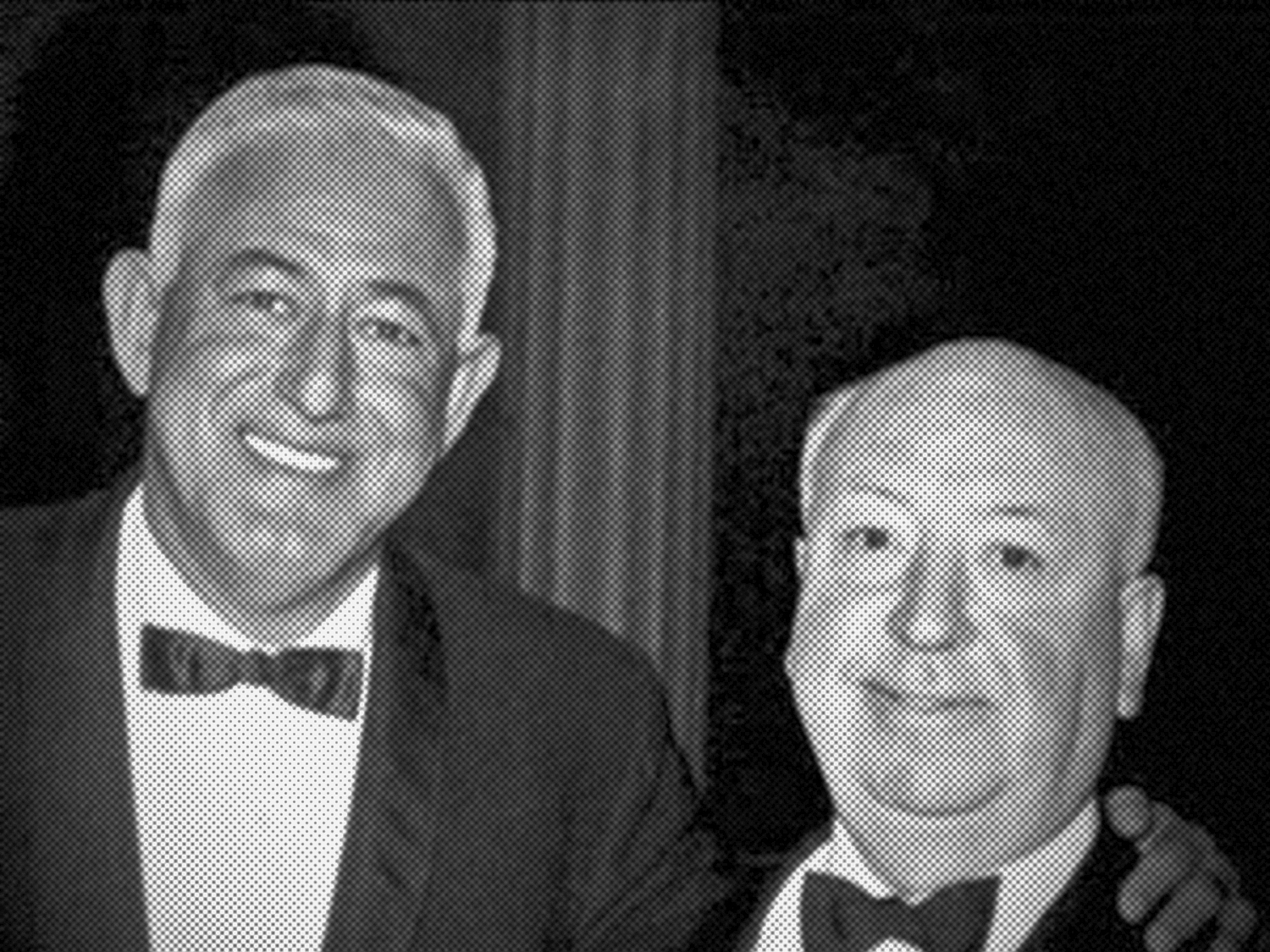
Alfred Hitchcock’s Psycho (1960) far outstripped 13 Ghosts at the box office. Interestingly, it was the financial success of B-movies by Castle and Roger Corman that convinced Hitchcock to make Psycho. He even employed a Castle-like gimmick at screenings, that of not allowing late admissions to screenings.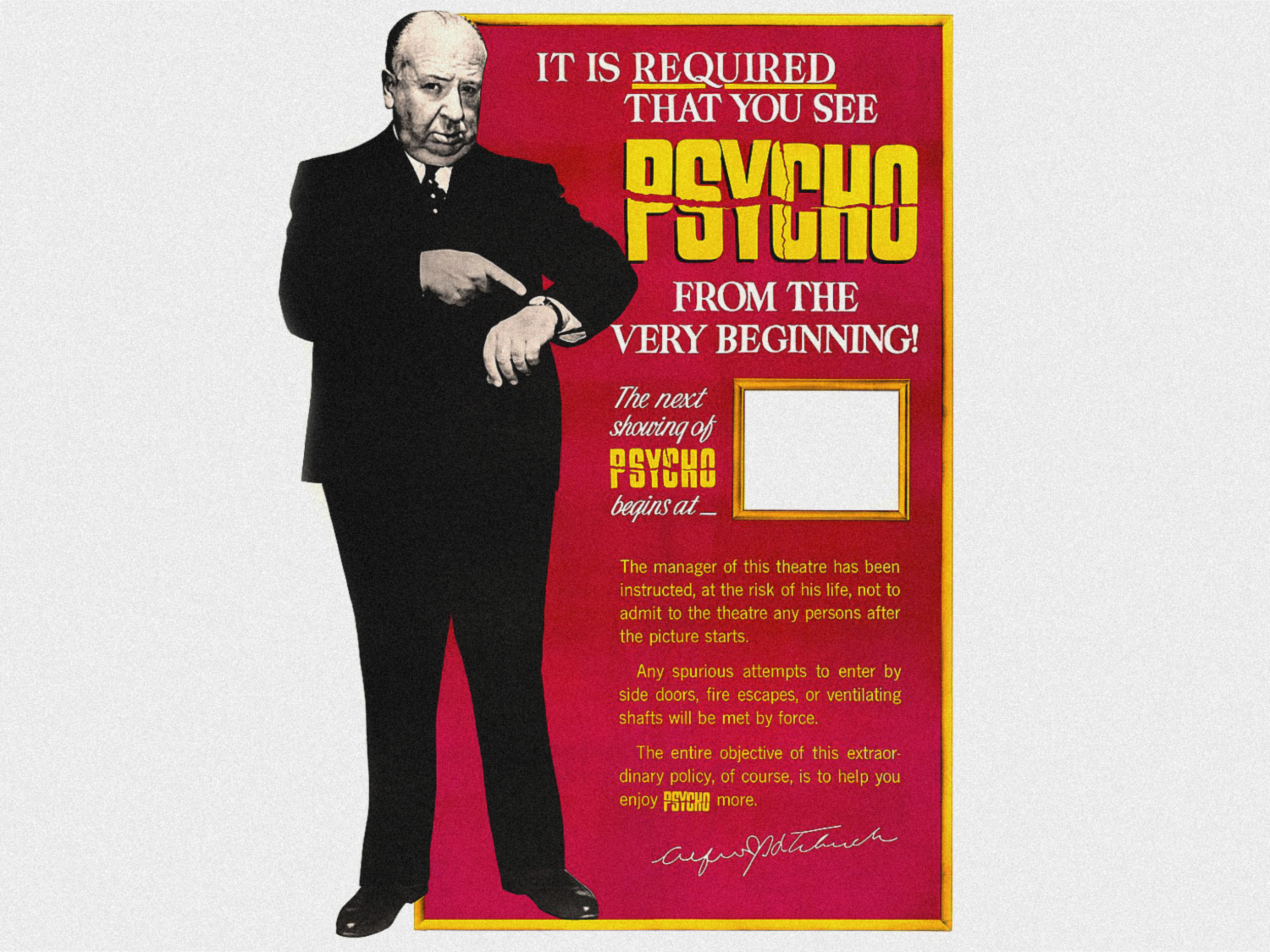
And Hitchcock cited Les Diaboliques as an inspiration, just as Castle had two years earlier when putting together Macabre.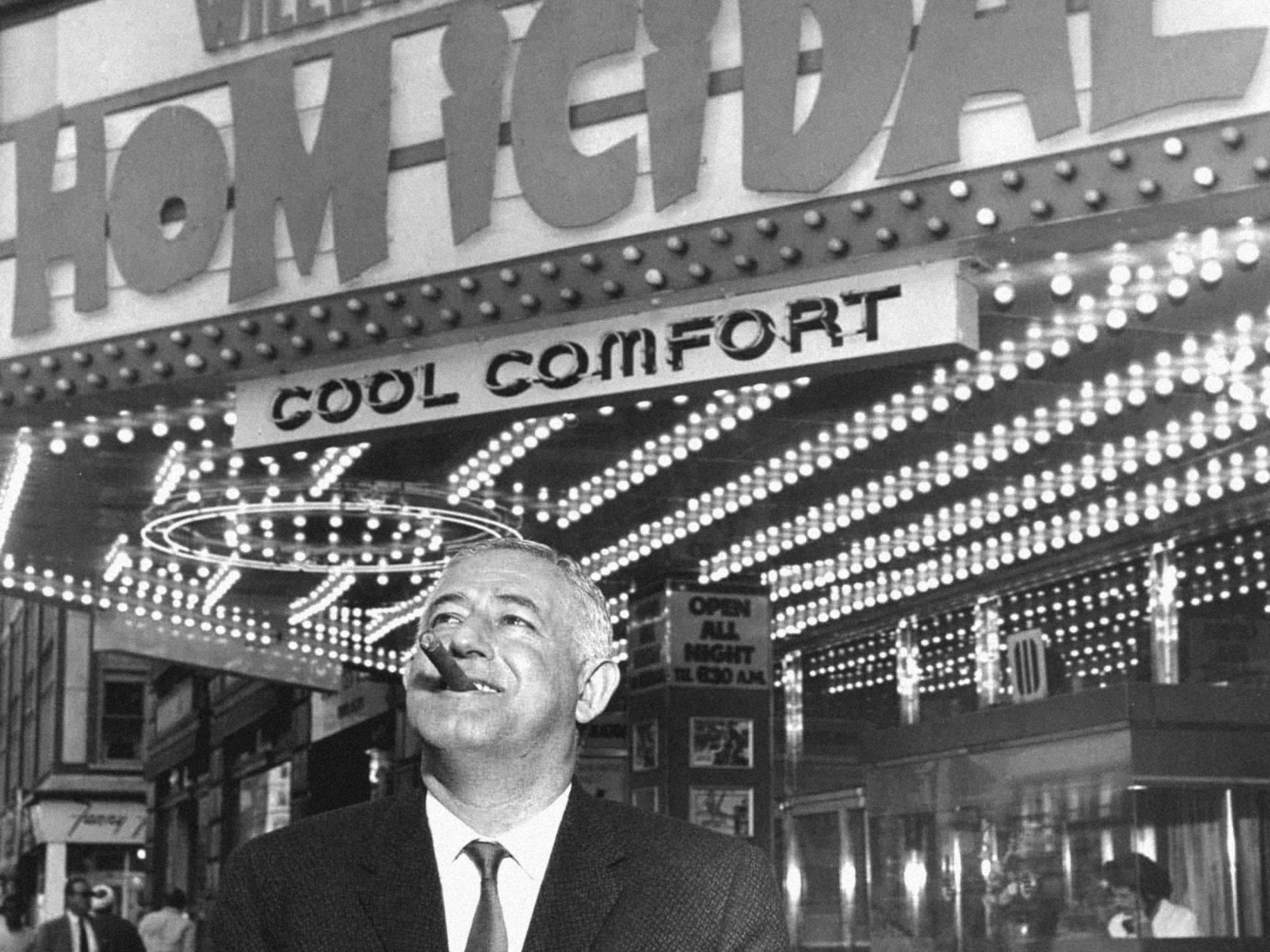
Castle admired Hitchcock’s work and responded to Psycho the following year with his own psychological horror film, Homicidal (1961), which was strongly influenced by Psycho. 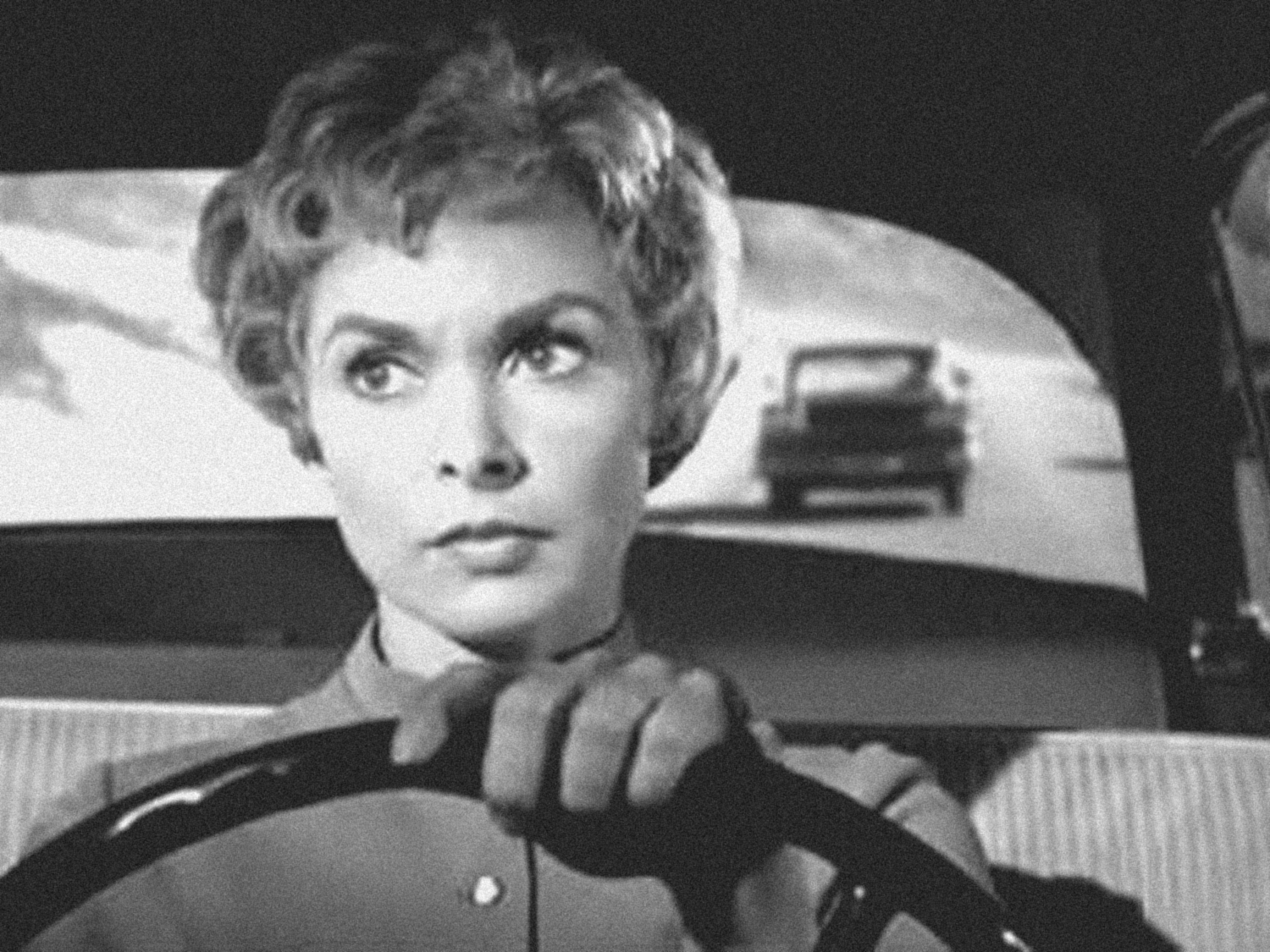
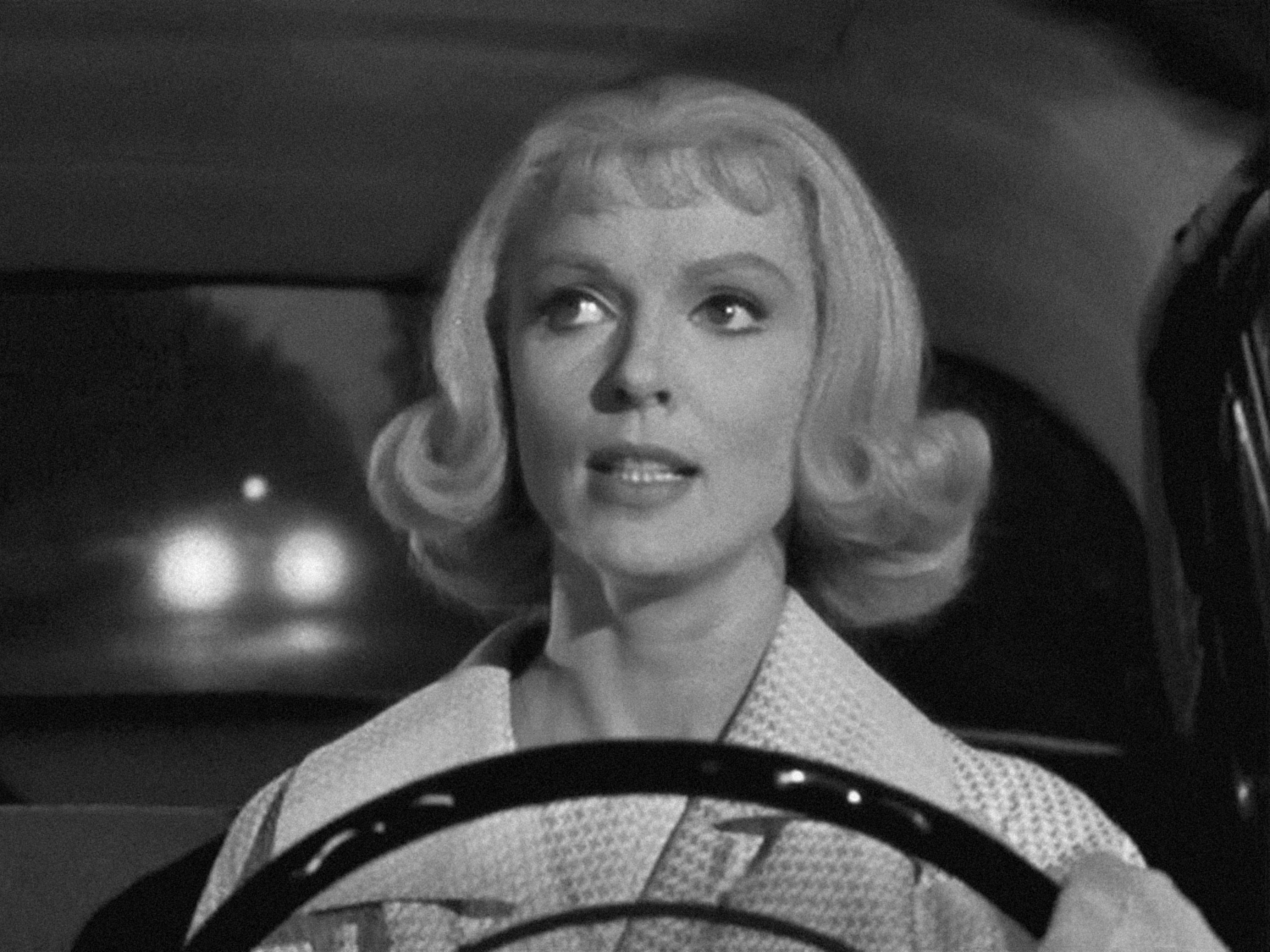 The story involves a homecare nurse, Emily, in the employ of a wealthy family, for which she is looking after an elderly, mute invalid named Helga. Other characters include Miriam and her boyfriend, Glen, and Miriam’s half-brother Warren, recently returned from Denmark after the death of his last surviving parent. There are family secrets a-plenty and an inheritance at stake, too, as we quickly learn that the enigmatic Emily is completely unhinged and somehow connected to Warren.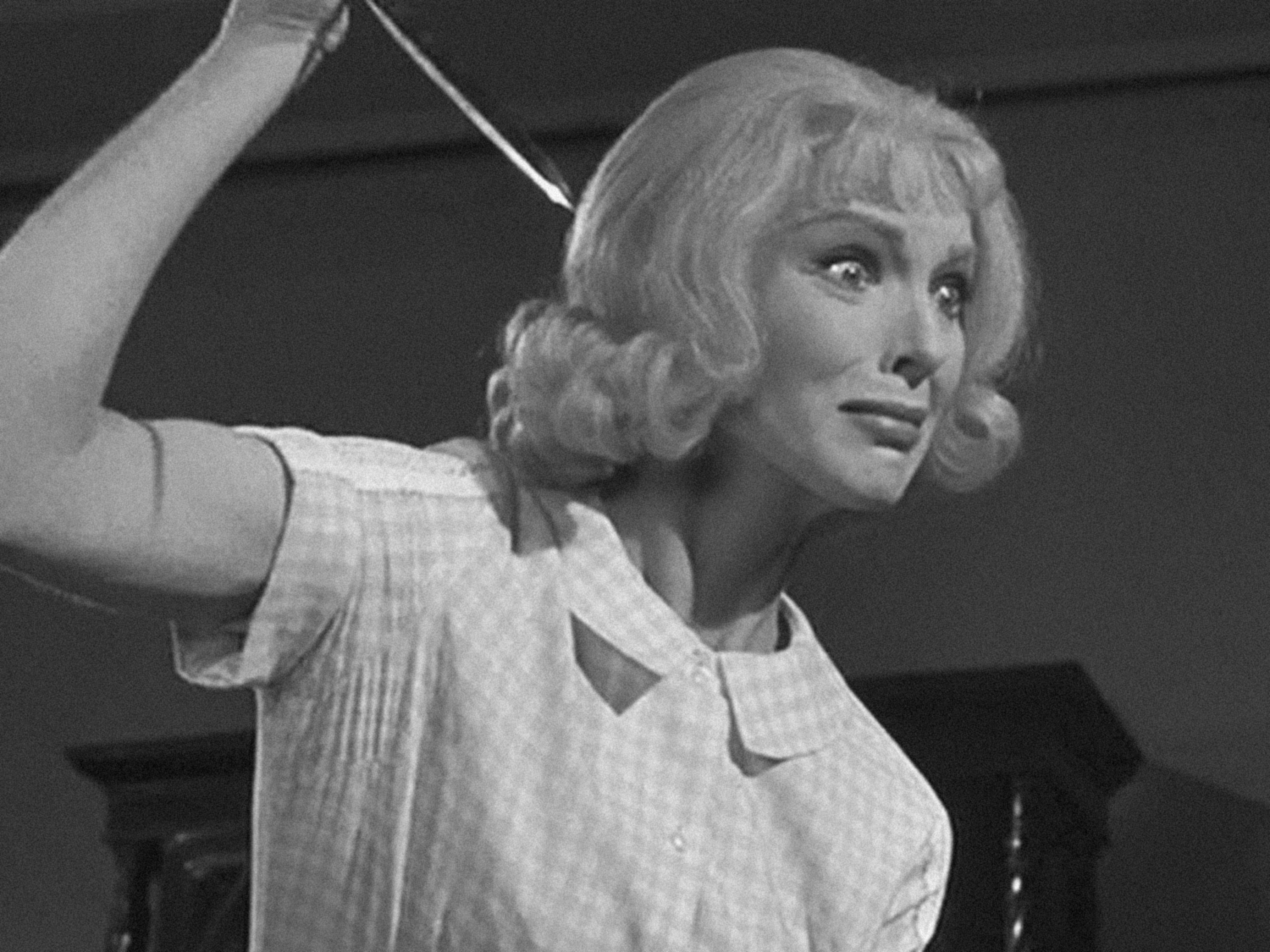
Castle’s gimmick for Homicidal was the “Fright Break,” a pause in the suspenseful climax of the film to allow any audience member too scared to watch the end of the movie to leave and receive a full refund.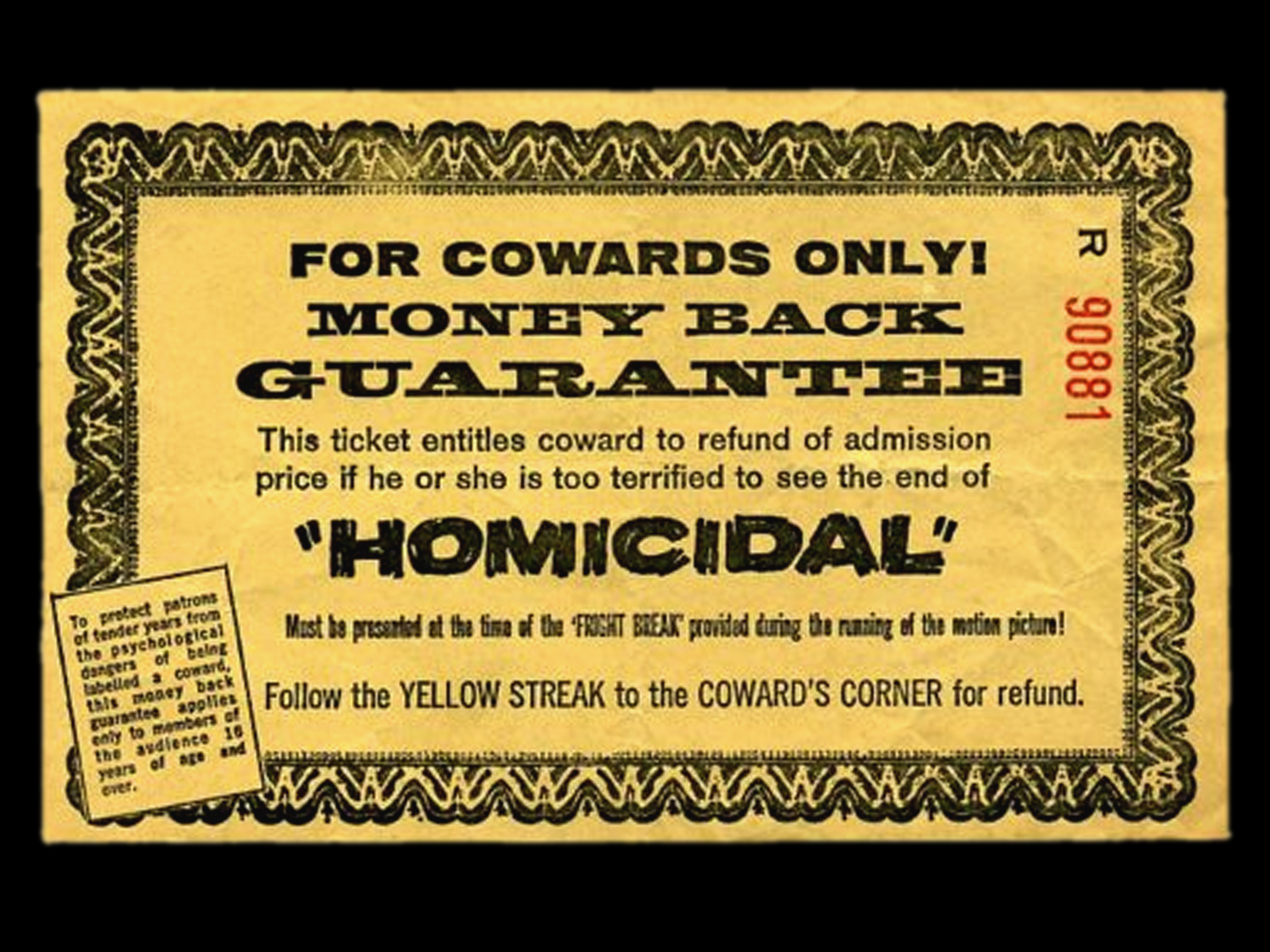
Of course, to claim their refund, they had to follow the “yellow streak” painted on the floor while bathed in a yellow spotlight, out of the theatre and into the lobby. There, a nurse awaited to offer a blood-pressure test, and finally, the anxious audience member had to report to “Coward’s Corner” so that all would know their shame!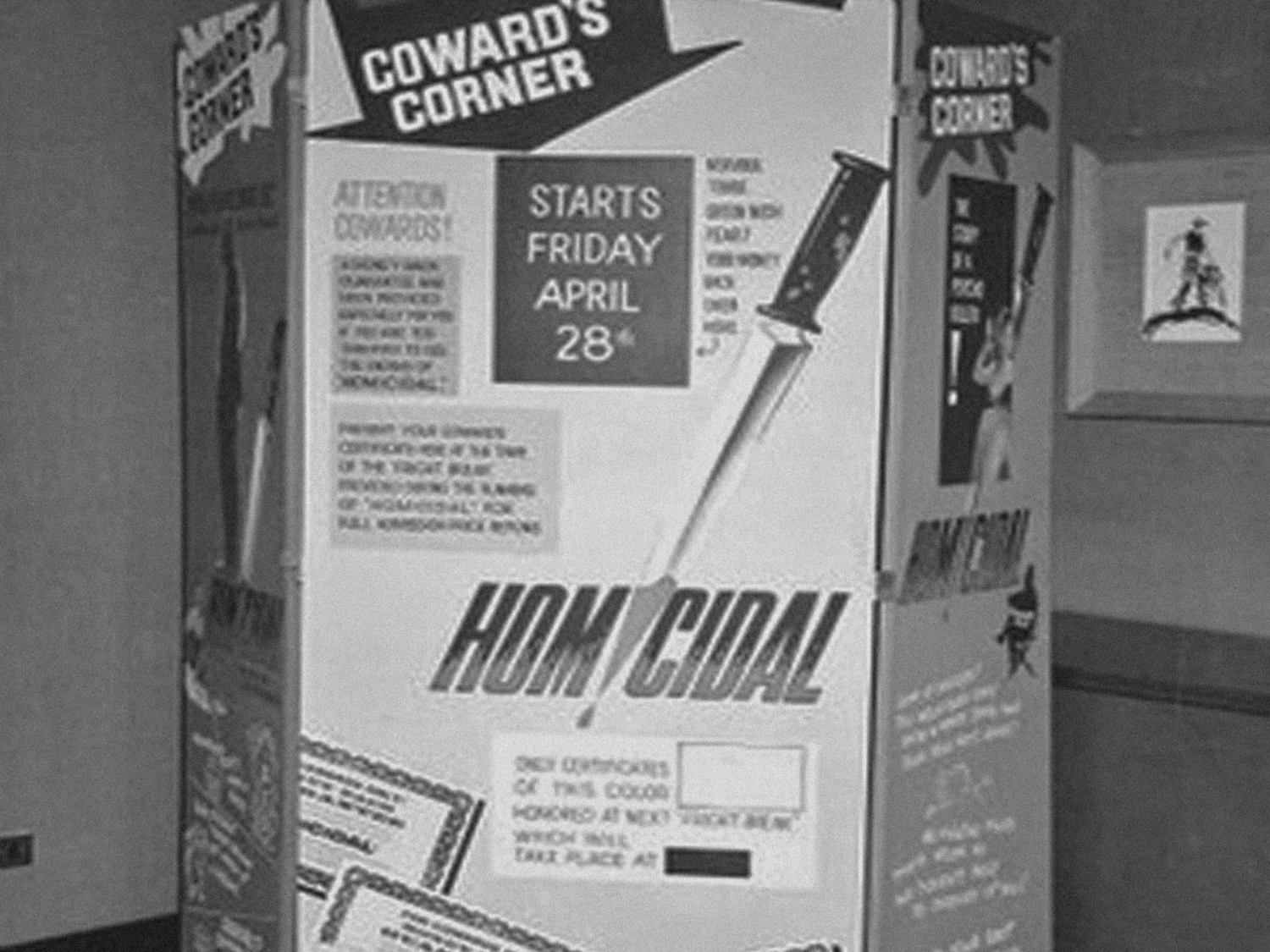
It would seem counterintuitive to interrupt the action just as the tension is mounting, but strangely, it kinda works!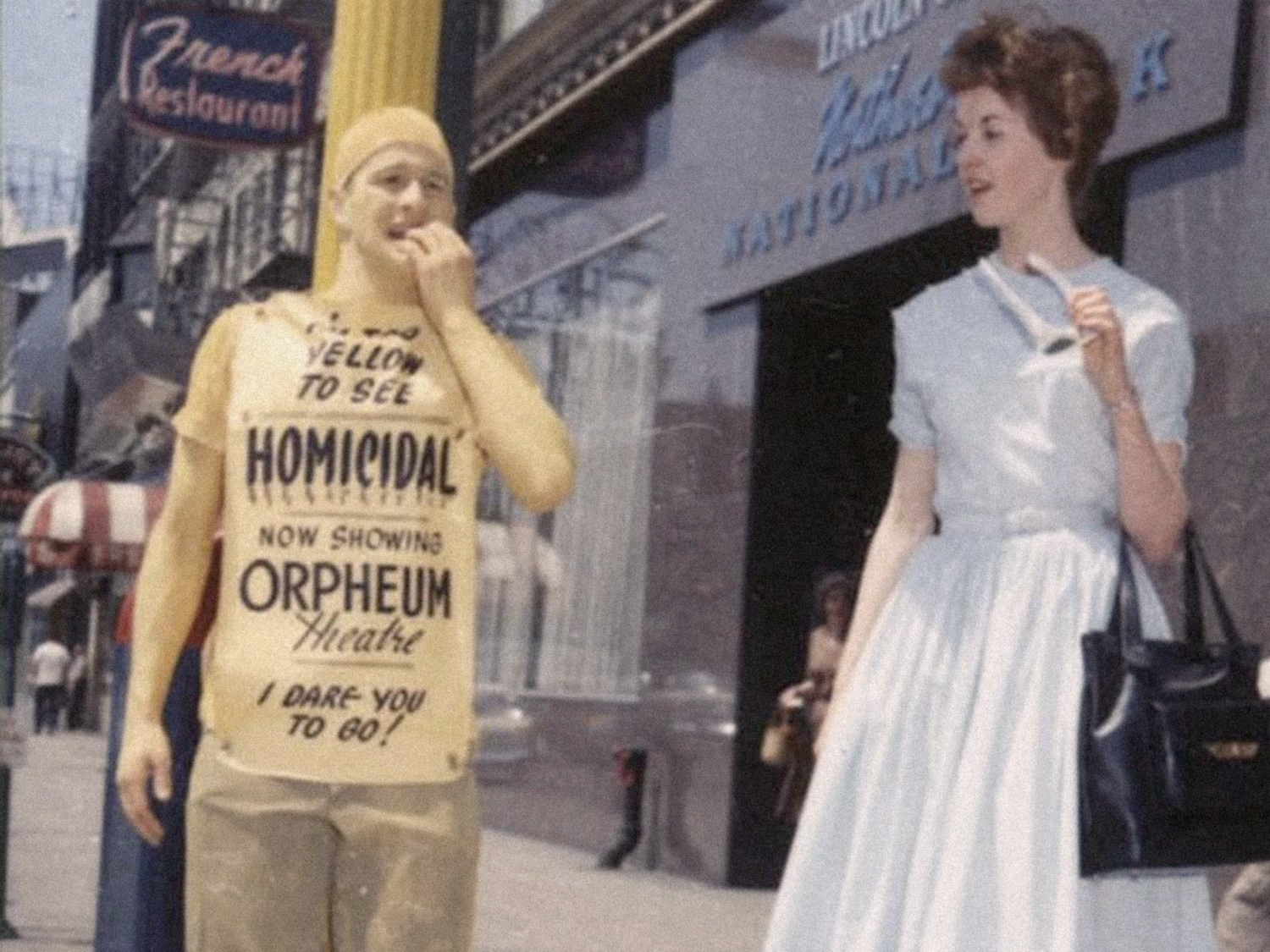
In some markets, Castle also hired people to promote the film out on the streets. Columbia’s press book for the film provided the usual publicity photos and touted the “Fright Break” and “Coward’s Corner” gimmicks to theatre owners as “Showmanship that Sets Records,” for some exhibitors were beginning to grumble that booking a William Castle movie involved a lot of extra work.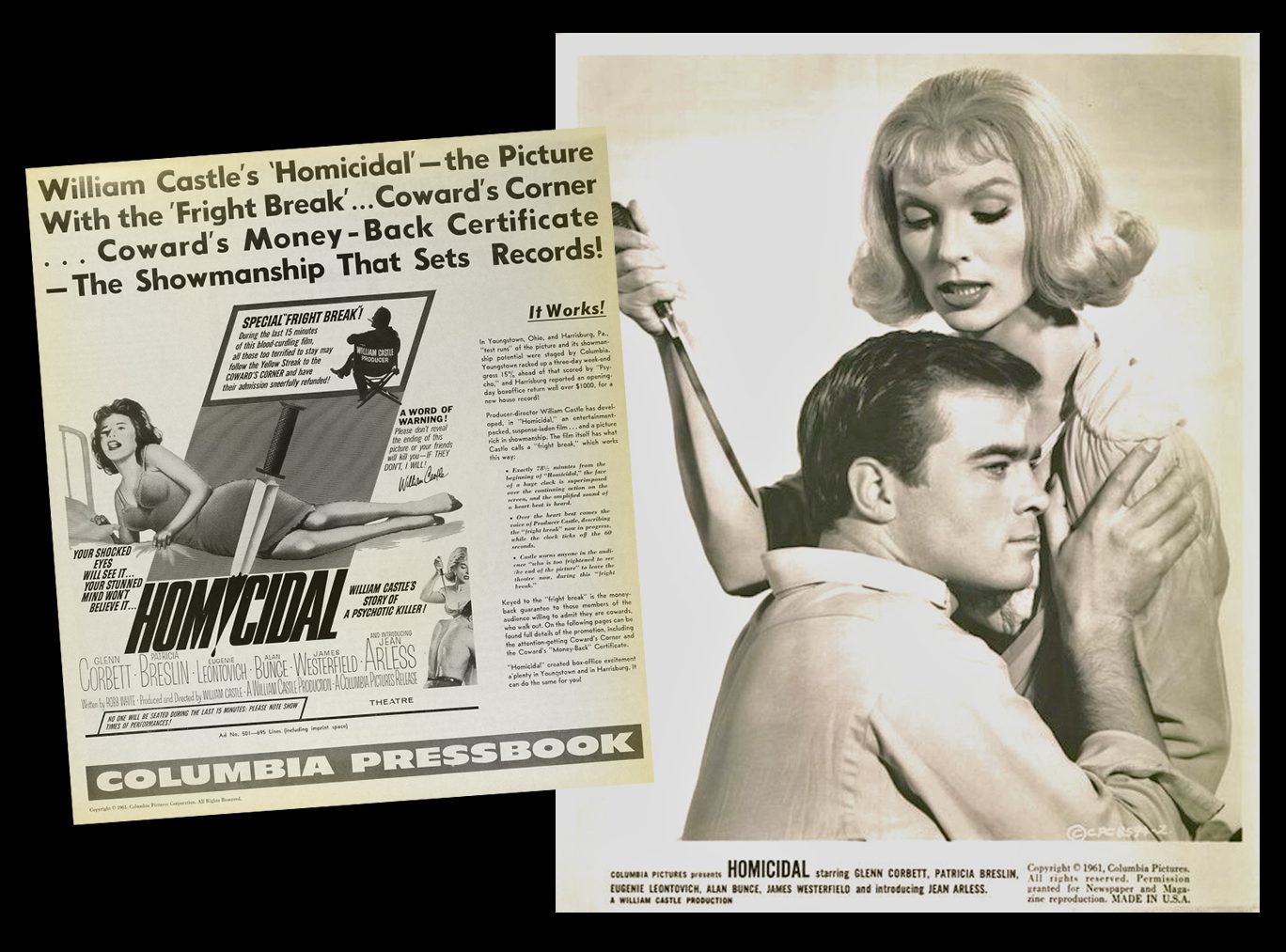
The cast included a new name, Jean Arless, dubbed the “Homicidal Girl.” But Jean Arless was a stage name. You see, the character of Emily and the character of Warren were played by the same thespian!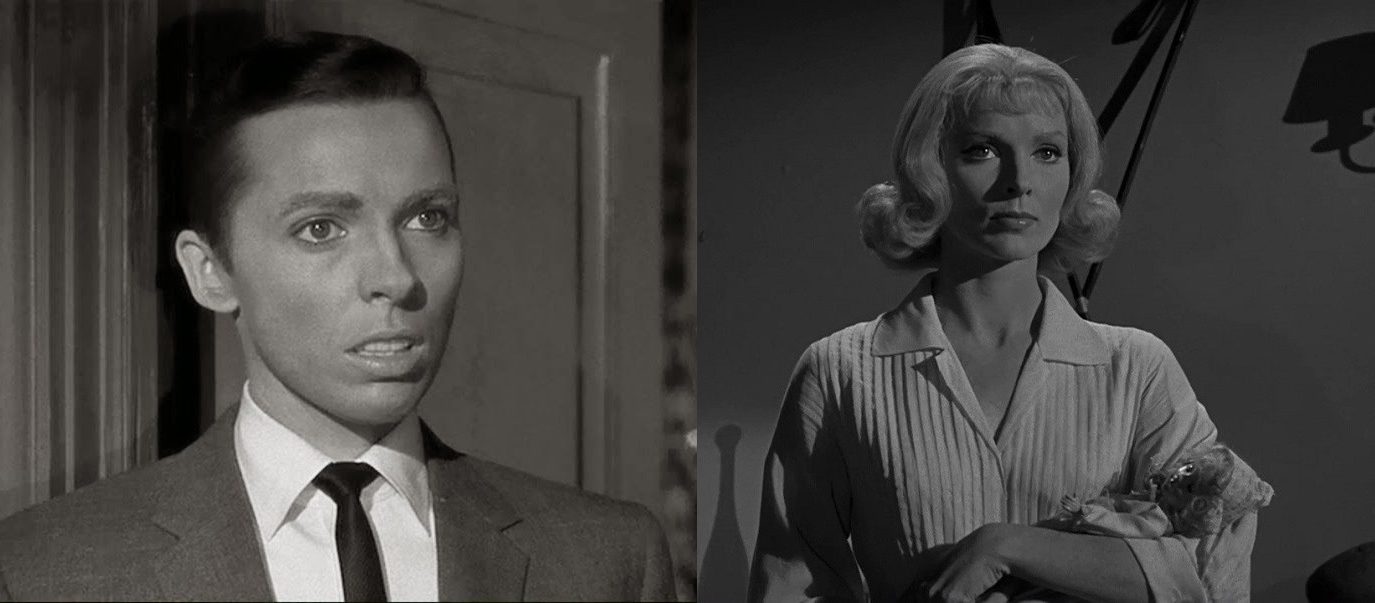
Castle came up with the gender-non-specific name so as not to tip his hand—Jean could be interpreted as feminine, as in actress Jean Harlow, or masculine, as in Jean Chrétien, the former Canadian prime minister. One could easily accept that Jean Arless was, perhaps, a French actor come to America. But he wasn’t.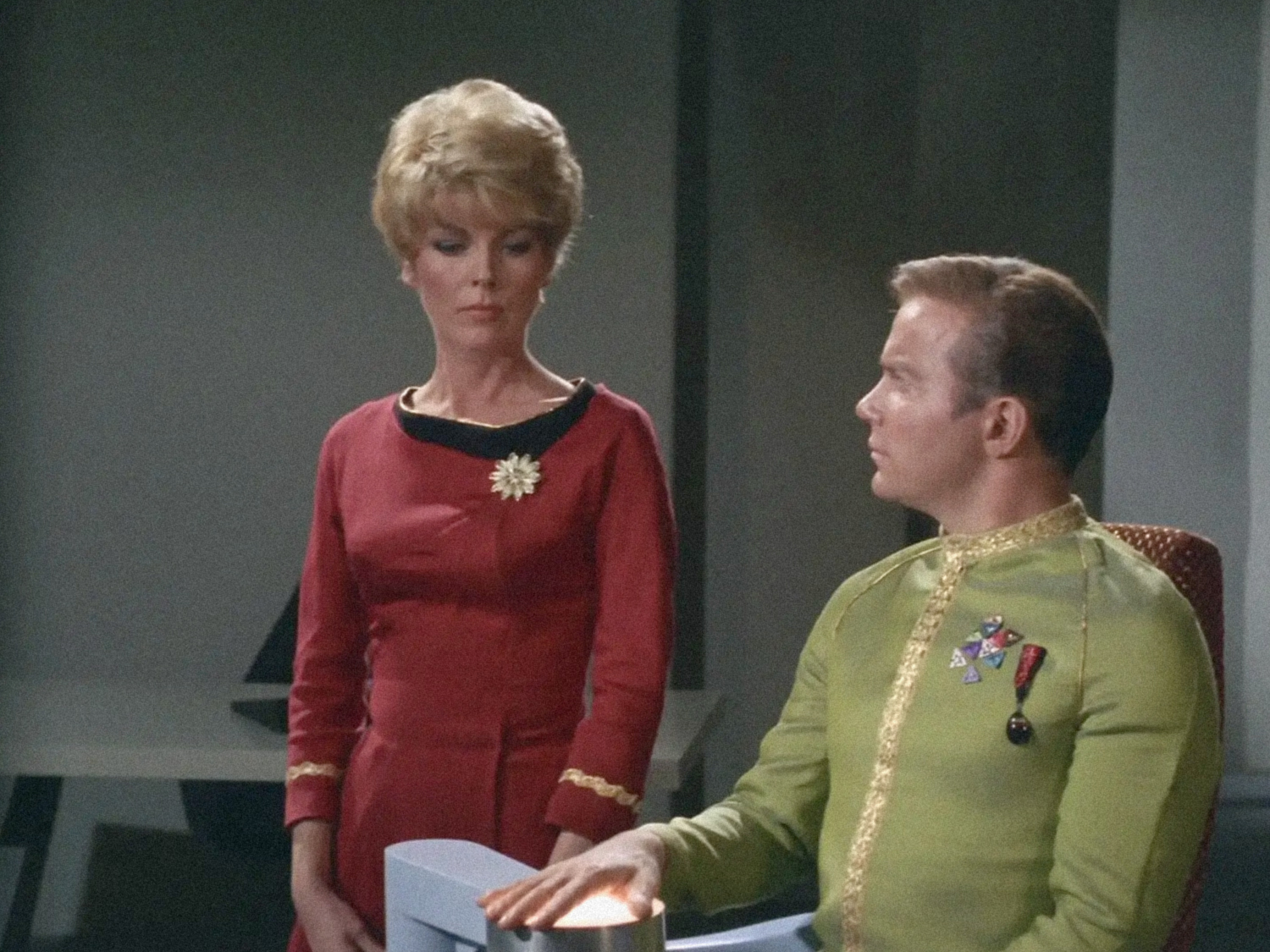
Jean Arless was, in fact, actress Joan Marshall, who successfully auditioned for both roles, impressing Castle with her transformation from female to male. You may know her from another production, Star Trek’s “Court Martial.”
THE INDEPENDENT YEARS: CASTLE IN THE SIXTIES
1961 also saw Castle release Mr. Sardonicus, a period piece about a nobleman stricken with a fright-induced facial deformity—a perpetual, grisly grin (medically, a condition called Risus Sardonicus).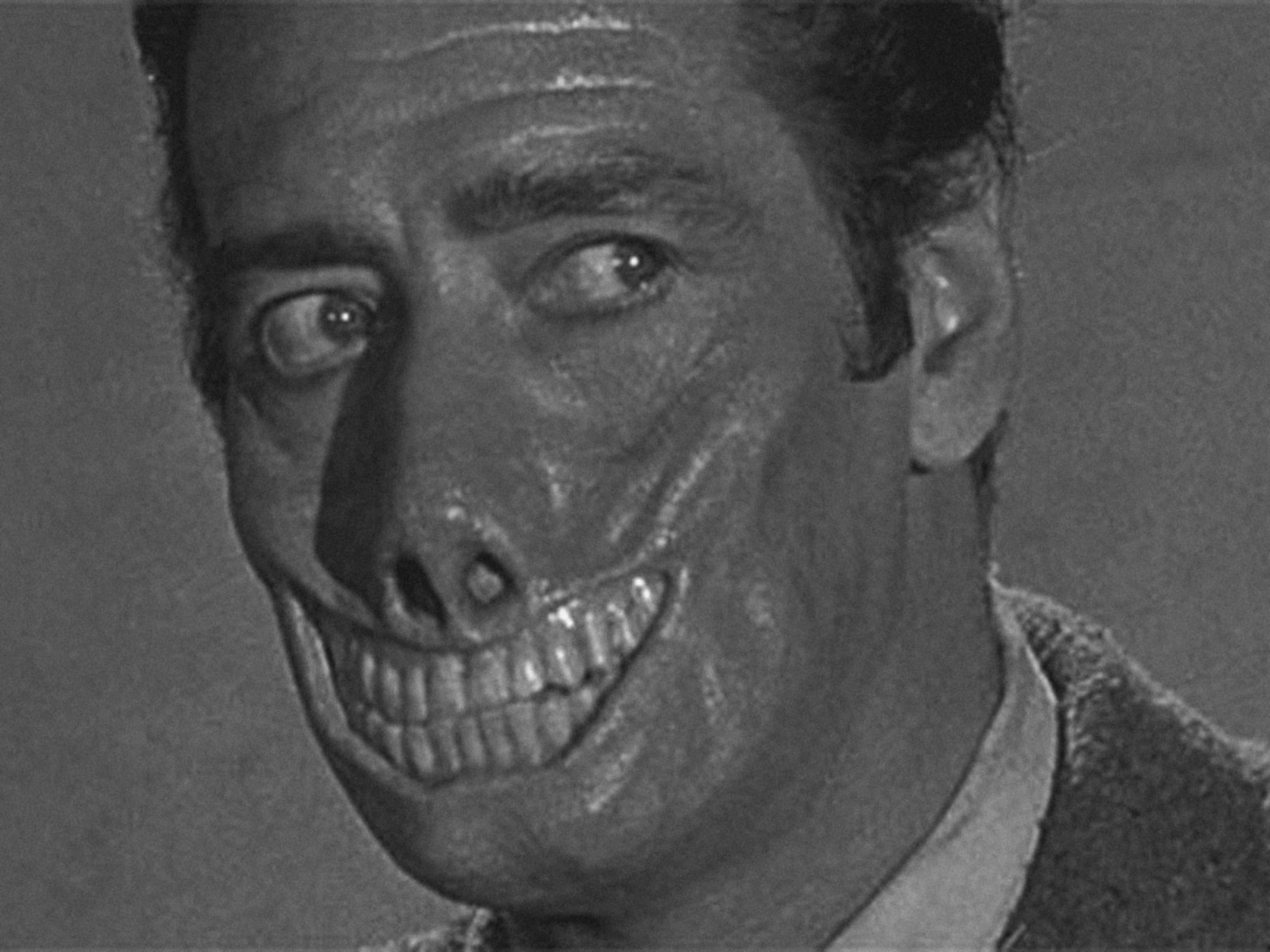
Phantom of the Opera-like, he wears a mask to hide his face.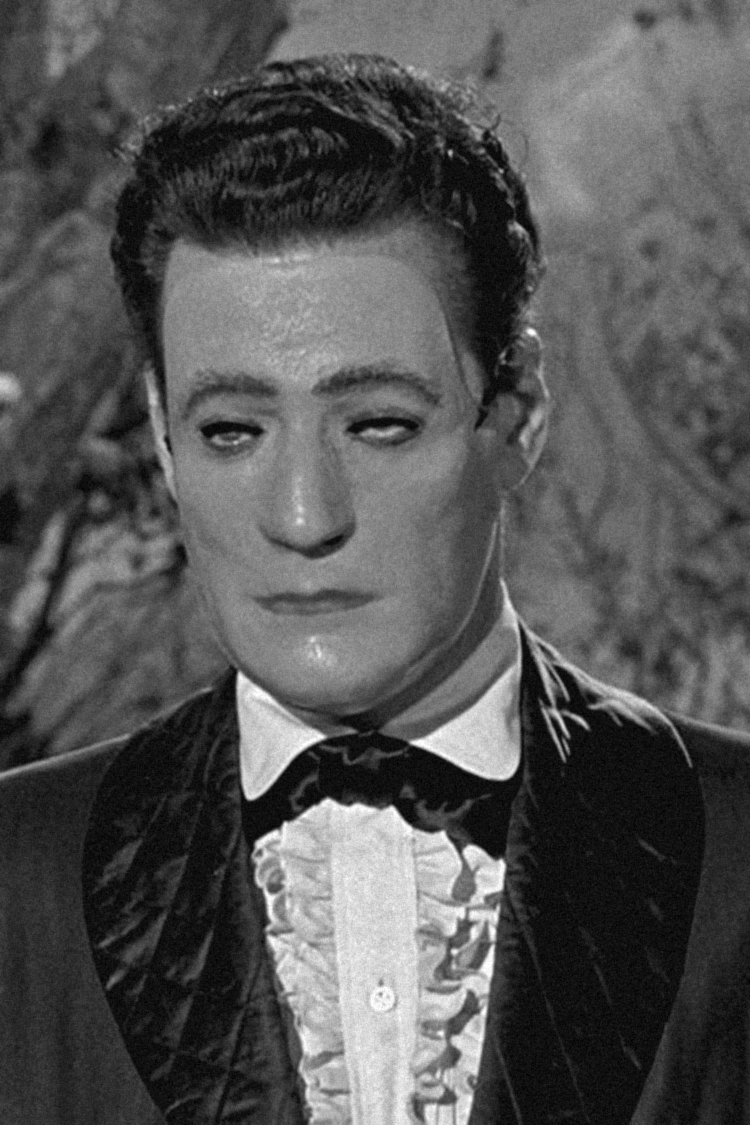
Assisted by Krull, his “Igor,” if you will, Sardonicus begins conducting sadistic experiments in his castle, preying on local women and hoping to find a cure for his condition, which a doctor summoned from England may be able to provide, albeit under duress.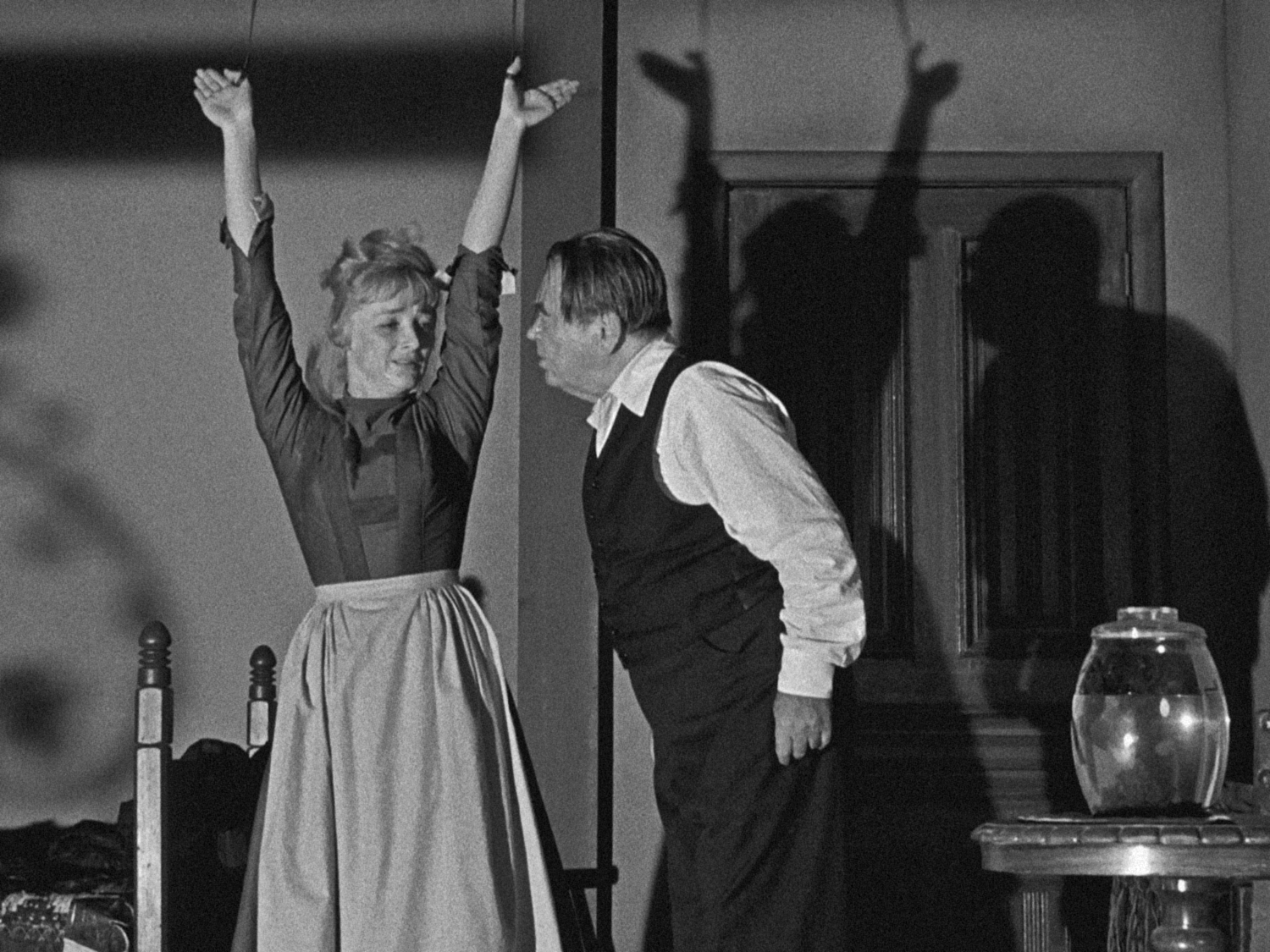
The gimmick Castle came up with for this film was called the “Punishment Poll.” He appears briefly at the end of the picture, breaking the fourth wall to poll the audience on whether Mr. Sardonicus should be shown mercy for his transgressions, or receive punishment.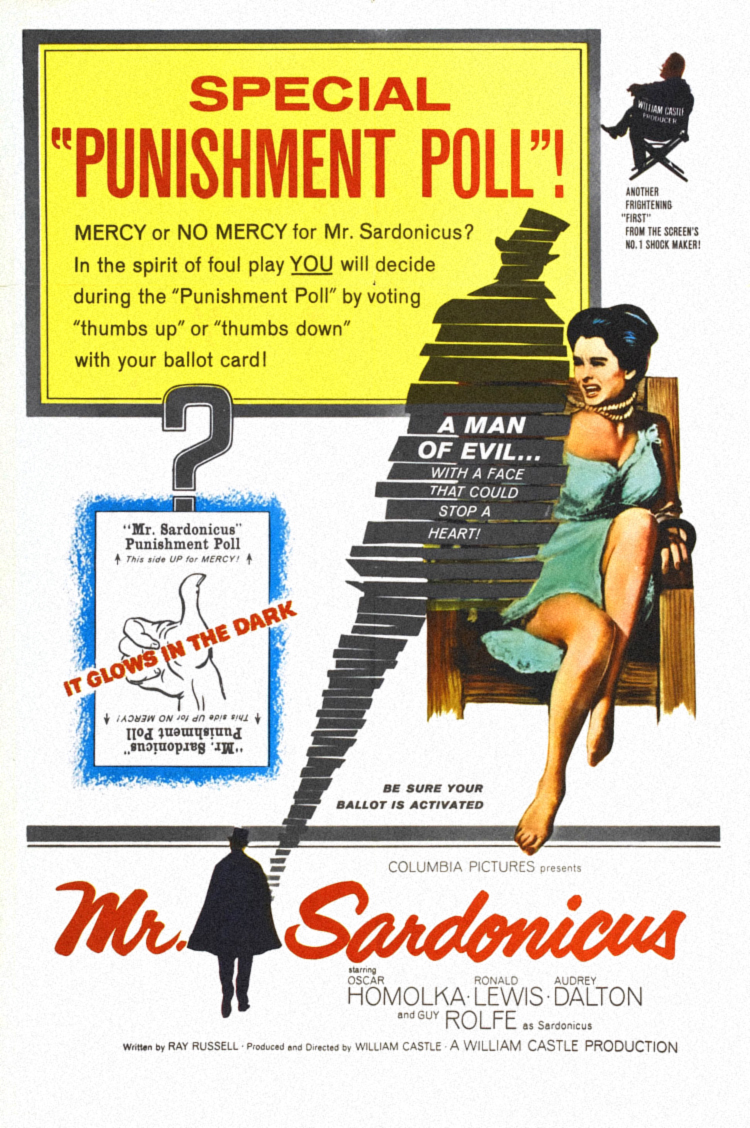
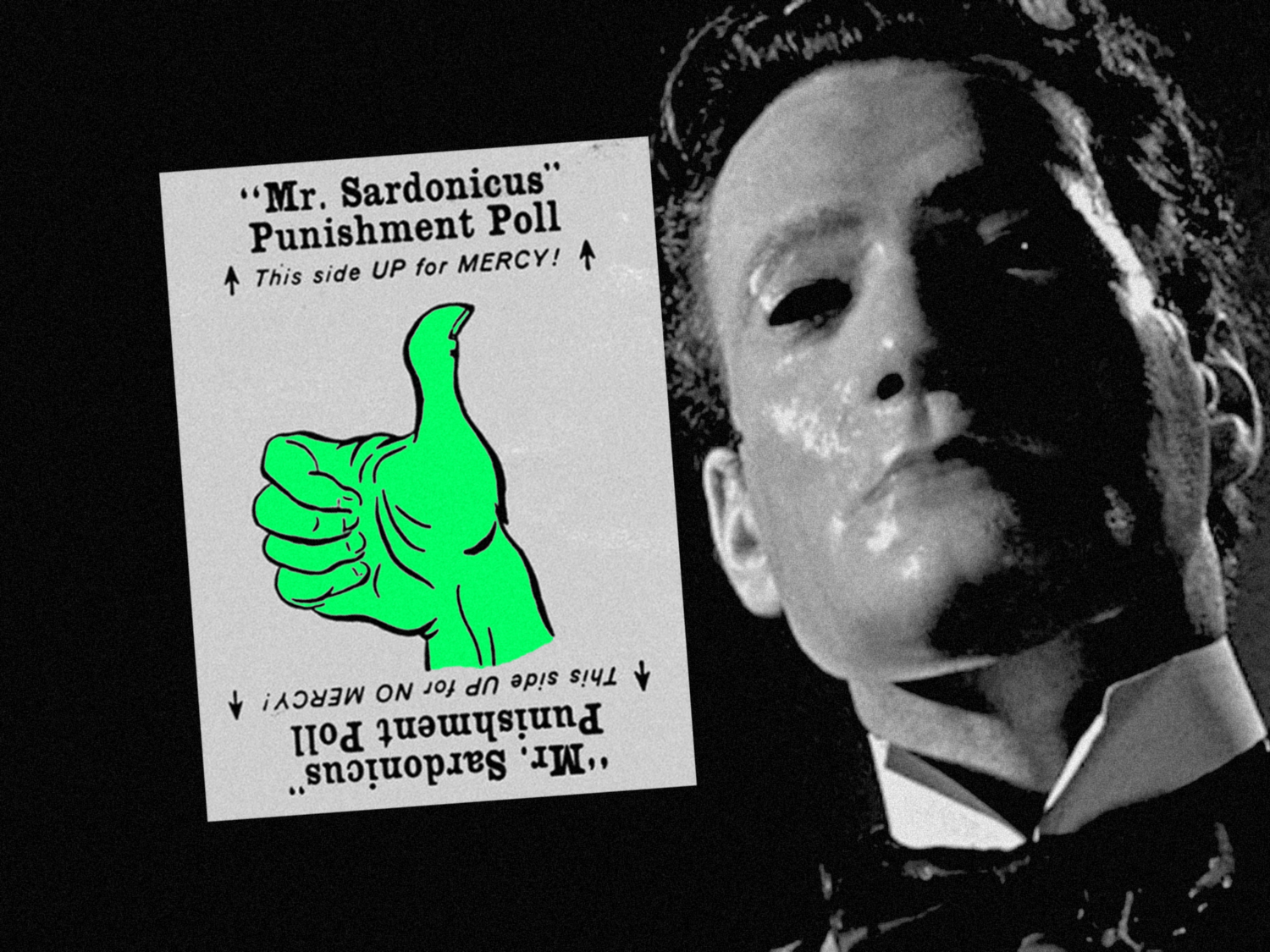
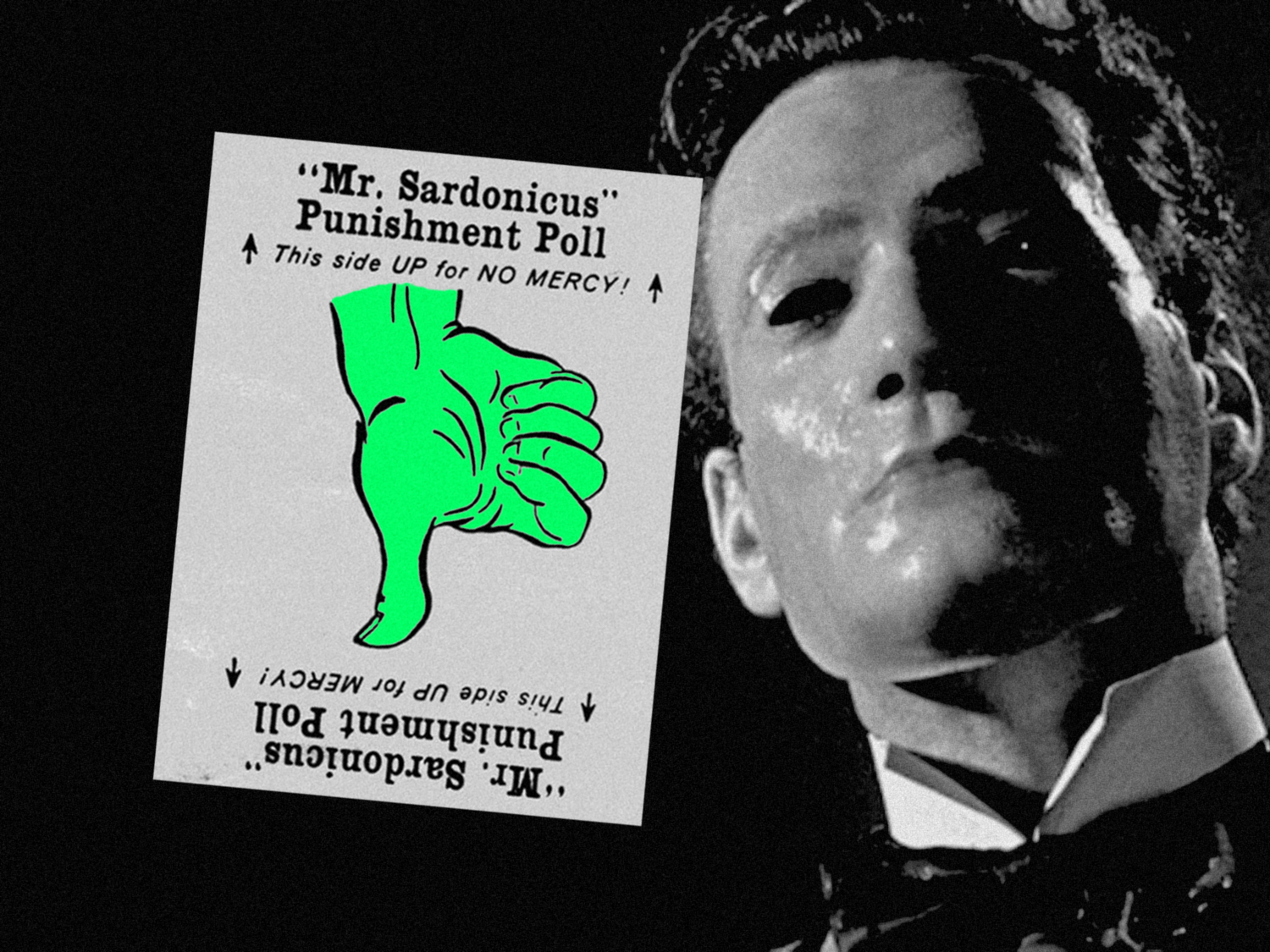
While he claims to have shot two endings, one for each possible outcome of the audience’s vote, there has never been found a print of the film which included a merciful ending.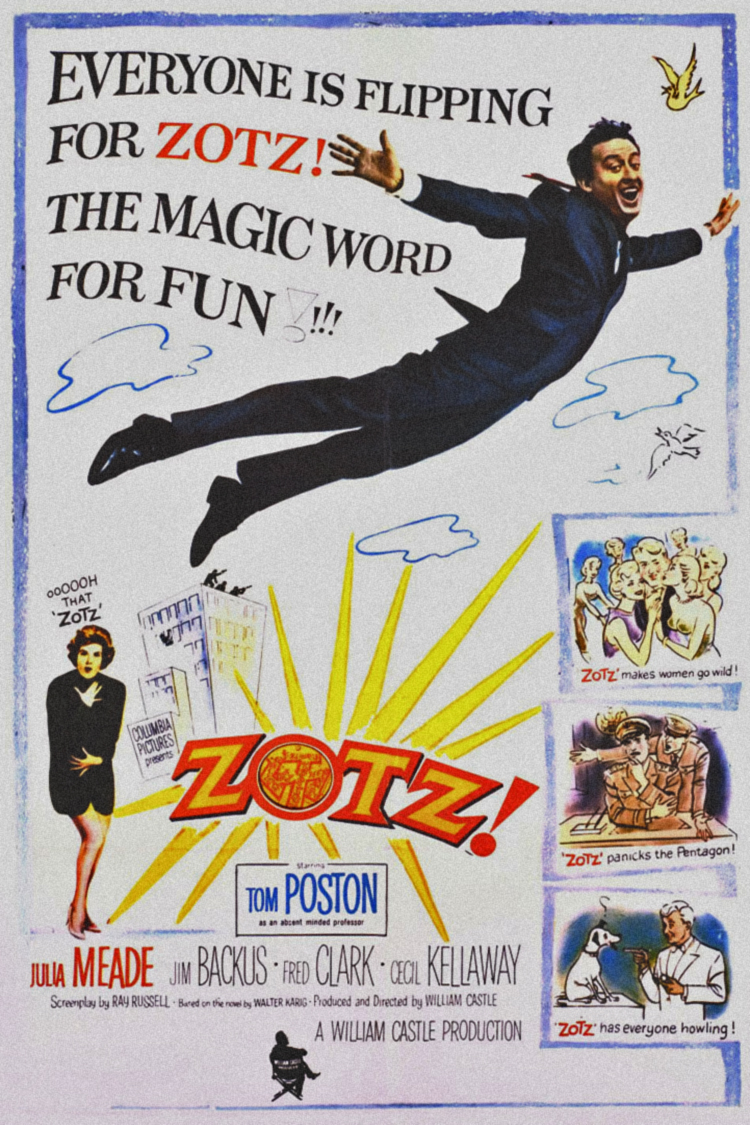
1962’s Zotz is a fantasy/comedy about a man who comes into possession of an ancient, magical amulet that imbues him with certain fantastic powers.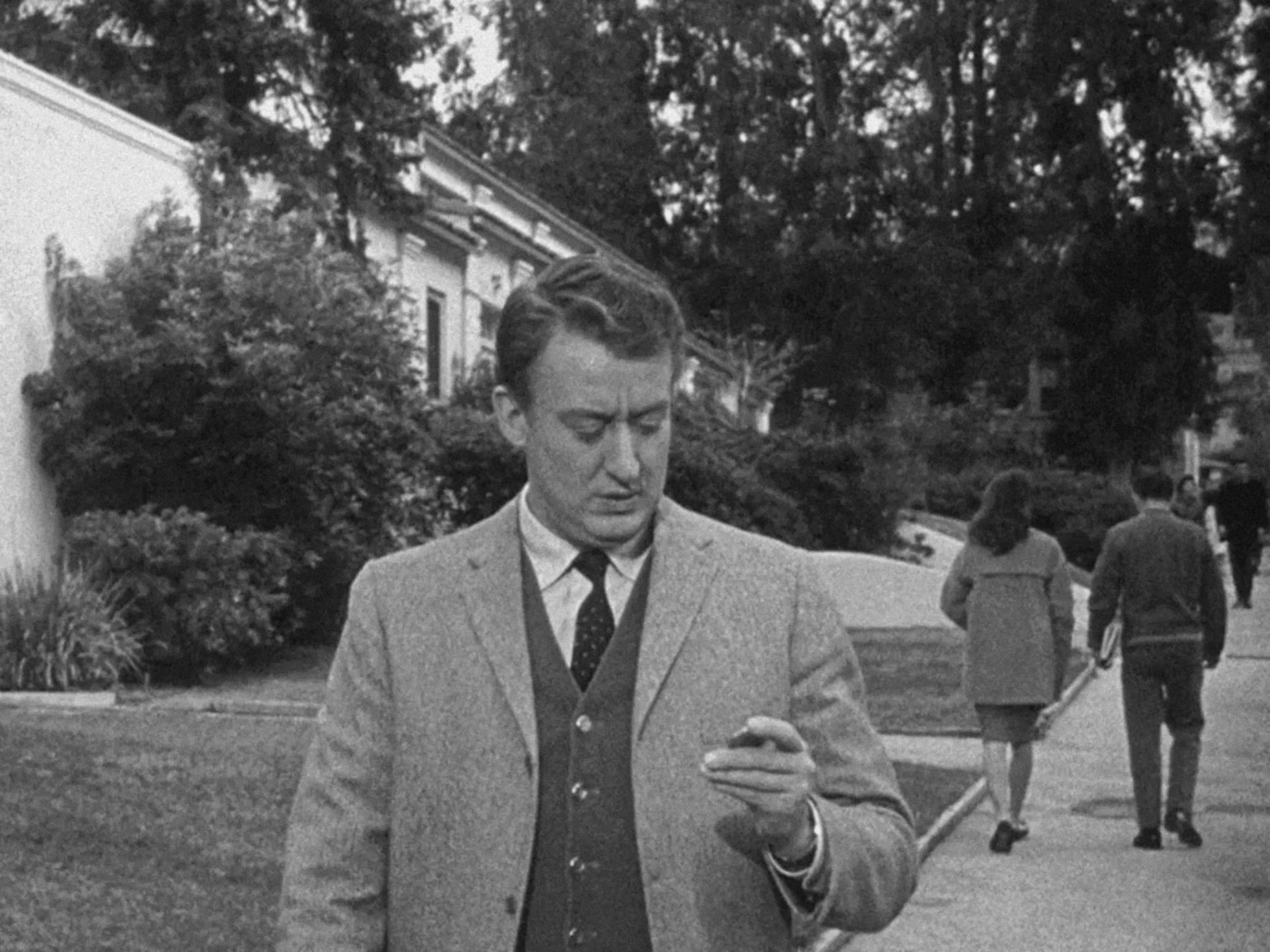
A young Tom Poston stars; you may recognize him as handyman George Utley, a character on the long-running sit-com Newhart (1982-1990).
The gimmick associated with this film was a simple give-away, a replica of the film’s amulet, usable as a key chain. Castle’s financial backers were, by now, urging him to scale back or do away altogether with his elaborate and sometimes quite expensive gimmicks.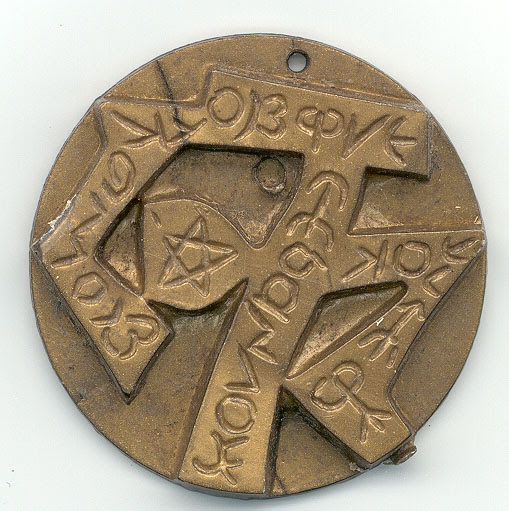
Other William Castle films produced in the 1960s came with rather more tame promotional gimmicks than his usual, or without benefit of any at all. 13 Frightened Girls (1963) is part teen drama, part espionage thriller.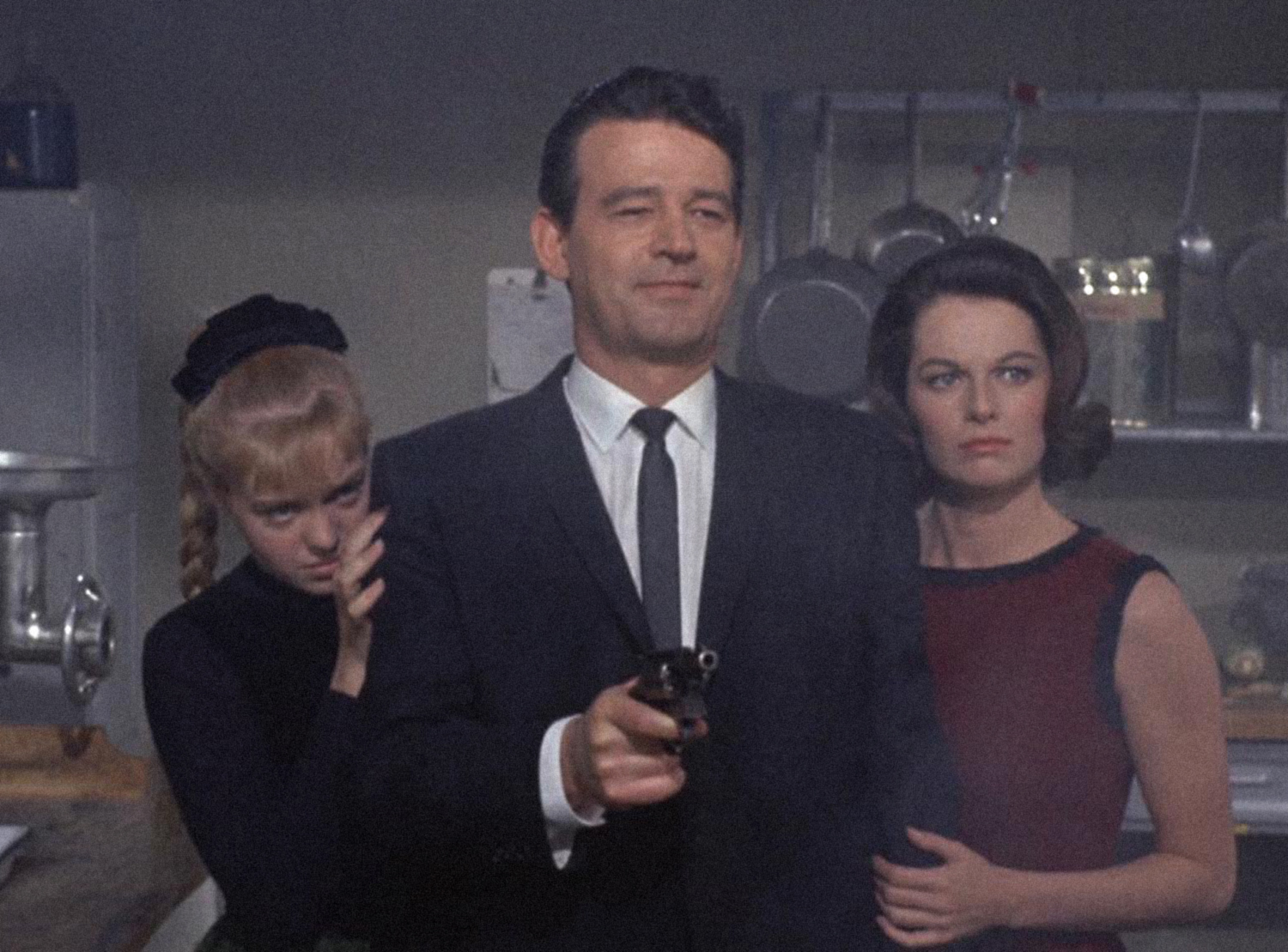
Castle highlighted his casting call for young girls from various countries to portray the daughters of diplomats. Apparently, scenes featuring each girl were shot especially for the home markets of each.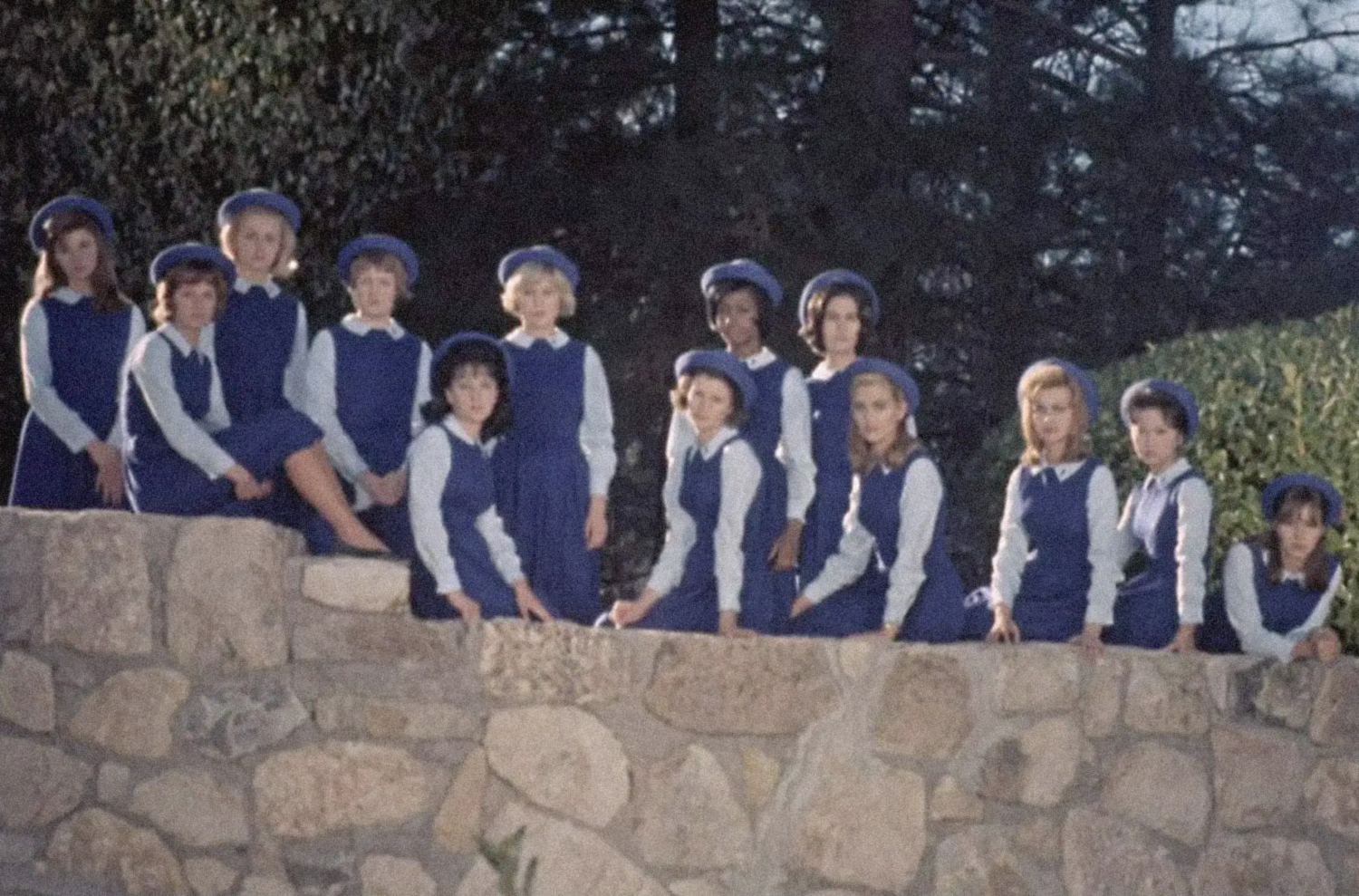
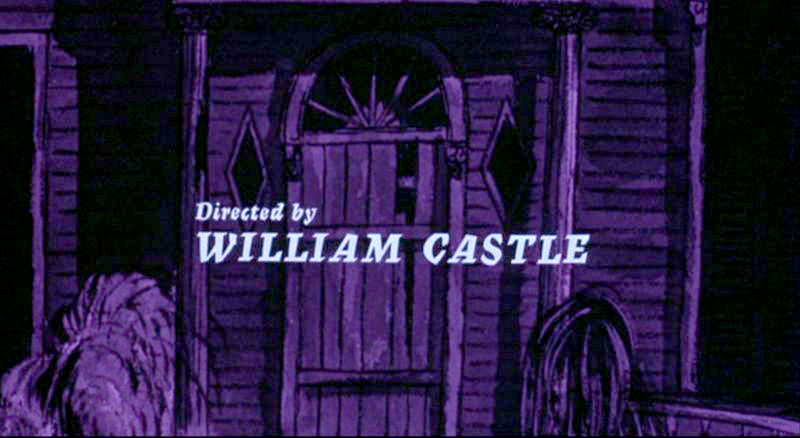
A comedic horror movie, The Old Dark House (1963) was a remake of the 1932 James Whale classic and starred Zotz’s Tom Poston.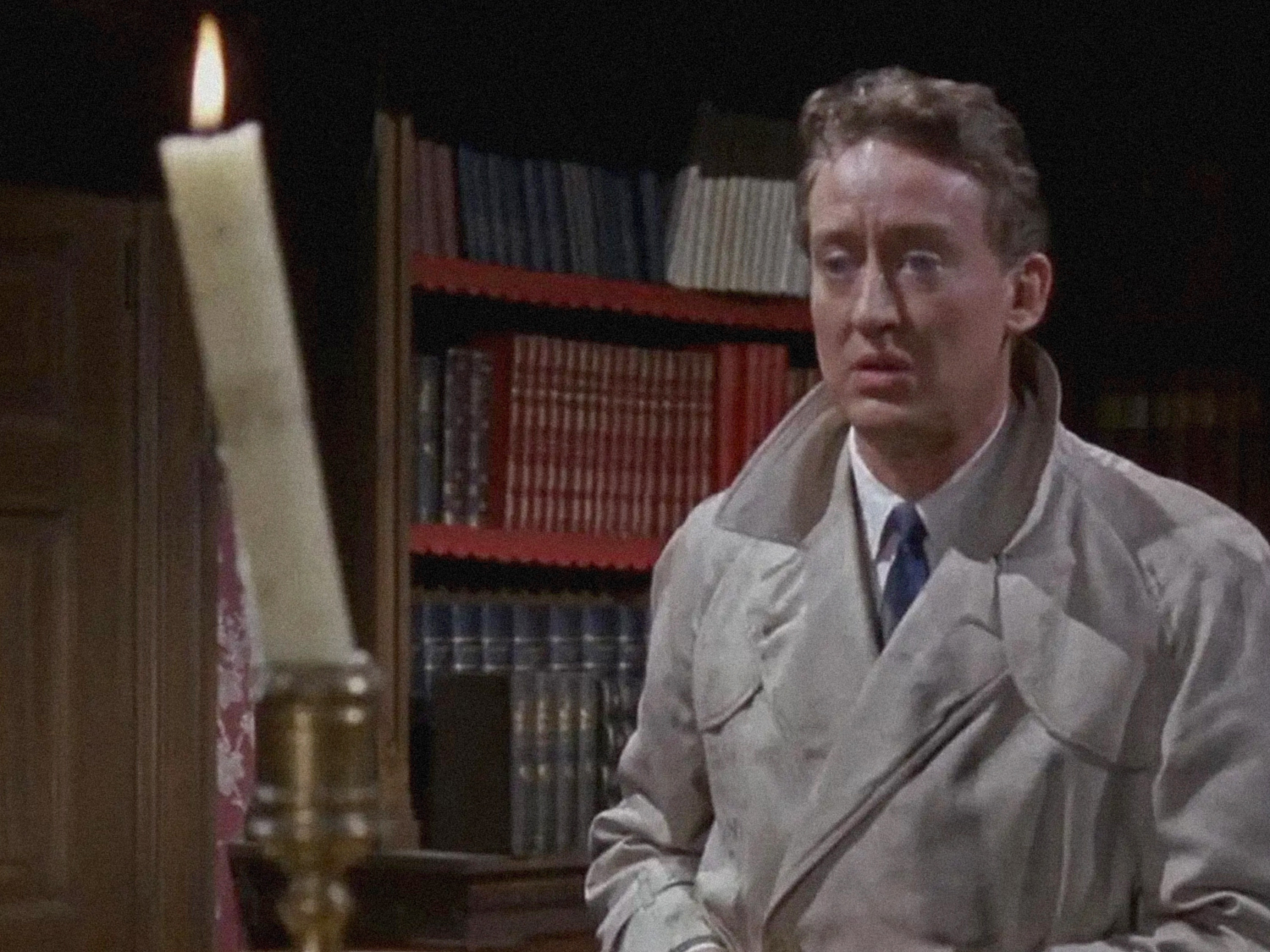
Castle featured a famous guest and fellow traveller in the macabre as his opening-titles artist.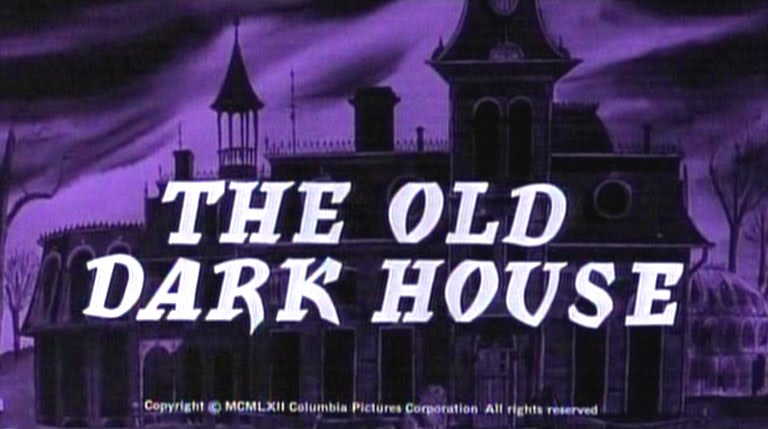
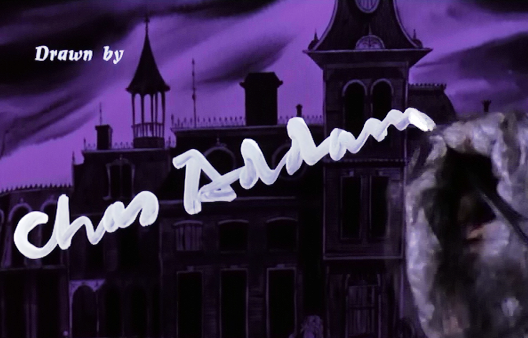 If you don’t recognize the name, you almost certainly know of his most celebrated work.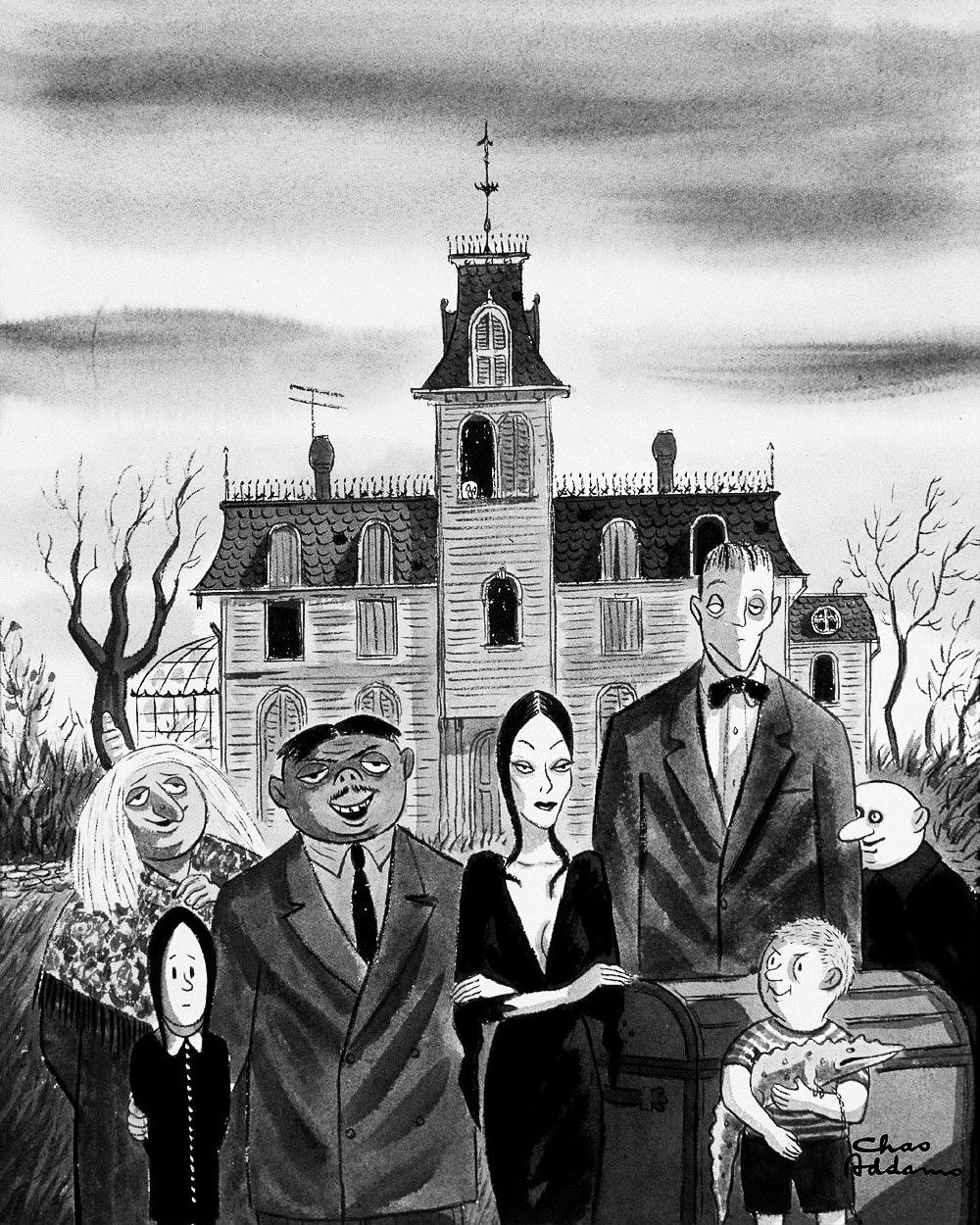
In 1964, Castle took a stab at what has been unflatteringly termed “Psycho-Biddy” or “Hagsploitation.” The promotional strategy for Strait-Jacket (1964), his psychological horror/thriller about an axe murderess, was to promote the film as “from the author of Psycho, the director of Homicidal, and the co-star of Whatever Happened to Baby Jane?”—Robert Block, Castle, and Joan Crawford, respectively. Name recognition, Castle hoped, would draw film-goers.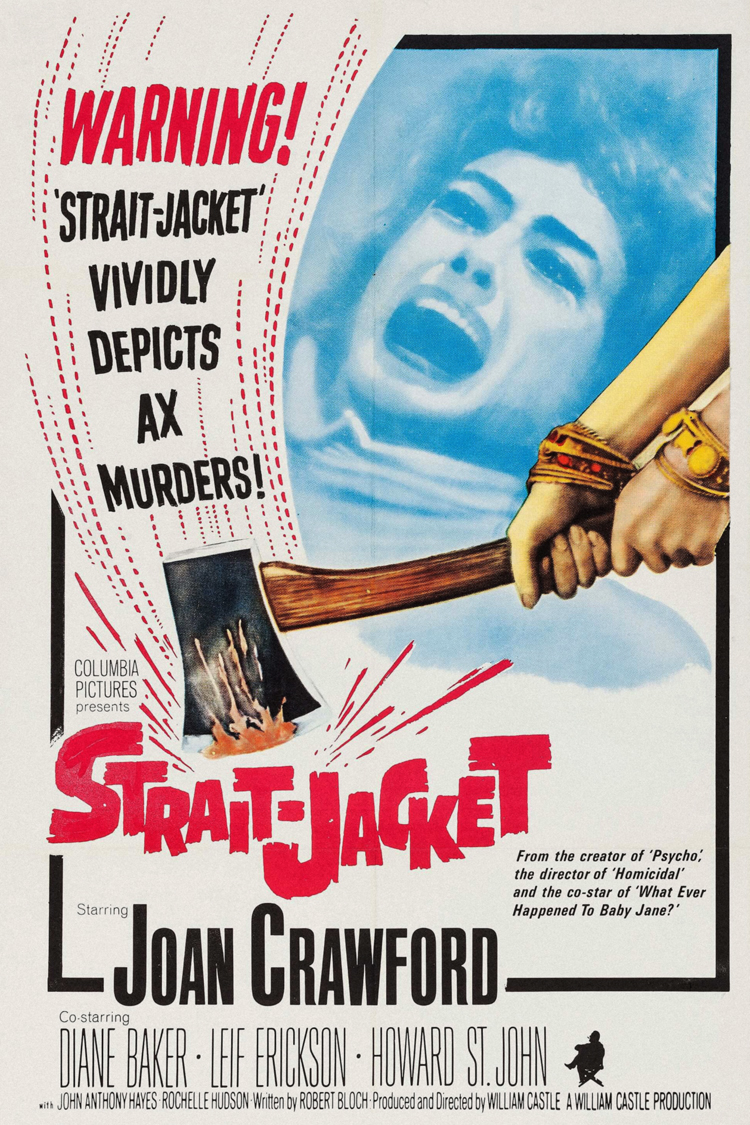
Crawford had co-starred with Bette Davis in the hit, Oscar-worthy chiller Whatever Happened to Baby Jane? (1962), launching a new horror sub-genre which involves mentally unbalanced and violent older women.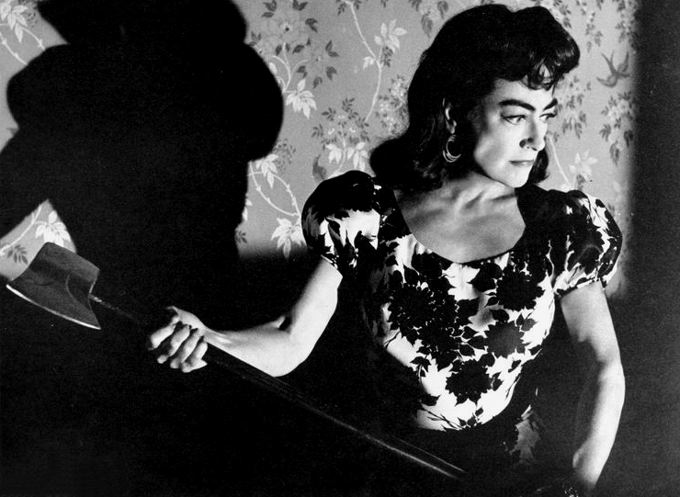
In Strait-Jacket, she plays a woman just released from a psychiatric hospital who is suspected of committing a spate of recent axe murders. While no Hitchcock, Castle demonstrates a certain panache for this type of thing.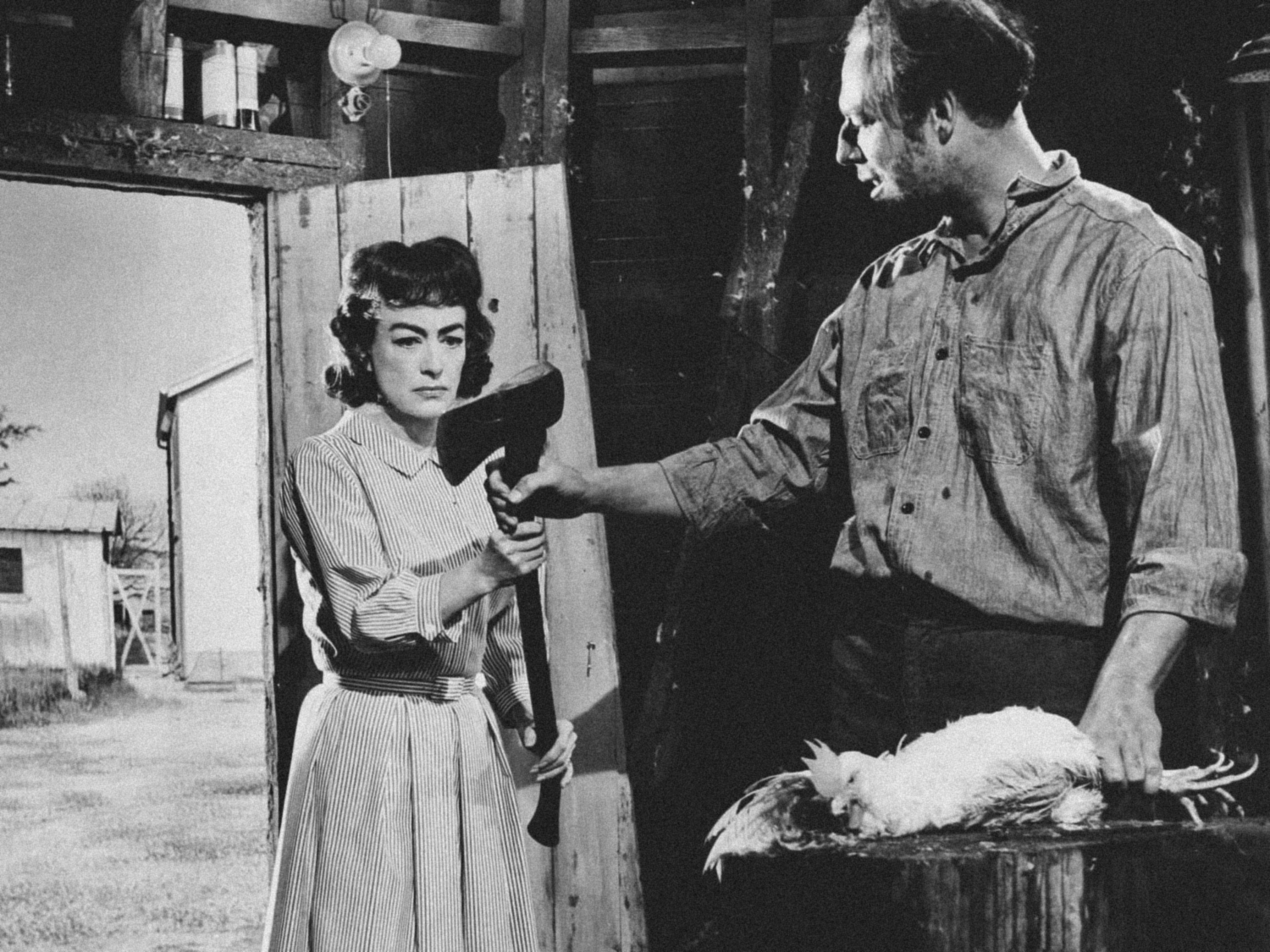
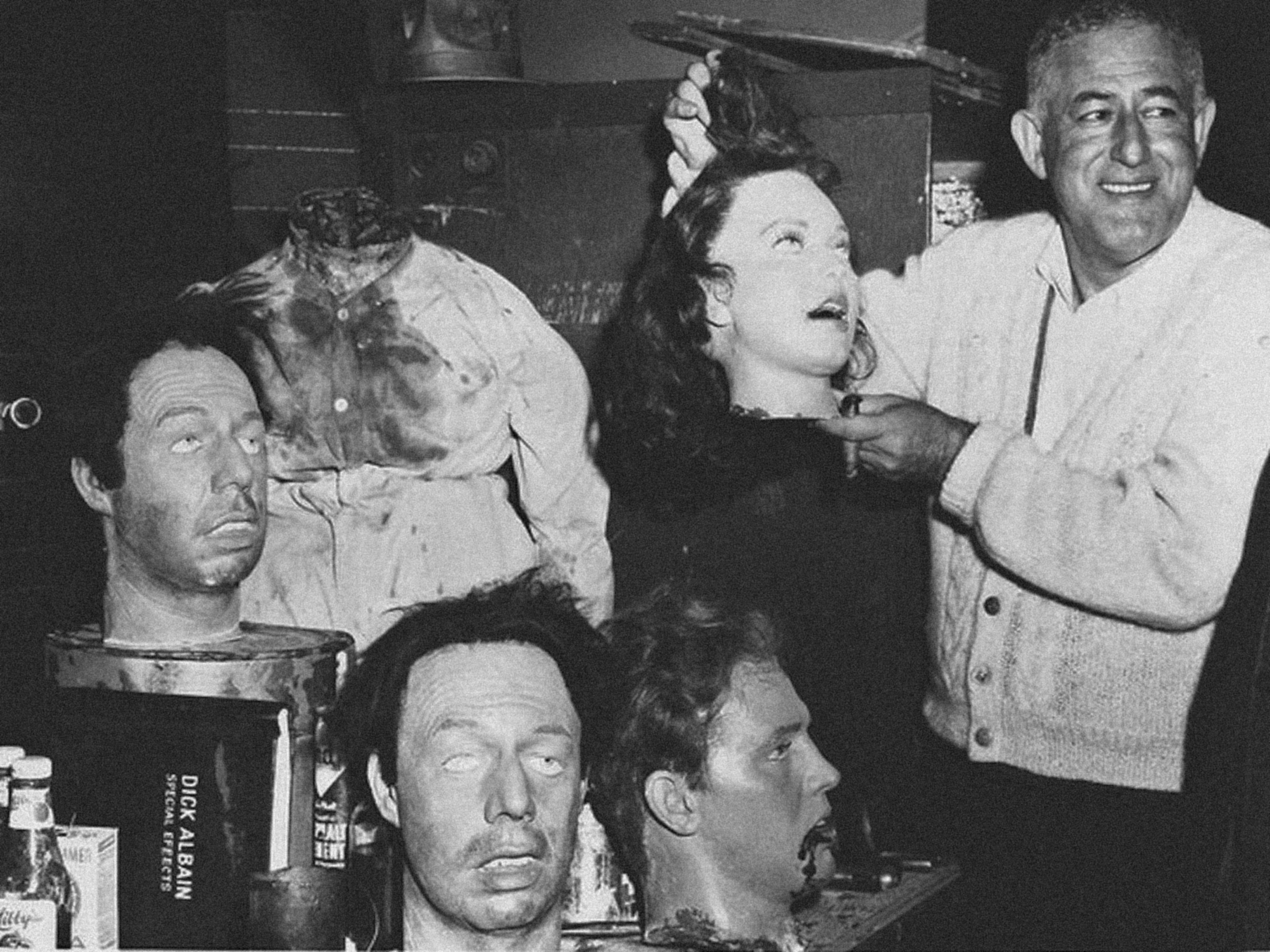
Here, he poses with some of the prop severed heads used in the production, and on location with his leading ladies, Crawford and Diane Baker.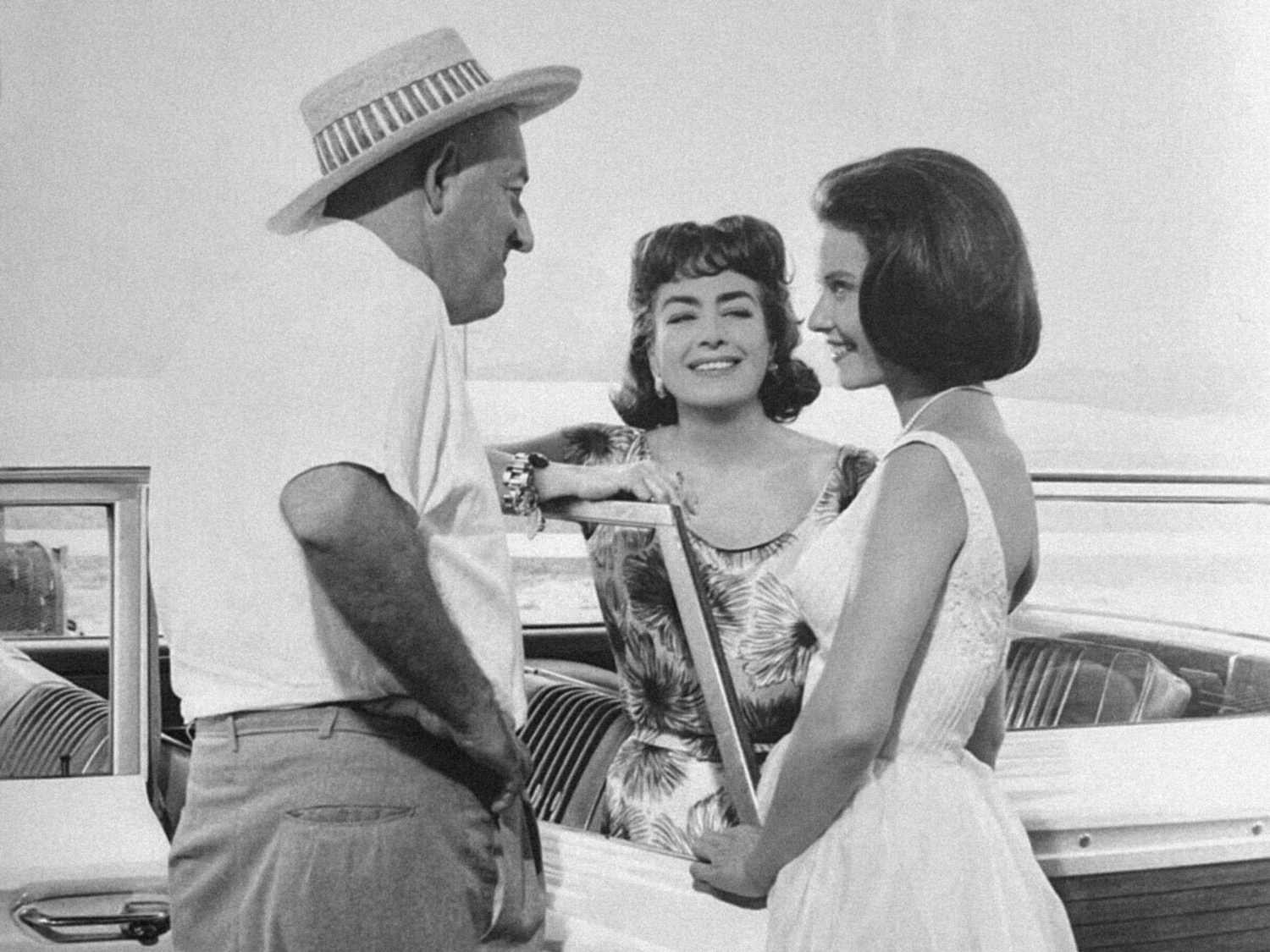
He couldn’t resist, I suppose, leaning a little on his signature marketing flair for Strait-Jacket, arranging for in-person appearances by star Crawford at some screenings, and handing out to movie-goers as they entered the theatre promotional cardboard axes emblazoned with the film’s title. 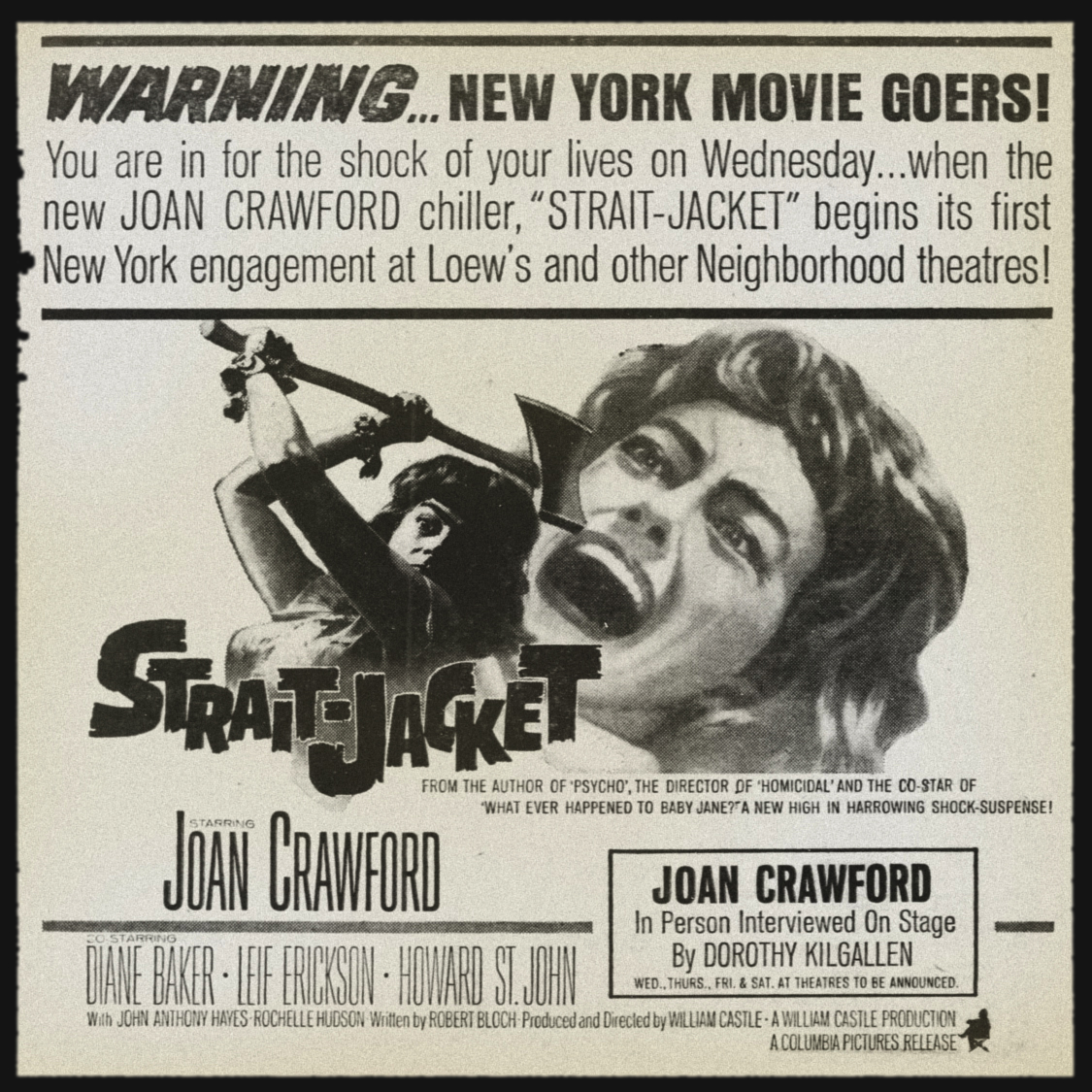
 Once-married couple Barbara Stanwyck and Robert Taylor starred in Castle’s 1964 production The Night Walker, scripted by Robert Bloch.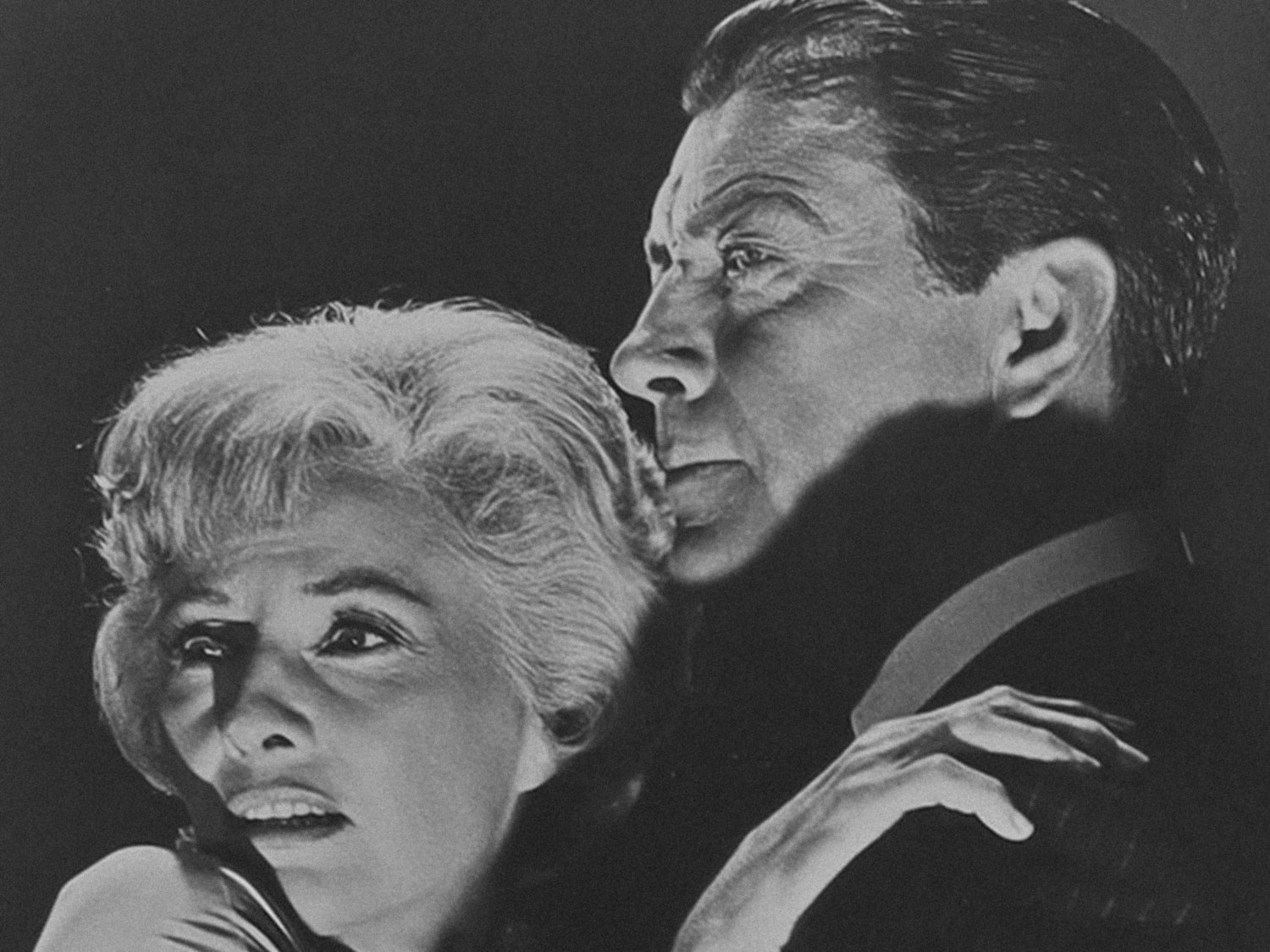
As with Strait-Jacket earlier that same year, Castle relied on name recognition to sell the picture, a surreal psychological horror piece exploring the world of dreams and nightmares.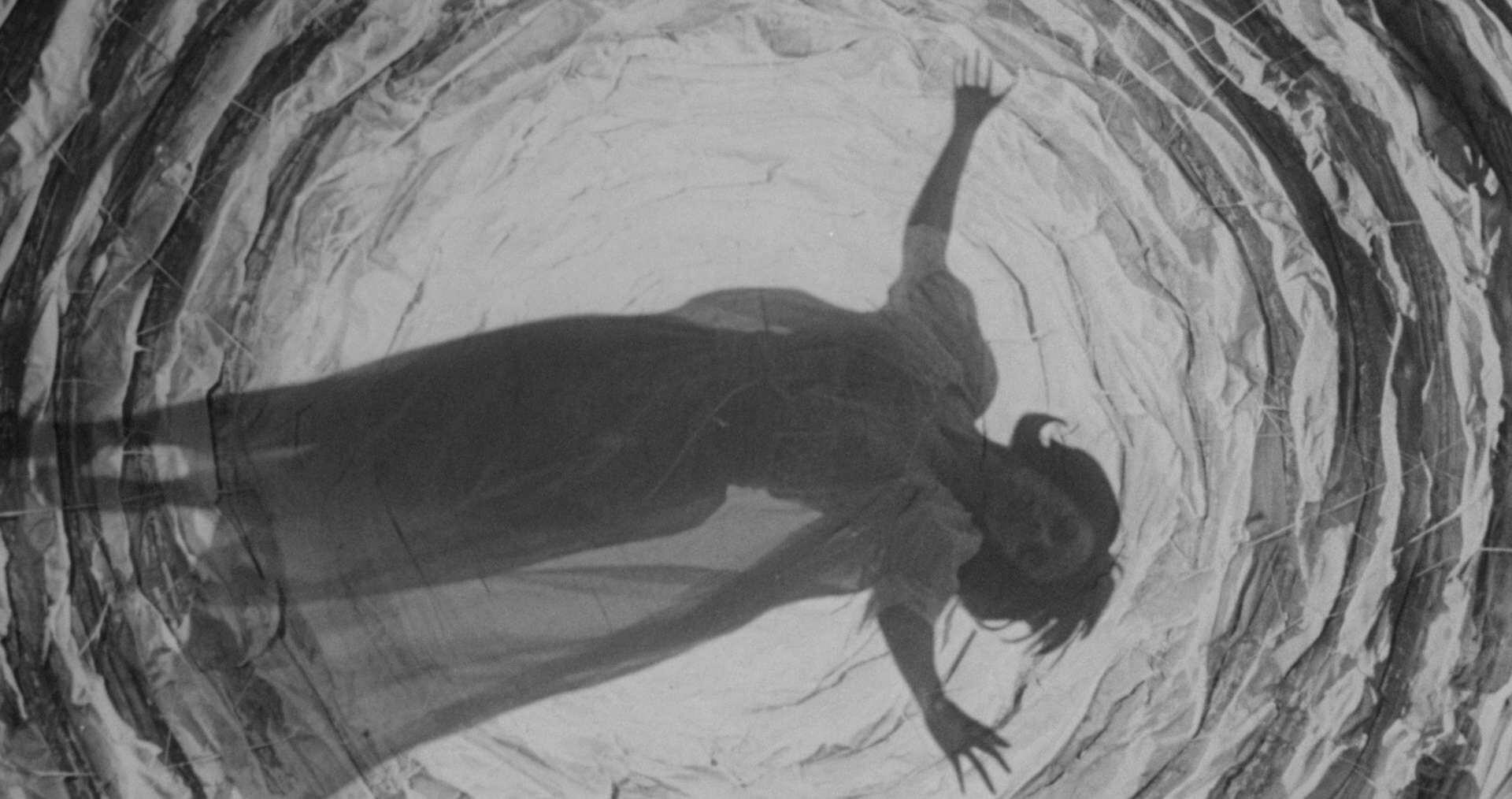
A five-minute promotional short featuring a hired hypnotist questioning people about their dreams was also produced to help market Night Walker, along with a novelization of Robert Bloch’s screenplay.
Joan Crawford was originally offered Stanwyck’s role but declined as she was, at the time, committed to Hush…Hush, Sweet Charlotte (1964), from which she would, ultimately, drop out shortly after principal photography had begun, thus scuttling a reunion with her Whatever Happened to Baby Jane co-star, Bette Davis. Olivia de Havilland stepped in as Crawford’s replacement.
As for the modestly budgeted Night Walker, despite largely positive reviews, the film proved a financial failure for Castle.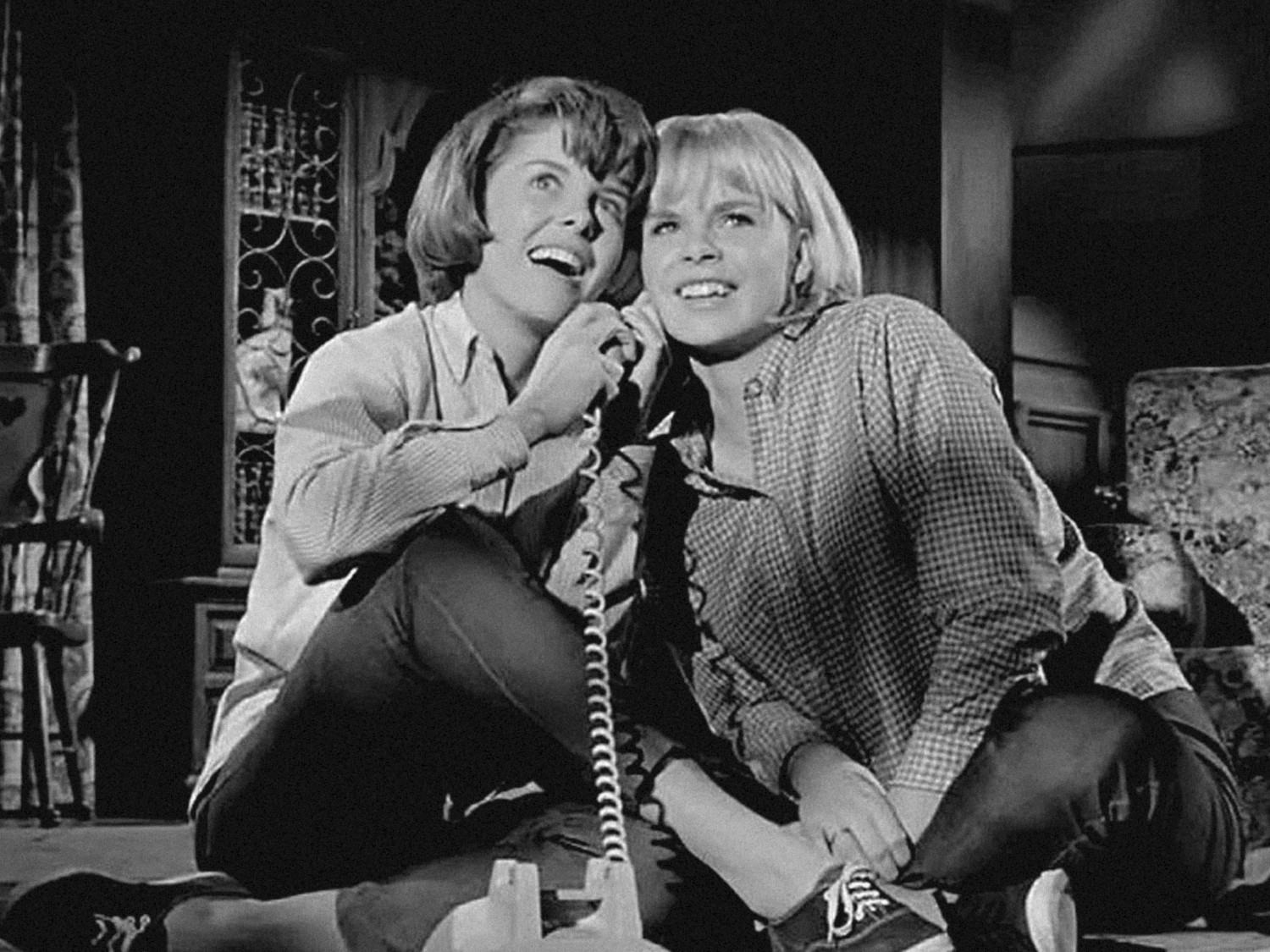
I Saw What You Did (1965) anticipated such later horror/slasher films as When a Stranger Calls (1979) and Scream (1996). Two teenaged girls amuse themselves making prank phone calls one night, telling whoever answers, “I saw what you did, and I know who you are.”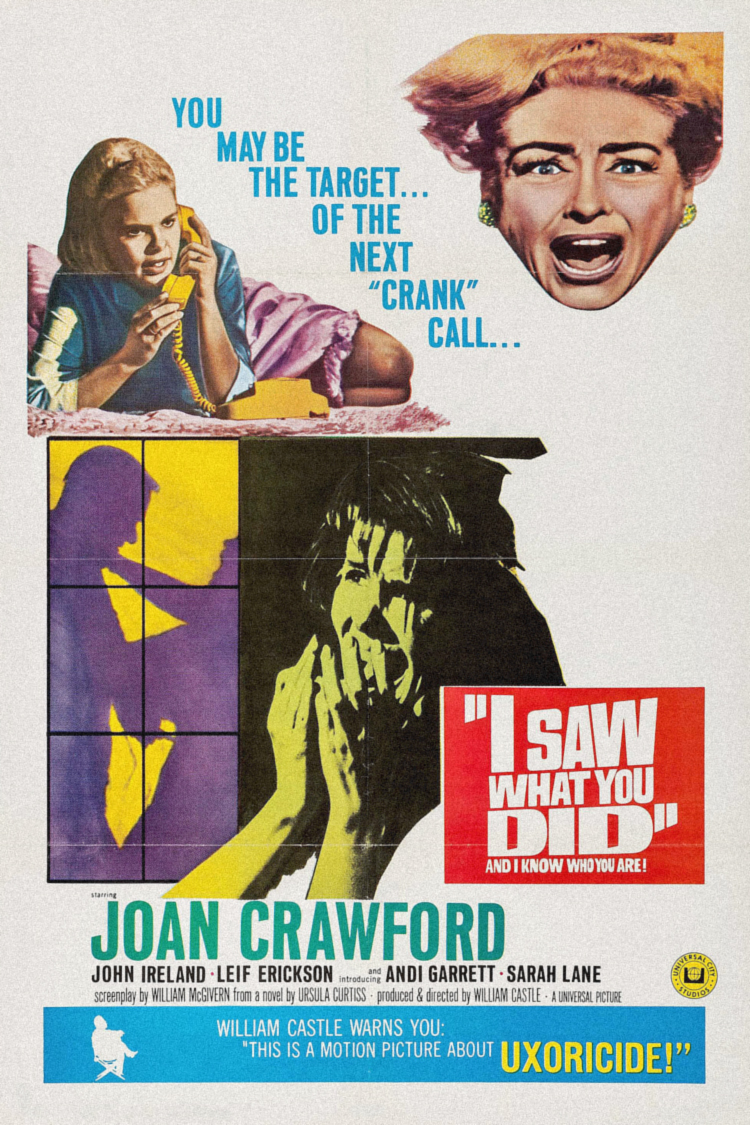
But when they connect to a man who has just murdered his wife, he believes they have witnessed his crime and comes looking for them. Joan Crawford is back in another Castle film, but hers is just a supporting role this time.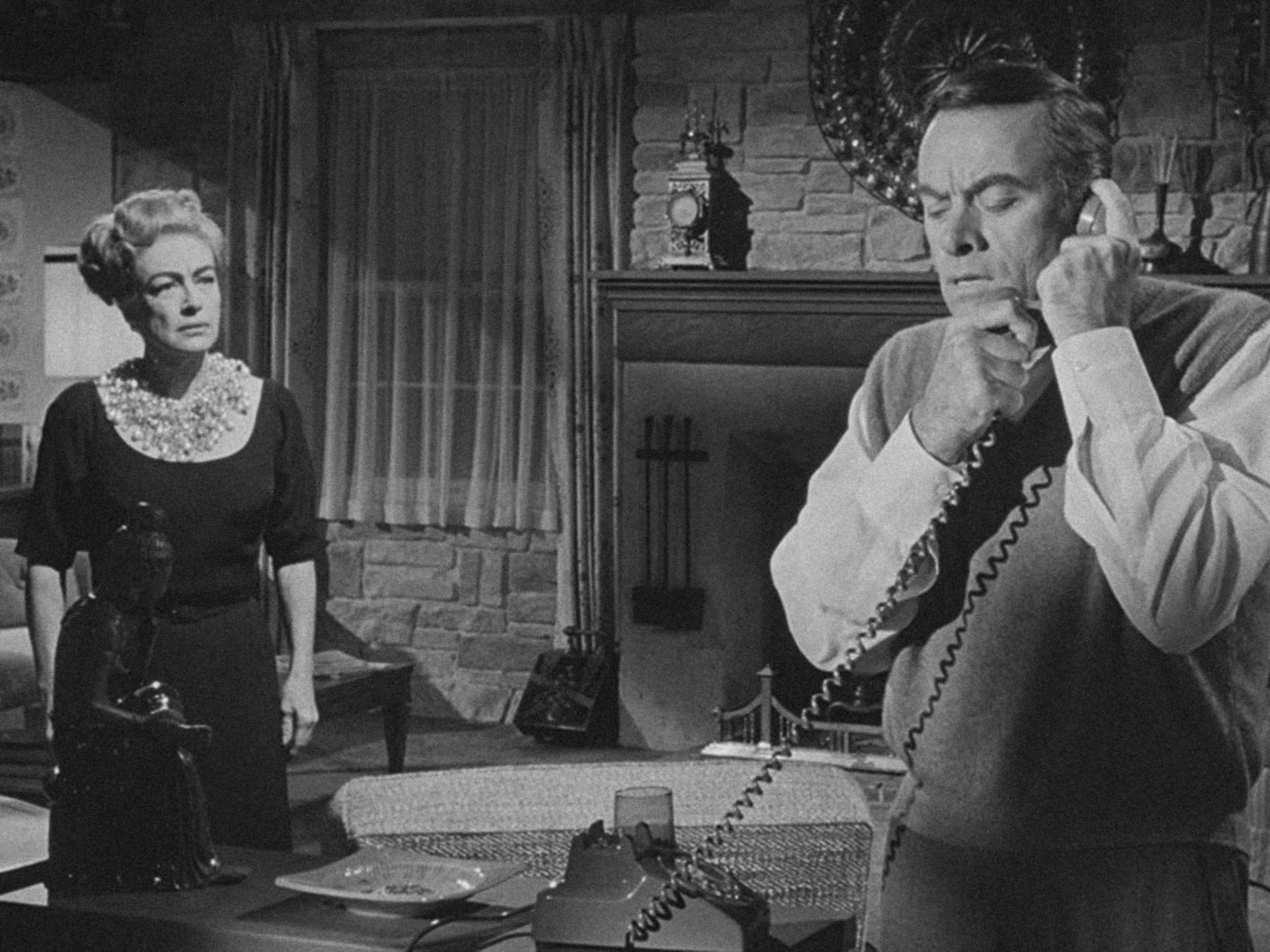
Castle arranged with the phone company for a special number to be activated so movie-goers could call in to hear a seductive female voice tell them “I saw what you did, and I know who you are,” then make a date to meet-up at whichever local movie house was screening the film. Also, giant plastic promotional phones borrowed from the phone company were initially part of the film’s publicity campaign, but after a string of prank calls like those depicted in the movie from mischievous teenagers, and the ensuing complaints, the phone company withdrew support.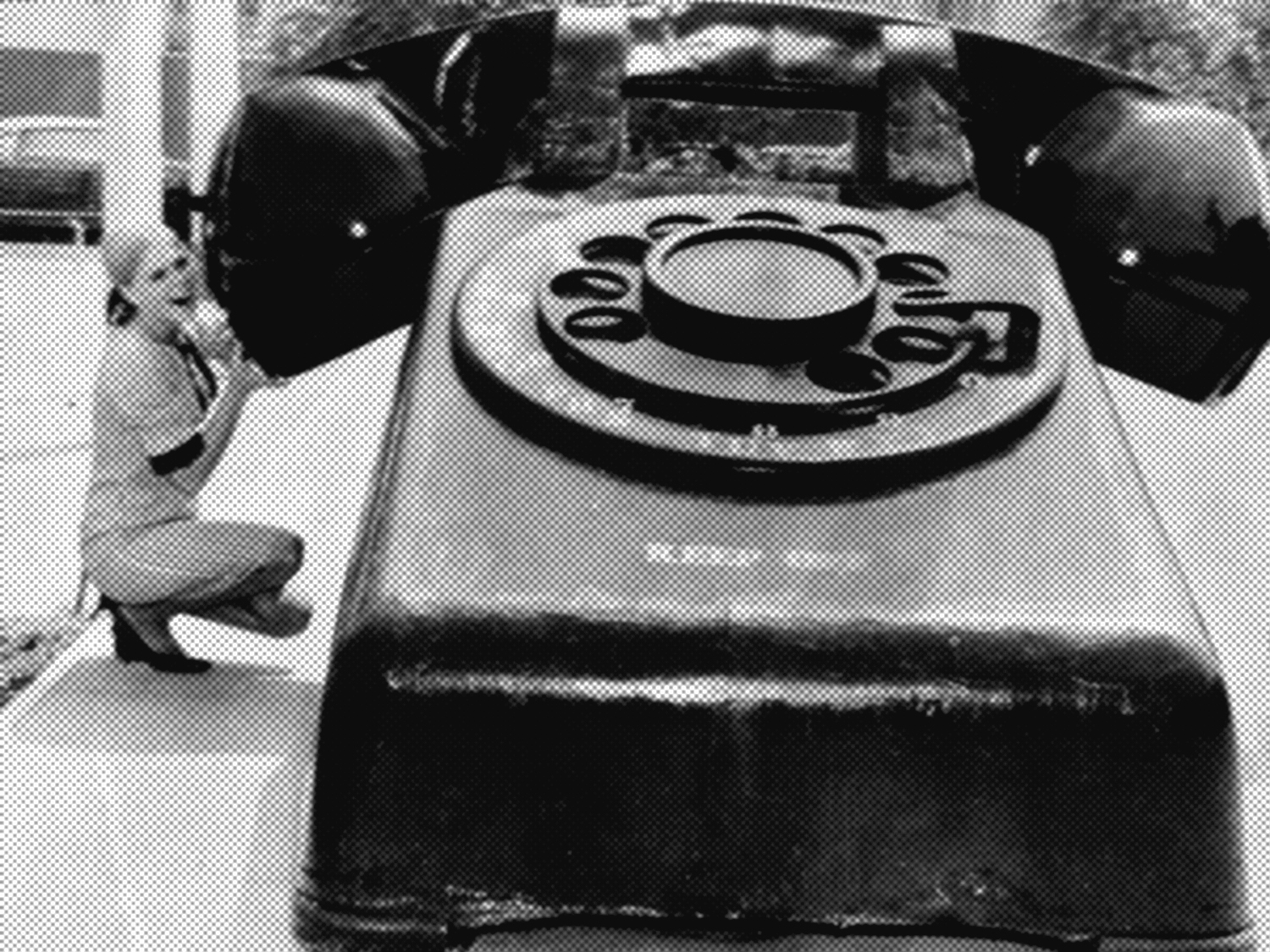
Another gimmick considered was to install seatbelts in a section of the theatre for those “who might be scared out of their seats,” but the idea was abandoned before the film premiered. It was an idea, however, that would resurface decades later.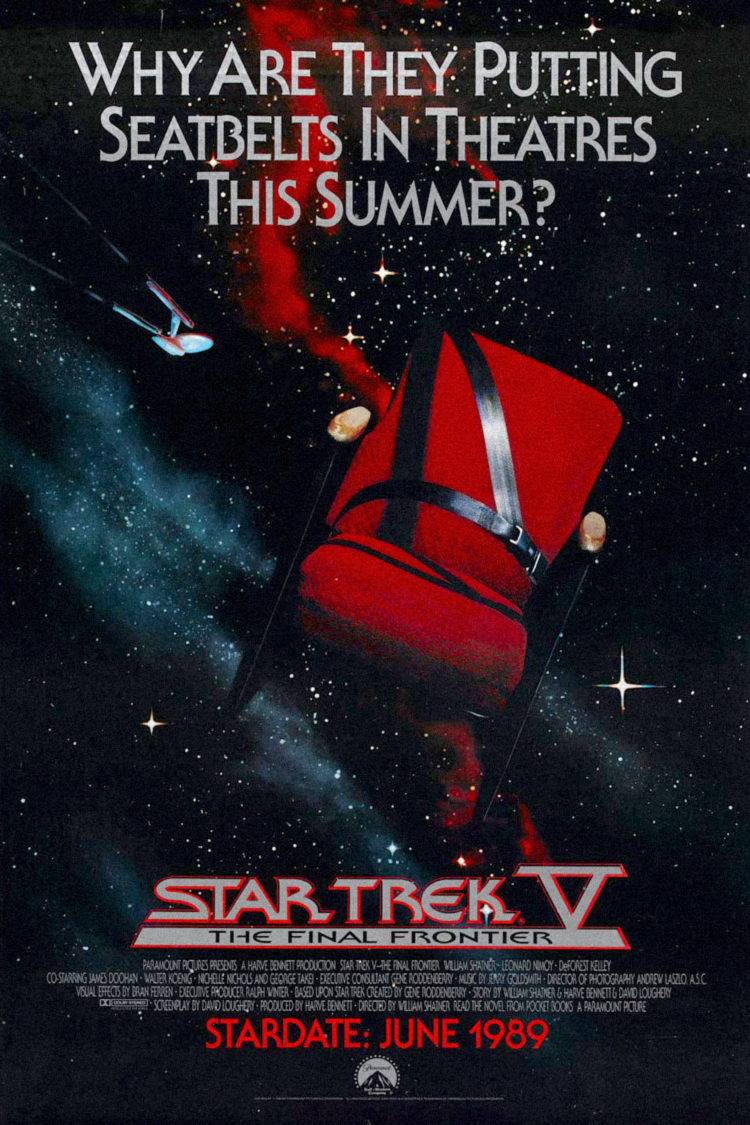
Set on a remote island, Let’s Kill Uncle (1966) is a dark comedy about a cat-and-mouse game of attempted assassination between a boy and girl, and the boy’s uncle, who plans to kill the lad for his inheritance.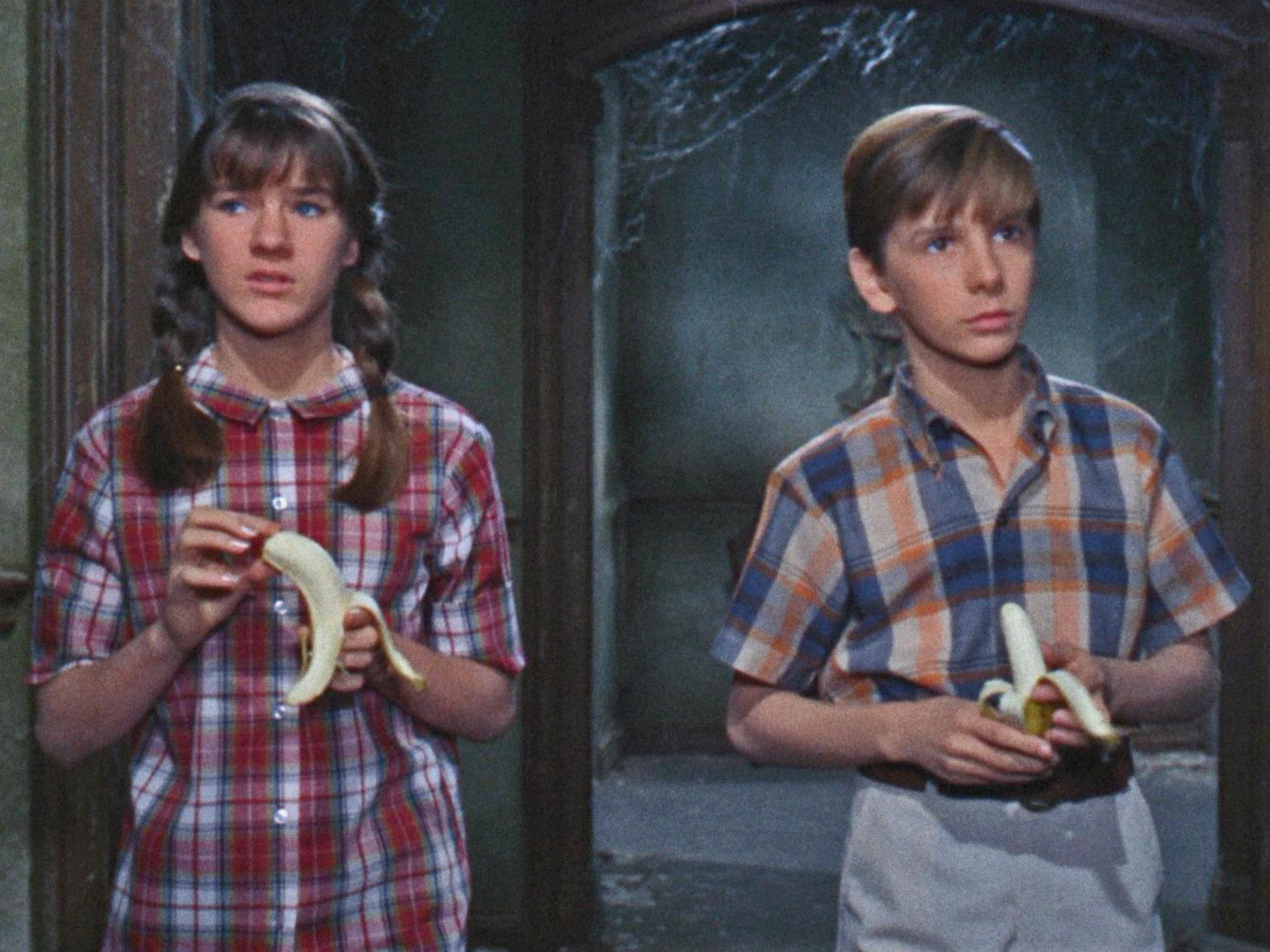
The Busy Body (1967) is a horror/comedy about the effort to find the missing corpse of a mob courier, whose burial suit was stuffed with a million dollars. Popular comedian of the day Sid Caesar starred. The Busy Body is notable as Richard Pryor’s film debut.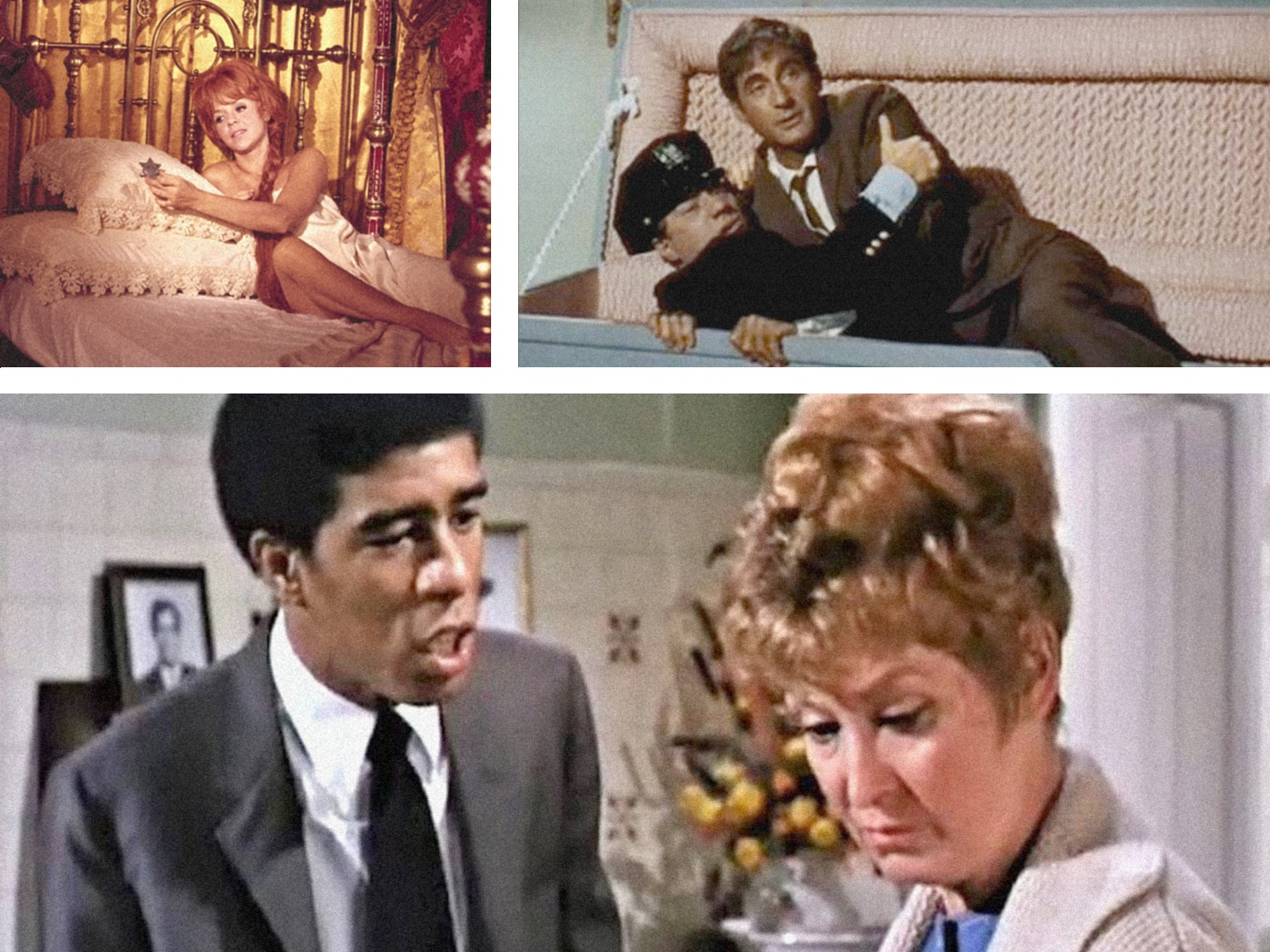
The Spirit is Willing (1967) is a horror/comedy ghost story, again starring Caesar.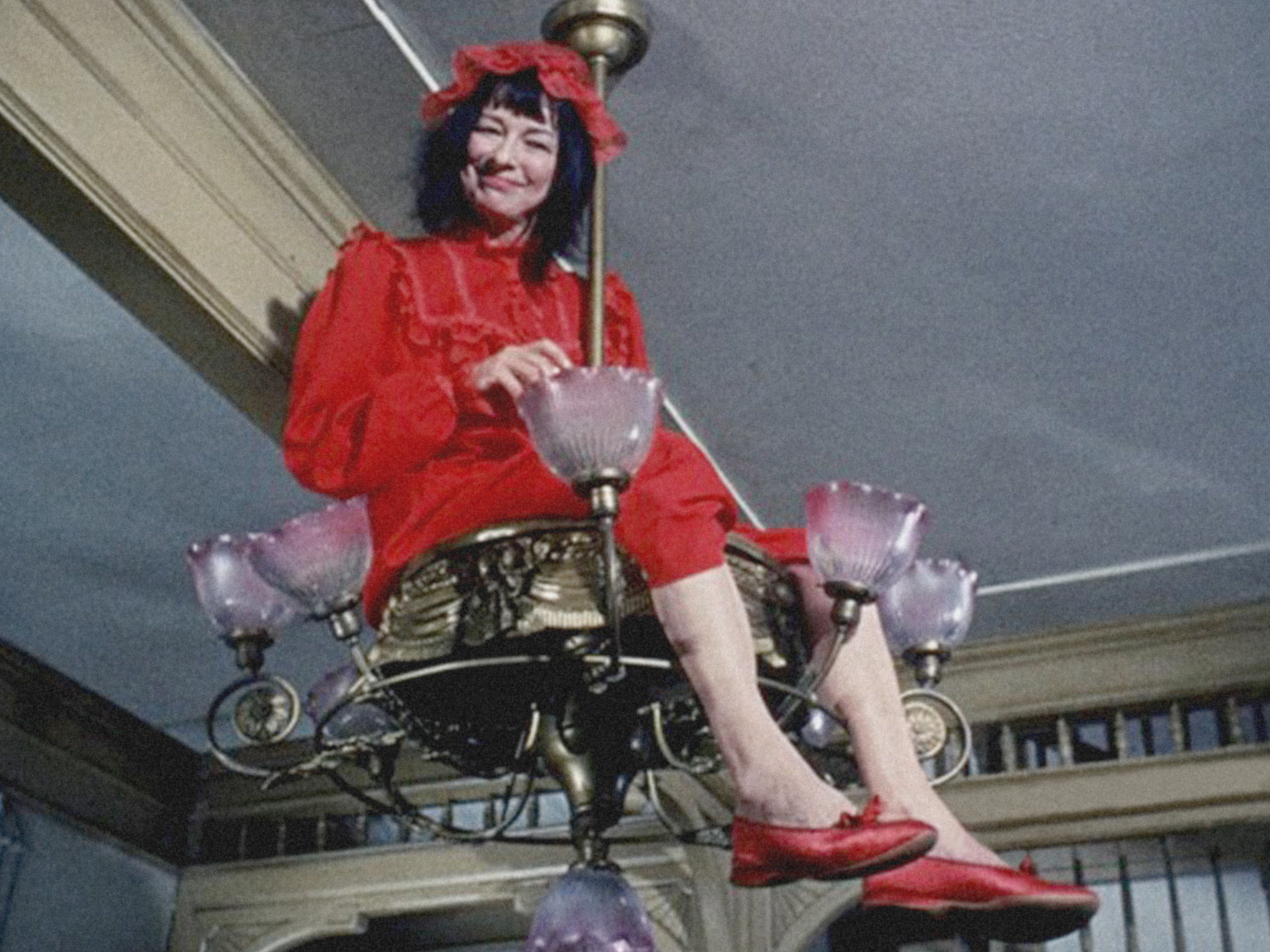
None of these was particular successful and Castle realized that such as his recent fare just wasn’t cutting it with modern audiences. He needed something…different.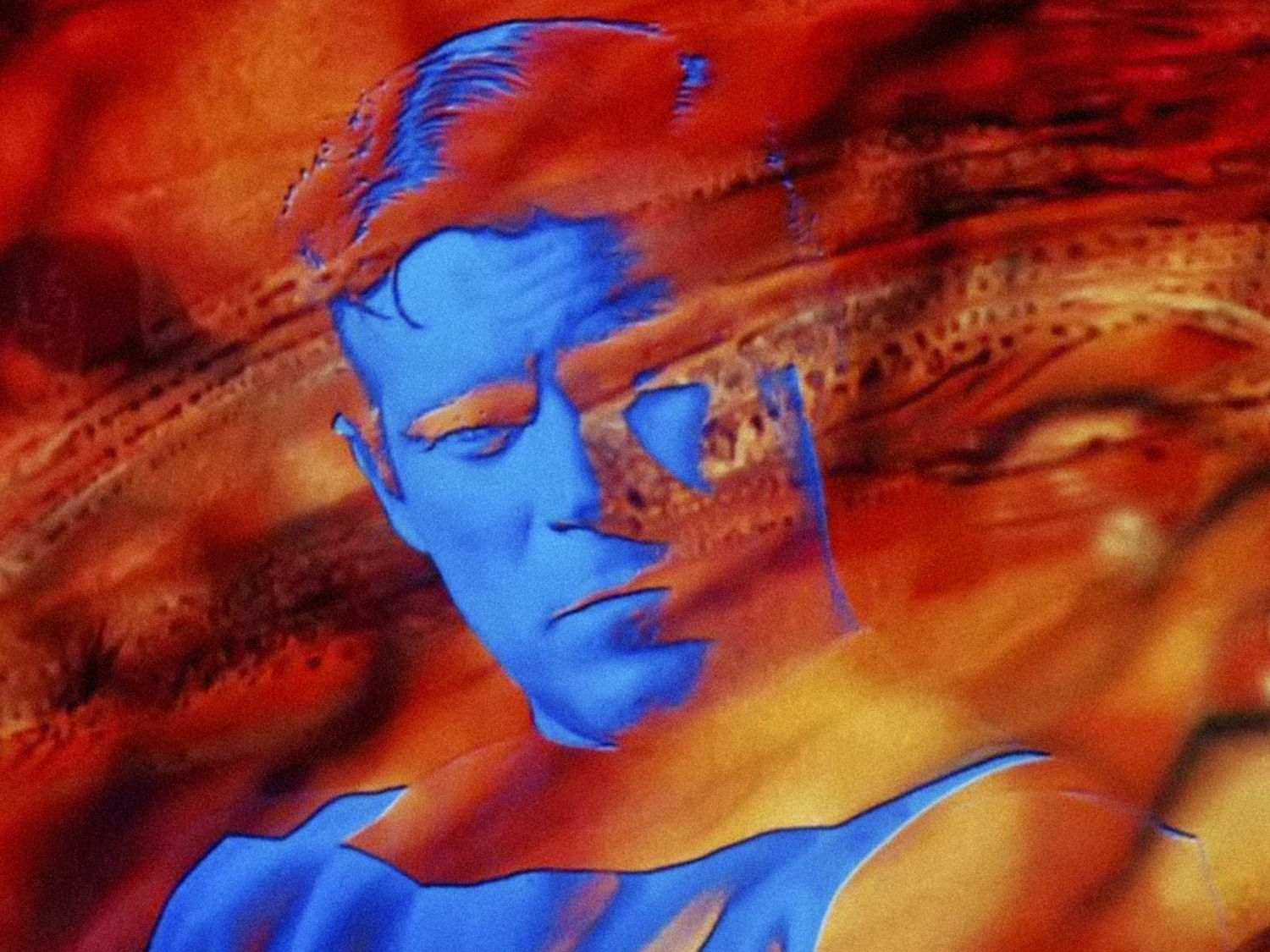
1968’s Project X is his take on a science fiction espionage story of the far future, complete with cryogenics, genetic engineering, a world overpopulated, Western fears of Asian hegemony, and technology capable of memory manipulation and the viewing of a subject’s subconscious. And what’s a science fiction movie without a brain in a jar?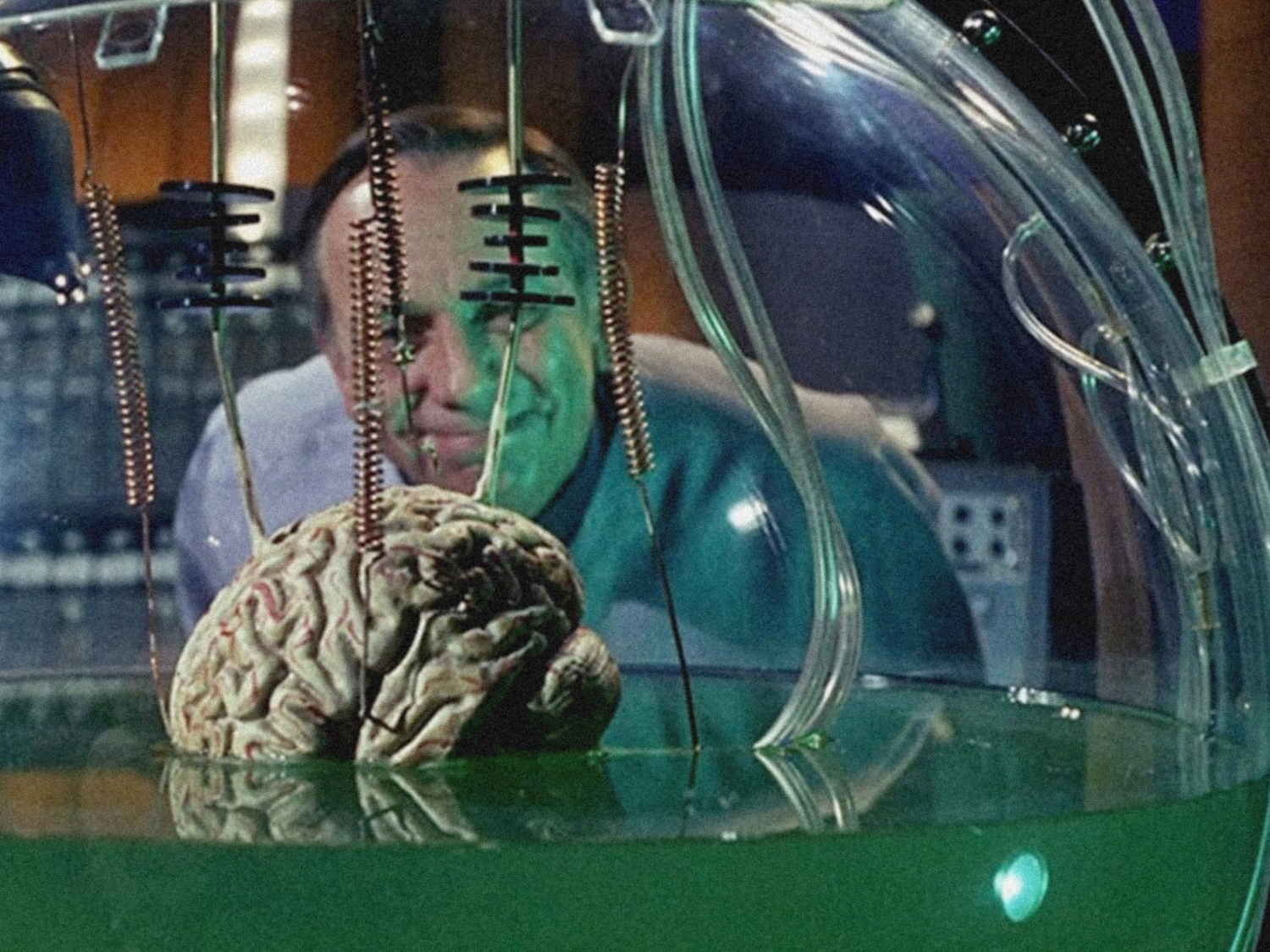
The film has the look and feel of its contemporaries, sci-fi films like Fantastic Voyage (1966), The Power (1968), Colossus: The Forbin Project (1970), Genesis II (1973), The Terminal Man (1974) and The Questor Tapes (1974).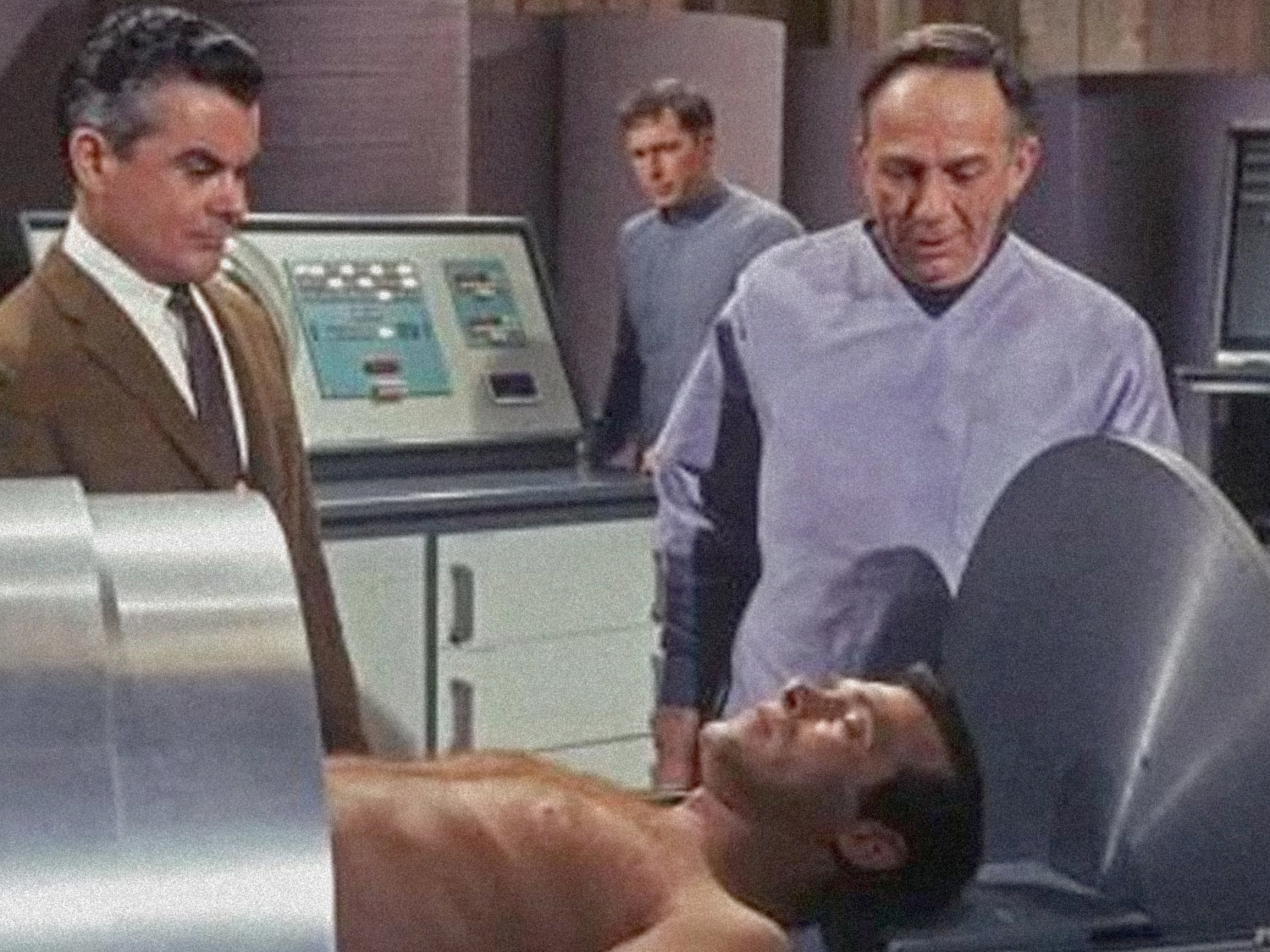
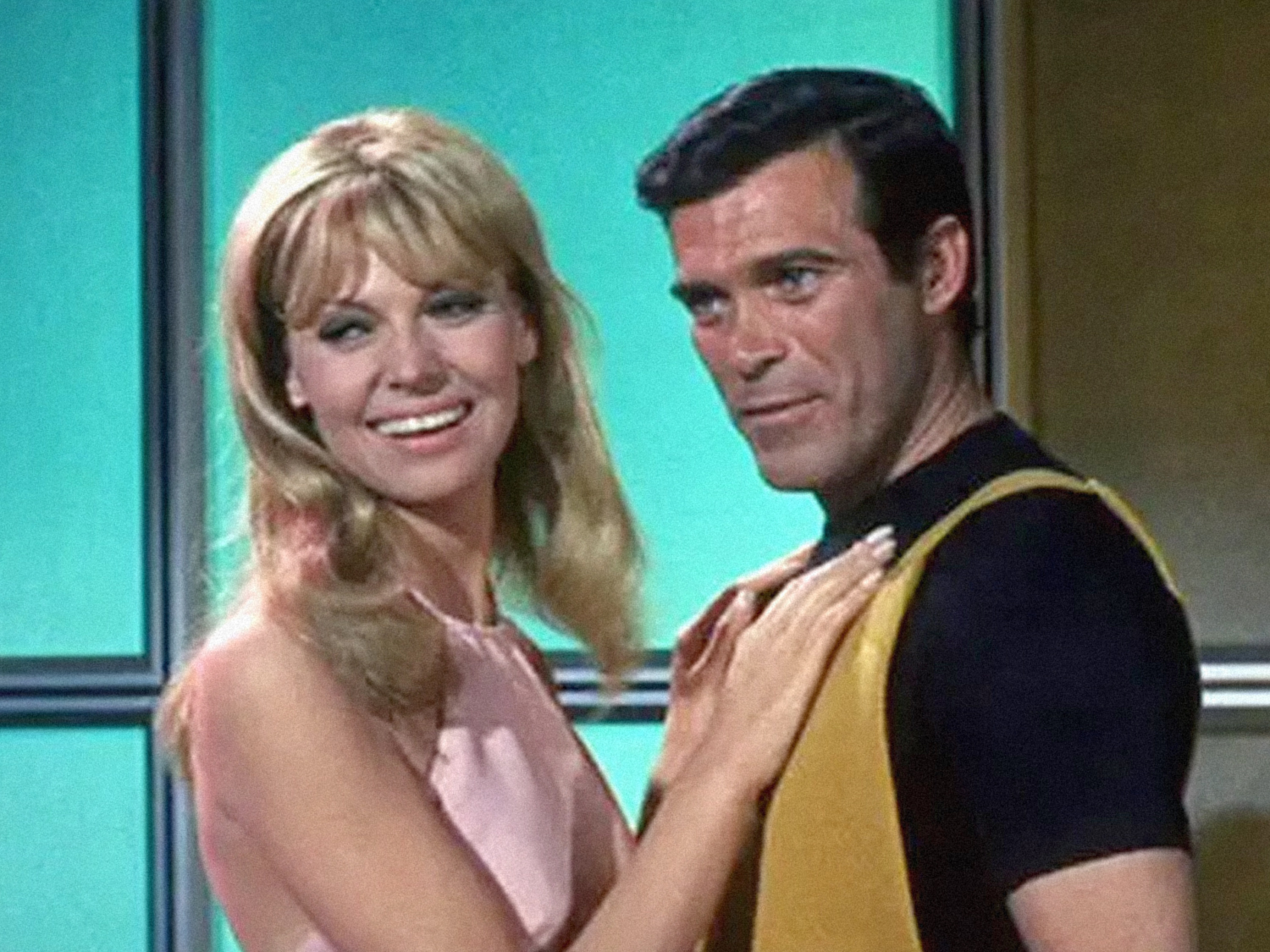
Christopher George and Greta Baldwin starred, here filming on location—that’s Castle seated on the far left.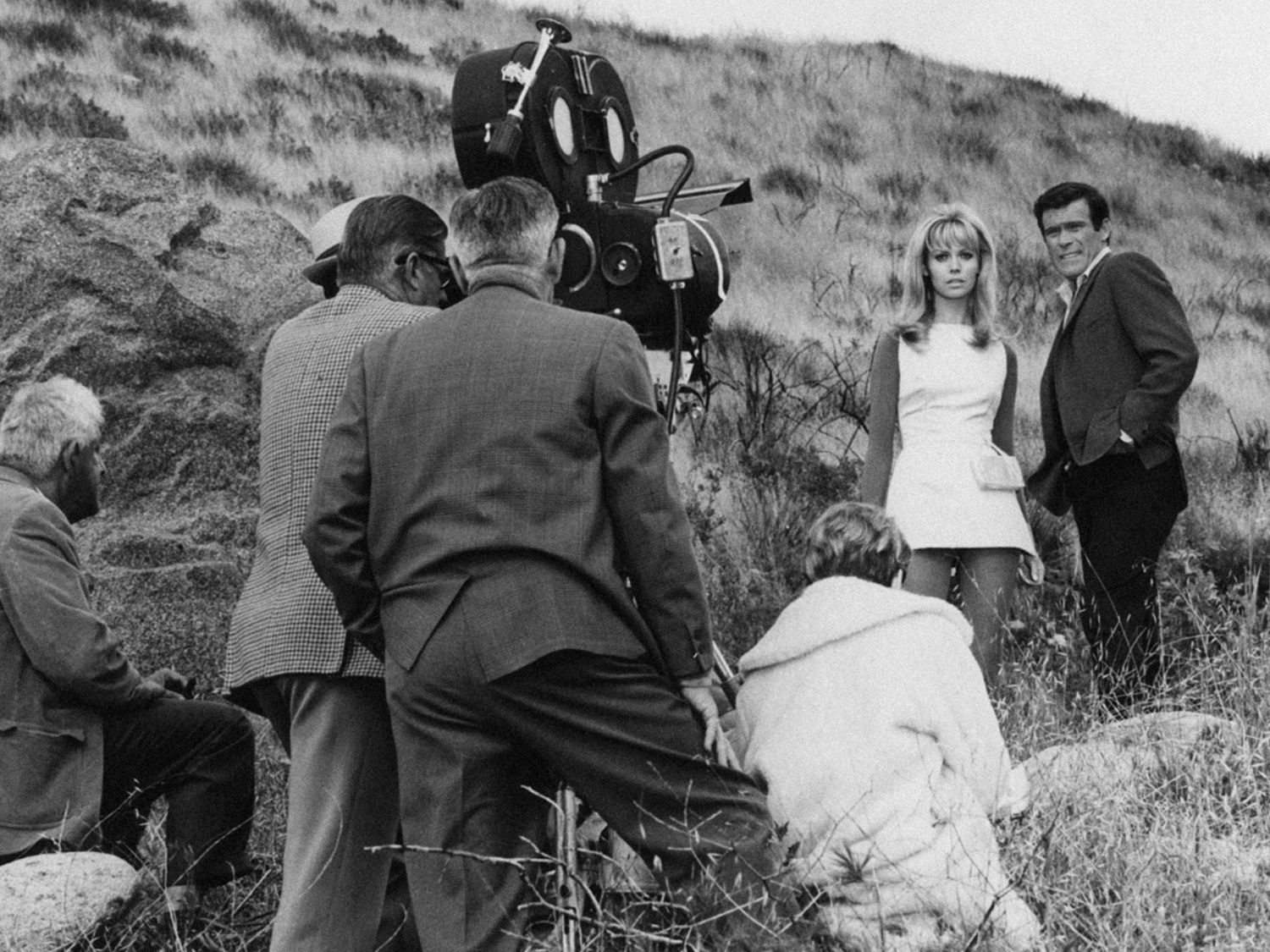
Animation house Hanna Barbera handled the sequences in which the protagonist’s mind is probed for information, his subconscious dreams viewed on a monitor. These sequences are a combination of live-action footage tinted, filtered, with weird double-exposures applied, all superimposed over animated sequences to arrive at a kind of dreamy, psychedelic trip! Some of the animation was lifted from an episode of the Saturday-morning cartoon spy-fi/adventure Jonny Quest (1964-1965).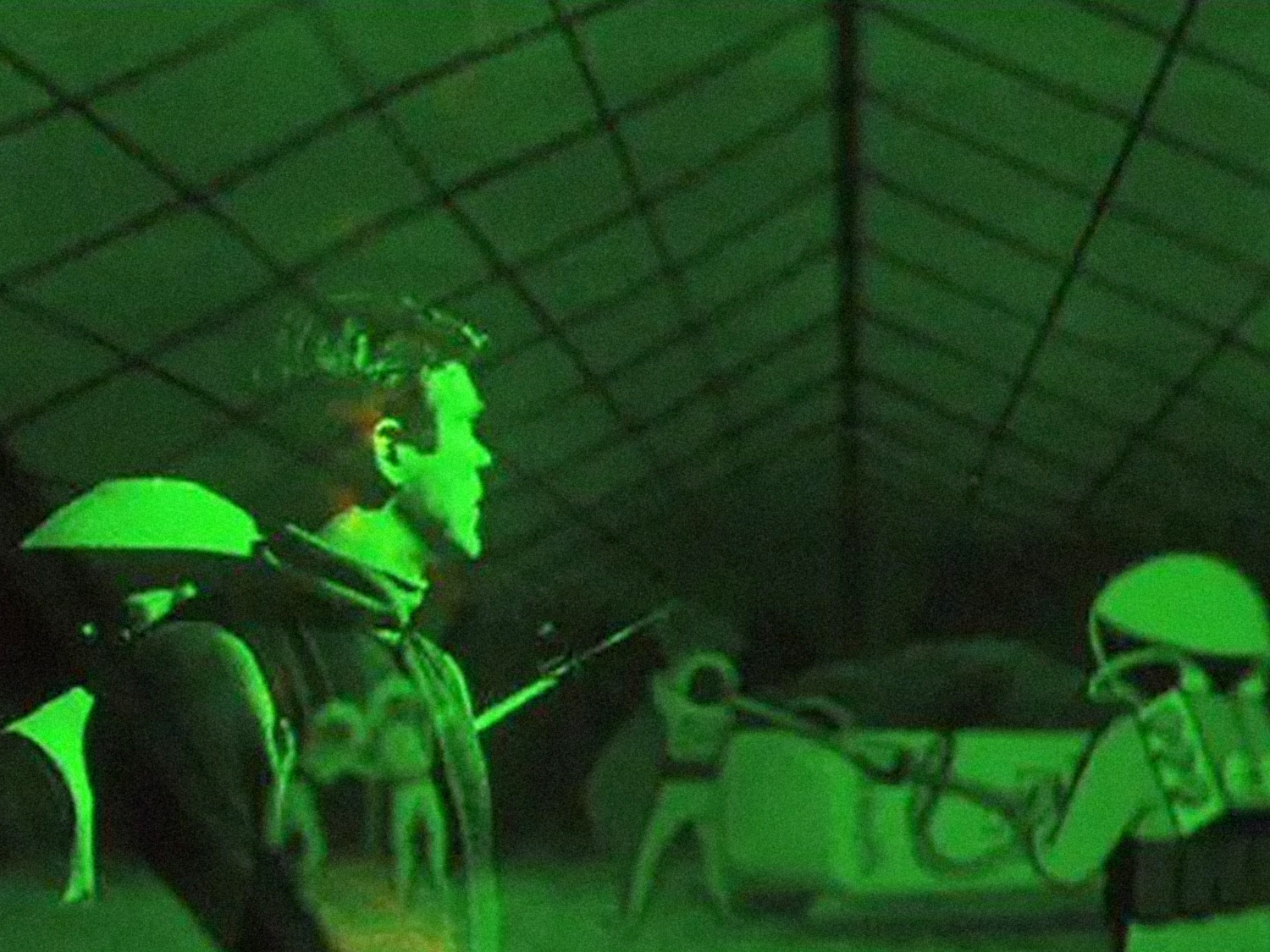
Given the limitations of budget, this was a clever and effective way to pull off what otherwise would have been a complex and expensive sequence had it been conventionally shot, live-action. The non-realistic aspect, here, does not detract from proceedings in that these are the protagonist’s subconscious dreams.
THE INDEPENDENT YEARS: ROSEMARY’S BABY
That same year, Castle found a project he felt would pull him out of his box office doldrums, the supernatural horror/thriller Rosemary’s Baby (1968), which kicked off a wave of A-list, religiously-themed horror films released in the 1970s—The Omen (1976), The Amityville Horror (1979), Canada’s own contribution, The Pyx (1973), set in and filmed right here in Montreal, and, of course, The Exorcist (1973). This is a sub-genre the popularity of which continues to this day.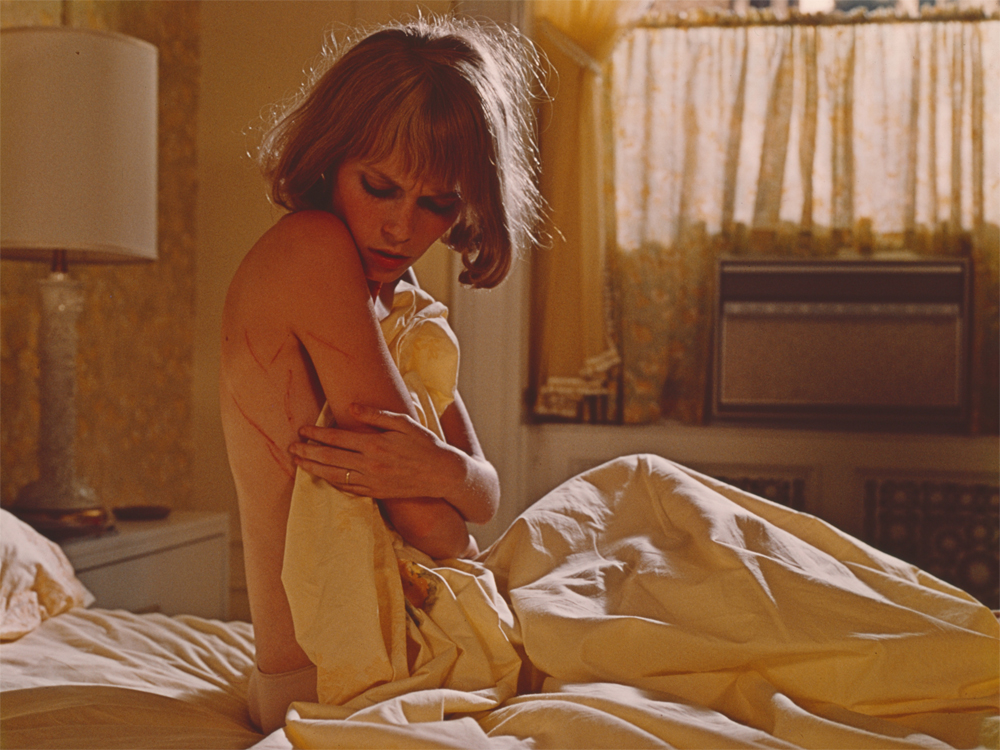
Castle had brought proofs of Ira Levin’s as yet unpublished novel to then Paramount Pictures executive Robert Evans, urging him to purchase the film rights. Evans agreed with Castle’s assessment of the book as having great commercial potential as an A-level picture and agreed to secure the rights. But Evans saw Castle as a B-horror-movie director and so limited him to producing the project. A young European auteur named Roman Polanski had impressed Evans and agreed to direct, provided he could also write the script. Castle was disappointed, of course, but upon meeting Polanski, took a liking to him.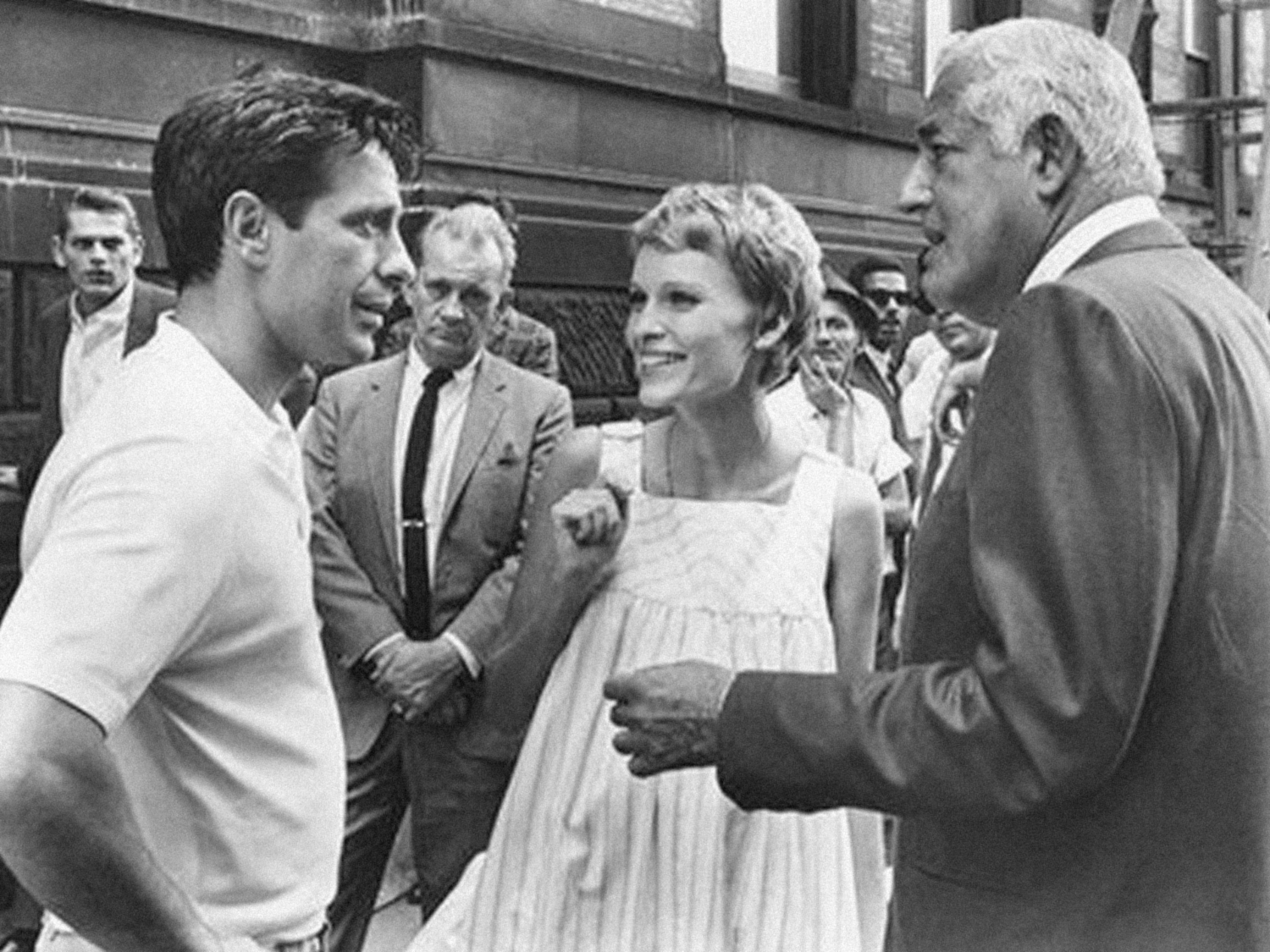
Castle is seen, here, on location with stars Mia Farrow and John Cassavetes. He also appears in a cameo as the man waiting to use the phone after Rosemary completes her call.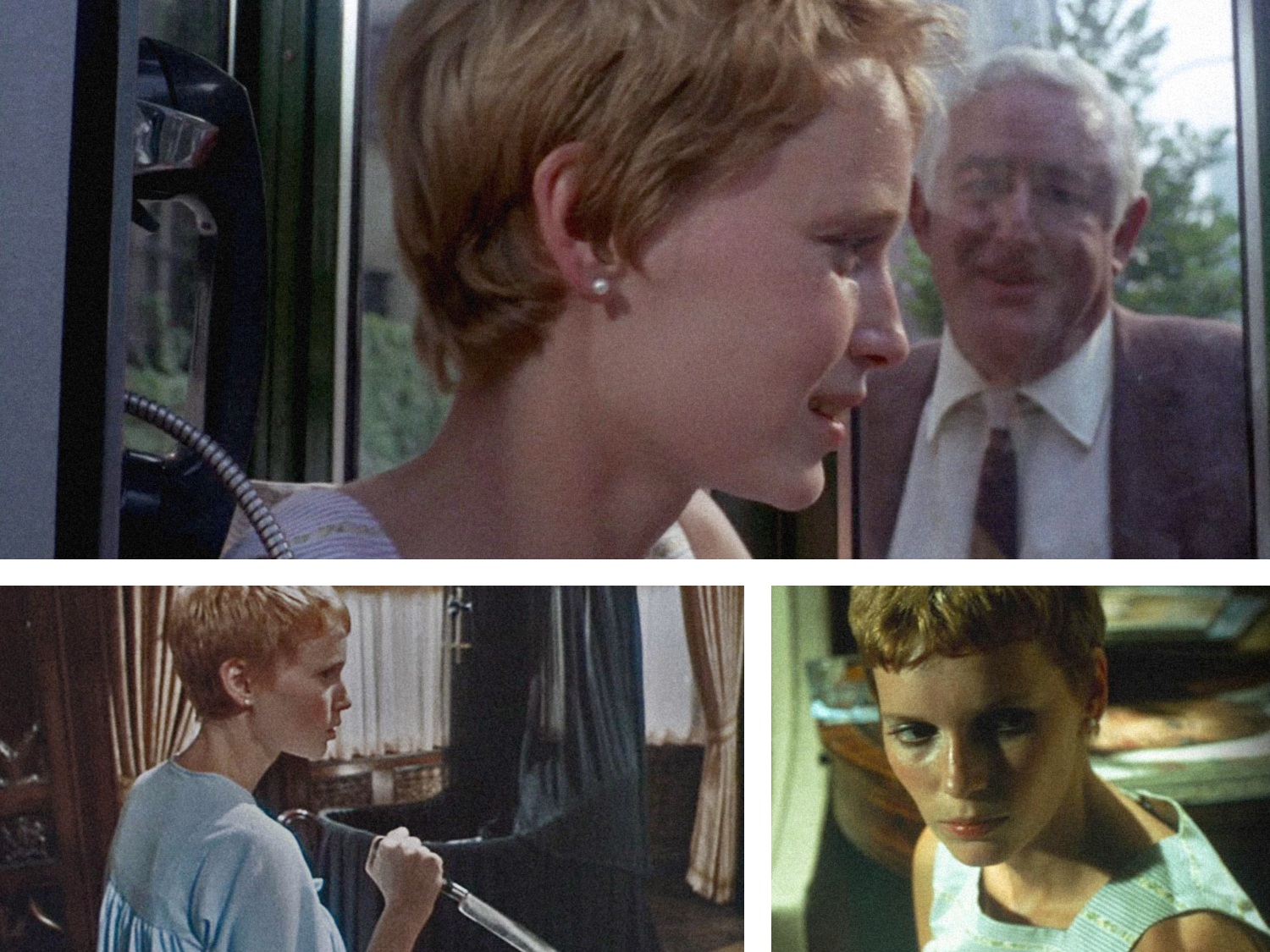
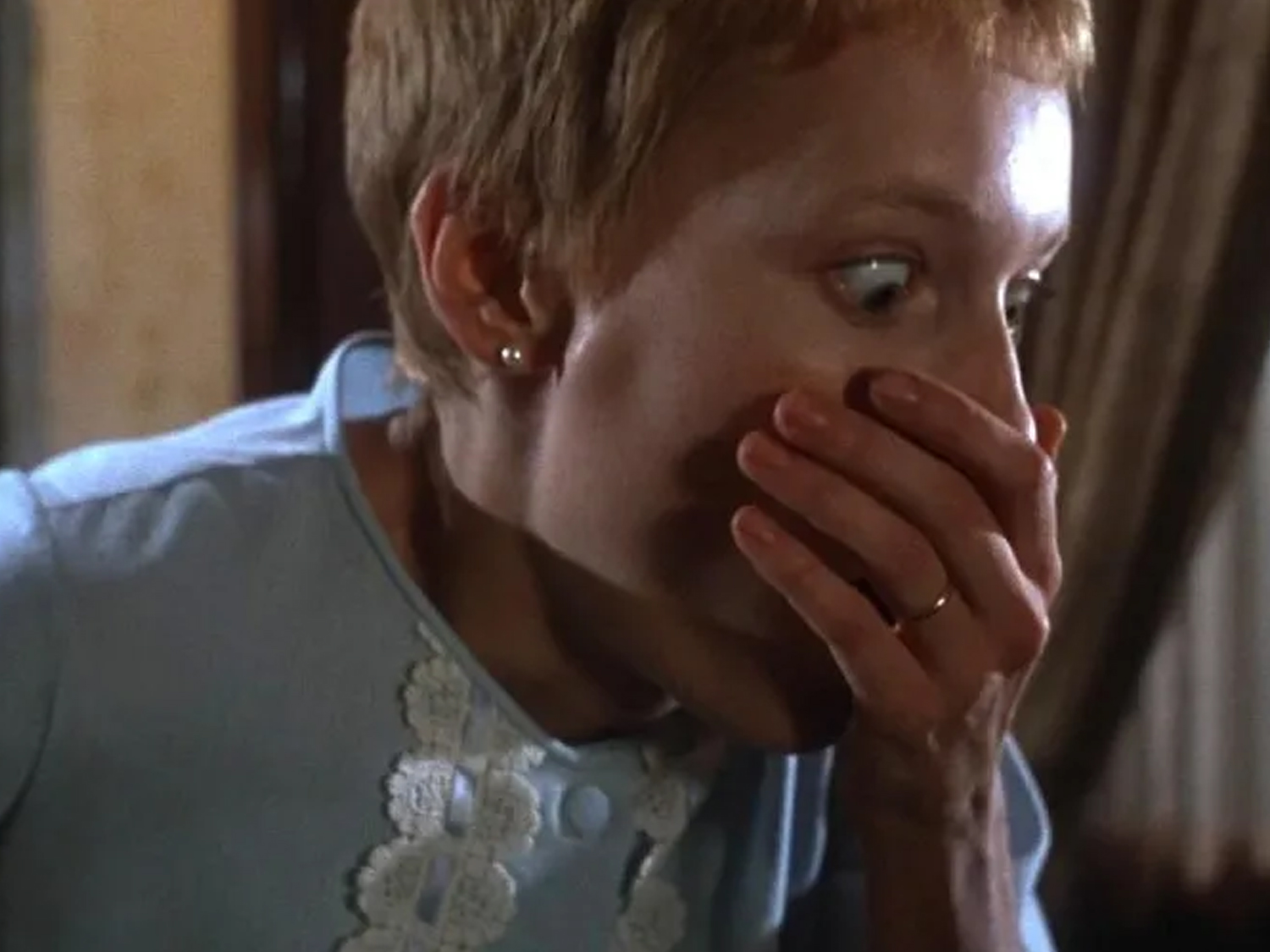 None of Castle’s over-the-top gimmicks were used to publicize Rosemary’s Baby, but the film soon acquired something of a reputation as cursed when people associated with the production began experiencing a series of grave misfortunes, not the least of which was the brutal, bloody murder, the following year, of Polanski’s pregnant wife, Sharon Tate, at the hands of the infamous Manson family. Some believe that the film’s devilish subject matter is what manifested the curse. Castle himself, who was receiving hate-mail and death threats for having brought Rosemary’s Baby to movie screens, became seriously ill with kidney failure shortly after the film premiered and so was unable to capitalize on the success of Rosemary’s Baby and move into the ranks of A-list producers and directors.
THE INDEPENDENT YEARS: TWILIGHT OF CASTLE’S CAREER
His next film was his last in the director’s chair. Shanks (1974) is an oddball horror movie, self-described as “a grim fairy tale” and “deliciously grotesque.” French mime Marcel Marceau starred in dual roles, one a speaking part. This was Marceau’s first feature film. As the deaf, mute puppeteer Malcolm Shanks, he has the strange ability to manipulate dead bodies like puppets.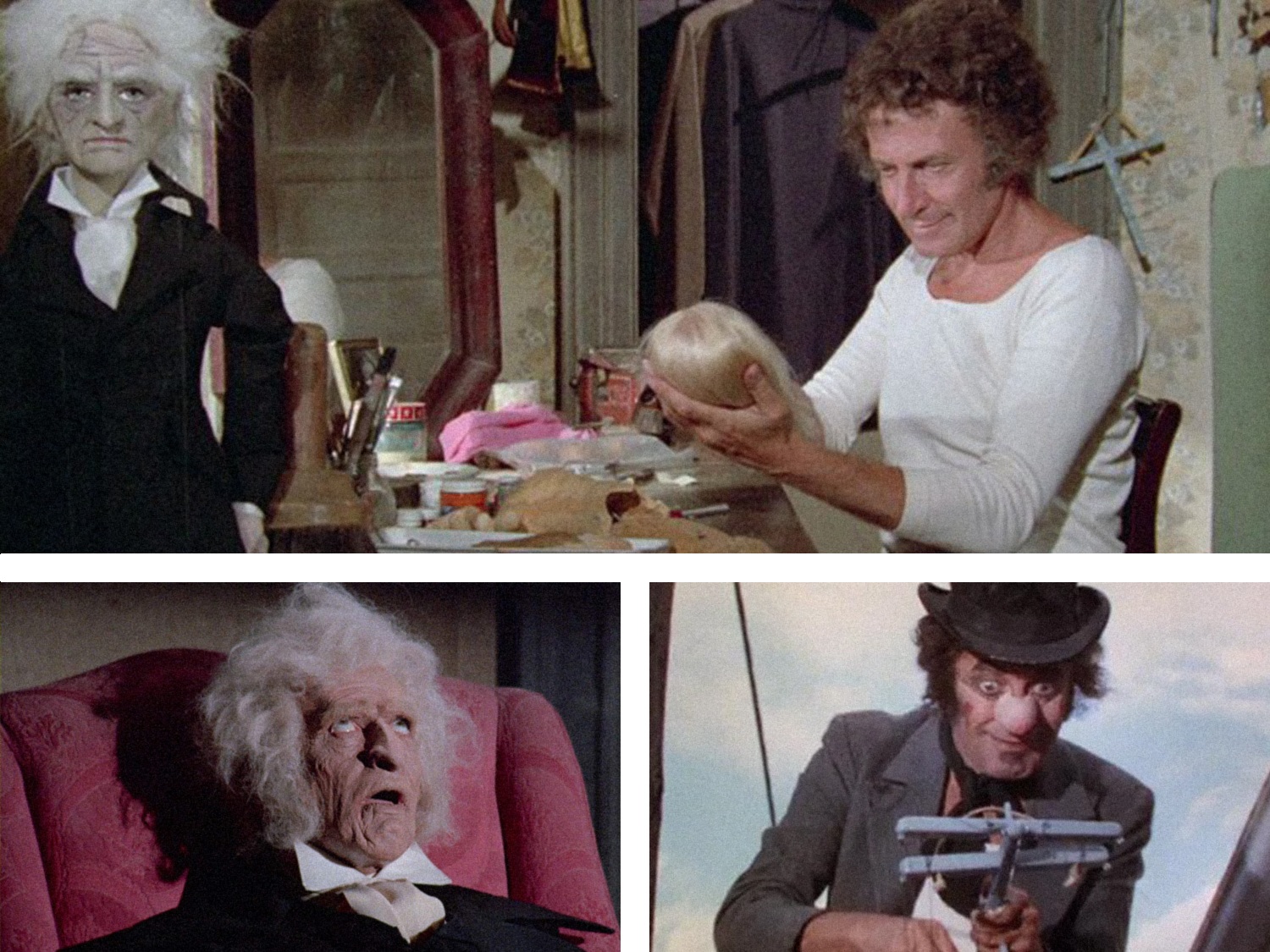
Castle acted in the 1975 comedy Shampoo, alongside stars Warren Beatty and Julie Christie. The film is based on the apparently wild swinging-sixties sex life of actress Joan Marshall, who was married to Shampoo director Hal Ashby in 1975. Like Castle, she appears briefly in the film. You will recall that she starred in Castle’s Homicidal under the pseudonym Jean Arless!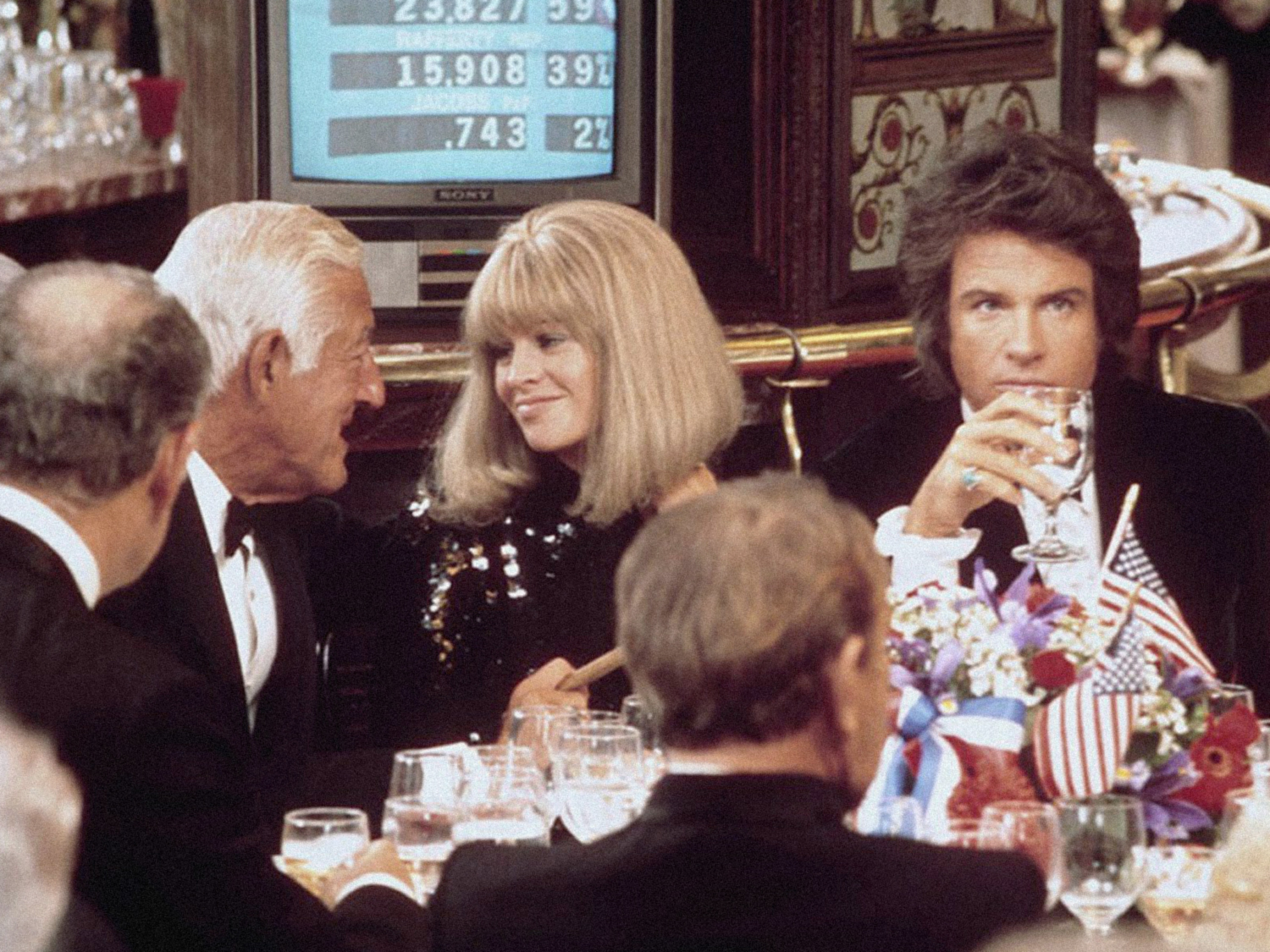
Castle appeared, as well that year, in The Day of the Locust, a satire of pre-World War II Hollywood focusing on the broken dreams of several characters, who had come to the motion picture capital seeking success and stardom. He cameos as the director of a period picture under production. This was his last on-screen appearance.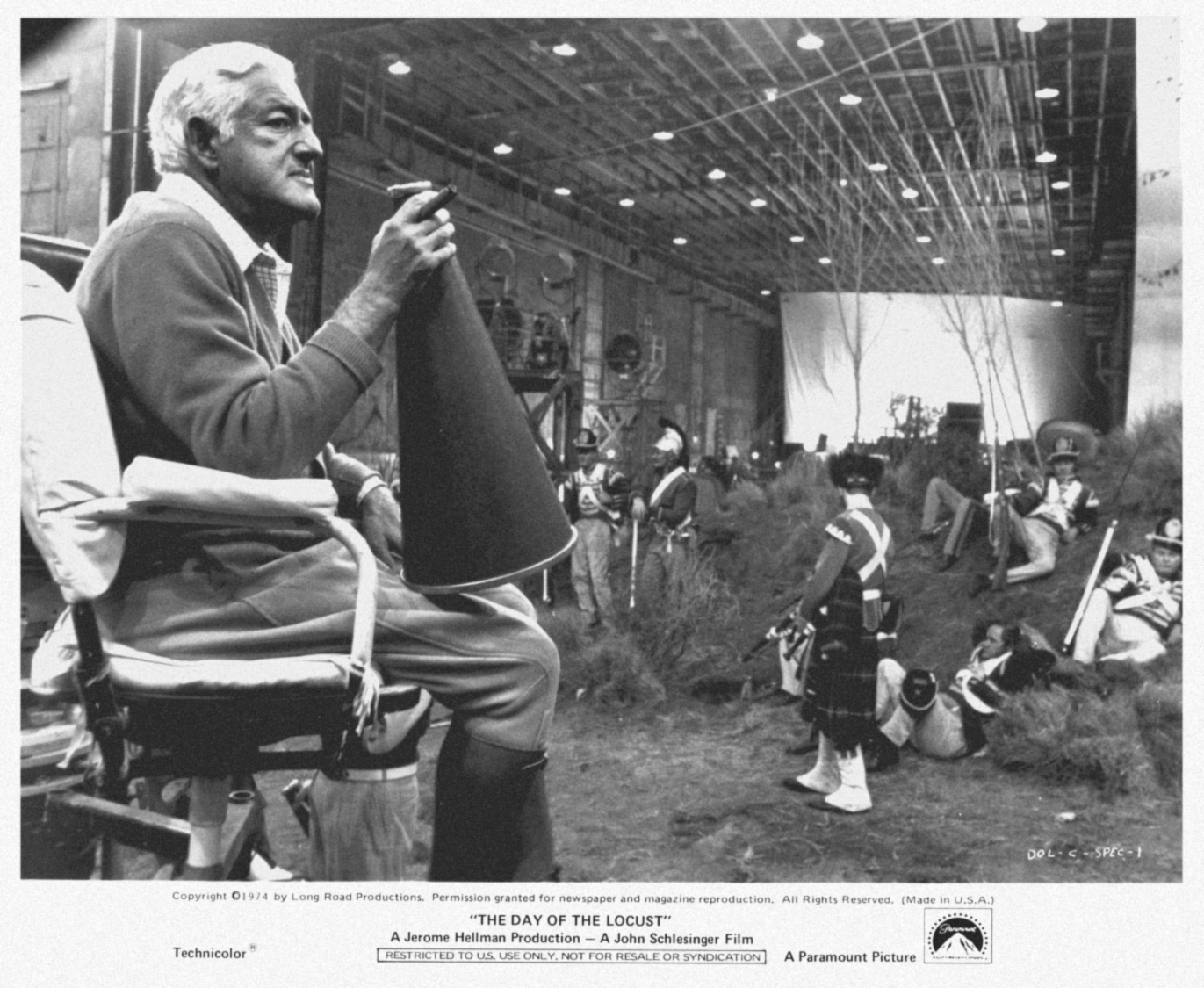
Also a 1975 release, his last film was the creature-feature Bug, about giant, intelligent, flying, fire-starting cockroaches!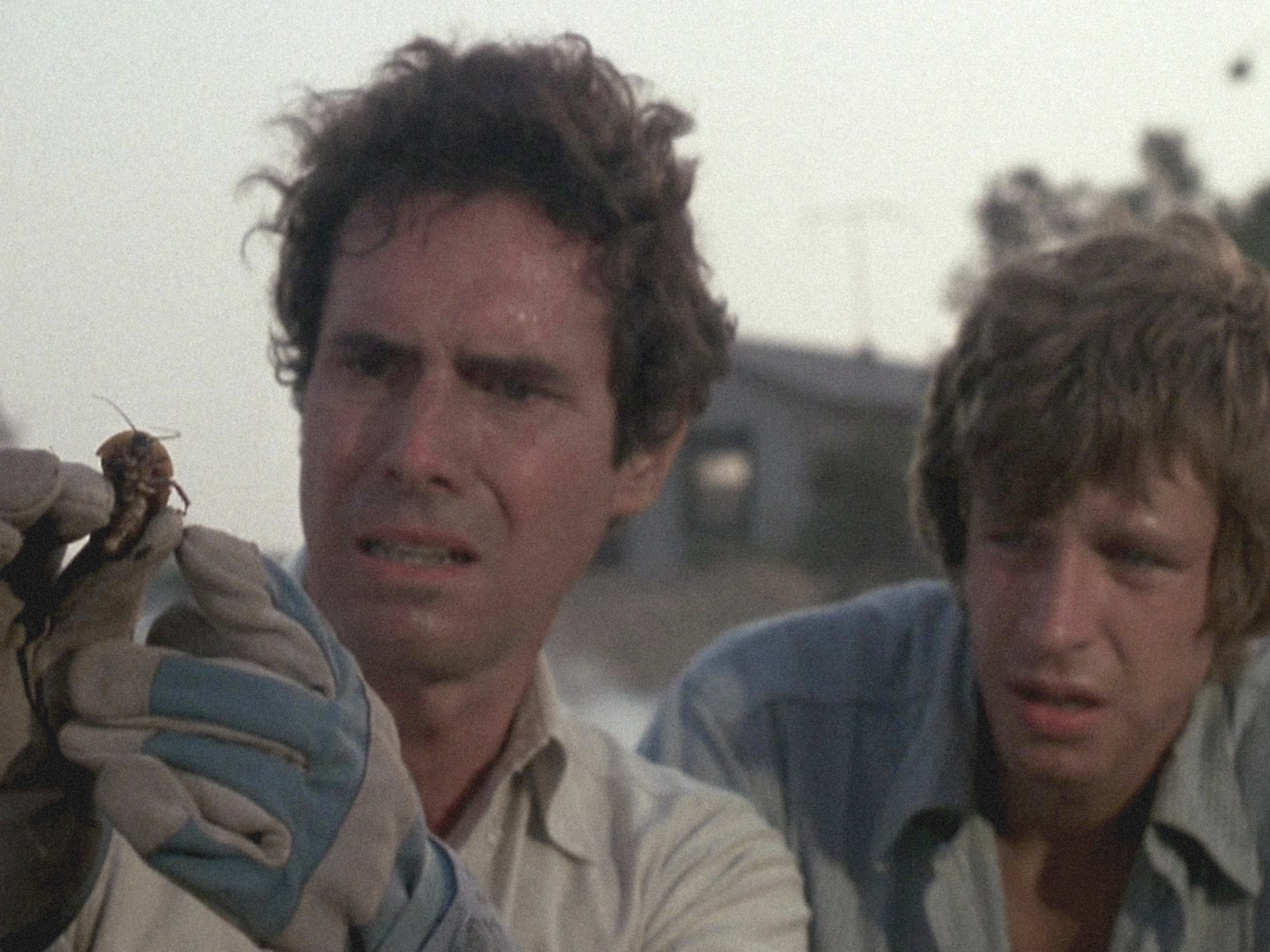
Castle produced the film, and co-wrote the script with Thomas Page, author of the The Hephaestus Plague, the book upon which the film was based. Not one for the insect-averse!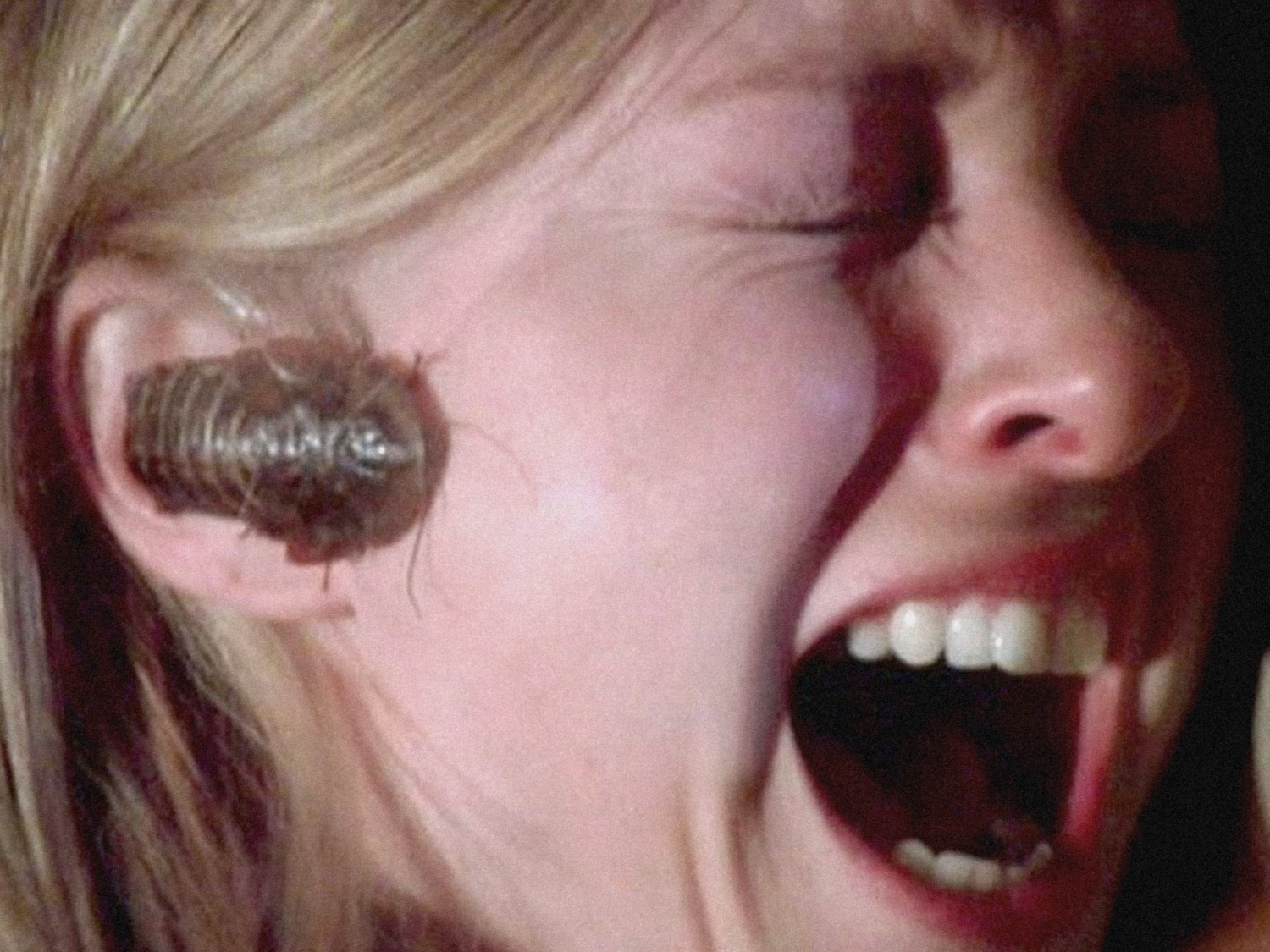
Castle reverted to his old ways on this one, announcing that he had taken out a one million dollar life-insurance policy on his “star,” Hercules the Cockroach!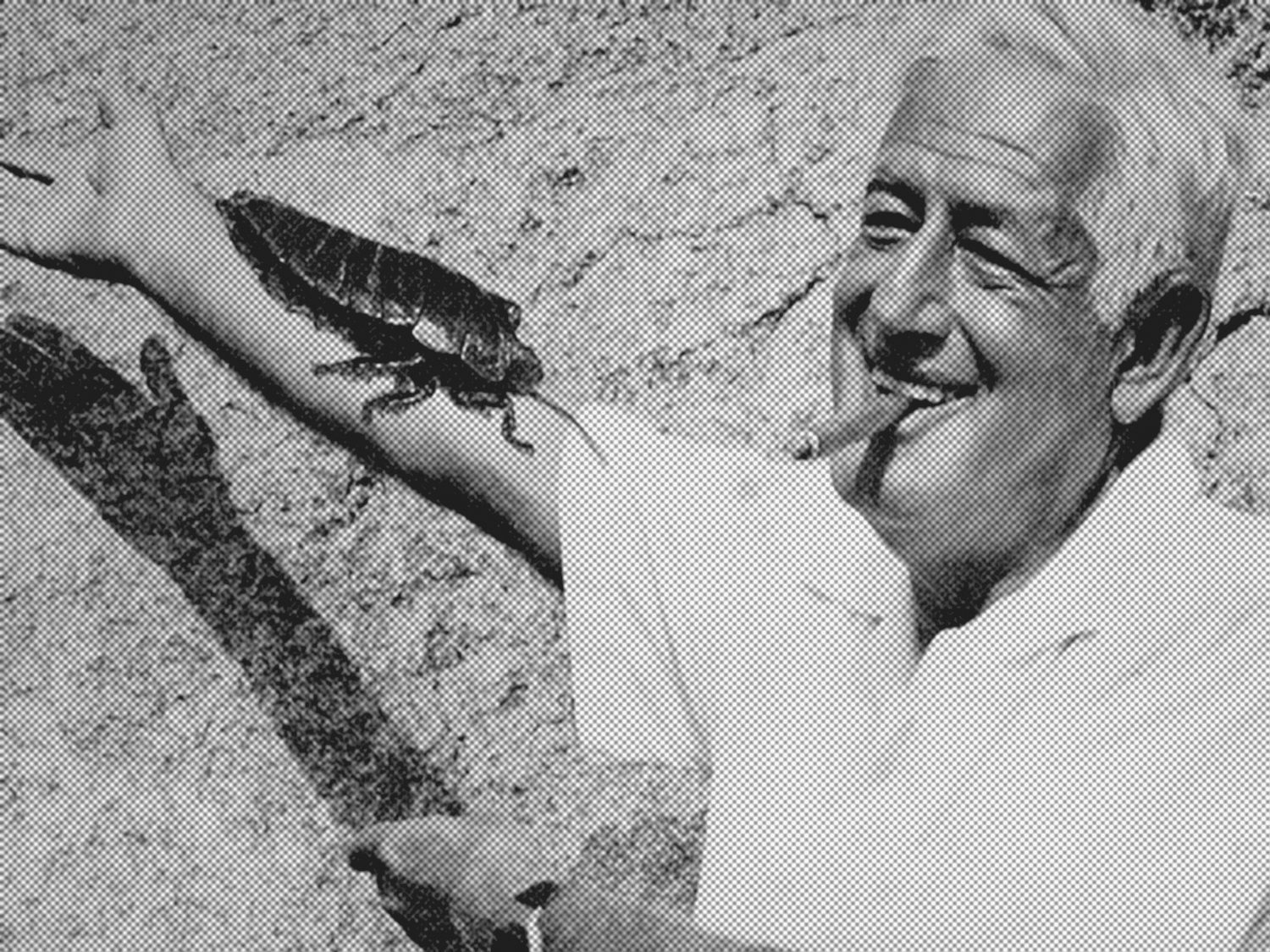
LEGACY
Castle’s autobiography, Step Right Up! I’m Gonna Scare the Pants Off America: Memoirs of a B-Movie Mogul, was published in 1976 and has been reprinted a couple of times since. William Castle died of a heart attack on May 31, 1977. He was only 63.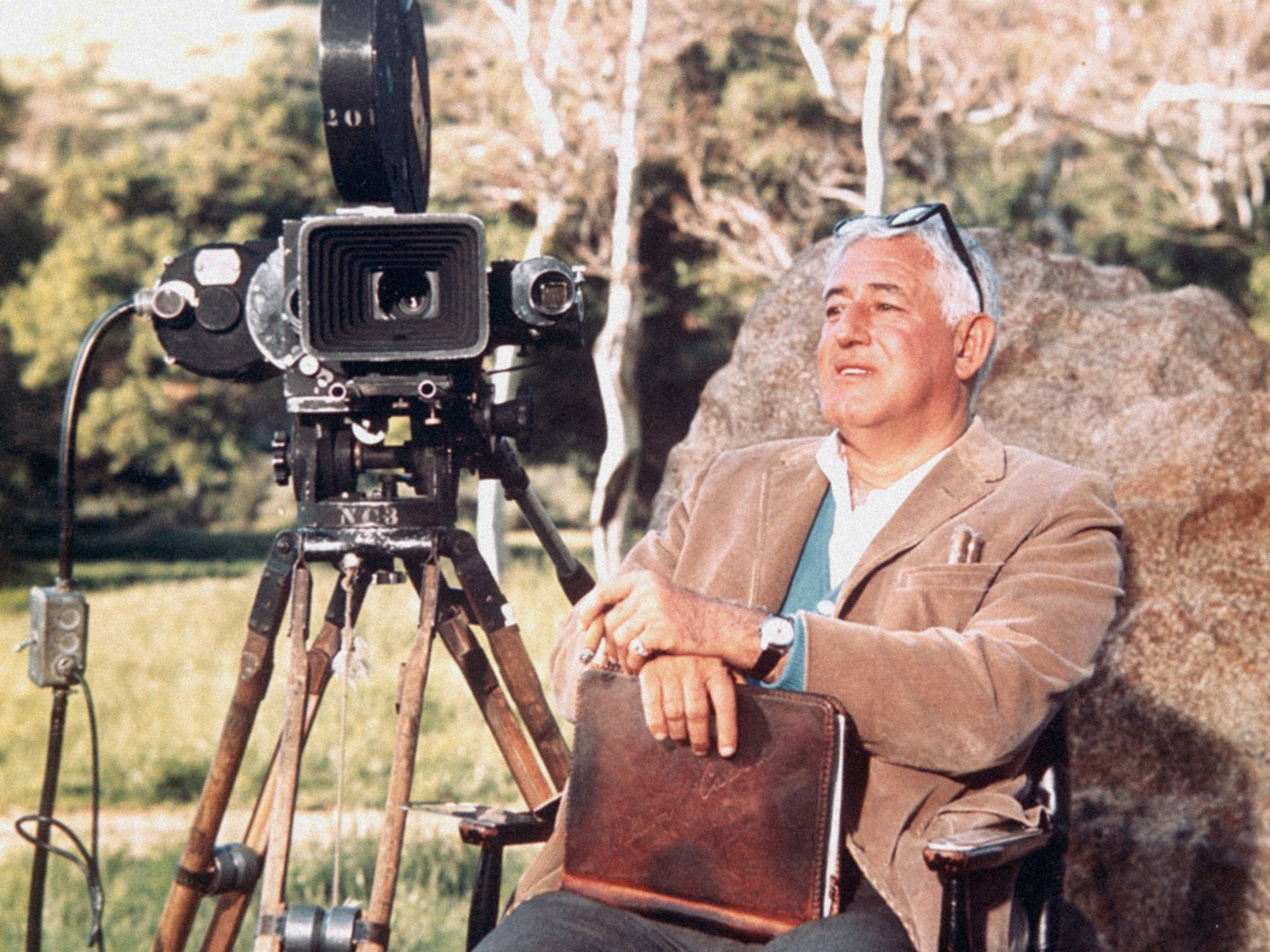
By all accounts, Castle was a charming, personable, gregarious, talented, determined and dynamic fellow, well-liked by his colleagues. He worked with a lot of very talented filmmakers over the years, and some of that movie magic undoubtedly rubbed off on him. While some might say he never amounted to anything more than a competent B-movie director and producer, having just once or twice breathed the rarefied air of Hollywood’s A-list filmmakers, I would argue that he is remembered as one of that singular breed of filmmaker whose name attached to a movie can, alone, draw an audience—Spielberg, Kubrick, Hitchcock, Harryhausen, Nolan…Castle.
No, he wasn’t the best ever, but he was certainly a competent director, gusting to inspired, excellent, daring! His affection for the horror genre in particular was always up on the screen. Yes, he was a carnival barker and purveyor of goofy gimmicks, but that’s what made his movies so much more fun, not just to watch, but to experience. He relished involving his audiences in the fun. Castle obviously loved his job, and despite the career disappointments and the condescension of critics and others over a lengthy career, he soldiered on, and he entertained his audiences. He brought flair, showmanship, and a sense of fun to the movie-going experience for generations of genre fans, inspiring future filmmakers, like John Waters, one of his biggest boosters, and Robert Zemeckis, who cites Castle as his favourite director.
Today, fans flock to retro-screenings of his films, with his classic gimmicks in full operation!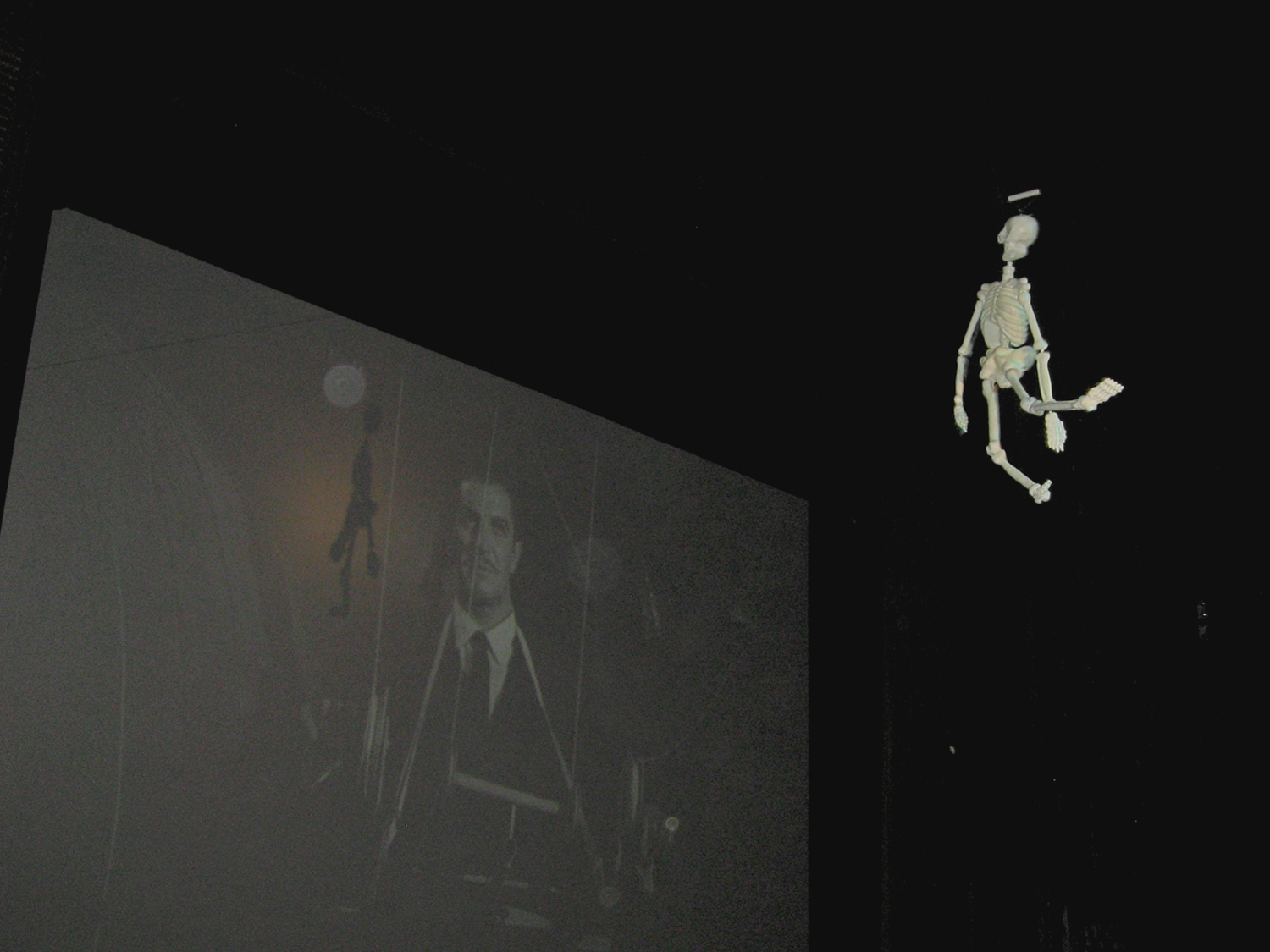
Authentic Castle give-aways in good condition are sought after by collectors.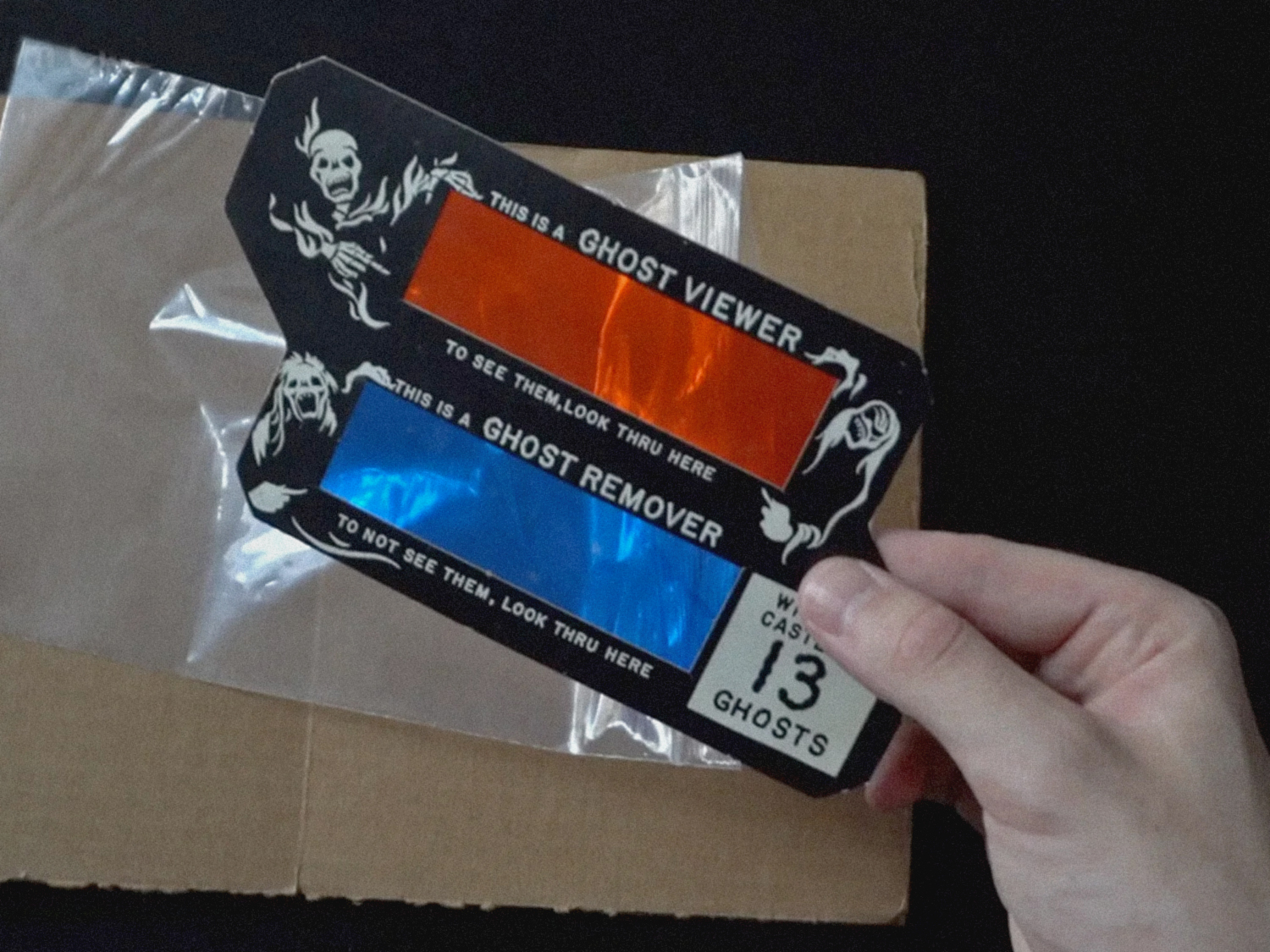
At the peak of his popularity, he had a national fan club in an age without the Internet and social media.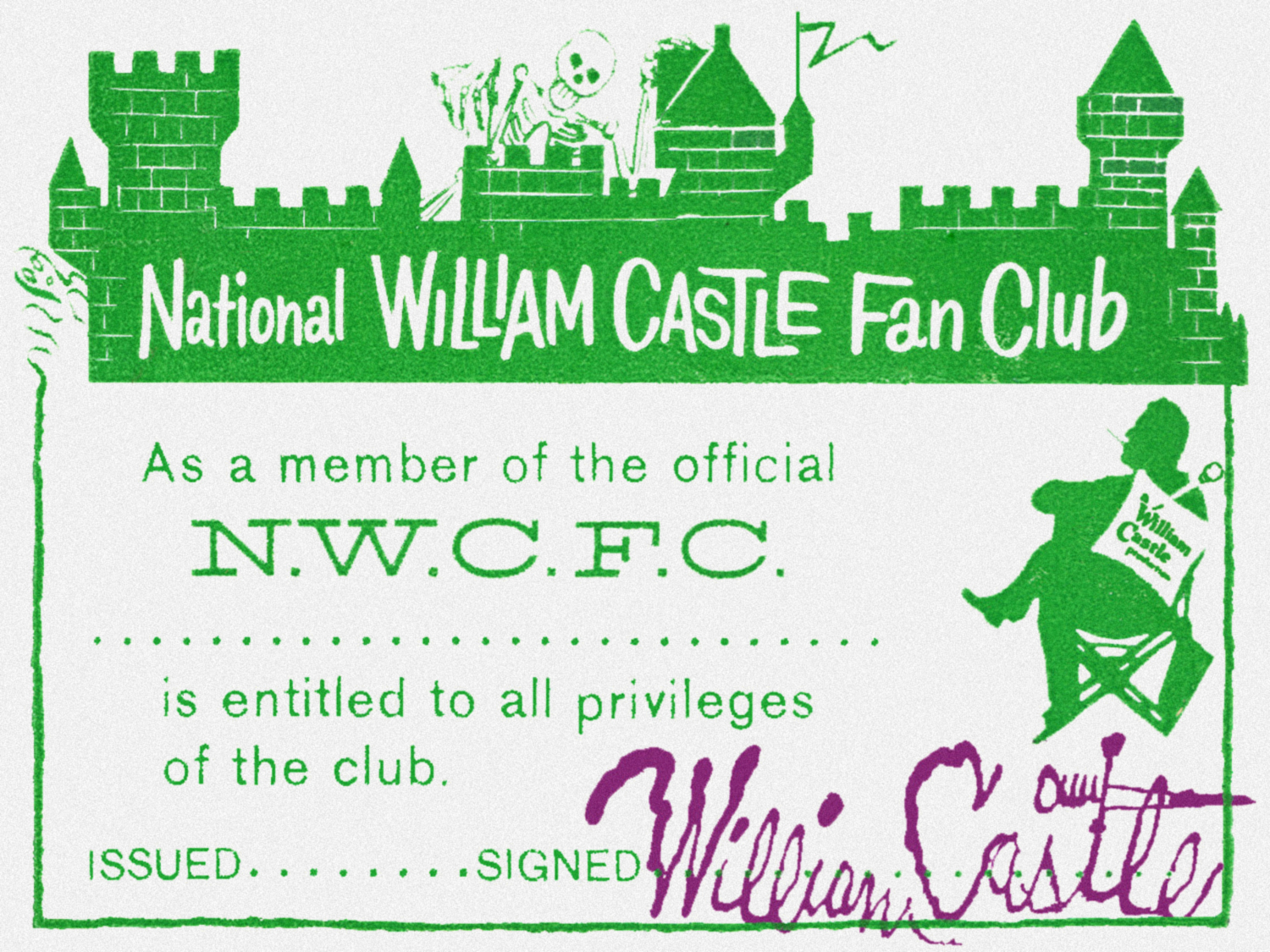
He wasn’t the first to employ gimmicks to promote his films, but he was the definitive practitioner of the art, and others have since followed in his footsteps. Waters’ “Odorama,” for his film, Polyester (1981), was directly inspired by, and a tribute to Castle. Robert Zemeckis (Back to the Future trilogy, Who Framed Roger Rabbit?) named his production company for Castle, and had the goal of remaking some of his films. Working with Castle’s daughter, Terry, Zemeckis’ company remade House on Haunted Hill in 1999 and 13 Ghosts in 2001, stylized as Thir13en Ghosts.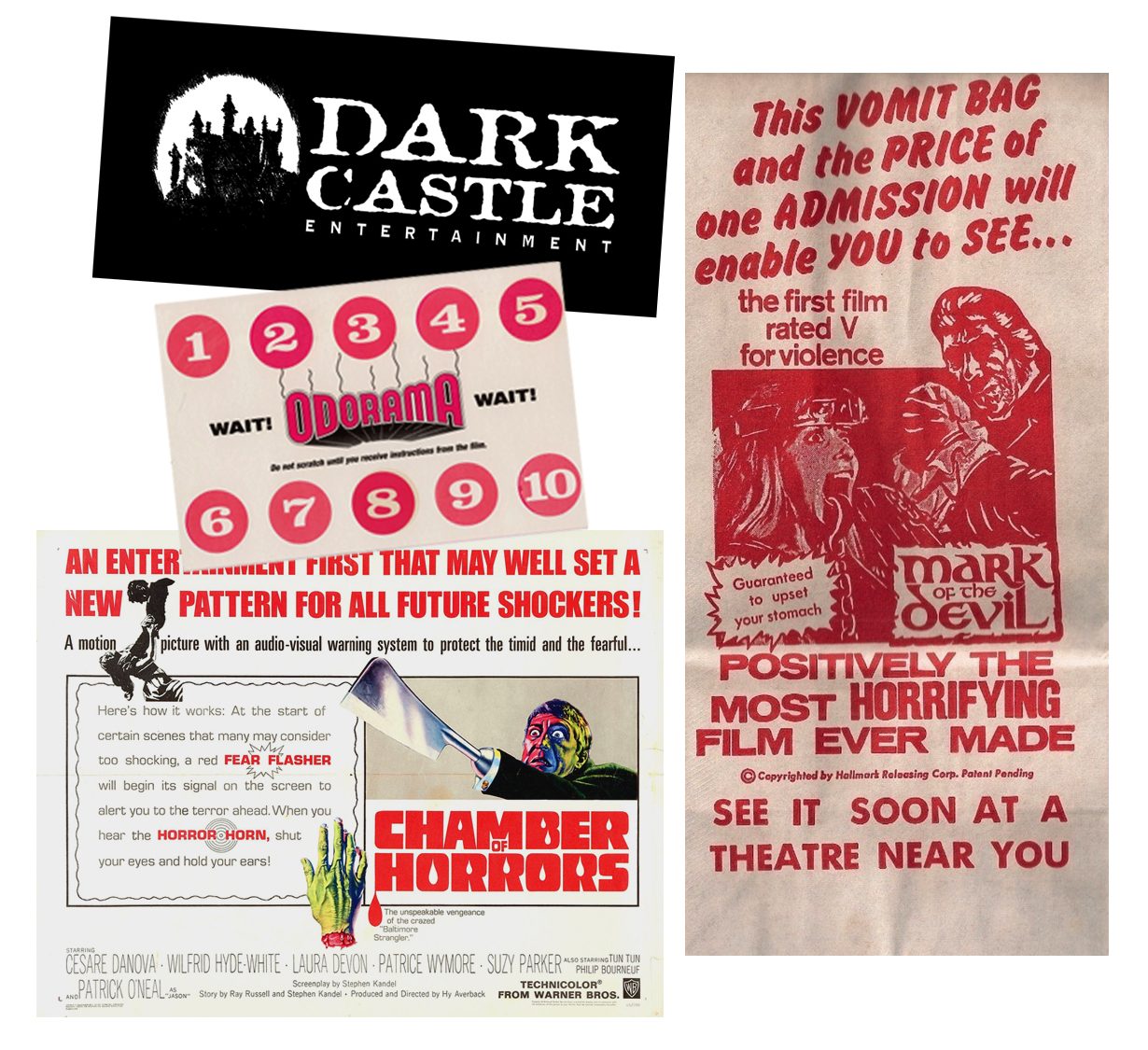
Director Joe Dante (Gremlins, Piranha, The Howling) is another fan of Castle’s and perhaps the best of the Castle tributes is his Matinee (1993), with John Goodman’s Lawrence Woolsey character an unmistakable homage to William Castle, and “Atomo-Vision” to “Percepto.”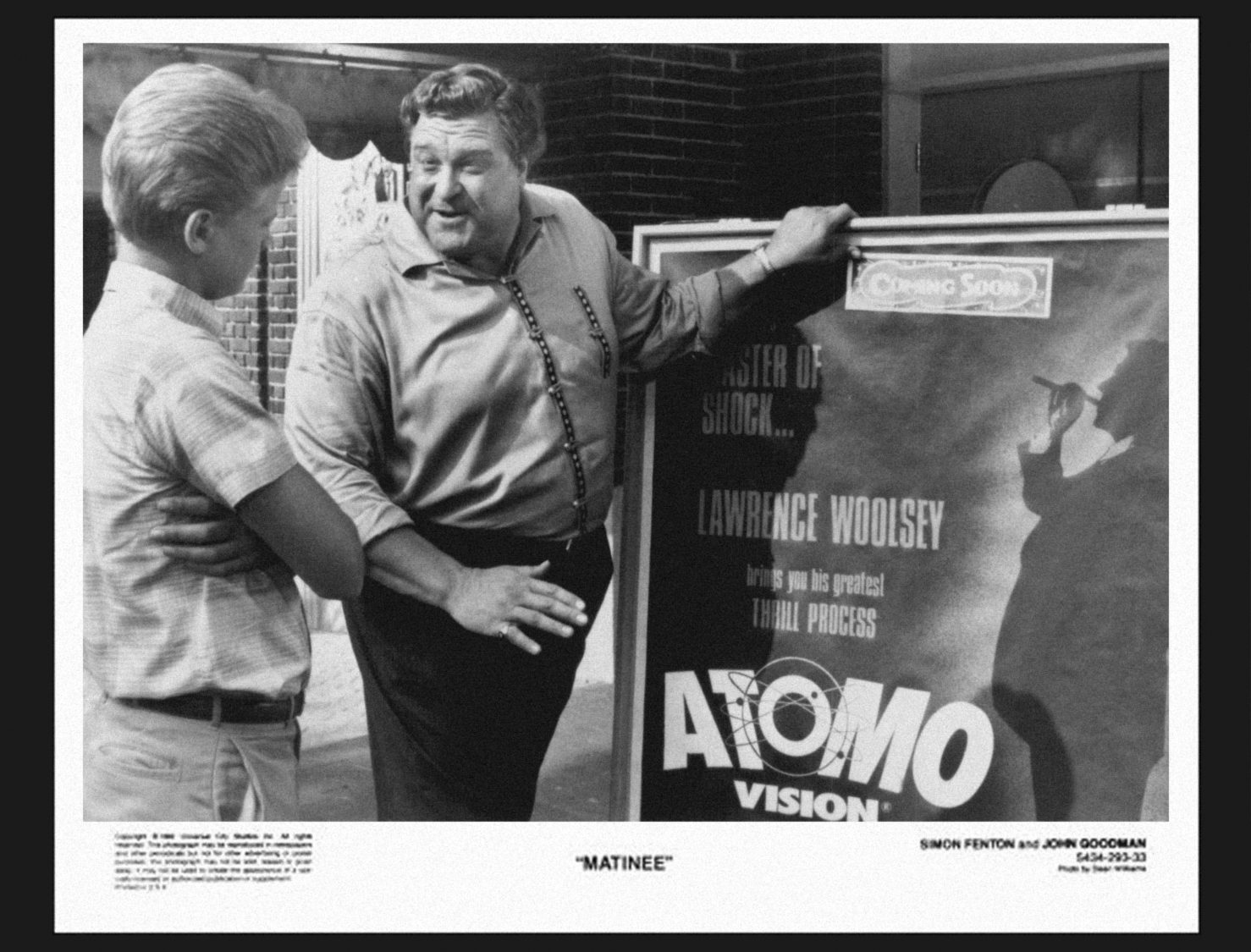
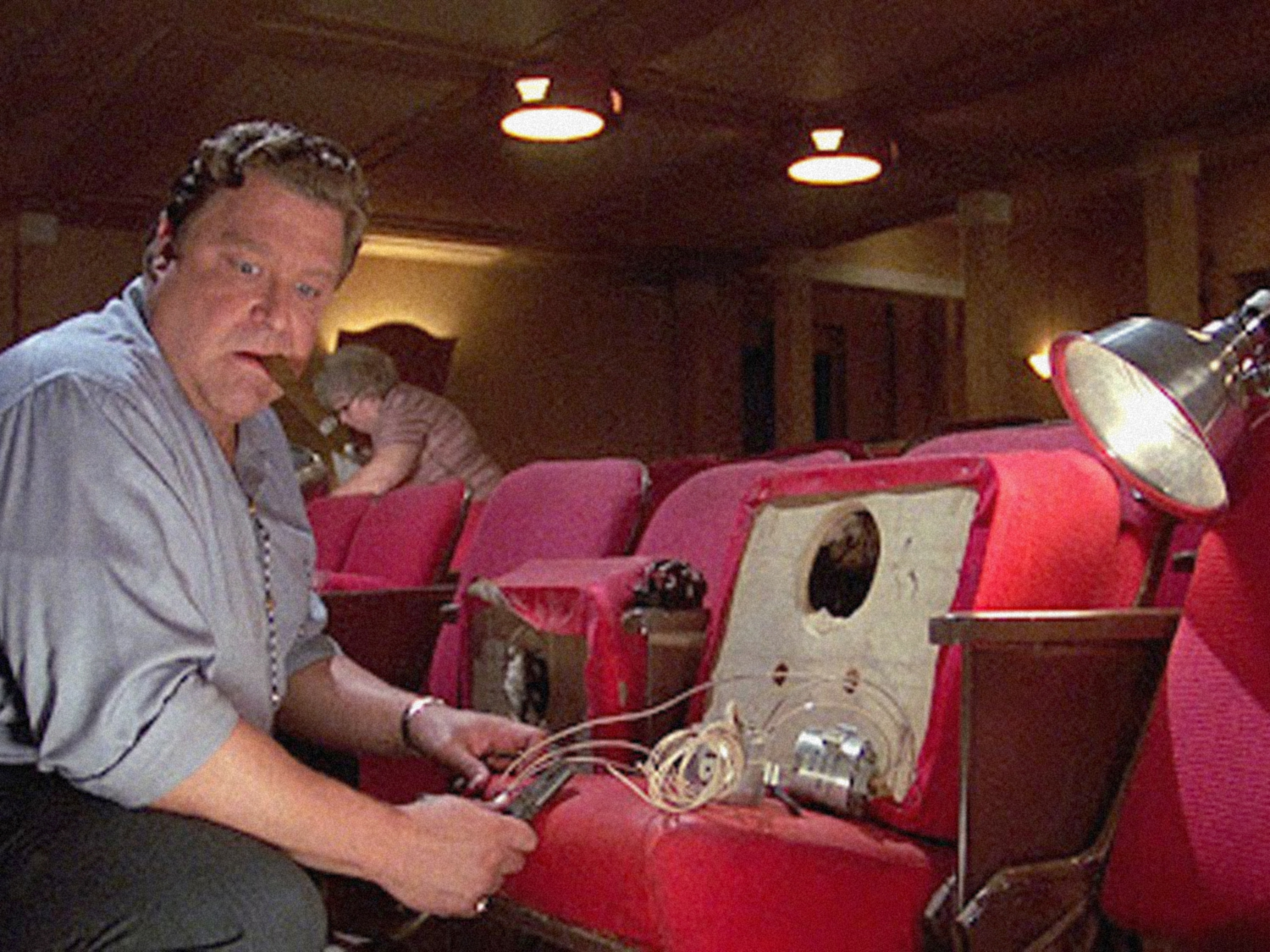
In this scene from the film, Woolsey installs Atomo-Vision under theatre seats in preparation for premiere night.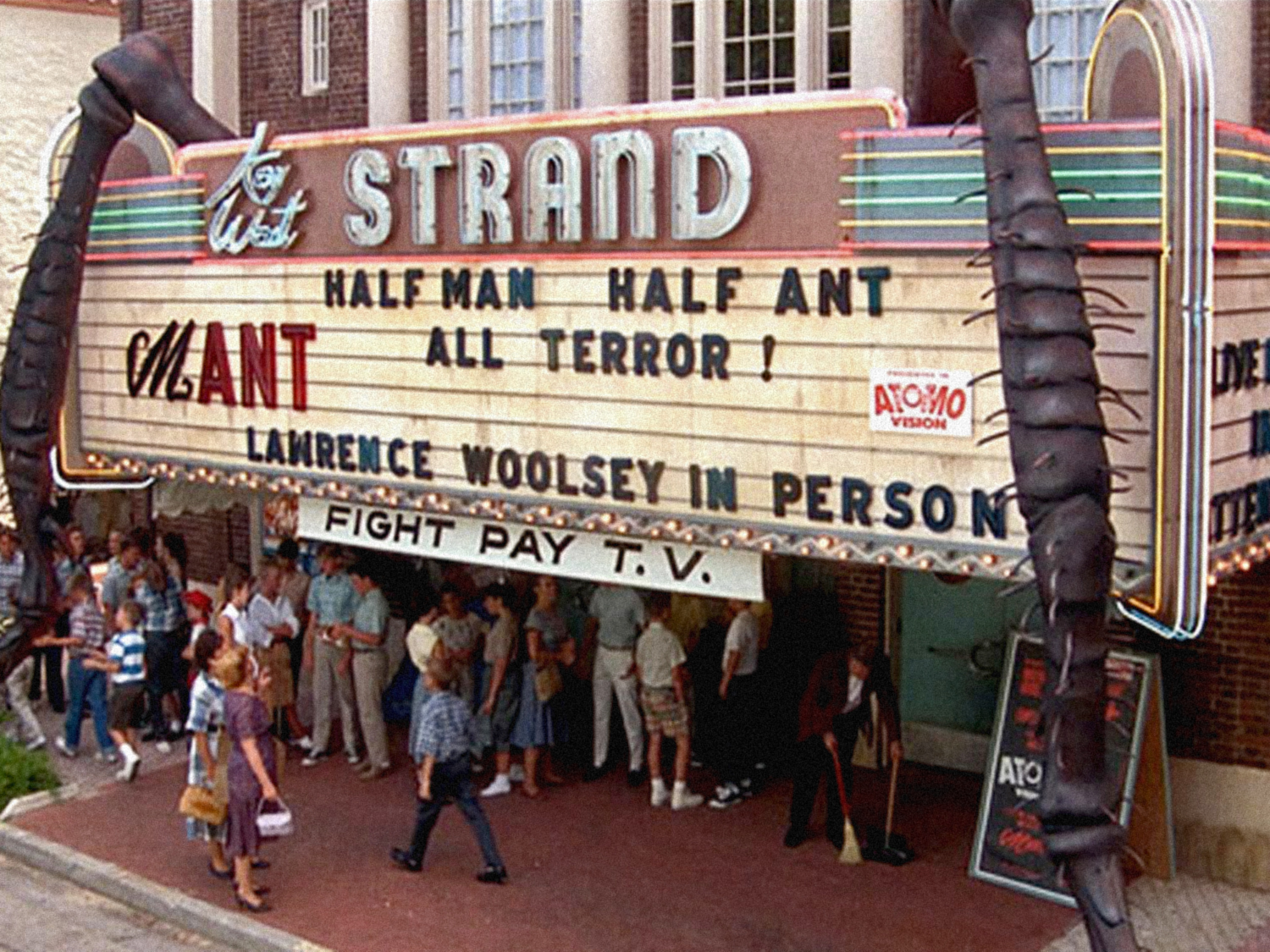
Produced for Matinee was a mock trailer for Mant, the fictional atomic-age sci-fi film Woolsey is promoting in Matinee, including with giant ant legs installed over the theatre entrance, as here depicted, something that Castle would no doubt have applauded. Filled with fond nods to Castle, check out the Mant trailer on YouTube: https://www.youtube.com/watch?v=gLCevDdMFPA
NEXT POST, 3:00PM