
EXPLODING COMET MCNAUGHT: There’s an exploding comet in the morning sky. Comet 220P/McNaught was a nondescript speck of 17th magnitude in late May when it suddenly multiplied in brightness 7000-fold. It was fading back toward obscurity when, on Aug. 5th, it exploded again. The second outburst (650x) propelled the comet to 7th magnitude, an easy target for binoculars and small telescopes.
This is what it looks like now:
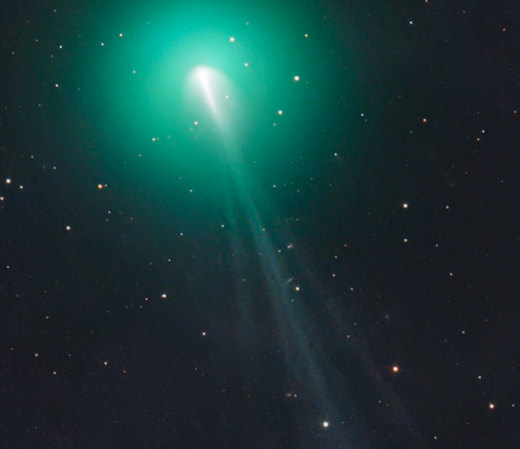
“We observed the comet in outburst on August 8th,” say photographers Gerald Rhemann and Michael Jäger, who used a 12-inch robotic telescope in Namibia. “It has a shock wave front.”
The comet is in the constellation Cetus near the star Mu Ceti, best seen around 4 AM local time. Its expanding atmosphere is already wider than 7 arcminutes–a quarter the size of a full Moon–with a short tail pointing away from the sun.
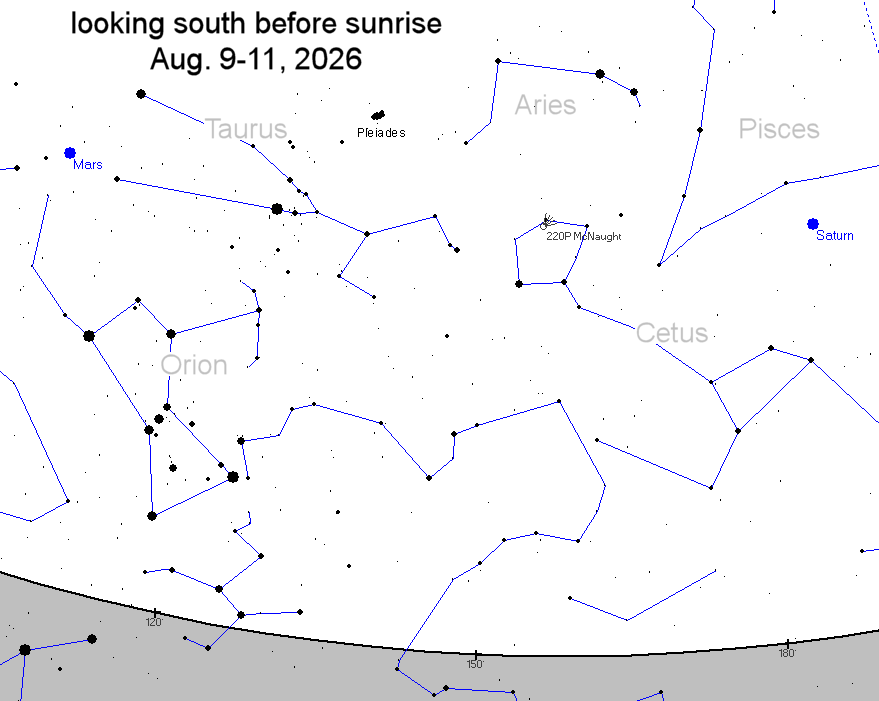 Some observers are comparing 220P to Comet 17P/Holmes, which famously exploded in 2007. Holmes brightened a million times, becoming a naked-eye object that you could watch expand from night to night without a telescope. “Mini-Holmes” might be a better name for 220P, although the resemblance is undeniable.
After the first outburst in May, telescopes monitoring 220P’s debris found it rich in gas. Some astronomers suspect a fragment broke off the nucleus, exposing fresh ice to sunlight. If so, more explosions may be in the offing. The comet is near its minimum distance from the sun (a 1.64 AU perihelion on June 14th) and still being exposed to disruptive solar heat.
If only one more fragment falls off, you won’t even need binoculars.
more images: from Ismael Civera of Villatoya, Spain; from Mike Olason of Tucson, Arizona; from Rafael Etges of Huntsville, ON Canada