Award-winning horror author, Nancy Kilpatrick, has passed away after along battle with lung cancer. She lived in Montreal and was a frequent guest at Con*Cept. Read her bio on her website is here: https://nancykilpatrick.com/
A tall brown dinosaur stands in a forest, its ostrich-like head almost in the tree canopy, grasping trees with hands containing two very large claws and sets of orange feathers on the arms. The dense rainforest is a dark green mixture of tropical-looking hardwood trees and fern-like plants. Duonychus tsogtbaatari would have been adept at grasping vegetation
Artist’s impression by Masato Hattori
A rare new species of two-clawed dinosaur has been discovered by scientists in Mongolia’s Gobi Desert.
The species, named Duonychus tsogtbaatari, was unique within a group of dinosaurs called Therizinosaurs, which stood on their hind legs and usually had three claws.
It was medium-sized, with an estimated weight of approximately 260kg.
Researchers believe the species’ long, curved claws and its ability to strongly flex them would have made it an efficient grasper of vegetation.
Yoshi Kobayashi, Hokkaido University– Researchers believe the dinosaur weighed approximately 260kg
Therizinosaurs were a group of either herbivorous or omnivorous theropod dinosaurs that lived in Asia and North America during the Cretaceous Period, which began 145 million years ago and ended 66 million years ago.
They are exemplified by the massive, long-clawed form Therizinosaurus, featured in the film Jurassic World Dominion, and were “awkward looking”, according to one of the study’s authors Dr Darla Zelenitsky, associate professor at the University of Calgary.
The specimen was recovered from the Bayanshiree formation in the Gobi Desert of Mongolia, which dates back to the Late Cretaceous period (between 100.5 to 66 million years ago).
Unesco, the UN’s Educational, Scientific and Cultural Organization, calls the Mongolian Gobi Desert the largest dinosaur fossil reservoir in the world.
The region is an especially important source of fossils from the later Cretaceous period, which is the last of the main three periods of the dinosaur age, representing the final phase of dinosaur evolution.
Kobayashi et al — The claws may also have been used as formidable weapons
At nearly a foot long, the claws themselves were much larger than their underlying bone, the study revealed.
Besides better grasping, the two-fingered hands may have been used for display, digging, or as formidable weapons.
The most famous two-fingered theropods are species within the group tyrannosaurids, which includes Tyrannosaurus rex, but Duonychus evolved its two-fingered hands separately from them and from other two-fingered theropods.
The specimen also preserves the first keratinous sheath of a therizinosaur, an element that covers the claw much like human fingernails, aiding defence, movement, or prey catching.
Are we on the verge of mining metals from the asteroids above Earth?
BBC, Josh Sims
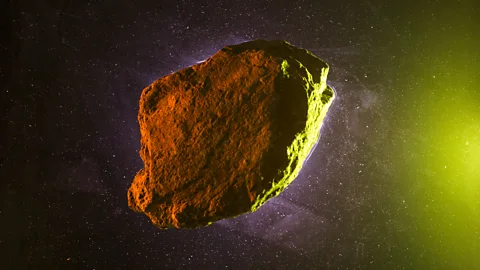
Asteroid mining firms say mining for minerals on asteroids is just around the corner now, but not everyone is convinced (Credit: Getty Images)
As an asteroid mining start-up’s latest mission goes awry, Josh Sims looks at how close we really are to extracting rare minerals from the many celestial bodies floating above us.
Thirty years ago the seminal BBC science programme Tomorrow’s World made a few predictions about how the world might be by 2025. It was a testament to how hard predicting the technological future is: we would, the programme suggested, have microchip implants to help us deal with ATMs, chat with holographic helpmates in our homes and there would be riots over internet access.
The episode also suggested we would be mining asteroids by now. And while we aren’t there yet, it’s something that some start-ups argue will happen sooner than many imagined.
The founder of the California-based company AstroForge believes it will be the first to get there, and the company has already taken the first tentative steps. On 27 February 2025 it launched its first $6.5m (£5.1m) unmanned spacecraft on a SpaceX Falcon 9 rocket from the Kennedy Space Center in Florida. Around nine days later, AstroForge believes the spacecraft – named Odin – likely passed beyond the Moon and into deep space as planned.
Unfortunately, however, AstroForge developed major communications problems with Odin, which it is still trying to rectify at the time of writing. The firm hopes Odin has now entered its nine-month long coast to its mission destination: a fly-by of the carefully pre-selected asteroid 2022 OB5, some eight million km (five million miles) from Earth, which Odin will assess the composition of using its sensors.
“Move fast and break rocks” might be the mantra of Matt Gialich, AstroForge’s ebullient founder with a penchant for swear words, who is not dissuaded by the perhaps unresolvable technical trouble. AstroForge expected nothing less than many hurdles and has, he says, learned much even if contact isn’t made with this spacecraft again. “Yes, there are a lot more baby steps to take,” he concedes. “But we’re going to start to actually do it. You have to try.”
STRONG GEOMAGNETIC STORM WATCH Space Weather News for March 22, 2025
NOAA forecasters have issued a watch for strong G3-class geomagnetic storms on March 23rd when a CME is expected to hit Earth. The Russell-McPherron effect could amplify the effectiveness of the impact, producing widespread equinox auroras. Full story @ Spaceweather.com.
CME impact alerts: Sign up for Space Weather Alerts to receive instant text messages when CMEs strike Earth.
Above: Equinox auroras over Luosto, Finland, on March 20th. “Thanks to the Russell-McPherron effect, the aurora showed up nicely,” reports photographer Zoltán Kolláth.
COSMIC RAY SHOWERS CAUSE LIGHTNING: A new study by researchers at the Los Alamos National Laboratory links lightning to antimatter in cosmic ray showers. This could solve a centuries-old mystery of what causes electrical outbursts in thunderstorms. Full story @ Spaceweather.com
Above: 3D images of lightning over New Mexico. Researchers at Los Alamos National Laboratory used these data to link lightning to cosmic rays.
Reminder: Voting on the FAAn awards for work published in 2024 closes at midnight (Pacific time) Saturday March 29, 2025. Full details in Nic Farey’s The Incompleat Register: https://efanzines.com/TIR/index.htm.
A busy week for fanzine production! These new issues are now at
So she went into the garden to cut a cabbage leaf to make an apple pie; and while she was there, a great she-bear in the street put its head through the kitchen window. “What! No soap?” So he died, and she very imprudently married the gardener; and there were the Joblillies, and the Pickninnies, and the Grand Panjandrum with the little round button at top, and they all fell to playing catch-as-catch-can, until the gunpowder ran out at the heels of their boots.
It’s very common for fans to travel on a tourist visa, sometimes as a guest of a con. I, for instance, had been invited to be a fan GoH at an American convention. I cannot make commitments more than a few months in advance, and even then there is a risk I have to cancel, so I regretfully declined. If I accepted such an invitation today, I could be arrested by ICE. It’s illegal to work while on a tourist visa, and accepting free room and flight counts as payment. Who knew?!
LUNAR ECLIPSE OBSERVED FROM THE MOON: For the first time in almost 60 years, a lunar lander has photographed an eclipse from the surface of the Moon. During last night’s lunar eclipse, Firefly Aerospace’s Blue Ghost recorded the sky show from Mare Crisium. Full story with photos @ Spaceweather.com.
Above: A two-planet view of last night’s lunar eclipse. Credit: Eric Allen and Firefly Aerospace.
“Over 40 dazzling outfits worn will be on display as well as photographs of guests in costume, souvenir publications and more —that capture the spirit and prestige of these grand events. This exhibition and the accompanying publication represent the culmination of a research effort which draws on the quintessential strengths of the McCord Stewart Museum’s rich collections. Many remarkable discoveries, unveiled to the public for the first time.”
Good morning, Moon! This image captured by Firefly Aerospace’s Blue Ghost lander on March 3 shows sunrise on the lunar surface. This marked the beginning of the lunar day and the start of Blue Ghost’s surface operations, which will last throughout one lunar day (about 14 Earth days). Image credit: Firefly Aerospace.
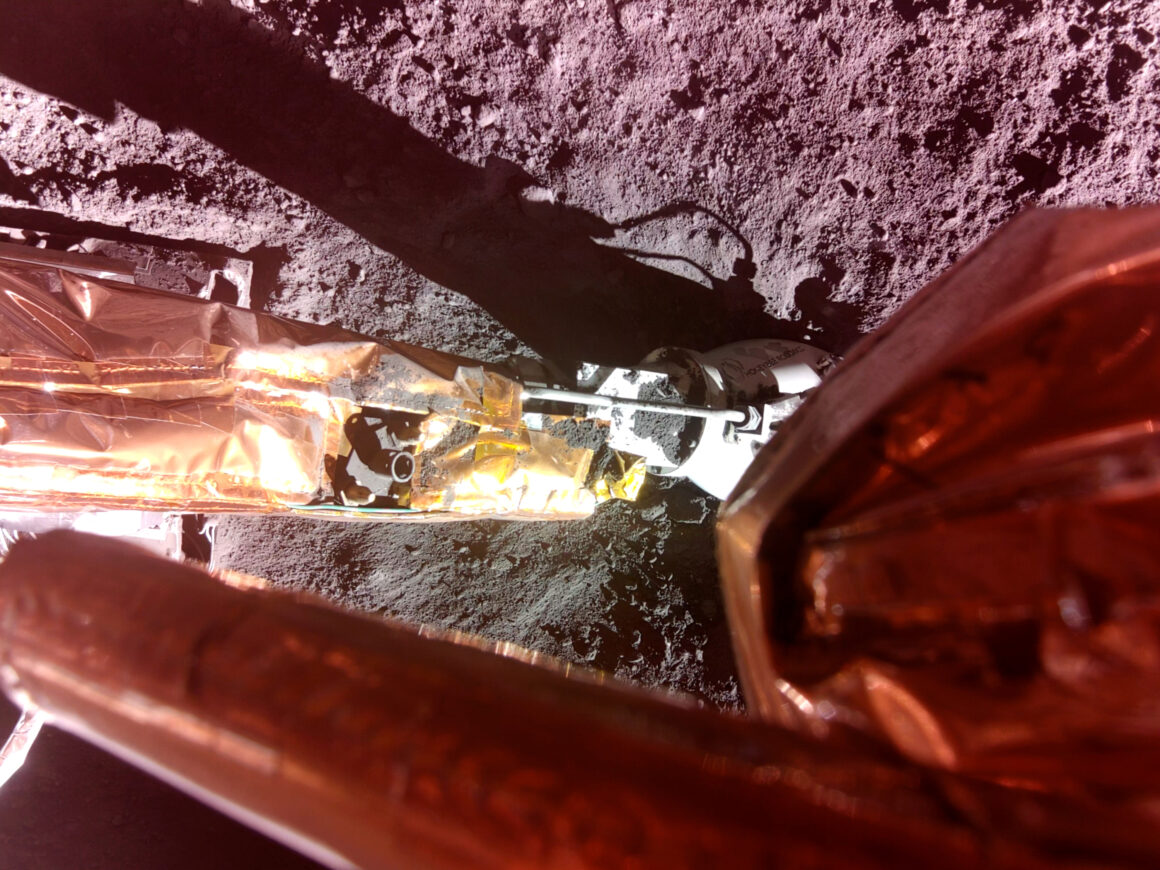
PlanetVac is sampling the Moon! Firefly Aerospace’s Blue Ghost successfully landed on the Moon on March 2, carrying with it 10 NASA science and technology instruments, including Lunar PlanetVac. This sample collection technology was developed and tested by Honeybee Robotics, with key tests funded by Planetary Society members and donors. Firefly Aerospace confirmed this week that Lunar PlanetVac has been deployed to begin collecting samples of lunar regolith.
Without an atmosphere, the temperature on the surface of the Moon depends almost entirely on direct sunlight. Near the Moon’s equator, temperatures can reach around 120 degrees Celsius (250 degrees Fahrenheit) in the daytime and ten drop to -130 degrees Celsius (-208 degrees Fahrenheit) at night.
The Lunar PlanetVac instrument on the end of Blue Ghost’s Surface Access Arm. Image credit: Firefly Aerospace.
PlanetVac is sampling the Moon! Firefly Aerospace’s Blue Ghost successfully landed on the Moon on March 2, carrying with it 10 NASA science and technology instruments, including Lunar PlanetVac. This sample collection technology was developed and tested by Honeybee Robotics, with key tests funded by Planetary Society members and donors. Firefly Aerospace confirmed this week that Lunar PlanetVac has been deployed to begin collecting samples of lunar regolith.





 Without an atmosphere, the temperature on the surface of the Moon depends almost entirely on direct sunlight. Near the Moon’s equator, temperatures can reach around 120 degrees Celsius (250 degrees Fahrenheit) in the daytime and ten drop to -130 degrees Celsius (-208 degrees Fahrenheit) at night.