Corflu news and more zines

Message from Nic Farey:

It’s award season!

Attached is The Incompleat Register 2022, the voters’ guide and pro forma ballot for the 2023 FAAn awards, fanzine fandom’s only dedicated honors, and voting is thus open.

The voting deadline is midnight (Pacific time) Friday March 10 2023, and ballots must be received by then (please note this if you’re sending by snail mail). Your own name and contact details should also be clearly supplied.

The awards will be announced at Corflu Craic in Belfast, Northern Ireland on April 2 2023.

Voting is open to anyone with an interest in fanzines, no memberships of anything are required.

Publicity is welcomed. Feel free to share and distribute this as far and wide as you like.

Nic Farey
(Current FAAn Awards administrator)


The following zines have been received and uploaded to our website:

ThisHere60 Reduced

Alex126

ObdurateEye23

Posted to efanzines:

  • Added today at https://efanzines.com are some of the final issues of 2022, and the first issue of 2023.
  • Opuntia #541, edited by Dale Speirs (2023)
  • Alan White’s Pixel Dreams (2022)
  • Nic Farey’s This Here…#60
  • Journey Planet #68 and #69, edited by James Bacon, Chris Garcia et al
  • Garth Spencer’s The Obdurate Eye #23
  • Christopher J. Garcia’s The Drink Tank #443Bill


Solar explosion now a dangerous sunspot

On the 4th of January there was a Class X explosion on the farside of the sun. Now it is turning toward Earth, and has already caused shortwave radio blackouts. We might see some Aurora activity. CPL
Space Weather News for Jan 6, 2023
https://spaceweather.com
https://www.spaceweatheralerts.com

X-CLASS SOLAR FLARE: A large and potentially dangerous sunspot is turning toward Earth. This morning (Jan. 6th at 0057 UT) it unleashed an X-class solar flare and caused a shortwave radio blackout over the South Pacific Ocean. Given the size and apparent complexity of the active region, there’s a good chance the explosions will continue in the days ahead.  Full story @ Spaceweather.com

Instant solar flare alerts: Sign up for Space Weather Alerts to receive instant text messages when strong solar flares are underway.

[]
Above: An X1.2-class solar flare on Jan. 6, 2023, recorded by NASA’s Solar Dynamics Observatory.

Space Weather News for Jan 4, 2023
https://spaceweather.com
https://www.spaceweatheralerts.com

SIGNIFICANT FARSIDE EXPLOSION: A powerful explosion rocked the farside of the sun yesterday, hurling a bright CME over the edge of the solar disk. It may have been an X-class event. Helioseismic echoes suggest that the source of the blast is just behind the sun’s southeastern limb and could turn to face Earth later this week. Full story @ Spaceweather.com

Instant solar flare alerts: Sign up for Space Weather Alerts to receive instant text messages when strong solar flares are underway.

[]
Above: A bright CME emerges from the farside of the sun on Jan. 3rd. Credit: The Solar and Heliospheric Observatory (SOHO)

HAARP IS PINGING AN ASTEROID TODAY

From https://spaceweather.com/

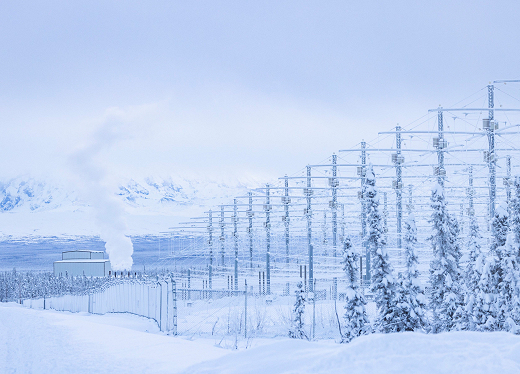
HAARP IS PINGING AN ASTEROID TODAY: Researchers from NASA and the University of Alaska are about to perform an unusual radar experiment. They’re going to ping a near-Earth asteroid using shortwave radio. The target is a 500-ft-wide space rock named “2010 XC15.” When it passes by Earth on Tuesday, Dec. 27th, the HAARP array in Alaska will hit it with a long pulse of 9.6 MHz radio waves.

The High-frequency Active Auroral Research Program (HAARP) site in Gakona, Alaska

Radio astronomers ping asteroids all the time. What’s unusual about this experiment is the frequency: 9.6 MHz is hundreds of times lower than typical S-band and X-band frequencies used by other asteroid radars. The goal is to probe the asteroid’s interior.

Lead investigator Mark Haynes of the Jet Propulsion Laboratory (JPL) explains: “The low frequencies we are using can penetrate the asteroid, unlike S-band or X-band frequencies which reflect mostly off of the surface. Ultimately the idea is to use echoes to form tomographic images of asteroid interiors.”

Knowing the internal structure of an asteroid could come in handy — especially if you need to destroy it. 2010 XC15 poses no threat 770,000 km from Earth. Tomorrow’s experiment is proof-of-concept for a scarier object: Asteroid Apophis, which will buzz Earth closer than many satellites on April 13, 2029. If shortwave asteroid radar works for 2010 XC15, it should work for Apophis, too, giving planetary defense experts key data about the asteroid’s vulnerabilities.

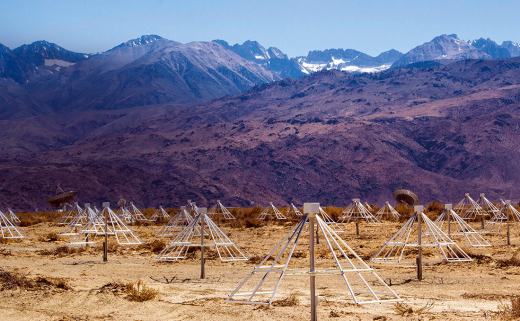
The OVRO Long Wavelength Array near Bishop, CA, will receive echoes from HAARP’s transmission

HAARP will transmit a continually chirping signal to asteroid 2010 XC15 at slightly above and below 9.6 MHz. The chirp will repeat at two-second intervals. The University of New Mexico Long Wavelength Array near Socorro, NM, and the Owens Valley Radio Observatory Long Wavelength Array near Bishop, CA, will receive the reflected signal.

“This will be the lowest frequency asteroid radar observation ever attempted,” notes Lance Benner, a co-investigator from JPL. If the experiment works it could mark a significant advance in asteroid radar. Stay tuned!

Mammal foot found in fossilized microraptor

Discovery important for reconstructing ancient food webs, scientist says

A brown/grey fossil with bones.

Mammal foot among the ribs of microraptor (Photo by Hans Larson)

An international team of scientists have discovered new evidence of a dinosaur dining on ancient mammals.

The foot of a tiny mammal was inside the stomach of a microraptor — a small feathered dinosaur that lived during the Cretaceous some 100 million years ago in temperate forests in what is now China.

It’s the first time a piece of a mammal was discovered inside a microraptor.

“Looking at interactions between animals, that’s much easier to tell in the modern biology in living animals because we can actually go out and make those observations,” said Caleb Brown, a curator of dinosaur systematics and evolution at the Royal Tyrrell Museum of Palaeontology in Drumheller, Alta.

“Trying to make those inferences for fossils is more difficult because you don’t necessarily know exactly which animal ate which other animal, unless you have exceptional cases like this.”

Artistic drawing of a dinosaur with a mammal foot in its mouth.

Reconstruction of Microraptor eating the foot of a small mammal. (Artwork by Ralph Attanasia III)

This find alone will not change understanding of Cretaceous ecosystems and how they evolved, said Corwin Sullivan, a professor in the department of biological sciences at the University of Alberta, who was involved in the new discovery.

But the discovery will contribute to the accumulation of paleontological knowledge and allow to “build up a very general picture of how food webs functioned, to some degree, in the geological past, how these various species were behaving and interacting,” Sullivan said.

“It’s rare for a preserved fossil vertebrate to have any kind of gut contents, and certainly evidence of dinosaurs eating mammals is rare.

READ MOREhttps://www.cbc.ca/news/canada/edmonton/dino-dining-on-mammals-canadian-scientists-part-of-rare-discovery-revealing-diet-of-microraptors-1.6694610

What did dinosaurs sound like?

We tend to associate dinosaurs with ground-shaking roars, but the latest research shows that this is probably mistaken.

You’d feel it more than hear it – a deep, visceral throb, emerging from somewhere beyond the thick foliage. Like the rumble of a foghorn, it would thrum in your ribcage and bristle the hairs on your neck. In the dense forests of the Cretaceous period, it would have been terrifying.

We have few clues for what noises dinosaurs might have made while they ruled the Earth before being killed off 66 million years ago. The remarkable stony remains uncovered by palaeontologists offer evidence of the physical prowess of these creatures, but not a great deal about how they interacted and communicated. Sound doesn’t fossilise, of course.

From what we know about animal behaviour, however, dinosaurs were almost certainly not silent.

Now with the help of new, rare fossils and advanced analysis techniques, scientists are starting to piece together some of the clues about how dinosaurs might have sounded.

There is no single answer to this puzzle. Dinosaurs dominated the planet for around 179 million years and during that time, evolved into an enormous array of different shapes and sizes. Some were tiny, like the diminutive Albinykus, which weighed under a kilogram (2.2lbs) and was probably less than 2ft (60cm) long. Others were among the biggest animals to have ever lived on land, such as the titanosaur Patagotitan mayorum, which may have weighed up to 72 tonnes. They ran on two legs, or plodded on four. And along with these diverse body shapes, they would have produced an equally wide variety of noises.

Some dinosaurs had greatly elongated necks – up to 16m (52ft) long in the largest sauropods – which would have likely altered the sounds they produced (think about what happens when a trombone is extended). Others had bizarre skull structures that, much like wind instruments, could have amplified and altered the tone the animals produced. One such creature, a herbivorous hadrosaur named Parasaurolophus tubicen, would have been responsible for the fearsome calls described at the start of this article.

READ MORE https://www.bbc.com/future/article/20221212-the-mysterious-song-of-the-dinosaurs

CHRISTMAS COMET ALERT

Space Weather News for Dec. 21, 2022
https://spaceweather.com
https://www.spaceweatheralerts.com

CHRISTMAS COMET ALERT: Newly-discovered Comet ZTF (C/2022 E3) is approaching Earth for a close encounter next month. It’s already within range of backyard telescopes, and a New Moon makes Christmas weekend a good time to look. Full story @ Spaceweather.com

Instant solar flare alerts: Sign up for Space Weather Alerts to receive text messages when solar flares are underway.
[] 
Above: Comet ZTF photographed by Michael Jaeger of Martinsberg, Austria, on Dec. 18, 2022

More Zines!

Lots more zines arrived while I was busy with Christmas stuff.

This is the November 2022 issue of The N3F Review of Books. N3FReview202211

This is Guy Lillian’s review of zines: TZD56

From Israel, here is CyberCozen for December CCDecember-2022-v01

From Gail in South Africa: PROBE194X

Received via the N3F:

MT VOID 2251

MT VOID 2252

MT VOID 2253


A busy week for fanzine production!  Now at https://efanzines.com are:

Andy Hooper’s CAPTAIN FLASHBACK #48

Alexiad #122 edited by Lisa & Joseph Major

Leybl Botwinik’s CyberCozen – December 2022

David Grigg’s The Megaloscope #4

Archive issues of Heath Row’s Telegraphs & Tar Pits #39-43, Explosion Containment Umbrella #4, Faculae & Filigree #16

Opuntia #539, edited by Dale Speirs

Journey Planet #66, edited by James Bacon, Chris Garcia et al

Octothorpe #72, a regular fannish podcast by John Coxon, Alison Scott and Liz Batty, is now on line

Bill

N3F: Origin and Fanactivity Gazette are attached. Happy Holidays!

origin202212

FanAct202212

From Garth Spencer: The Obdurate Eye 22

From the N3F: TNFF202212


Just added at https://efanzines.com:

Marc Ortlieb’s Knot a Fanzine #4

Garth Spencer’s The Obdurate Eye #22

Henry Grynnsten’s Wild Ideas #30

Christopher J. Garcia’s The Drink Tank #442

Journey Planet #67, edited by James Bacon, Chris Garcia et al


Bill


Montreal Science Fiction and Fantasy Association