Regarding a move to the Atwater Library: The last I heard, we were to be informed in August about when we could begin renting the auditorium. I wrote to the Atwater Library again, but no response. I’ve no idea what’s going on, and I’m getting discouraged.
Have you paid your dues? Please check with Joe! A lot of memberships are overdue!
DISPLAY
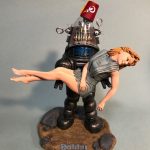
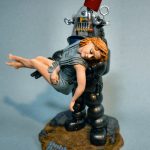
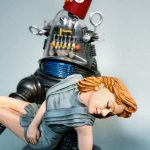
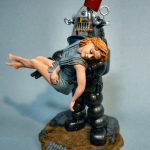
Brian Knapp sends us photos of his latest work.
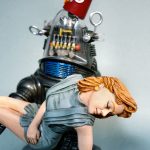
I finally finished Polar Light’s Robby the Robot from the shelf of doom. The resin base, Robby’s legs, Altaira, & the Fez are all aftermarket from Jimmy Flintstone Studios (https://jimmyflintstonestudios.com/Figurines_c_28.html). Please feel free to start a caption this segment during the next meeting, or if someone wants to write a short story.
RAFFLE PRIZES
Click the thumbnails to view full size image.
Sturmovik Neko Girl, Japanese Capsule Toy, donated by Brian Knapp.
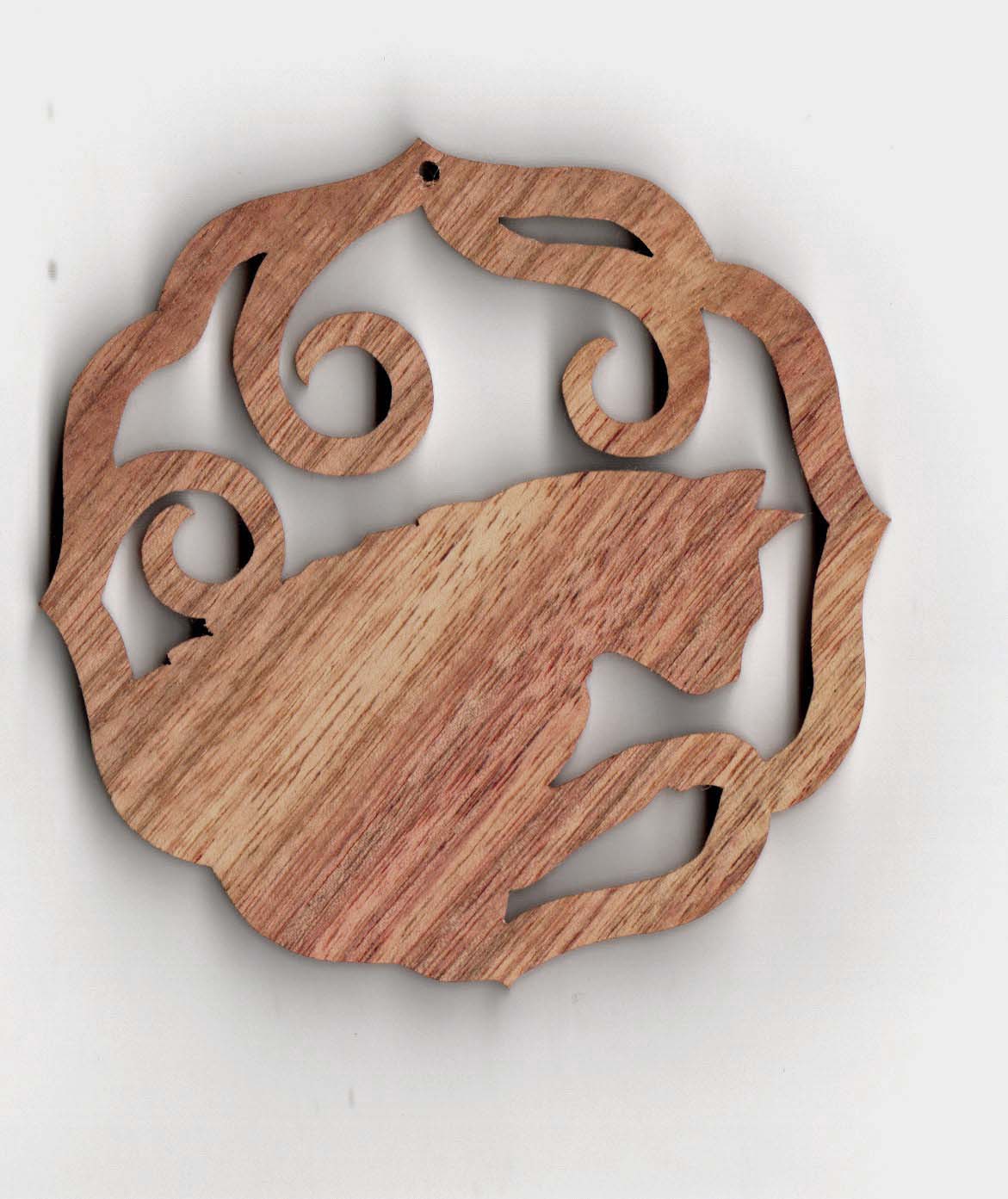
Cat licking paw, ornament designed by Sue Mey, cut by CPL from canary wood. 8cm diameter.
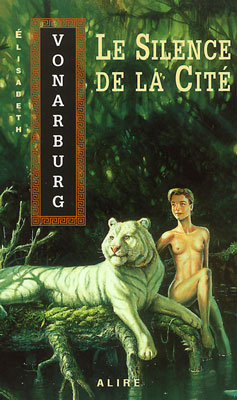
1982 – Prix Boréal 1982 – Prix Rosny-Aîné 1982 – Grand Prix de la science-fiction française From Sylvain’s collection
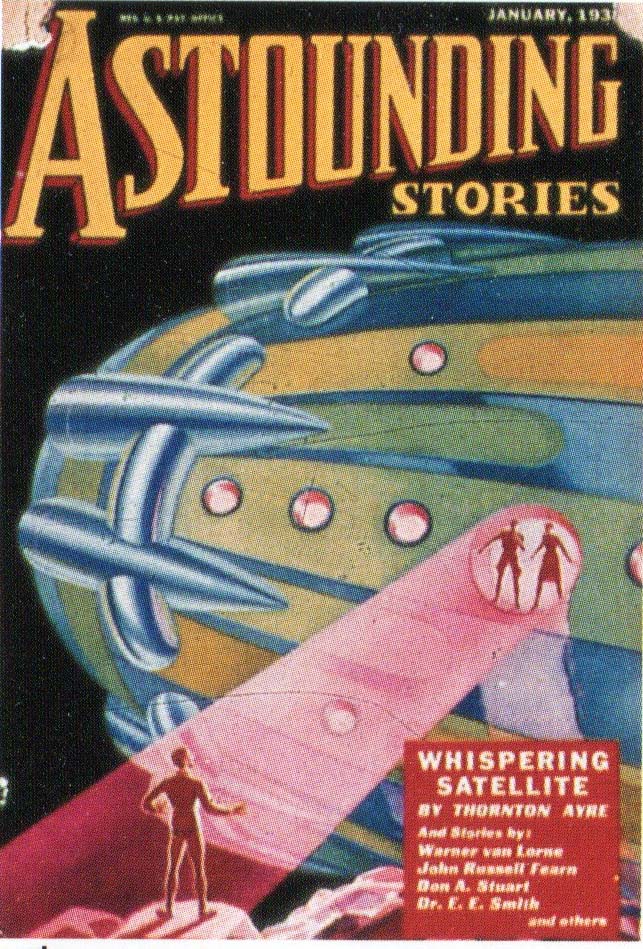
Set of 5o cards showing cover art for Astounding Magazines. Descriptions on back. From Sylvain’s legacy.
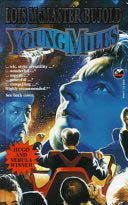
Young Miles by Lois McMaster Bujold, hardcover, pages a bit yellowed, Sylvain’s legacy
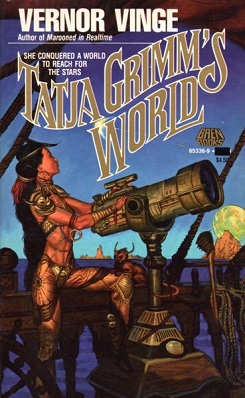
Vernor Vinge: Tatja Grimm’s World, excellent condition. Cover by Tom Kidd
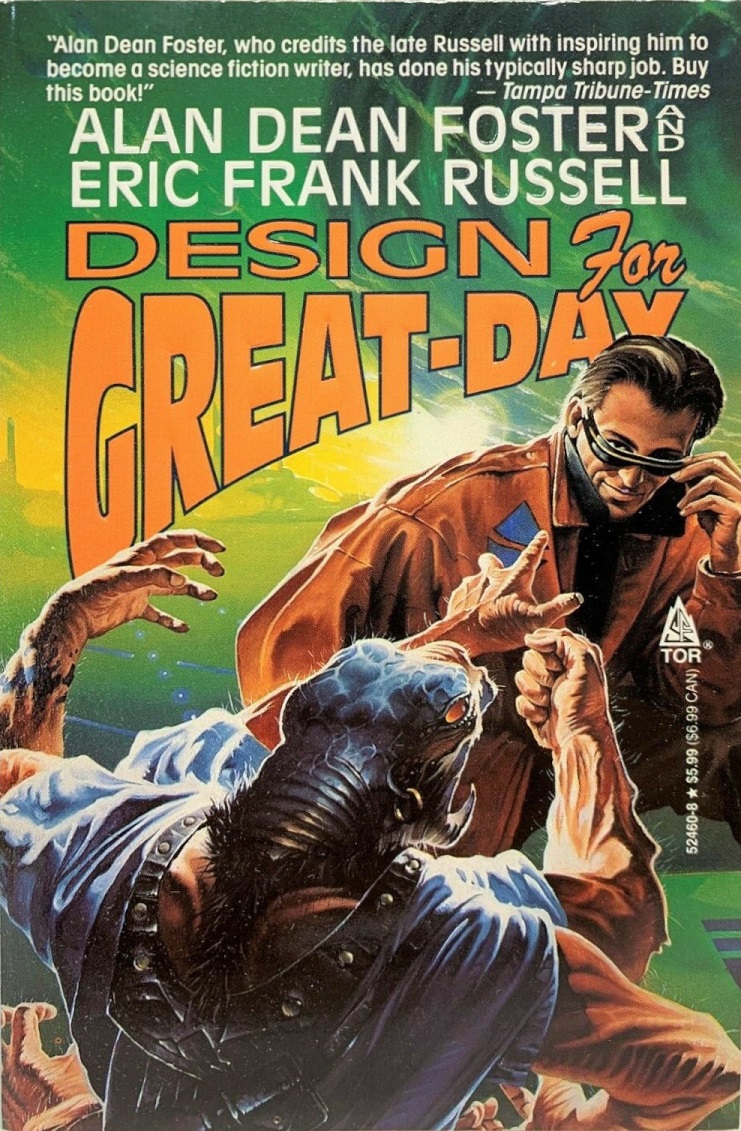
Alan Dean Foster and Eric Frank Russell: Design for Great-Day Good condition
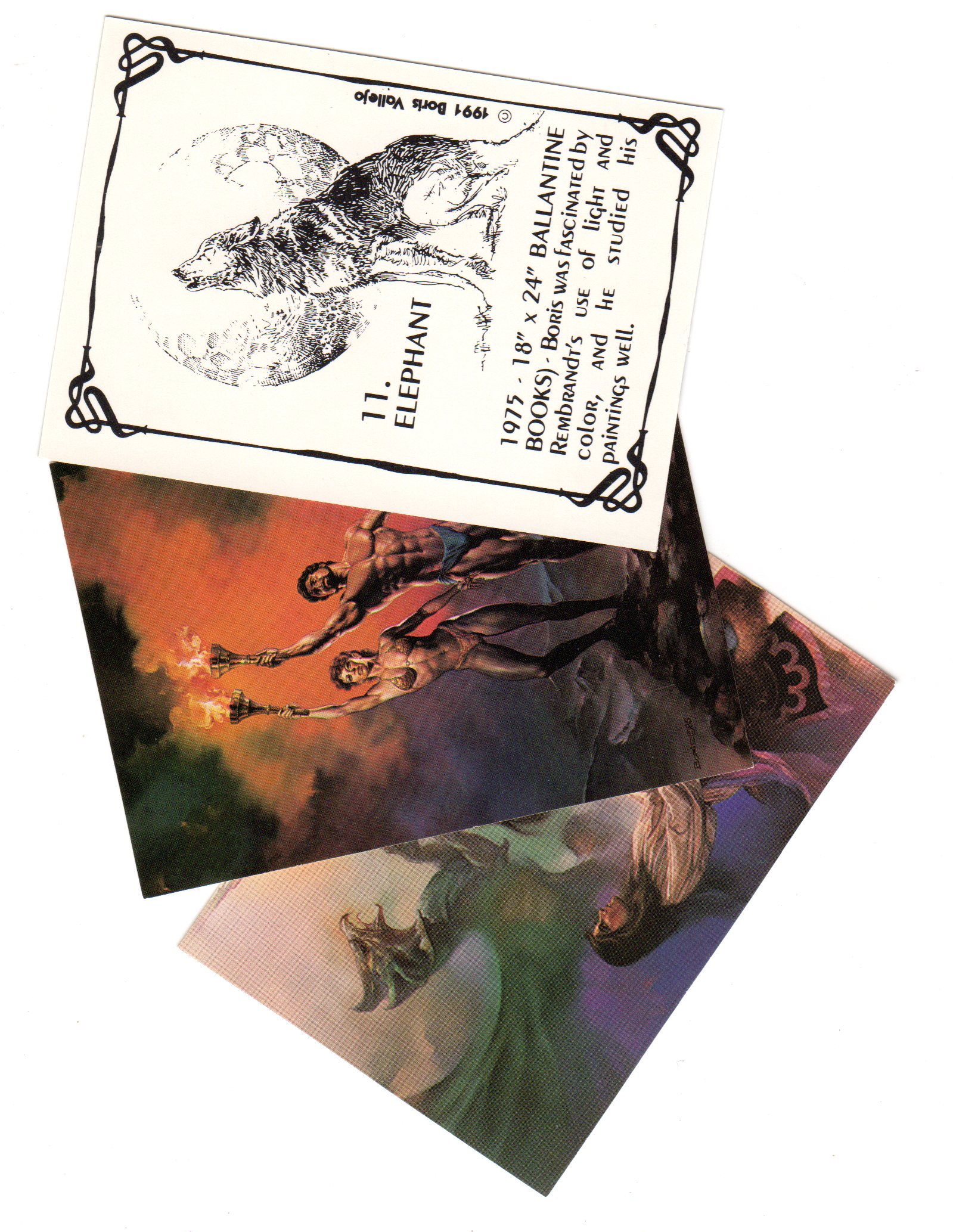
Boris, series 1, from Sylvain’s legacy, box of 90 cards, each card described on the back
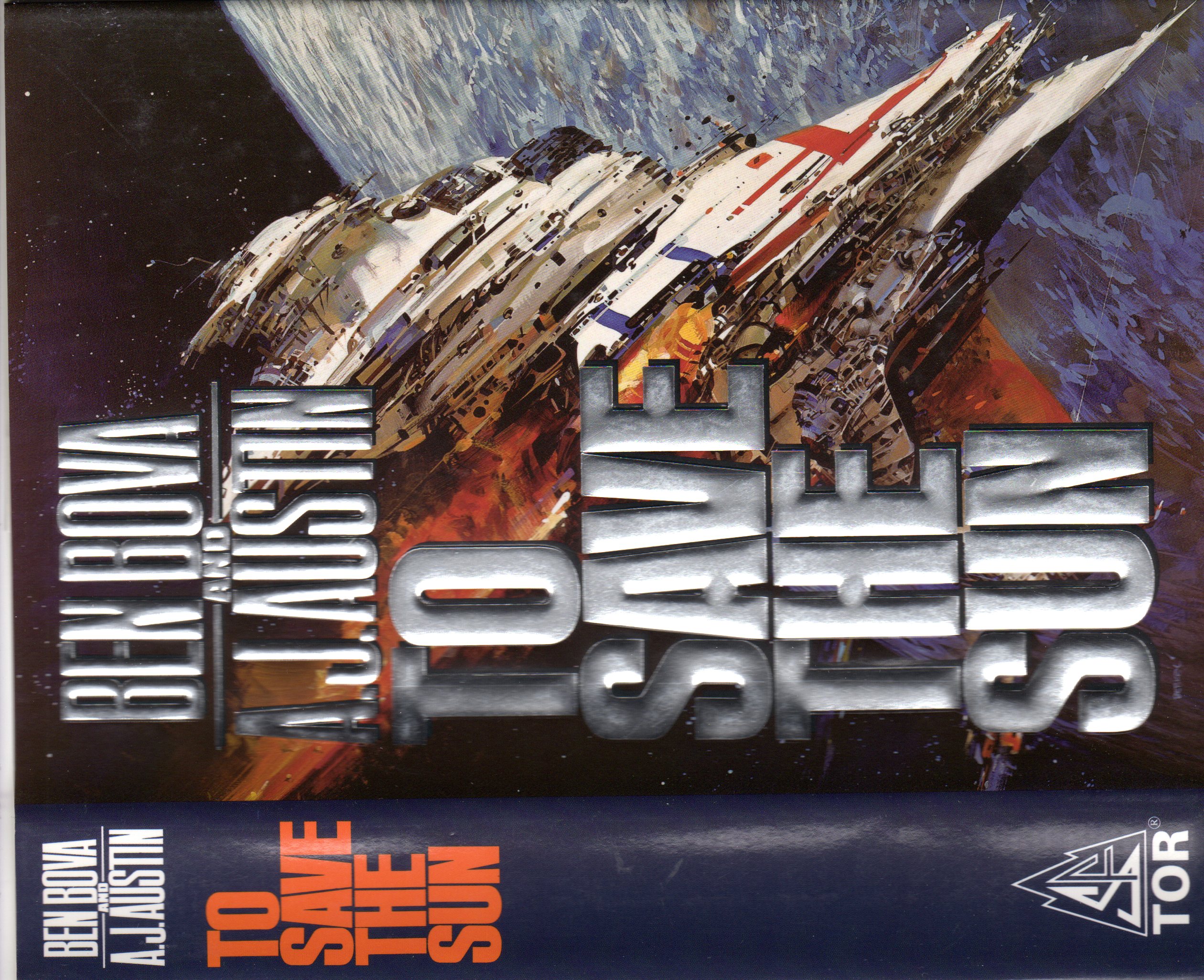
First of a duology by Ben Bova & A J Austin, dust jacket a bit scuffed, otherwise looks unread.
Concurrent with the written presentation below, which we invite all to read at some point, we’ll briefly reiterate on ZOOM this topic of The Vampire Myth, welcoming comment and fielding any questions.
Book Illustration: Varney the Vampire; or, the Feast of Blood (1847)
We will then shift the conversation, opening the floor to discuss each other’s picks for most frightening books and movies (or television episodes).
6) The horror, the horror…
From our teenage or subsequent years, we all remember a particularly spooky, suspenseful, startling, shocking, book, movie, or TV episode that creeped us out, or scared us stiff, and has stuck with us all these years!
“The Monkey’s Paw,” The Exorcist, The Haunting of Hill House, “Children of the Corn,” Psycho, Alien, the Doctor Who episode “Blink,” Invasion of the Body Snatchers, The Thing, The Blair Witch Project, the X-Files episode “Home”?… Are any of these your picks, or do you have others to put forth?
Which are your picks, and what was it about this book, and that film or TV episode, that terrified you so?
Those unable to join our ZOOM chat this afternoon may contribute nevertheless by using this post’s “Leave a Comment” feature to type in their picks, and any brief commentary. We welcome your participation.
PRESENTATION—THE VAMPIRE MYTH: FOLKLORE AND FACT
In March 2004, MonSFFA welcomed as a special guest speaker locally-based writer/editor Nancy Kilpatrick, lauded by Fangoria magazine as “Canada’s answer to Anne Rice.” An award-winning author of numerous vampire-themed novels and short stories, Ms. Kilpatrick was joined on the dais by club members Cathy Palmer-Lister and Keith Braithwaite for a panel discussion/Q&A on the topic of vampires, perhaps the most iconic terrors of horror fiction and film.
Keith’s notes on the panel capsulize that which the panel imparted to audience members:
The Vampire, an Ancient and Global Legend
Vampires, and supernatural entities that predate the term, are part of the folklore of almost every culture on Earth. While the word “vampire” is of relatively modern origin, revenants, spirits, and demons of vampiric attribute can be found in the mythologies of the ancient Mesopotamian, Greek, Roman, Hebrew, and other civilizations, and undoubtedly influenced the folklore of ensuing societies. Generally human-like in appearance, these evil, undead creatures feasted on a diet of human blood, and sometimes flesh.
Descriptions of vampires vary from region to region, country to country.
Certain European vampires are distinguished by red hair and a characteristic cleft lip, or harelip. The Bavarian variety sleeps with its left eye open and its thumbs linked. Purple-faced are Russian vampires, according to legend, while the Bulgarian type is distinguished by its single nostril.
Some Chinese vampires are said to draw their strength from the light of the moon, others come to be by way of magic, these drawing “qi,” or life-force from their victims. A hopping gait and fuzzy, greenish skin are unique characteristics.
Several female vampires are to be found in Southeast Asia and Oceania. Appearing as beautiful women by day, they transform by night into winged freaks with a taste for entrails, blood, or human foetuses! These fiends sport an elongated, hollow tongue with which to feed. Some are capable of severing their upper torsos in order that they may fly off into the night to prey upon sleeping pregnant women.
The Mexican vampire is readily recognized as a ghastly chimera, its horrific face a fleshless skull. Further north, reportedly dwelling in the Rocky Mountains, is a vampire that feeds through its nose, sucking blood from its victims’ ears!
The Western Vampire
Stemming almost entirely from the Balkans in Eastern Europe, the Western archetype of the vampire, that of a preternaturally strong, virtually immortal, blood-feasting creature of the night, is but one of many variations when considering vampire mythology, worldwide. The Western vampire, however, is arguably the world’s best known and most popular, no doubt due, at least in modern times, to the widespread exporting of Western culture.
The archetypal Western Vampire was hilariously spoofed in the1963 Merrie Melodies animated short “Transylvania 6-5000.”
Travellers visiting the remote regions of 16th century Transylvania returned home with strange and terrifying tales of ungodly devils, monstrosities neither living nor dead, which feasted on human blood under darkness of night. These abominations were called, variously, “vurculac,” “wampyr,” and “vampire.”
Transylvanian and other Eastern European vampires shared common characteristics. The legends tell of hellions gaunt in appearance, pale of complexion, having full, red lips, pointed canine teeth, and long, sharp fingernails. They exuded a foul stench, likened to that of a rotting corpse. They possessed superhuman strength, supposedly derived from their diet of blood, and cast a hypnotic gaze upon their prey from behind demonically gleaming eyes. They also possessed an uncanny shape-shifting ability and were able to assume the forms of a variety of animals, and further, to command the nocturnal faunae of the forest.
The Science and the Superstition
Fear and superstition fed the vampire myth during the late Middle Ages, the prevalent conjecture being that these nightmarish monsters were evil spirits capable of inhabiting and animating corpses for malevolent purposes. Alternately, persons viewed as sinful or wicked for one reason or another—suicides, those excommunicated from the church, or buried without appropriate rites—might return from the grave, some believed, “reborn” as vampires. Barred from the afterlife, the souls of these vile individuals continued to utilize their lifeless bodies.
But vampire lore did not grow exclusively from superstitious fantasy. Circumstances very real contributed, as well, to the making of the myth.
Unsolved mass murders and cattle mutilations by wild animals are among the kinds of incidents in those days that provided ample fodder for tales of vampirism. The surreptitious removal of corpses from graves by, for example, sexual deviants like necrophiliacs, left behind indisputable “proof” that the dead could leave the grave to any predisposed to such beliefs. And one can easily imagine that the rare, crazed person driven by a pathological or physiological thirst for human blood would quickly be deemed a vampire by his or her frightened neighbours.
Commonly believed to be a source of vampire legend was premature burial. Several centuries ago, it was not unusual for comatose or cataleptic individuals, or even falling-down drunks, to be mistaken for dead, and so buried alive. It is theorized that when subsequent exhumations found that their bodies had not decomposed as a dead body normally would, rumours that these poor unfortunates were vampires soon spread.
One episode in Serbia prompted the government to send a detachment of soldiers, including a few army surgeons, to investigate a village whose panicked inhabitants were suffering an apparent epidemic of vampirism. Thirteen graves were opened and only three bodies were deemed to be undergoing the normal process of decomposition. The others, some longer underground than those three, were reportedly rosy-cheeked, firm of flesh, and when dissected, found to have within them fresh blood. They were promptly decapitated and burned to ashes.
Such anecdotes, inevitably enhanced with each recounting, were picked up by travellers and spread throughout Europe, fuelling the vampire myth.
Also contributing to the myth were the noble Slavs of the 1400s, whose interbreeding resulted in a number of genetic disorders, including a rare disease, erythropoietic protoporphyria, which was not diagnosed until the 19th century. This disease is a pigment disorder which causes the body to produce an excess of protoporphyin, basic to red blood cells. Symptoms include unbearable itching, redness and edema, and bleeding cracks in the skin after brief exposure to sunlight. The physical appearance of those who suffered from this affliction, and their necessary avoidance of daylight, fed right into the belief in vampires.
The Vampire in Art
For centuries, artists have depicted vampires, from great works of fine art to commercial illustrations for books, comics, films and other forms of pop culture. Here is a sampling:
The Vampire (1897), by Sir Philip William Burne-Jones. This painting was exhibited at The New Gallery in London just a few months prior to the first publication of Bram Stoker’s Dracula. The artist, son of British pre-Raphaelite painter Sir Edward Coley Burne-Jones, never achieved his father’s level of recognition and fame, and is known largely for this single work of art, and the story behind it.
Sir Philip was, briefly, involved romantically with beautiful actress Beatrice Rose Stella Tanner, better known by her stage name, Mrs. Patrick Campbell. But his infatuation with her was rather more than hers for him, and she soon left him heartbroken. Painting from memory, he modelled his vampire after her.
Inspired by the image, Sir Philip’s cousin, Rudyard Kipling, wrote a poem about a foolish man destroyed by a heartless woman, which helped to drum up publicity for the painting prior to its exhibition. Sir Philip displayed a copy of the poem alongside his artwork.
Shown here is a printed reproduction of The Vampire from an illustrated period publication of Kipling’s poem. The actual painting’s whereabouts are currently unknown; Sir Philip may have sold the work, or destroyed it.
Love and Pain (1895), by Edvard Munch. The esteemed Norwegian artist painted six different versions of this scene between 1893 and 1895, and later in his career, returned yet again to his depiction of a woman kissing a man on the neck. The kiss, the man’s submissive pose, and the woman’s flaming red hair led some to interpret the painting to be of a vampire embracing her victim. Though sometimes called Vampire, Munch never referred to as, or so named his work. Yet today, this painting is liberally interpreted as vampire-themed by enthusiasts.
Another work so interpreted is Une semaine de bonté (1934), a collage novel and artist’s book by Max Ernst. Created by clipping images from Victorian novels and encyclopaedias, and combining and arranging these to create new pictures, Ernst was inspired by the Dadaist and Surrealist movements. He divided his work into seven sections, each named for one of the days of the week, with each having a theme, one of which was “Blood.” The work consists of five volumes, for which the artist created 182 dark, bizarre, dreamlike images. One in particular has been widely taken to be that of a vampire, here reproduced.
Creatures of the Night (1969), by Frank Frazetta. The venerated “Godfather of Fantasy Art” celebrated two classic monsters with this canvas, perhaps the two most famous of all. And one of them is a vampire!
Vampirella is a comic book superheroine and, for all intents and purposes, vampire pin-up girl! She was co-created in 1969 by noted science fiction fan/literary agent/magazine publisher Forrest J Ackerman and pioneering underground comix artist Trina Robbins—it was Robbins who came up with the lovely lady’s revealing costume. Frazetta painted Vampirella for the first edition of her self-titled comic book series, but the artist most associated with the character is José Gonzáles, whose iconic rendering (left) was made into a popular poster (1972).
In 2010, Joe Jusko employed Vampirella to pay homage to Ackerman, who had died two years earlier (right).
Zora la Vampira (1972-1985) was an erotic/horror comic book series about a female vampire’s sexually-charged adventures as she sought to satisfy her taste for both blood and sex! She was one of many such supernatural characters in the fumetti tradition of sex, violence, and horror. Fumetti are, simply, Italian comic books. This cover illustration was painted by one of the most talented artists of the genre, Alessandro Biffignandi.
Commercial Art: A British merchandise and jewellery designer, and contemporary fantasy illustrator, Anne Stokes (www.annestokes.com) has produced artwork for books, record albums, and games, including Dungeons & Dragons. Her art has also been licenced for posters, T-shirts, calendars, jigsaw puzzles, tarot and greeting cards, coffee mugs, and jewellery. This piece (left), entitled Await the Night, is from her Gothic Collection and was adapted, too, as a collectible figurine.
To the right is cover art produced for a paperback vampire novel, circa 1960; the artist is unknown and likely one of the many unsung in-house commercial illustrators hired to turn out such artwork.
The best Vampire Movie Posters featured dynamic designs and gloriously garish artwork rendered in a variety of styles.
The Vampire on Page and Screen
History’s poets and writers have showcased the vampire over the centuries, some adding to the mythology an erotic element. Among the most influential works of the early 19th century was “The Vampyre” (1819), a short story written by John William Polidori (1795-1821), personal physician to Romantic poet Lord Byron.
During the summer of 1816—the so-called Year Without a Summer, a recent volcanic eruption having caused unusually cool temperatures and heavy rain over Europe—Byron welcomed guests to his rented villa near Lake Geneva, Switzerland. In the evenings, the group amused themselves telling ghost stories by the fire, until their host proposed that they each write a horror story of their own. Polidori’s “The Vampyre” came of this challenge, which also, famously, begat Mary Shelley’s Frankenstein; or, the Modern Prometheus (1818).
Victorian vampire tales often featured an alluring, elegant neck-biter, seductively preying on young, virtuous women who find themselves at the same time repelled by and attracted to the gentleman. Gothic horror virtuoso Joseph Sheridan Le Fanu’s (1814-1873) novella, Carmilla (1872), offered readers a Sapphic angle, his titular character the template for many a lesbian vampire to come.
Carmilla, book illustration (1872)
Byron, Goethe, Tolstoy, Théophile Gautier, and Alexandre Dumas, pére are among the literary greats who were inspired by the vampire. Contemporary novelists Anne Rice, Chelsey Quinn Yarbro, Laurel Hamilton, Montreal-based Nancy Kilpatrick, Stephanie Meyer, Richard Matheson, George R. R. Martin, Stephen King, and countless others, followed in their footsteps.
The German silent-film classic Nosferatu (1922) stars Max Schreck as vampire Count Orlok. The film was an unauthorized adaptation of Dracula, produced for German audiences—thus were the details changed to so reflect—but Stoker’s heirs successfully sued, nonetheless, resulting in the court ordering all prints of the film destroyed. Fortunately, some copies survived as the film is, today, considered a masterpiece of German Expressionist cinema, not to mention a prototype of the vampire movie.
Advancing the genre on screen were films like F.W. Murnau’s silent classic Nosferatu: A Symphony of Horror (1922), Tod Browning’s definitive Dracula (1931), and the numerous vampire pictures of the Hammer Horror oeuvre (1958-1974) starring Christopher Lee, Peter Cushing, Ingrid Pitt, and others.
Bela Lugosi in Universal Pictures’ Dracula (1931), a role that forever defined the actor.Christopher Lee played Dracula in all but two of Hammer Films’ nine Dracula films.
More recent fare has included The Hunger (1983), Fright Night (1985; remade 2011), The Lost Boys (1987), the Francis Ford Coppola-directed Bram Stoker’s Dracula (1992), 30 Days of Night (2007), the Swedish Let the Right One In (2008; remade in English as Let Me In, 2010), as well as television series like the Canadian-made, Toronto-set Forever Knight (1992-1996), Joss Whedon’s Buffy the Vampire Slayer (1997-2003) and its spin-off, Angel (1999-2004), True Blood (2008-2014), and The Vampire Diaries (2009-2017).
Forever Knight: modern-day Toronto police detective Nick Knight is a guilt-ridden, 800-year-old vampire in search of redemption, and a way to again become human.TV’s vampire slayer Buffy Summers, right, with the two principal vampires in her life, Spike, left, and Angel, center.The Vampire Diaries: Elena Gilbert (Canadian actress Nina Dobrev) becomes involved in a love triangle with vampire brothers Stephan (Paul Wesley) and Damon Salvatore (Ian Somerhalder).
Thomas Peckett Prest (1810-1859), a hack writer and prolific author of penny dreadfuls, co-wrote with James Malcolm Rymer (1814-1884) perhaps the first vampire best-seller, Varney the Vampire; or, the Feast of Blood (serialized 1845-1847; book, 1847). The gory tale predated by 50 years that undisputed masterwork of vampire fiction, penned by a relatively unknown Irish writer who, early in his career, had served as an unpaid theatre critic for the Dublin Evening Mail, a newspaper co-owned at the time by the aforementioned Le Fanu.
Right: First edition, Dracula (1897); Left: Book cover, Varney the Vampire; or, the Feast of Blood (1847)
Abraham “Bram” Stoker’s (1847-1912) Dracula was first published in 1897 and his Transylvanian count has come to epitomize the vampire.
Bram Stoker, circa 1906
Stoker’s research of Eastern Europe’s vampire legends, while preparing to write his novel, led him to the grisly stories surrounding one of history’s most savage figures, Vlad Basarab.
Vlad the Impaler
Stoker based his fictional blood-thirsty count in part on this very real and equally blood-thirsty late-1400s ruler of Wallachia, now part of southern Romania. Vlad III, also known as Vlad Tepes or Vlad the Impaler, was a son of the notoriously cold-blooded Prince Vlad Dracul (translates as “dragon”). Vlad the younger thus became Draculaea, or Dracula, son of the dragon.
Portrait of Vlad III, one of history’s most barbaric personages, commonly known by the appellation “Vlad the Impaler.”
Vlad Dracula was a formidable warrior but it his sadistic brutality that earned him his inhuman reputation. According to various historical accounts, he would have his victims flayed, dismembered, and roasted or boiled over flame, among other torments. But his favourite means of execution was to impale his victims on long wooden stakes, which brought about a slow and excruciatingly painful death. Men, women, even children, noble or peasant, were not spared his unusual malice. The crossroads and fields surrounding his castle were a hellish display of impaled corpses. In one rampage, some 30,000 met their end on the stake! While reports of his barbarity differ as to details, there are sufficient affidavits from various sources to conclude that Vlad Dracula was, indeed, one of history’s most diabolical personages.
German woodcut (1499) depicting Vlad III’s savagery.
Elizabeth Báthory
Another historical figure whose supposed cruelty contributed to the vampire myth was the comely Hungarian countess Elizabeth Báthory de Ecsed, who began a bloody spree about 100 years after Vlad Dracula died.
Initiated into the black arts by her manservant and her nurse, she is believed to have engaged in macabre pleasures which involved the drinking of human blood. With her husband often away at war, and later, following his death by undetermined causes, Báthory and her minions would lure young, chaste girls to her castle with promises of employment as servants. But once there, these innocents would be hung on chains, their veins opened, and their blood drained so that the countess, obsessed with her own beauty, might bathe in their virgin blood, which she apparently believed would preserve her youthfulness. This and other devilish tortures awaited any maiden who found herself within the walls of the countess’ Castle Csejthe!
Portrait of Hungarian noblewoman Countess Elizabeth Báthory de Ecsed, the notorious “Blood Countess,” sometimes called Countess Dracula, she was convicted of murdering hundreds of women.
Having grown careless disposing of her victims’ bodies, she was eventually found out, arrested, and brought to trial. As a noblewoman, she was spared the execution meted out to her accomplices. Instead, she was walled up in her bedchamber, with only a narrow slit in the masonry permitted, through which she received food and water. She died after four years of this imprisonment.
Báthory’s depraved excesses may well have been exaggerated with repeated tellings, and some historians argue that her crimes might also have been purposely embellished to politically benefit her aristocratic rivals. Others speculate that she was almost certainly that rarity, a female sexual sadist and serial killer.
Often cited as an inspiration, it must be noted that Stoker’s research for Dracula may, or may not have extended to Báthory’s blood-soaked story.
The Vampire Endures
Today, the vampire is a fixture of popular culture and, arguably, the most preeminent monster of horror literature and film, with tabletop RPGs and video games like Vampire: The Masquerade and Castlevania extending the mythos further still.
The unquestionable appeal of the vampire has been tied by some to blood, coursing through our bodies, the life-sustaining essence of our very lives, and additionally has been posited as our means of metaphorically coping with a supressed desire for sexual abandon, as well as the dread of our own mortality. So beguiling are Dracula and his cohorts that within the Goth subculture, for example, adherents of “sanguine vampirism” actually drink each other’s blood, motivated by a potent fascination with the fiction, the established aesthetic and lifestyle, an occult belief, or for some, a cult-like devotion to the long and terrible legacy of the vampire throughout human history.
A less expansive version of this primer was published in Warp 57 (Spring 2004).
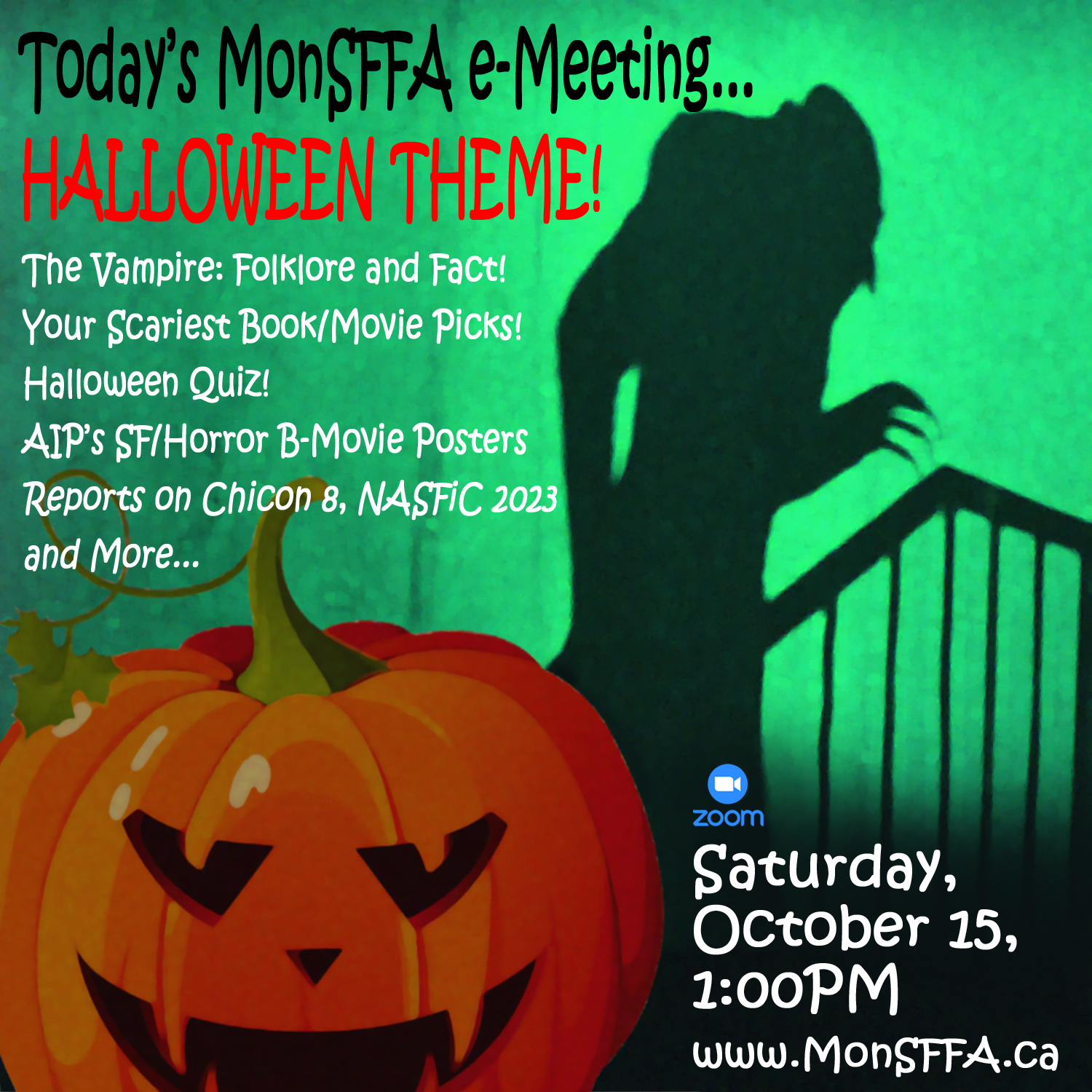
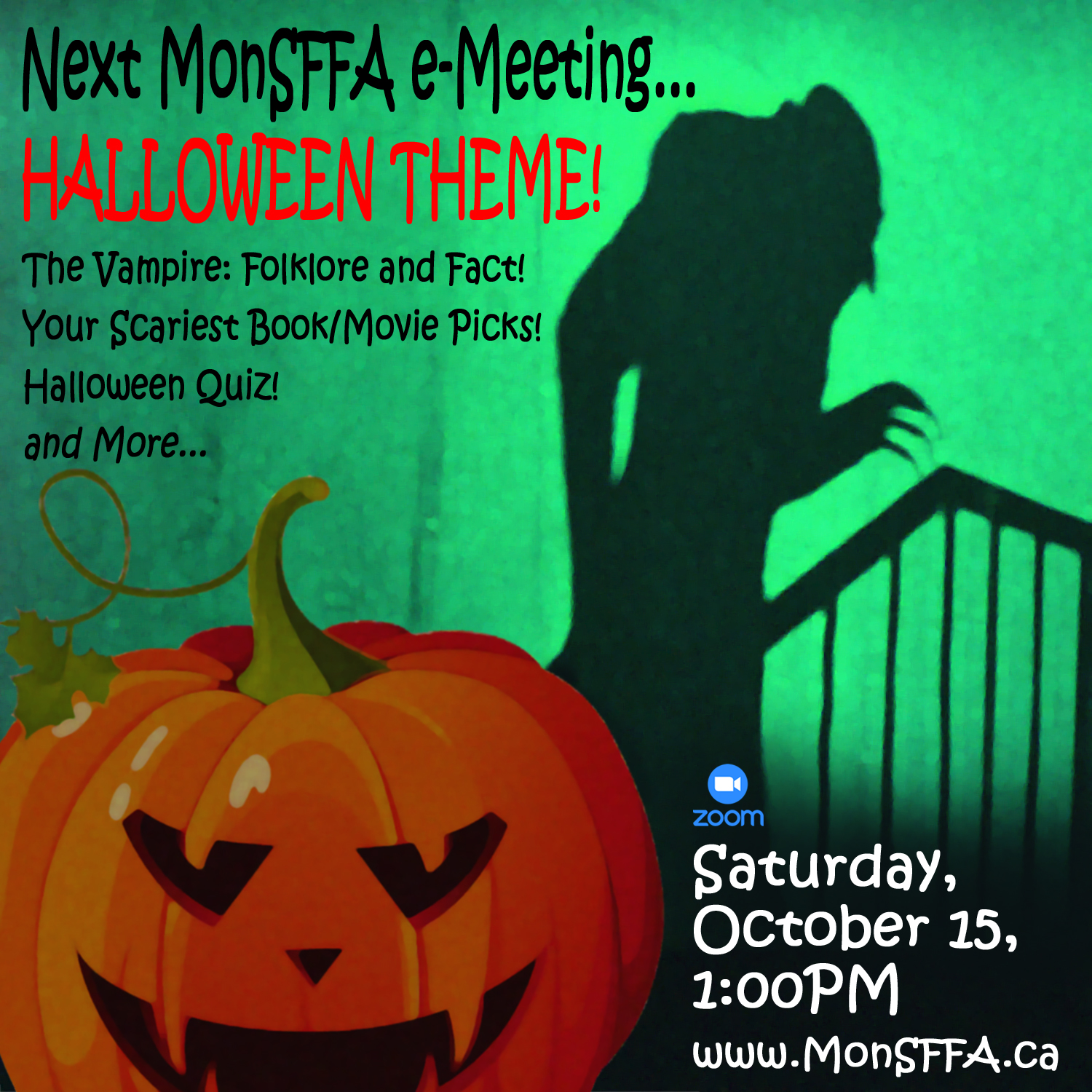
Welcome to MonSFFA’s Halloween 2022 e-Meeting! We hope you have a spooktacular few hours with us this afternoon…
Settle into your most comfortable chair, tasty treats at hand—the ones you are supposed to be handing out to all the Trick-or-Treaters in two weeks!—along with a good cup o’ Joe, and join us for an afternoon of sci-fi/horror fun and conversation.
Today, we’ll be exploring vampire mythology, talking scary books and movies, and, after being regrettably scrubbed last meeting because of unforeseen circumstance, we’ll hear those convention reports on the recent Chicon 8, and next year’s NASFiC, which will be hosted by Winnipeg. This will mark the very first time the NASFiC will take place outside of the U.S.
All of this, and more, awaits, so let’s get started!
If you’re not fully equipped to ZOOM, you can also join in by phone (voice only); in the Montreal area, the toll-free number to call is: 1-438-809-7799. Outside of the city? Find your local number here: Phone to ZOOM!
Also, have this information on hand as you may be asked to enter it:
Meeting ID: 881 2635 6895
Passcode: 120606
To survive until the ’morrow on Halloween, call 1-800-666!
On a scale of 1-10, with “1” being the least and “10” being the most, rate the sincerity of this pumpkin patch.
3) MEETING AGENDA
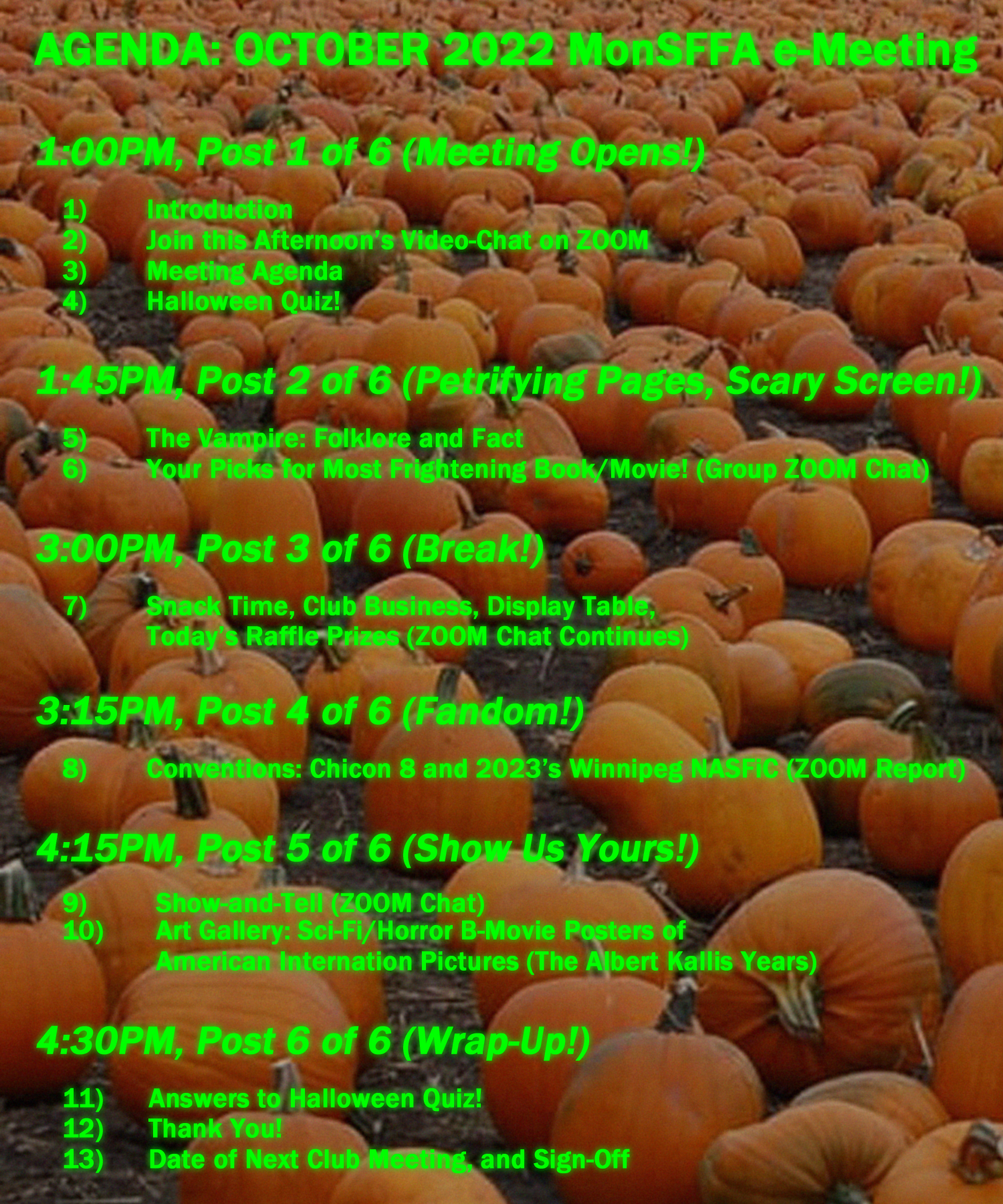
Here is the agenda for this afternoon’s gathering of the fannish:
As always, all scheduled programming is subject to change.
4)
Lindsay Brown has prepared a Halloween Quiz for the occasion of this, our 2022 Halloween e-meeting! Those participating, today, on ZOOM will have a go at the quiz to kick off the afternoon’s chat; the answers will be revealed in our closing post of the afternoon, at 4:45PM.
Says Lindsay, “Happy Halloween trivia!”
1) Halloween is the day before which holiday?
2) The tradition of making Jack-o-Lanterns to ward off evil spirits is thousands of years old. Which vegetable were they originally made out of?
3) According to superstition, if you stare into a mirror at midnight on Halloween, what will you see?
4) Which region in the world do pumpkins originate from?
5) Who wrote the novel Frankenstein?
6) Transylvania is a region in which country?
7) Halloween has its origins in which ancient Celtic festival?
8) Which actor played Dr. Frank-n-Furter in The Rocky Horror Picture Show?
9) Is a pumpkin a fruit or vegetable?
10) What is the significance of seeing a spider on Halloween?
11) Which country celebrates the Day of the Dead starting at midnight on October 31?
12) According to superstition, a person born on Halloween has what particular ability?
13) Who directed The Nightmare Before Christmas?
14) Which vampire said, “Don’t be afraid. I’m going to give you the choice I never had.”
15) How many people were hanged during the Salem Witch Trials?
16) Every Halloween, Charlie Brown helps his friend Linus wait for what character to appear?
17) What do people “bob” for on Halloween?
18) Who is said to haunt the White House Rose Garden?
19) Pumpkins can be orange, white, green, or what other colour?
20) In The Texas Chainsaw Massacre, how many people are killed with a chainsaw?
21) What’s the body-count for the film Halloween?
22) Which year was the movie Freaks made?
23) In the original Alien film, how many alien eggs were made for the egg chamber inside the downed spacecraft?
If you’re not fully equipped to ZOOM, you can also join in by phone (voice only); in the Montreal area, the toll-free number to call is: 1-438-809-7799. Outside of the city? Find your local number here: Phone to ZOOM!
Also, have this information on hand as you may be asked to enter it:
Meeting ID: 881 2635 6895 Passcode: 120606
We’ll see you in just three hours!
One more thing: to survive until the ’morrow on Halloween, call 1-800-666!
This month’s roundup: • More Yiddish-related SF material dedicated to my dear departed father, David Botwinik (o”h – ע”ה ): o Chapter C of “Kamf-Nign” Yiddish SF short story by Leybl Botwinik (with English translation) • Book review: “More Zion’s Fiction” o Story #09: “The Thirteenth Fairy” – by Nadav Almog Our usual tidbits from the Web – in our next issue.
– Your editor, Leybl Botwinik
From Nic Farey
Beam17r3 Has a totally gorgeous cover from Alan White.
Passed on to us by the N3F, Mt Void from the Leepers.
J.L. Farey’s JenZine #2
Archive issues of Heath Row’s Telegraphs & Tar Pits #31-34, Faculae & Filigree #15, and new title Explosion Containment Umbrella #1 & 2
Christopher J. Garcia’s The Drink Tank #441
David Grigg’s The Megaloscope #3 Opuntia #535, edited by Dale Speirs
Leybl Botwinik’s CyberCozen – October 2022
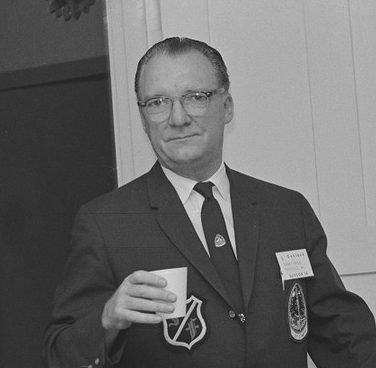
Robert Madle, 1968, photo by Jay Kay Klein, UC Riverside Libraries
Fan, collector, and bookseller Robert A. Madle, 102, died peacefully in his sleep on October 8, 2022. Madle was a founder and the first president of First Fandom (and the last survivor of the original membership), and was a warm and familiar presence in the field since the 1930s.
Robert Albert Madle was born June 2, 1920 in Philadelphia PA. He enlisted in the Army in July 1942, serving three-and-a-half years, working as a truck driver and teletype operator. He met his wife Billie in the latter job, while she was a switchboard operator. He also worked in the Army’s public relations office. He was married during the war, then attended college and went for his MBA. He worked for the government in the Navy Department, doing personnel research, and later became a research psychologist studying human/machine interfaces. He was also a book collector and dealer, continuing to sell by mail order even in his later years.
Madle began reading SF as 13-year-old in 1933 with Tom Swift and Edgar Rice Burroughs, then discovered the pulp magazines and became active in fandom soon after. An organizer from the first, he formed the Boys’ Science Fiction Club with a few friends in 1934. He attended the 1936 gathering in Philadelphia that Donald A. Wollheim dubbed “The first science fiction convention,” was active in the Philadelphia Science Fiction Society, and was generally a pillar of Philly fandom. He spread his love for organizing wherever he went, serving as a trustee of Washington Science Fiction Association, and founding the Carolina SF Society in North Carolina in the ’50s.
He attended the first Worldcon in 1939 and was the 1957 TAFF winner, writing trip report “A Fake Fan in London” afterward. He was Fan Guest of Honor at SunCon, the 1977 Worldcon and was a frequent guest at other conventions. He helped organize Worldcons and was involved in the creation of the Hugo Awards.
Madle was active in fanzine circles, where he was best known for Fantascience Digest (1937-41). His first fanzine was one issue of The Science Fiction Fan (1935) with John V. Baltadonis. They started Imaginative Fiction in 1935, continuing it intermittently until 1938. He also worked on Fantasy Fiction Telegram and wrote a column, “Fantaglimmerings”, for The Science Fiction Collector. He was a founder of New Era Publishers with Jack Agnew and Al Pepper, publishing David H. Keller’s Solitary Hunters and the Abyss (1946). He wrote many letters to SF magazines, his first appearing in Pirate Stories (July 1935), with others in Astounding Stories, Amazing Stories, Weird Tales, and more.
An occasional SF writer, his story “Devolution” appeared in his own Imaginative Fiction (1936). Other stories include “Brain, the Creator” (1936, with Corwin F. Stickney), “Black Adventure” (1937), and “The Infinite Vision” (2006).
Madle won the Big Heart Award in 1974, the First Fandom Hall of Fame Award in 1990, and the Moskowitz Archive Award in 2002. He was a nominee for the Best Feature Writer Hugo Award in 1956. His Fantascience Digest was a Retro Hugo Award finalist in 2014. He is survived by his daughter Jane.
The Corflu Pangloss fanzine auction catalog and bid sheet may be viewed on Andy Hooper’s page. The auction will be held at Corflu over the weekend of October 21-23 2022
Rich Lynch’s My Back Pages #27
Ethel the Aardvark #216 and archive issues 14, 184
Octothorpe #67, a regular fannish podcast by John Coxon, Alison Scott and Liz Batty, is now on line
Fiction
2 … A Desolation Called Peace by Arkady Martine … Review by Perry Middlemiss
2 … All the Myriad Ways by Larry Niven … Review by Perry Middlemiss
2 … All the Sounds of Fear by Harlan Ellison … Review by Perry Middlemiss
3 … The Book Club by J.H. Nadler … Review by Jason P. Hunt
5 … The Butlerian Jihad by Kevin J. Anderson and Brian Herbert … Review by Graham Bradley
6 … Children of Blood and Bone by Tomi Adeyemi … Review by Chris Nuttall
8 … The Dragon Proofed House by L.E. Henderson … Review by Jim McCoy
10 … Dangerous Visions #1 edited by Harlan Ellison … Review by Heath Row
11 … Elder Race by Adrian Tchaikovsky … Review by Perry Middlemiss
12 … Hail Mary Project by Andy Weir … Review by Perry Middlemiss
12 … If It Bleeds by Stephen King … Review by Jon D. Swartz
14 … Imaginary Friends by Arlene F. Marks … Reviewed by Robert Runté
15 … Lisey’s Story by Stephen King … Review by Perry Middlemiss
15 … Me, Myself, and Bob by Phil Vischer … Review by Pat Patterson
17 … Metaphysical Machines/Maquinas Metafisicas by Heinzy Cruz … Review by Heath Row
18 … Other Rhodes by Sarah A. Hoyt … Review by Pat Patterson
19 … The Past is Red by Catherynne M. Valente … Review by Perry Middlemiss
19 … Penance by Paula Richey … Review by Declan Finn
21 … The Seance by John Harwood … Review by Perry Middlemiss
23 … Semper Paratus: An Anthology of the Apocalypse edited by Jamie Ibson and Chris Kennedy
… Review by Pat Patterson
24 … The Shadowed Sun by N.K. Jemisin … Review by Chris Nuttall
27 … Sleepless Hollow by Graham Bradley … Review by Michael Gallagher
29 … Songs That the Astral Crickets Shall Sing by Luis G. Abbadie … Review by Heath Row
30 … A Spindle Splintered by Alix E. Harrow … Review by Perry Middlemiss
Non-Fiction
31 … The Life & Art of Dave Cockrum by Glen Cadigan … Review by Heath Row
32 … The Story of Batman by Charles Lee Jackson II … Review by Heath Row
32 … The Story of Superman by Charles Lee Jackson II … Review by Heath Row
33 … What Is Dungeons and Dragons? by John Butterfield, Philip Parker, and David Honigmann
… Review by Heath Row
Literary Criticism
35 … The 2022 Hugos: How I Voted and Why by Tom Feller, with reviews of:
Novels
Project Hail Mary by Andy Weir—
The Galaxy, and the Ground Within by Becky Chambers—
A Master of Djinn by P. Djeli Clark—
A Desolation Called Peace by Arkady Martine—
Light From Uncommon Stars by Ryka Aoki—
She Who Became the Sun by Shelley Parker-Chan—
Novellas
Across the Green Grass Fields by Seanan McGuire—
Elder Race by Adrian Tchaikovsky—
Fireheart Tiger by Aliette de Bodard—
The Past is Red by Catherynne M. Valente—
A Psalm for the Wild-Built by Becky Chambers—
A Spindle Splintered by Alix E. Harrow—
Novelettes
Bots of the Lost Ark by Suzanne Palmer—
Colors of the Immortal Palette by Caroline M. Yoachim—
L’Esprit de L’Escalier by Catherynne M. Valente—
O2 Arena by Oghenechovwe Donald Ekpeki—
That Story Isn’t the Story by John Wiswell—
Unseelie Brothers, Ltd. By Fran Wilde—
Short Stories
Mr. Death by Alix E. Harrow—
Proof by Induction by Jose Pablo Iriate—
The Sin of America by Catherynne M. Valente—
Tangles by Seanan McGuire—
Unknown Number by Blue Neustifter—
Where Oaken Hearts Do Gather by Sarah Pinsker—
Lodestar Award for Young Adult Novel (Not a Hugo)
Chaos on Catnet by Naomi Kritzer—
Victories Greater Than Death by Charlie Jane Anders—
Prose Bono
46 … How To Anthology: Part 1 by Cedar Sanderson
48 … Work vs. Writing by Becky Jones
49 … Style vs. Knowledge A. C. Cargill
A BIG DANGEROUS SUNSPOT: One of the biggest sunspots in years has just rotated over the sun’s northeastern limb. AR3112 has a mixed-polarity magnetic field that harbors energy for strong X-class solar flares. The appearance of this dangerous sunspot could herald two weeks of high solar activity as it transits the Earth-facing side of the sun. Full story @ Spaceweather.com
Don’t miss the next solar flare: Subscribers to our Space Weather Alert Service receive instant text messages when strong solar flares are underway. Above: A white-light photo of sunspot group AR3112 is inset atop a magnetic map of the sun from NASA’s Solar Dynamics Observatory.

 Post 3 of 6: The Break
 Get your Bheer & Chips!















![[]](https://mcusercontent.com/0c5fce34d5ca05f64a13d085d/images/1ba00921-cbe0-e11d-ddcb-d0fecc8df715.jpg)