I was shocked today to learn of the passing of Guy Lillian, a well known and respected zine editor. Guy always had nice things to say about MonSFFA’s zine, WARP. I had the pleasure of meeting him at World Cons, and we often corresponded. I submitted an article to an issue of Challenger, which he published to my great delight.
Guy’s Zine Challenger was nominated 12 times for the Hugo and he was twice nominated for best fan writer, but he never took home the rocket. It would be a wonderful gesture for the next world con to award a special trophy posthumously.
Todd first appeared in the Star Trek universe as the Klingon Commander Kurn, son of Mogh and brother of Worf, in Star Trek: The Next Generation‘s “Sins of The Father,” then returning for “Redemption” and “Redemption, Part II,” as well as Star Trek: Deep Space Nine‘s “Sons of Mogh.”
In the fan-favorite DS9 episode, “The Visitor,” Todd portrayed the adult Jake Sisko as Captain Benjamin Sisko’s son spends decades of his life trying to rescue his father following an accident.
In a 2010 interview with StarTrek.com, recalling his experience with “The Visitor,” Todd shared, “‘The Visitor’ changed my life, not just in terms of convention appearances, but at the time that episode was done the Internet was just exploding and I remember sitting for hours just basking in the glow of the love that was being written about that single episode.”
“The story behind my doing it is that the woman who raised me, my aunt, was a single woman, and she’d passed away at the beautiful age of 82,” continued Todd. “I’d just finished Candyman 2 and it devastated me because she was a person I talked to every day. Fortunately, she was able to see some of the beginnings of my success. But I was in a state of shock and I wasn’t able to work for four months. They sent me the script for ‘The Visitor.’ It wasn’t a complete offer, but they sent it for my consideration and wanted me to come in and see them. So it was the role that got me up off the bed, out of the house, and into the producers’ office. When I went in, I saw a lot of actors who I felt were of the age and who were people I respected. But I went in and I got it. So that was sort of my homage to the parental figure in my life that I loved and cherished.”
Artist Greg Hildebrandt, 85, died October 31, 2024.
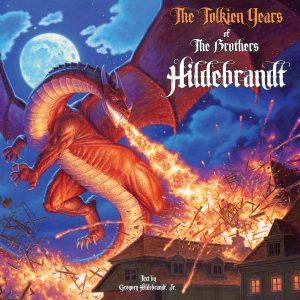
He frequently collaborated with his identical twin brother Tim (1939-2006) as “The Brothers Hildebrandt,” achieving fame for their illustrations of works by J.R.R. Tolkien, frequently featured in calendars. They also illustrated a 1975 edition of Tolkien’s Smith of Wootton Major and Farmer Giles of Ham.
Gregory J. Hildebrandt was born January 23, 1939 in Detroit MI. Both Hildebrandts joined the Army Reserve after high school, then attended art school briefly before dropping out to become working artists. They worked on animated and documentary films and illustrated children’s books before moving to their popular calendar work in the 1970s. The success of those projects led them to thriving careers as cover artists, illustrating works by Terry Brooks, Lester del Rey, Anne McCaffrey, and more. They also painted movie posters, including for Star Wars and the 1978 animated version of The Lord of the Rings. Their illustrated novel Urshurak (1979), co-written with Jerry Nichols, showcased their own ideas for a fantasy film.
The brothers began to pursue separate careers in the 1980s, with Greg mostly illustrating children’s books, before collaborating again in the 1990s for Marvel and DC comics and more cover art. After Tim’s death in 2006, Greg largely retired from making art.
Some of his work is collected in The Art of the Brothers Hildebrandt (1979), Hildebrandt Collector Cards (1992), 30 Years of Magic: Greg Hildebrandt II (1993), Star Wars: The Art of the Brothers Hildebrandt (1997), and Greg and Tim Hildebrandt: The Tolkien Years (2001).
Fandom will mostly remember James Darren as Vic Fontaine in DS9, but I’m just old enough to remember the teen idol of Goodbye Cruel World. I don’t remember ever seeing Gidget but certainly remember knowing about it. There was a time when there was no way to escape the beach movies.
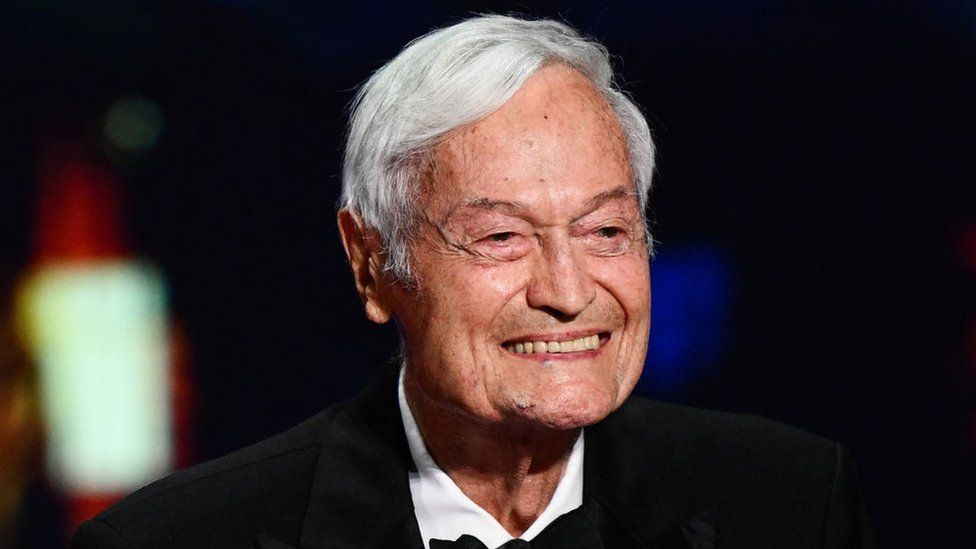
Roger Corman: The Little Shop of Horrors cult B-movie director dies aged 98
“It became something of a joke in the film industry that Corman could negotiate a contract from a public phone, shoot the film in the phone box and pay for it with the coins in the change slot.”
Corman attended the Cannes Film Festival in 2023 at the age of 97,Image source, Getty Images
Roger Corman, who directed a series of cult films including 1960’s The Little Shop of Horrors, has died aged 98.
His family told industry publication Variety that he died on Thursday at his home in Santa Monica, California.
“His films were revolutionary and iconoclastic, and captured the spirit of an age,” their statement said.
Jack Nicholson and Robert De Niro are among the actors he helped develop. Directors James Cameron and Martin Scorsese cut their teeth on his films.
Many of his films became cult classics and he became famous for the speed at which he worked, often making two films at the same location and at the same time, in order to save money.
Roger Corman was born in Detroit on 5 April 1926. His father, William, was an engineer and he had intended to follow in his footsteps.
However, while studying at college, he became attracted to film-making and after a spell working for General Motors quit his job and went to work at 20th Century Fox as a messenger boy.
Having failed to make much progress, he set off for Europe where among other things, he briefly studied English literature at Oxford. He returned to the US with ambitions to become a screenwriter.
He sold his first script, The House in the Sea, in 1953 and it was filmed as Highway Dragnet the following year with Corman being credited as co-producer.
However, he was so upset by the changes made to his story that he scraped together some cash and set himself up as a producer.
Corman began directing in 1955 with Swamp Women and over the next 15 years he made more than 50 films, gaining a reputation for the speed with which he could turn them out.
It became something of a joke in the film industry that Corman could negotiate a contract from a public phone, shoot the film in the phone box and pay for it with the coins in the change slot.
The 1960 release, The Little Shop of Horrors, which featured a brief appearance by a young Jack Nicholson, took just two days to shoot with Corman using the set of a previous film, Bucket of Blood.
A stage musical based on the film opened in 1982 and would itself spawn a second film version four years later.
Corman decided to widen his horizons with a series of films based on the works of Edgar Allan Poe and featuring Vincent Price as the lead in all but one of them.
MonSFFA’s Executive was saddened to hear of the sudden and unexpected death of Jennifer Bulman on 19 March 2023. Jennifer was a long-time fan who hailed originally from Montreal. Some of our members might recall that Jennifer, and her husband Henry Troup, joined us in February for the monthly MonSFFA meeting, during which we discussed book collections and how we accumulate — and dispose of — same. Their input was insightful, interesting and of value to the discussion. The Executive joins all MonSFFA members in offering condolences to Henry, and to extended family, at this time. Information on the memorial service, which will be live-streamed on 22 April 2023, is in the obituaries that have been published (links below).
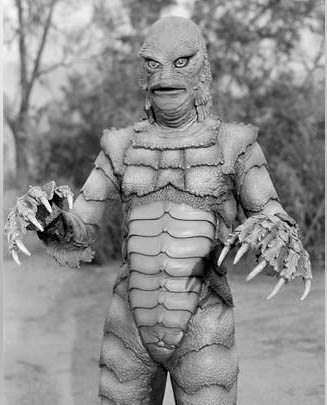
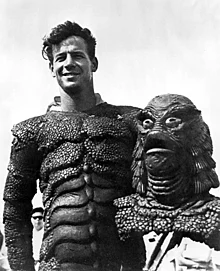
Ricou Browning, who starred as The Gill Man in the 1954 movie Creature from the Black Lagoon, died Monday of natural causes. He was 93. Browning reprised Gill Man for the sequels Revenge of the Creature (1955) and The Creature Walks Among Us (1956). His other acting credits include the 1958 TV show Sea Hunt, and as a stuntman he worked on 20,000 Leagues Under the Sea (1954). Browning was the creative force behind the 1963 Flipper movie and subsequent TV show. He directed on that show and directed scenes in films including Thunderball and Caddyshack.
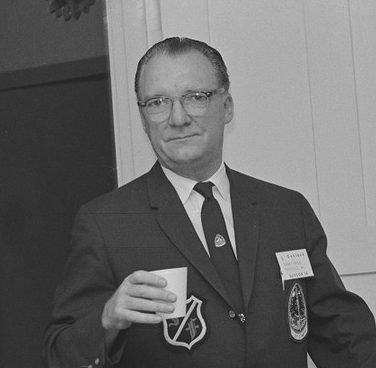
Robert Madle, 1968, photo by Jay Kay Klein, UC Riverside Libraries
Fan, collector, and bookseller Robert A. Madle, 102, died peacefully in his sleep on October 8, 2022. Madle was a founder and the first president of First Fandom (and the last survivor of the original membership), and was a warm and familiar presence in the field since the 1930s.
Robert Albert Madle was born June 2, 1920 in Philadelphia PA. He enlisted in the Army in July 1942, serving three-and-a-half years, working as a truck driver and teletype operator. He met his wife Billie in the latter job, while she was a switchboard operator. He also worked in the Army’s public relations office. He was married during the war, then attended college and went for his MBA. He worked for the government in the Navy Department, doing personnel research, and later became a research psychologist studying human/machine interfaces. He was also a book collector and dealer, continuing to sell by mail order even in his later years.
Madle began reading SF as 13-year-old in 1933 with Tom Swift and Edgar Rice Burroughs, then discovered the pulp magazines and became active in fandom soon after. An organizer from the first, he formed the Boys’ Science Fiction Club with a few friends in 1934. He attended the 1936 gathering in Philadelphia that Donald A. Wollheim dubbed “The first science fiction convention,” was active in the Philadelphia Science Fiction Society, and was generally a pillar of Philly fandom. He spread his love for organizing wherever he went, serving as a trustee of Washington Science Fiction Association, and founding the Carolina SF Society in North Carolina in the ’50s.
He attended the first Worldcon in 1939 and was the 1957 TAFF winner, writing trip report “A Fake Fan in London” afterward. He was Fan Guest of Honor at SunCon, the 1977 Worldcon and was a frequent guest at other conventions. He helped organize Worldcons and was involved in the creation of the Hugo Awards.
Madle was active in fanzine circles, where he was best known for Fantascience Digest (1937-41). His first fanzine was one issue of The Science Fiction Fan (1935) with John V. Baltadonis. They started Imaginative Fiction in 1935, continuing it intermittently until 1938. He also worked on Fantasy Fiction Telegram and wrote a column, “Fantaglimmerings”, for The Science Fiction Collector. He was a founder of New Era Publishers with Jack Agnew and Al Pepper, publishing David H. Keller’s Solitary Hunters and the Abyss (1946). He wrote many letters to SF magazines, his first appearing in Pirate Stories (July 1935), with others in Astounding Stories, Amazing Stories, Weird Tales, and more.
An occasional SF writer, his story “Devolution” appeared in his own Imaginative Fiction (1936). Other stories include “Brain, the Creator” (1936, with Corwin F. Stickney), “Black Adventure” (1937), and “The Infinite Vision” (2006).
Madle won the Big Heart Award in 1974, the First Fandom Hall of Fame Award in 1990, and the Moskowitz Archive Award in 2002. He was a nominee for the Best Feature Writer Hugo Award in 1956. His Fantascience Digest was a Retro Hugo Award finalist in 2014. He is survived by his daughter Jane.
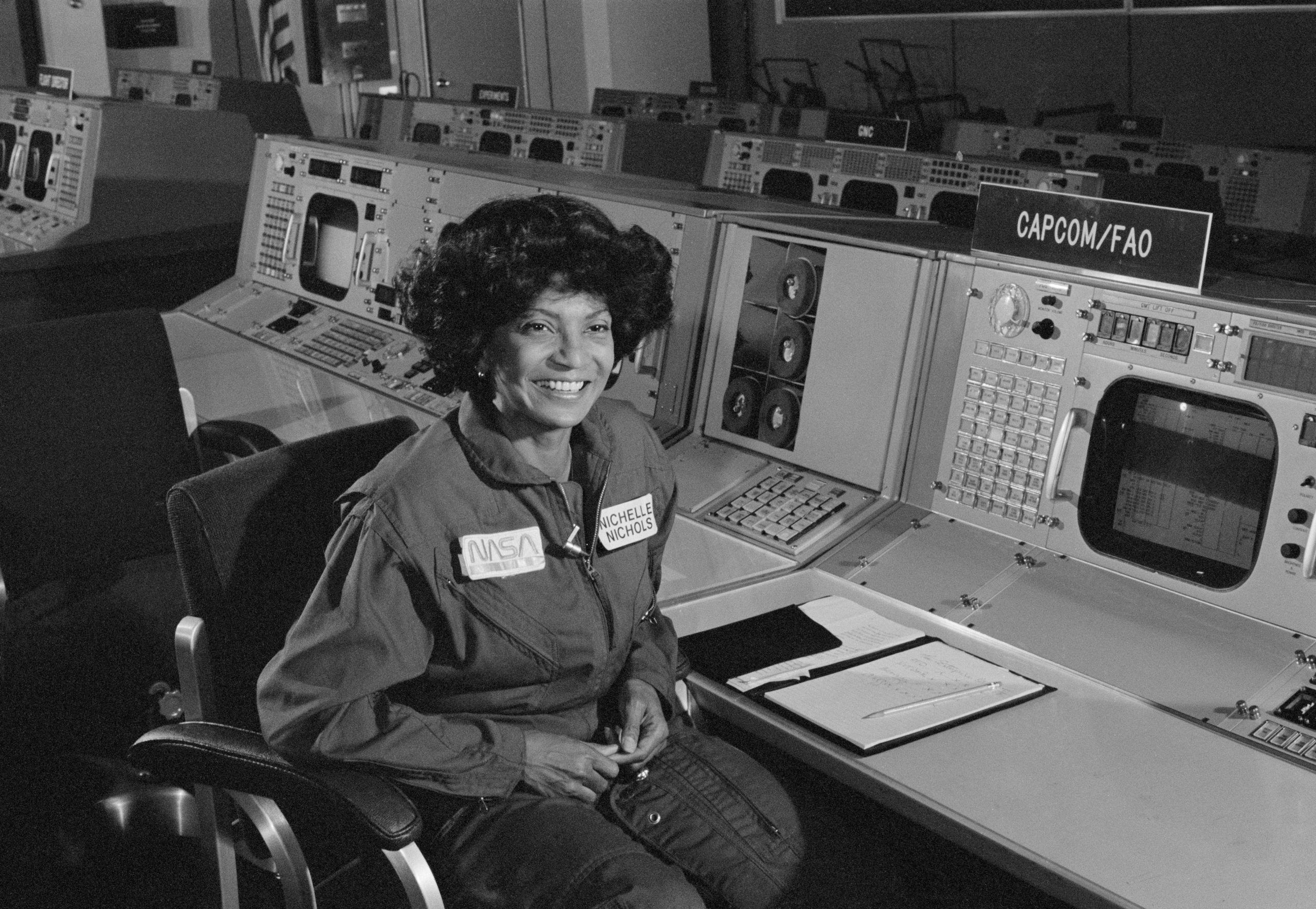
Nichelle Nichols, trail-blazing Star Trek actress, dead at 89
Nichelle Nichols, who broke barriers for Black women in Hollywood when she played communications officer Lt. Uhura on the original Star Trek television series, has died. She was 89.
Her son Kyle Johnson said Nichols died Saturday in Silver City, N.M.
“Last night, my mother, Nichelle Nichols, succumbed to natural causes and passed away. Her light however, like the ancient galaxies now being seen for the first time, will remain for us and future generations to enjoy, learn from, and draw inspiration,” Johnson wrote on his mother’s official Facebook page Sunday.
We celebrate the life of Nichelle Nichols, Star Trek actor, trailblazer, and role model, who symbolized to so many what was possible. She partnered with us to recruit some of the first women and minority astronauts, and inspired generations to reach for the stars.
Known to fans of Dr Who as Donna’s grandfather, he’s also responsible for, “Right, Said Fred”, my favourite silly song. You may also remember him from an episode of Faulty Towers in which he played the part of a spoon salesman whom Basil mistakes for a hotel inspector. –cpl

 about MonSFFA’s zine, WARP. I had the pleasure of meeting him at World Cons, and we often corresponded. I submitted an article to an issue of Challenger, which he published to my great delight.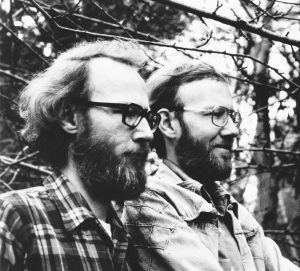
 The brothers began to pursue separate careers in the 1980s, with Greg mostly illustrating children’s books, before collaborating again in the 1990s for Marvel and DC comics and more cover art. After Tim’s death in 2006, Greg largely retired from making art.