https://www.gocomics.com/lio/2026/03/05
Keith will love this!

Yeah, I know–another quarter in the jar!

https://www.gocomics.com/lio/2026/03/05
Keith will love this!
Yeah, I know–another quarter in the jar!
Space Weather News for March 4, 2026
https://spaceweather.com
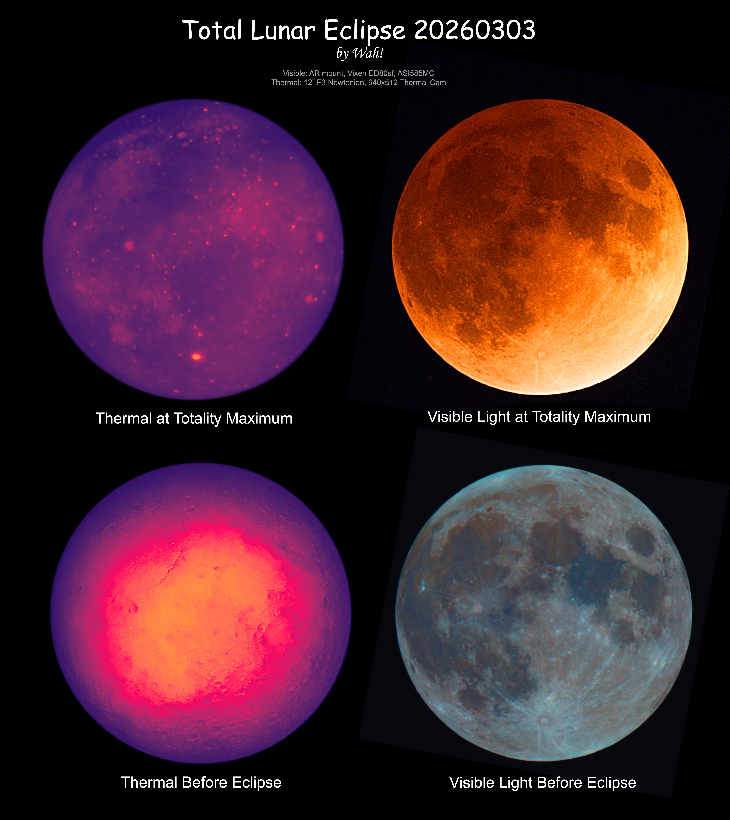
LUNAR ECLIPSE REVEALS HOT SPOTS ON THE MOON: Millions of people witnessed yesterday’s total lunar eclipse–but only one photographed it using a thermal camera. An amateur astronomer’s rare infrared image reveals dozens of hot spots scattered like stars across the lunar surface. Full story @ Spaceweather.com.
From Locus magazine: https://locusmag.com/forthcomingbooks/
MARCH 2026
We have received an update regarding Garth Spencer’s website, “Across the Fandomension with Garth Spencer” . This is shaping up to be a valuable resource for fans of SFF. –Cathypl
Dear Guys,
My SF information website, “Across the Fandomension with Garth Spencer” (https://www.vcn.bc.ca/~garth2), is now extended and updated. I intend to make additions and updates monthly.
This is still a bare-bones information website, so to begin with I have focused on simply finding the links to resources. If you spot errors and omissions in the information about clubs, conventions, fanzines, fandoms, writers’ resources, markets, or websites, please comment and criticize and suggest amendments. If you have suggestions for improved layout and format, I am open to them, too.
Yours cordially,
Garth Spencer
Locus list of upcoming books, Jan & Feb
JANUARY 2026
FEBRUARY 2026
For the details, click https://agupubs.onlinelibrary.wiley.com/doi/10.1029/2025JE009047
On 27 December 2024, NASA’s Juno spacecraft observed an enormous volcanic eruption on Io, Jupiter’s most volcanically active moon. The eruption covered a vast area of about 65,000 km2 in the southern hemisphere and released an estimated 140–260 TW of energy-possibly the most intense volcanic event ever recorded on Io, far surpassing previous eruptions. The eruption affected multiple volcanic hot spots, with some increasing in brightness by over 1,000 times their usual levels. Scientists believe this was a single massive event spreading underground across hundreds of kilometres, linking multiple magma reservoirs. However, other nearby volcanoes remained unaffected, adding complexity to how Io’s interior works. This unprecedented event suggests that Io’s volcanoes may be more interconnected than previously thought. Future observations by Juno could reveal whether the eruption left behind new lava flows or ash deposits, helping scientists better understand the moon’s geology and volcanic activity.
 Here are the zines that arrived in the virtual mailbox. Enjoy! and share!
Jason P Hunt
Publisher/CEO
www.SciFi4Me.com
Jason also sent us N3FReview202601
From Leybl in Israel: CCJanuary2026-v01
From Ahrvid Engholm: Intermission163
Intermission in the Epstein files?

It wouldn't surprise us, considering how morally corrupt it is! But in
the Engholm files (latest example #163 enclosed) we find Jules Verne!
(With his unknown, only English story!) And a whole bunch of writers
in deplorable filthy-pro magazines such as Beyond Fantasy,
Imagination, Startling Stories and others presenting your wettest,
wildest dreams! Blue films - at least one - also covered, and AI
translation.
  But we start with the latest goofs by Trump and Putin. Agent
Orange's Greenland plans get cold shoulders from the Arctic and
Putins's under-supplied alcoholic bumbs of an "army" is destroyed by
drones. And why don't media report on Putin' collapsing economy?
 Finally, don't miss ■■■■  and ■■■■, especially ■■■■!!!

Don't Put Hands In Running Mower,

--Ahrvid Engholm, edit■■■■or
  (Comments welcome, but whatever you write, make CC: to
ahvid@atomicmail.io, due to failing Microsoft...)
From the N3F: Tightbeam 377 is attached. There is an Alarming Event…we are back on schedule. On the topic of schedules, Mindy Hunt reports that the next issue of FanActivity Gazette will be delayed.
Dear Guys and Gals,

I am now launching a fannish information website, listing Canadian and Pacific Northwest clubs and conventions, as well as less regional information for fanzine fans and aspiring writers. Please check out https://www.vcn.bc.ca/~garth2/ and let me know if you find it useful. The plan is to edit the web page monthly.
Any critical comments or helpful suggestions are welcome, so I have put an email link on every web page to make it easy to contact me. I have no aesthetic sense, so this month’s edition is almost entirely text-only. (My smiling face is on the welcome page, but it’s a bit large – I think I must cut it down.)
Many thanks are due to the Vancouver Community for hosting this website, and to their Help Desk and to Kalin Stacey of the Canadian SF and Fantasy Association for getting me over some glitches.
Yours cordially,
Garth Spencer
On March 10, 2026, Amazing Stories will mark a singular milestone: one hundred years since the moment science fiction became a genre with a name, a home, and a future.
On a cold Wednesday in Manhattan—March 10, 1926—The Experimenter Publishing Company released the first issue of Amazing Stories. Its cover was impossible to miss: bright yellow, boldly optimistic, and illustrated by Frank R. Paul, who would soon be recognized as the founding visual architect of science fiction. Behind that cover stood editor and publisher Hugo Gernsback, holding a radical idea: that stories grounded in real science, boldly extrapolated into tomorrow, deserved a magazine of their own.
With his opening editorial, “A New Kind of Magazine,” Gernsback didn’t just launch a publication—he defined a genre. He called it scientifiction: stories that were entertaining, intellectually serious, rooted in known science, and unafraid to speculate. Sometimes they advocated. Sometimes they warned. Always, they invited readers to imagine what might be.
That first issue of Amazing Stories did more than publish fiction. It established science fiction’s rules of engagement, made the future visible, and—perhaps most importantly—created a conversation. The magazine’s letters column became the birthplace of science fiction fandom, a community that would grow into clubs, fanzines, conventions, cosplay, superheroes, and an enduring global culture. The modern world’s relationship with the future can be traced, in no small part, back to those pages.
It is no exaggeration to say that the last century would look very different without Amazing Stories.
Why This Matters Now
At a time when scientific progress is accelerating faster than ever—reshaping how we live, work, communicate, and even define what it means to be human—science fiction’s original mission feels newly urgent. For a century, Amazing Stories has explored both the promise and the peril of innovation, reminding us that the future is not something that simply happens to us, but something we actively imagine, question, and choose. As we confront challenges that once seemed purely speculative, science fiction remains what it has always been at its best: a rehearsal space for tomorrow, powered by curiosity, skepticism, and hope.
We invite readers, writers, historians, fans, and future-builders to join us in celebrating this extraordinary anniversary. Celebrate with us in person at Ravencon in Richmond, Virginia, April 26–28, 2026. Or celebrate in your own way: read a story, discover a new author, write a review, or visit our website to explore a sampling of what began on a newsstand in 1926 and helped shape the imagination of a century.
It has been our privilege, honour, and joy to help keep Amazing Stories alive. We look forward—with appropriate scientific optimism—to carrying its legacy into the next hundred years.
(A formal centennial celebration will be held at Ravencon, Richmond, Virginia, April 26–28, 2026.)