MonSFFA’s next meeting, an “online-only” event exclusively on ZOOM, is set for tomorrow, Saturday, February 8, from 1:00PM to 5:00PM! Join our ZOOM-chat and take part in the meeting from the warmth and comfort of home!
We’ll be exploring which genres—romance, Western, mystery, horror—mix well with our favourite genres, science fiction and fantasy!
An indispensable necessity for life as we know it, we’ll also be looking at SF/F’s use of water as a story element, and talk about our individual hobby workspaces. We all have hobbies—painting, sculpting, woodworking, scale-model building, knitting, writing fanfic, etc. We’ll ask, “Where in your home is located your hobby workstation—corner nook, basement workshop, kitchen table?” Snap a few photos of your hobby space to share with the group, and tell us all about your genre-flavoured hobbies!
So mark Saturday, February 8 in your calendars, and we’ll see you then…
Please note that we will return to our downtown meeting hall at Le Nouvel Hotel beginning in March, as winter, hopefully, begins to recede!
MonSFFA’s next meeting is an “online-only” event scheduled to take place exclusively on ZOOM in just three days, on Saturday, February 8, from 1:00PM to 5:00PM! Join our ZOOM-chat and take part in the meeting from the warmth and comfort of home!
We’ll be exploring which genres—romance, Western, mystery, horror—mix well with our favourite genres, science fiction and fantasy!
An indispensable necessity for life as we know it, we’ll also be looking at SF/F’s use of water as a story element, and talk about our individual hobby workspaces. We all have hobbies—painting, sculpting, woodworking, scale-model building, knitting, writing fanfic, etc. We’ll ask, “Where in your home is located your hobby workstation—corner nook, basement workshop, kitchen table?” Snap a few photos of your hobby space to share with the group, and tell us all about your genre-flavoured hobbies!
So mark Saturday, February 8 in your calendars, and we’ll see you then…
Please note that we will return to our downtown meeting hall at Le Nouvel Hotel beginning in March, as winter, hopefully, begins to recede!
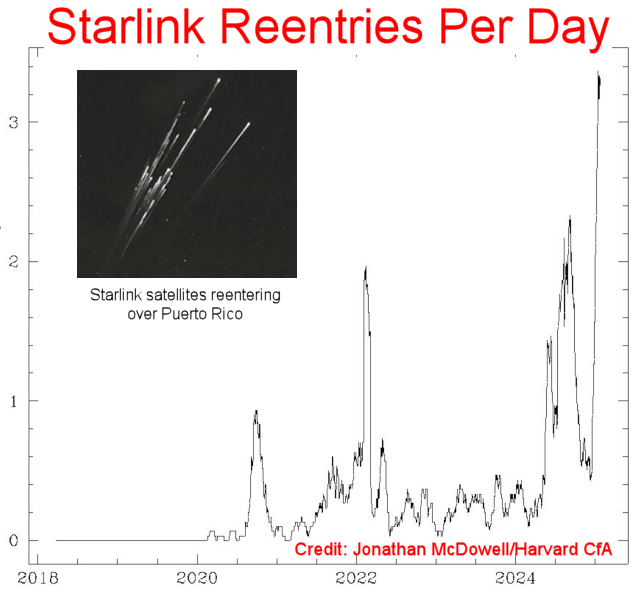
UNPRECEDENTED STARLINK REENTRIES: Last month, more than 120 Starlink satellites fell out of orbit. The daily rate of reentries is unprecedented and might be altering the chemistry of Earth’s atmosphere.
What goes up, must come down–which could be a problem when you’re launching thousands of satellites. Since 2018, SpaceX has placed more than 7,000 Starlink satellites into Earth orbit, and now they are starting to come down. In January alone, more than 120 Starlinks deorbited, creating a shower of fireballs.
“The sustained rate of daily reentries is unprecedented,” says Jonathan McDowell, an astronomer at the Harvard Center for Astrophysics who tracks satellites. “They are retiring and incinerating about 4 or 5 Starlinks every day.”
Planners have long known this would happen. First generation (Gen1) Starlink satellites are being retired to make way for newer models. “More than 500 of the 4700 Gen1 Starlinks have now reentered,” says McDowell.
When Starlinks reenter, they disintegrate before hitting the ground, adding metallic vapors to the atmosphere. A study published in 2023 found evidence of the lingering devris. In February 2023, NASA flew a WB-57 aircraft 60,000 feet over Alaska to collect aerosols. 10% of the particles contained aluminum and other metals from the “burn-up” of satellites.
Right: NASA’s WB-57 high altitude airplane. [more]
What we’re observing is a giant uncontrolled experiment in atmospheric chemistry. The demise of just one Gen1 Starlink satellite produces about 30 kilograms (66 pounds) of aluminum oxide, a compound that eats away at the ozone layer. A new study finds these oxides have increased 8-fold between 2016 and 2022, and the recent surge is increasing the pollution even more.
On the bright side, each reentry produces a beautiful fireball–and the odds are increasing that you’ll see one. Visit the Aerospace Corporation for reentry predictions, and submit your photos here.
MonSFFA’s next meeting is an “online-only” event scheduled to take place exclusively on ZOOM next weekend, on Saturday, February 8, from 1:00PM to 5:00PM! Join our ZOOM-chat and take part in the meeting from the warmth and comfort of home!
We’ll be exploring which genres—romance, Western, mystery, horror—mix well with our favourite genres, science fiction and fantasy!
An indispensable necessity for life as we know it, we’ll also be looking at SF/F’s use of water as a story element, and talk about our individual hobby workspaces. We all have hobbies—painting, sculpting, woodworking, scale-model building, knitting, writing fanfic, etc. We’ll ask, “Where in your home is located your hobby workstation—corner nook, basement workshop, kitchen table?” Snap a few photos of your hobby space to share with the group, and tell us all about your genre-flavoured hobbies!
So mark Saturday, February 8 in your calendars, and we’ll see you then…
Please note that we will return to our downtown meeting hall at Le Nouvel Hotel beginning in March, as winter, hopefully, begins to recede!
WHAT ARE ‘MIYAKE EVENTS’? So you thought the Carrington Event was bad? Researchers have found evidence in tree rings of solar storms 10 times worse. The discovery of “Miyake Events” has placed dendrochronologists at the center of space weather research.
A WARNING FROM THE TREES: How bad can a solar storm be? Just ask a tree. Unlike human records, which go back hundreds of years, trees can remember solar storms for millennia.
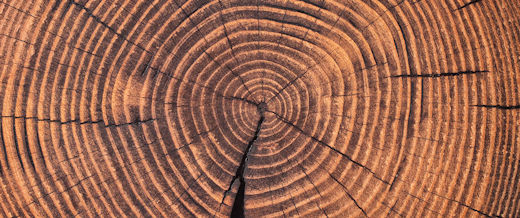
Above: Rings in the stump of an Ancient Bristlecone Pine may reveal evidence of extreme solar storms dwarfing modern events.
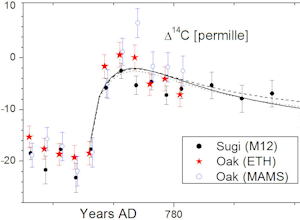
Nagoya University doctoral student Fusa Miyake made the discovery in 2012 while studying rings in the stump of a 1900-year-old Japanese cedar. One ring, in particular, drew her attention. Grown in the year 774–75 AD, it contained a 12% jump in carbon-14 (14C), an isotope created by cosmic radiation. The surge was 20 times greater than ordinary fluctuations in cosmic rays. Other teams confirmed the spike in wood from Germany, Russia, the United States, Finland, and New Zealand. Whatever happened, trees all over the world experienced it.
Most researchers think it was a solar storm—an extraordinary one. Often, we point to the Carrington Event of 1859 as the worst-case scenario for solar storms. The 774-75 AD storm was at least 10 times stronger; if it happened today, it would floor modern technology. Since Miyake’s initial discovery, she and others have confirmed four more examples (7176 BC, 5259 BC, 664-663 BC, 993 AD). Researchers call them “Miyake Events.”
It’s not clear that all Miyake Events are caused by the sun. Supernova explosions and gamma-ray bursts also produce carbon spikes. However, the evidence tilts toward solar storms. For each of the confirmed Miyake Events, researchers have found matching spikes of 10Be and/or 36Cl in ice cores. These isotopes are known to trace strong solar activity. Moreover, the 774-75 AD Miyake Event had eyewitnesses; historical reports of auroras in China and England suggest the sun was extremely active around that time.
Miyake Events have placed dendrochronologists (scientists who study tree rings) in the center of space weather research. After Miyake’s initial discovery in 2012, the international tree ring community began working together to look for evidence of solar superstorms. Their collaboration is called “the COSMIC initiative.” COSMIC results published in a 2018 edition of Nature confirm that Miyake Events in 774-75 AD and 993 AD were indeed global. Trees on five continents recorded carbon spikes.
“There could be additional Miyake Events throughout the Holocene” says Irina Panyushkina, a member of the COSMIC initiative from the University of Arizona’s Laboratory for Tree-Ring Research. “Finding them will be a slow and systematic process.”
Above: A global map of COSMIC tree ring and ice core measurements [more]
“An important new source for annual 14C measurements are floating tree-ring records from Europe and the Great Lakes,” says Panyushkina. “These are very old rings that could potentially capture 14C spikes as far back as 15,000 years. Eventually, I believe we will have a complete record of Miyake Events throughout that period.”
Four more candidates for Miyake Events have recently been identified (12,350 BC, 5410 BC, 1052 C, and 1279 C). The candidate in 12,350 BC, identified from tree rings the French Alps, may be more than twice the size of any other Miyake Event. Confirmation requires checking trees on many continents and finding matching spikes of 10Be and 36Cl in ice cores.
A complete survey of Miyake Events could tell us how often solar superstorms occur and how much peril the sun presents to a technological society. Stay tuned for updates from the trees.
The latest issue of MonSFFA’s News Bulletin, Impulse, has been distributed to club members electronically, and is also archived here on the club’s Web site. To view or download, visit the “Impulse” page, or just click here: Impulse, January-February 2025
NOTE: The recent postal strike, and other unforseen issues, disrupted our usual production schedule, and our mailing of print copies; Impulse is, this month, being distributed a couple weeks later than intended.
MonSFFA’s next meeting, an “online-only” event, is scheduled to take place exclusively on ZOOM Saturday, February 8, from 1:00PM to 5:00PM! Join our ZOOM-chat and take part in the meeting from the warmth and comfort of home!
On the Agenda:
Romance? Western? Mystery? Horror? Which genres mix well with SF&F? We’ll discuss!
An indispensable necessity for life as we know it, we offer a presentation on water in SF&F!
Corner nook, basement workshop, kitchen table? Where in your home is located your hobby space? Snap a few photos of your hobby work station to share with the group, and tell us all about your genre-flavoured hobbies!
plus more…
So mark Saturday, February 8 in your calendars, and we’ll see you then…
Please note that we will return to our downtown meeting hall at Le Nouvel Hotel beginning in March, as winter, hopefully, begins to recede!
I took an extended break from web duties over the holidays, so lots of zines to catch up.
TZD60 From Guy Lillian who says,” It’s very small, it’s very late, it’s most confused and incomplete … but it’s here. The usual apologies, promises, and request for zines …”
CCDec2024-v01 From Leybl in Israel, still in war mode, sadly.
Kerosene papers from Nic, who says,”Well, “gift” is dubious, but from the recent discovery of The Kerosene Papers document, a pdf has been acquired and is attached for, if not your delectation, then – er – something else…
Yes, it’s once again time to open voting for the 2025 FAAn Awards (for work first published in 2024), fanzine fandom’s only dedicated honors.
Attached you will find The Incompleat Register2024 voters’ guide for this year’s awards. To repeat some of the salient points within (but please also read the voting procedure):
Closing date for votes to be received is midnight Pacific time, March 29 2025.
The Incompleat Register is NOT intended to define who or what you can or cannot vote for (The listings define the proper categorization of fanzines from 2024 known to the Administrator, who cannot possibly be aware of everything. Ballots are accepted in good faith)
You do NOT have to use the specific form provided (A simple list will do)
You do NOT have to be a member of Corflu or anything else (Voting is open to anyone with an interest in fanzines. There is no other requirement or fee)
The results will be announced at the Corflu 42 banquet on April 13 2025 and disseminated widely thereafter.
As always, we encourage other faneds and purveyors of fannish news to publicize the awards and encourage voting from their own readers. TIR will also be available on the Corflu and efanzines websites and in various online groups shortly.

 MonSFFA’s next meeting, an “online-only” event exclusively on ZOOM, is set for tomorrow, Saturday, February 8, from 1:00PM to 5:00PM! Join our ZOOM-chat and take part in the meeting from the warmth and comfort of home!