From the BBC: There’s a new race in space, but it’s not where you might think. It’s happening close to home – in the nearest bit of space, right on the edge of Earth’s atmosphere.
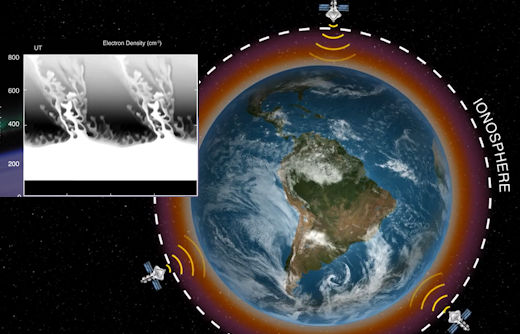
High in the skies of Earth, a new space race is underway. Here, just above the boundary where space begins, companies are trying to create a new class of daring satellites. Not quite high-altitude planes and not quite low-orbiting satellites, these sky skimmers are designed to race around our planet in an untapped region, with potentially huge benefits on offer.
Roughly 10,000 satellites are orbiting our planet right now, at speeds of up to 17,000mph (27,000km/h). Every one of these delicate contraptions is in constant free-fall and would drop straight back down to Earth were it not for the blistering speeds at which they travel. It’s their considerable sideways momentum, perfectly stabilised against the Earth’s gravitational pull downwards, that keeps satellites in orbit.
A new class of satellites is aiming to push the limits of this balancing act and plough a much more precarious, lower orbit that would skim the top of Earth’s atmosphere. Known as Very Low Earth Orbit (VLEO), spacecraft at these altitudes have to battle against the significantly greater drag from the air in the upper reaches of the atmosphere than their loftier cousins, lest they get pushed out of the sky. Should they manage it, however, such satellites might achieve something even more jaw-dropping – they could potentially fly forever.
“When you start describing it to people, it starts to sound like a perpetual motion machine,” says Spence Wise, senior vice-president at Redwire, an aerospace firm in Florida. A perpetual motion machine is not meant to be possible. But it almost is, in this instance.
We thank club members Danny Sichel, Keith Braithwaite, and Cathy Palmer-Lister for their contributions to this afternoon’s programming. A nod, as well, to all of our contributing participants, and everyone who helped to plan and run this meeting. Finally, of course, we thank all of you who joined us here on ZOOM; don’t forget to comment on today’s get-together (www.MonSFFA.ca).
7) NEXT MONTH’S MEETING:
The club meets next on Saturday, March 8, from 1:00PM-5:00PM! On this occasion, we return to our downtown meeting locale, Groundhog Science having assured us that we will enjoy an early spring! So beginning in March, club meetings for the remainder of the year will unfold as in-person and concurrently, online events! We hope to see you live and in person at our March 8 meeting, or if you’re from out of town, online via ZOOM. MonSFFA meets downtown in the Maisonneuve Room of Le Nouvel Hotel, 1740 Rene-Levesque Ouest (corner St-Mathieu).
8) SIGN-OFF
Thank you, all, for taking part today. We appreciate the enthusiastic involvement of our members, and we hope you will all join us again next month!
9) ONE LAST THING!
Thinking of the frosty weather still, we leave you, today, with our list of…
The Top Dozen Superheroes and Supervillains with Wintery Powers!
1) Iceman (First Appearance: X-Men, 1963) – An Omega-level mutant and mainstay of Marvel’s X-Men titles, he was co-created by comics legends Stan Lee and Jack Kirby. A founding member of the X-Men, Bobby Drake, or Iceman, has the power to instantly lower the temperature of ambient water vapour, rendering his surroundings cold, and manipulating ice as an offensive weapon or defensive shield.
2) Killer Frost (First Appearance: Firestorm, 1978) – In conjunction with the superhero Firestorm, three women have taken on the name Killer Frost in DC Comics publications, beginning with Crystal Frost in 1978, who was succeeded by her friend, Louise Lincoln, in 1985, and finally, bright, young S.T.A.R. Labs scientist Caitlin Snow assumed the role in 2013, in due course dropping the “Killer” to become, simply, Frost. Supervillains all, Snow’s iteration of the character eventually reformed and joined the Justice League of America. Powers include heat absorption and transmutation into surges of cold, the ability to produce and direct intense blizzards that quickly freeze a target, and to generate and throw ice projectiles, or create ice armour. Fan favourite Danielle Panabaker portrayed Snow in The Flash and other popular “Arrowverse” television adaptations.
3) Mr. Freeze (First Appearance: Batman, 1959) – Originally appearing as Mr. Zero, this DCU supervillain is a foe of Batman’s. An unnamed scientist developing an ice-gun, his physiology is altered by an accidental cryogenic chemical spill, which leaves him constrained to living in sub-zero temperatures in order to survive. He fashions a special air-conditioned suit that allows him to operate in normal environments, and forms a gang of jewel thieves. His name was later changed to Mr. Freeze after the character had been adapted for the Batman TV series (1966-1968) under that appellation. A later incarnation introduced him as Victor Fries—pronounced “Freeze”—a brilliant expert in cryogenics who seeks to successfully freeze his terminally ill wife until a cure for her condition can be found. He turns to crime in order to fund his efforts.
4) Captain Cold (First Appearance: Showcase, 1957) – A nemesis of the Flash, Leonard Snart is a career criminal who devised a unique gun capable of expelling blasts of cold and ice, instantly freezing solid his targets. Donning a snowsuit and special goggles, he embarked on a crime spree, declaring himself to be Captain Cold! He uses his gun to create slippery stretches of ice on which the Flash may slip, or to slow the Scarlet Speedster’s movements with an inhibiting coating of ice. He has joined forces with a variety of other supervillains over the years, and also tangled with the below-mentioned superheroines Fire and Ice.
5) Ice (First Appearance: Justice League International, 1988) – Tora Olafsdotter is a Norwegian superheroine and member of Justice League International who exercises a magic-infused ability to create and manipulate ice. She was formerly Icemaiden as one of the Global Guardians, an international superhero team, along with her Brazilian friend, Beatriz da Costa, alias Green Fury, and later Green Flame. When the Global Guardians lost their U.N. funding and closed down, the two joined JLI as Fire and Ice.
6) Blizzard (First Appearance: Tales of Suspense, 1963) – An adversary of Iron Man’s, the supervillain Blizzard was initially dubbed “Jack Frost” in newspapers before he assumed the name Blizzard. A scientist obsessed with immortality and cryonics, he worked for Stark Industries until he was fired for attempting to steal secrets from Tony Stark’s vault. Courtesy of a special, cold-generating battle suit he had developed, and later refined with funding from Stark’s rival, Justin Hammer, he is able to discharge freeze-rays, and create and shoot ice projectiles. There have been several other versions of Blizzard in subsequent Marvel comics series.
7) Snowman (First Appearance: Batman, 1981) – The offspring of a union between Katrina Kristin and a Yeti, the Snowman is a superpowered criminal of great strength and ice-and-snow-controlling ability who manages to blend into Gotham City society as star athlete Klaus Kristin. But Bruce Wayne is suspicious of him and, as Batman, investigates and tracks him to Austria, where the two engage in a fight on the ski slopes, with Batman prevailing and Snowman falling into an abyss. The Caped Crusader later encounters his foe again, in the Himalayas, where he discovers that Snowman is dying as a consequence of his hybrid nature, and compassionately allows him to be with his Yeti father in the final moments of his life.
8) Frozone (First Appearance: The Invincibles, film, 2004) – Lucius Best, alias Frozone, is the coolest superhero on Earth! The best friend of super strongman Mr. Incredible and family, he is a supporting character in Disney-Pixar’s animated Invincibles superhero satires, and serves to spoof ice-controlling superheroes like Iceman.
9) Ymir (First Appearance: Journey Into Mystery, 1963) – A Stan Lee-Jack Kirby creation based on the Frost Giants of Norse mythology, Ymir is an antagonist of the Mighty Thor. A thousand-foot tall immortal deity, he is possessed of great strength and endurance, and can project an extreme and lethal cold. Able to regenerate himself from as little as a shard of ice, he is immortal and carries a huge icicle, which he wields as a club.
10) Sub-Zero (First Appearance: Blue Bolt Comics, 1940) – A Venusian sent to Earth on a mission of first contact, his spaceship crash-lands near Salt Lake City after passing through a comet, which has transformed him into an iceman whose touch freezes anything. Ice-coated and in pain, he manages to extricate himself from his wrecked ship and finds local scientists, who expose him to experimental gamma radiation, returning him to his normal humanoid form while retaining his power to freeze things. He is able to shoot blasts of ice from his hands, freeze a localized area, and whip up gusts of cold air to create cyclones. Teaming up with fellow superheroes Blue Bolt and Twister, and taking on a young Inuit boy as his sidekick, he uses his superhuman abilities to fight crime.
Left to Right: Sub-Zero, Polar Boy, Jack Frost
11) Polar Boy (First Appearance: Adventure Comics, 1963) – A character created at the suggestion of a reader, he hails from the extremely hot planet Tharr in the DCU’s 30th century. The people of Tharr possess the innate “cryokinetic” ability to generate cold in order to counter their world’s unrelenting heat. Thus is Polar Boy able to produce, and project, a freezing chill. His application to join the Legion of Super-Heroes was rejected, however, prompting him to found and lead the Legion of Substitute Heroes.
12) Jack Frost (First Appearance: U.S.A. Comics, 1941) – A Golden Age superhero published by Marvel forerunner Timely Comics, he was one of future Marvel luminary Stan Lee’s earliest creations, in collaboration with artist Charles Wojtkoski. This hero’s star shone but briefly, however. Eclipsed after just four issues by a new hero, Captain America, he would make only a few more appearances. He is notable in that his powers were the template for those of Iceman, a character envisioned by Lee over 20 years later!
Welcome to MonSFFA’s February 2025, “mid-winter” meeting! Take a break from shovelling your walk and join us for a few hours of sci-fi fun!
Today’s proceedings will be getting underway shortly. We are meeting exclusively online, today; join our ZOOM-chat and take part in the meeting from the warmth and comfort of home! See the instructions, immediately below (Item 2), to join in and participate on ZOOM.
Our programming agenda begins at 1:00PM; the meeting will conclude at 5:00PM. This opening post has gone up 30 minutes before the meeting’s start time to allow folk to gather online at their leisure.
A closing post will go up at 5:00PM to officially thank today’s presenters/discussion moderators, and to publish the date of the next MonSFFA event.
2) JOIN THIS AFTERNOON’S VIDEO-CHAT ON ZOOM!
To take part in this afternoon’s meeting online, join our ZOOM video-chat, which will run throughout the next few hours. Simply click here and follow the prompts: This Afternoon’s MonSFFA Meeting on ZOOM
If you’re not fully equipped to ZOOM, you can also take part by phone (voice only); in the Montreal area, the toll-free number to call is: 1-438-809-7799.
Also, have this information on hand as you may be asked to enter it:
Meeting ID: 873 2473 3518
Passcode: 454855
3) FEBRUARY 2025 MEETING THEME
Snap a few photos of your hobby work space to share with the group, and tell us all about your genre-flavoured hobbies!
4) THIS AFTERNOON’S AGENDA
Today’s programming agenda is as follows:
1:00PM – What Goes Well with SF/F?
Romance, mystery, horror, Western—which genres mix well with our favourite types of story, science fiction and fantasy? We’ll discuss!
2:00PM – Water in SF/F!
An indispensable necessity for life as we know it, we’ll explore SF/F’s use of water as a story element!
3:00PM – Break
Club business, announcements, and raffle
3:30PM – My Hobby Space!
We all have hobbies—painting, sculpting, scale-model building, knitting, writing fanfic, etc. We’ll ask “Where in your home is located your hobby workstation—corner nook, basement workshop, kitchen table?” Snap a few photos of your work space to share with the group, and tell us all about your genre-flavoured hobbies!
4:30PM – Final Thoughts and Wrap-Up!
We close the afternoon with final thoughts, questions, and commentary on today’s topics, or other subjects members may have to briefly share with the group. Your feedback, dear members, is always welcome!
Please Note: While we strive to keep on schedule, we do, sometimes, fall behind a little, or find ourselves having to reshuffle the order of items on the agenda for one reason or another, or reschedule planned presentations/discussions. Therefore, please understand that all programming is subject to change!
5) WINTER WORLDS OF SF/F
In the midst of this recent spate of winter weather, we are reminded of a recurrent setting in SF/F, the ice planet, or ice realm! While we await the start of the meeting, here, for your consideration, are a few winter worlds of note and interest.
Hoth:
Perhaps the best-known ice world in sci-fi by virtue of the blockbuster popularity of the Star Wars franchise, this snow-covered planet was, in The Empire Strikes Back (1980), the setting of a thrilling battle between rag-tag Rebel forces and an imposing, mechanized Imperial army.
Rura Penthe:
An icy, unforgiving world on which the Klingons have established a penal colony, Admiral Kirk and Doctor McCoy were imprisoned here in Star Trek VI: The Undiscovered Country (1991).
Another ice world in the Star Trek universe is Delta Vega, featured in the reboot film Star Trek (2009).
And, in the original series episode “All Our Yesterdays” (1969), the Enterprise visits the planet Sarpeidon, soon to be destroyed by a supernova. The people of Sarpeidon escape doom by time-travelling into the past by way of a machine called the Atavachron, and Mr. Spock and Dr. McCoy are unintentionally transported back some 5000 years, to the planet’s ice age, where all they have to keep them warm are the shelter of a cave heated by a hot spring, animal skins, and Mariette Hartley!
Barsoom’s North Pole:
Home to the Okar of Edgar Rice Burroughs’ Warlord of Mars, the third book in his seminal planetary romance adventure series. Thought extinct, the Okar, or Yellow Martians, live in secret within glass-domed cities built to protect them from the severe arctic environment. When outside, they wear heavy furs of Apt or Orluk, wildlife indigenous to Barsoom’s northern polar region.
Frigia:
Alex Raymond’s Flash Gordon comic strip premiered in 1934, and featured the planet Mongo, a far-northern territory of which encompasses the ice kingdom Frigia, so cold as to be entirely inhospitable to all but the native peoples of this area, who wear special synthetic, and oddly transparent, clothing to repel the cold. Frigia is ruled by the beautiful blonde Queen Fria, who takes a liking to the handsome, titular space adventurer and hero, much to the consternation of his girlfriend, Dale Arden. The wildlife of Frigia include Snow Oxen, Ice Bears, Snow Dragons, Snowbirds, and Ice Worms.
Zura:
In Ray Cummings’ novelette “Revolt in the Ice Empire,” first published in the fall 1940 issue of Planet Stories, an expedition from Earth aboard the spaceship Planeteer arrives on Zura, described as “a frigid little world” with “patches of snow and sleek blue ice everywhere.” An asteroid following an elliptical orbit around the sun, Zura is rich in the valuable element Xalite. Tara, a beautiful Earth girl, rules over the less sophisticated native Zurians, her father having travelled to the asteroid from Earth in a previous expedition with the intention of establishing a perfect society. But the Planeteer brings with it avarice, violence, fear, and revolt soon stirs, the Utopian dream Tara inherited from her father quickly becoming a nightmare!
Pulp Illustrations: Revolt in the Ice Empire (left) and The Lake of the Gone Forever (right).
Iskar:
In Leigh Brackett’s “The Lake of the Gone Forever,” first featured in the October 1949 issue of Thrilling Wonder Stories, Iskar is a wintery world the topography of which includes a semi-liquid lake having “particles of some transuranic element” which acts as a repository of the memories of Iskar’s dead.
Gethen:
Also known as “Winter,” this bitterly cold world populated by the ambisexual Gethenians is the setting of Ursula K. LeGuin’s acclaimed The Left Hand of Darkness (1969), one of the leading examples of feminist SF. A major theme of the book is the effect of sex and gender on culture and society.
Tran-Ky-Ky:
A group of spaceship passengers find themselves shipwrecked on the windblown ice world Tran-Ky-Ky in Alan Dean Foster’s Icerigger trilogy (1974-1987) The planet’s native population are burly, cat-faced bipeds having sail-like membranes under their arms and extended, curved claws on their feet that serve as ice skates, allowing them to easily manoeuver over a glacial landscape.
Helliconia:
Brian W. Aldiss’ Helliconia trilogy (1982-1985) traces the rise and fall of a civilization over more than a thousand years on the planet Helliconia, where the seasons are measured not in months, but centuries! Situated within a binary star system and slightly larger than Earth, Helliconia sustains vast polar ice caps, even during the hot summer season. The planet’s northern continent, Sibornal, is the setting of the third book in the series, Helliconia Winter. Ice Age conditions prevail during the Helliconian winter, and a major theme of the books is the influence of climate on human civilization.
Narnia:
A hundred-year winter, with no Christmas, has descended on C. S. Lewis’ magical fantasy realm, Narnia, brought about by the evil White Witch, who rules the land. The arrival of the Pevensie children, however, in The Lion, The Witch, and the Wardrobe (1950) marks the beginning of the end of her dominance.
Westeros, North of “The Wall”:
George R. R. Martin’s yet to be completed fantasy series A Song of Ice and Fire, the first book of which was published in 1996, was adapted for television as Game of Thrones. In Martin’s fictional world, the northernmost region of “Westeros,” one of the world’s two continents, is the largely unexplored and unmapped wintery domain of the enigmatic “Others,” or “White Walkers.” These supernatural creatures are a deadly threat to mankind, and a giant wall of ice and stone, imbued with magic and overseen by the Sworn Brotherhood of the Night’s Watch, stretches from coast to coast across northern Westeros. The Wall serves to keep the Others at bay, to separate them from the Seven Kingdoms to the south.
Martin’s world, here, is one of very long and brutally cold winters, and he has stated that Canada most closely resembles his vision of northern Westeros.
The Earth Itself as a Frozen World:
John Christopher’s The World in Winter (1962; U.S. title: The Long Winter) envisions a new ice age descending over Europe due to a lessening of solar radiation. Food shortages and starvation ensue, and England descends into anarchy and barbarism, with refugees fleeing to tropical countries, like former colony Nigeria.
Michael Moorcock’s The Ice Schooner (1969) depicts a post-apocalyptic Earth under a thousand feet of ice, with surviving humans navigating the frozen expanses in sailing ships fitted with skis and hunting what has become their primary food source, “ice whales”—whales that have adapted to the temperature change and live atop the ice.
Another story sees an interplanetary narcotics operative working with inhabitants of an extremely frigid alien world to help stop a drug-smuggling operation; this is Hal Clement’s Iceworld (1953). The titular world is, in fact, our own, temperate Earth, but from the agent’s point of view, it is an ice world, given that the sulfur his kind breathes exists as a solid on this planet!
In the Twilight Zone episode “The Midnight Sun” (1961), a New York City artist and her landlady suffer in the heat of rising temperatures as Earth slowly drifts closer to the sun following a realignment of the planet’s orbit. But in a twist typical of the acclaimed television series, this whole scenario is revealed to have been the artist’s fevered dream, and she awakens to find humanity gradually freezing to death as the Earth’s orbital displacement has, in fact, caused the planet to begin spinning away from the sun!
And, the 2006 climactic disaster movie Absolute Zero portrays the results of a sudden shift in the Earth’s magnetic field, causing a drastic drop in temperature to absolute zero in equatorial regions while Greenland, Iceland, Siberia, Alaska, and Northern Europe and Canada are transformed into scorching deserts!
Other examples include the frozen Earth of Snowpiercer, both graphic novel (French: Le Transperceneige, 1982) and screen adaptations (2014, 2020-2024), the Montreal-shot Quintet (film, 1979), and The Day After Tomorrow (film, 2004)
Arcta:
A two-part episode of the original Battlestar Galactica, “The Gun on Ice Planet Zero,” is something of a Guns of Navarone in space! Military engagements with the Cylons are driving the Galactica and Colonial Fleet towards the ice planet Arcta, where the Cylons have set up a trap in the form of a powerful pulsar cannon capable of destroying the Galactica. Apollo leads a special task force to the planet to infiltrate the Cylon garrison and destroy the gun.
Abeth:
Mark Lawrence’s Book of the Ancestors (2017-2019) and Book of the Ice (2020-2022) fantasy trilogies are set on the planet Abeth, a frozen world which orbits a dying red sun. Abeth’s artificial moon serves to refract sunlight onto the planet’s surface along a narrow equatorial corridor, staving off the slowing encroaching walls of glacial ice on either side of this habitable zone, where most of the planet’s inhabitants live.
Niflheim:
In the upcoming dark comedy/sci-fi film Mickey 17 (2025), Niflheim is a hostile ice planet to which Mickey Barnes is dispatched as part of a dangerous colonization mission. Mickey’s desire to get off of Earth had prompted him to sign on as an “Expendable,” a crew member assigned the most hazardous tasks because as an Expendable, he is, essentially, disposable—each time he dies in the performance of his duties, a new version of his body is “printed out,” or cloned, while preserving intact almost all the memories of the previous Mickeys! But when Mickey’s 17th incarnation is erroneously presumed to have died while performing his latest duties, a replacement is produced, Mickey 18, and the rules of the game do not allow “multiples” to co-exist!
The meeting officially begins at 1:00PM! Thanks for joining us today, and enjoy the afternoon!

MonSFFA’s next meeting, an “online-only” event exclusively on ZOOM, is set for tomorrow, Saturday, February 8, from 1:00PM to 5:00PM! Join our ZOOM-chat and take part in the meeting from the warmth and comfort of home!
We’ll be exploring which genres—romance, Western, mystery, horror—mix well with our favourite genres, science fiction and fantasy!
An indispensable necessity for life as we know it, we’ll also be looking at SF/F’s use of water as a story element, and talk about our individual hobby workspaces. We all have hobbies—painting, sculpting, woodworking, scale-model building, knitting, writing fanfic, etc. We’ll ask, “Where in your home is located your hobby workstation—corner nook, basement workshop, kitchen table?” Snap a few photos of your hobby space to share with the group, and tell us all about your genre-flavoured hobbies!
So mark Saturday, February 8 in your calendars, and we’ll see you then…
Please note that we will return to our downtown meeting hall at Le Nouvel Hotel beginning in March, as winter, hopefully, begins to recede!
MonSFFA’s next meeting is an “online-only” event scheduled to take place exclusively on ZOOM in just three days, on Saturday, February 8, from 1:00PM to 5:00PM! Join our ZOOM-chat and take part in the meeting from the warmth and comfort of home!
We’ll be exploring which genres—romance, Western, mystery, horror—mix well with our favourite genres, science fiction and fantasy!
An indispensable necessity for life as we know it, we’ll also be looking at SF/F’s use of water as a story element, and talk about our individual hobby workspaces. We all have hobbies—painting, sculpting, woodworking, scale-model building, knitting, writing fanfic, etc. We’ll ask, “Where in your home is located your hobby workstation—corner nook, basement workshop, kitchen table?” Snap a few photos of your hobby space to share with the group, and tell us all about your genre-flavoured hobbies!
So mark Saturday, February 8 in your calendars, and we’ll see you then…
Please note that we will return to our downtown meeting hall at Le Nouvel Hotel beginning in March, as winter, hopefully, begins to recede!
UNPRECEDENTED STARLINK REENTRIES: Last month, more than 120 Starlink satellites fell out of orbit. The daily rate of reentries is unprecedented and might be altering the chemistry of Earth’s atmosphere.
What goes up, must come down–which could be a problem when you’re launching thousands of satellites. Since 2018, SpaceX has placed more than 7,000 Starlink satellites into Earth orbit, and now they are starting to come down. In January alone, more than 120 Starlinks deorbited, creating a shower of fireballs.
“The sustained rate of daily reentries is unprecedented,” says Jonathan McDowell, an astronomer at the Harvard Center for Astrophysics who tracks satellites. “They are retiring and incinerating about 4 or 5 Starlinks every day.”
Planners have long known this would happen. First generation (Gen1) Starlink satellites are being retired to make way for newer models. “More than 500 of the 4700 Gen1 Starlinks have now reentered,” says McDowell.
When Starlinks reenter, they disintegrate before hitting the ground, adding metallic vapors to the atmosphere. A study published in 2023 found evidence of the lingering devris. In February 2023, NASA flew a WB-57 aircraft 60,000 feet over Alaska to collect aerosols. 10% of the particles contained aluminum and other metals from the “burn-up” of satellites.
Right: NASA’s WB-57 high altitude airplane. [more]
What we’re observing is a giant uncontrolled experiment in atmospheric chemistry. The demise of just one Gen1 Starlink satellite produces about 30 kilograms (66 pounds) of aluminum oxide, a compound that eats away at the ozone layer. A new study finds these oxides have increased 8-fold between 2016 and 2022, and the recent surge is increasing the pollution even more.
On the bright side, each reentry produces a beautiful fireball–and the odds are increasing that you’ll see one. Visit the Aerospace Corporation for reentry predictions, and submit your photos here.
MonSFFA’s next meeting is an “online-only” event scheduled to take place exclusively on ZOOM next weekend, on Saturday, February 8, from 1:00PM to 5:00PM! Join our ZOOM-chat and take part in the meeting from the warmth and comfort of home!
We’ll be exploring which genres—romance, Western, mystery, horror—mix well with our favourite genres, science fiction and fantasy!
An indispensable necessity for life as we know it, we’ll also be looking at SF/F’s use of water as a story element, and talk about our individual hobby workspaces. We all have hobbies—painting, sculpting, woodworking, scale-model building, knitting, writing fanfic, etc. We’ll ask, “Where in your home is located your hobby workstation—corner nook, basement workshop, kitchen table?” Snap a few photos of your hobby space to share with the group, and tell us all about your genre-flavoured hobbies!
So mark Saturday, February 8 in your calendars, and we’ll see you then…
Please note that we will return to our downtown meeting hall at Le Nouvel Hotel beginning in March, as winter, hopefully, begins to recede!
WHAT ARE ‘MIYAKE EVENTS’? So you thought the Carrington Event was bad? Researchers have found evidence in tree rings of solar storms 10 times worse. The discovery of “Miyake Events” has placed dendrochronologists at the center of space weather research.
A WARNING FROM THE TREES: How bad can a solar storm be? Just ask a tree. Unlike human records, which go back hundreds of years, trees can remember solar storms for millennia.
Above: Rings in the stump of an Ancient Bristlecone Pine may reveal evidence of extreme solar storms dwarfing modern events.
Nagoya University doctoral student Fusa Miyake made the discovery in 2012 while studying rings in the stump of a 1900-year-old Japanese cedar. One ring, in particular, drew her attention. Grown in the year 774–75 AD, it contained a 12% jump in carbon-14 (14C), an isotope created by cosmic radiation. The surge was 20 times greater than ordinary fluctuations in cosmic rays. Other teams confirmed the spike in wood from Germany, Russia, the United States, Finland, and New Zealand. Whatever happened, trees all over the world experienced it.
Most researchers think it was a solar storm—an extraordinary one. Often, we point to the Carrington Event of 1859 as the worst-case scenario for solar storms. The 774-75 AD storm was at least 10 times stronger; if it happened today, it would floor modern technology. Since Miyake’s initial discovery, she and others have confirmed four more examples (7176 BC, 5259 BC, 664-663 BC, 993 AD). Researchers call them “Miyake Events.”
It’s not clear that all Miyake Events are caused by the sun. Supernova explosions and gamma-ray bursts also produce carbon spikes. However, the evidence tilts toward solar storms. For each of the confirmed Miyake Events, researchers have found matching spikes of 10Be and/or 36Cl in ice cores. These isotopes are known to trace strong solar activity. Moreover, the 774-75 AD Miyake Event had eyewitnesses; historical reports of auroras in China and England suggest the sun was extremely active around that time.
Miyake Events have placed dendrochronologists (scientists who study tree rings) in the center of space weather research. After Miyake’s initial discovery in 2012, the international tree ring community began working together to look for evidence of solar superstorms. Their collaboration is called “the COSMIC initiative.” COSMIC results published in a 2018 edition of Nature confirm that Miyake Events in 774-75 AD and 993 AD were indeed global. Trees on five continents recorded carbon spikes.
“There could be additional Miyake Events throughout the Holocene” says Irina Panyushkina, a member of the COSMIC initiative from the University of Arizona’s Laboratory for Tree-Ring Research. “Finding them will be a slow and systematic process.”
Above: A global map of COSMIC tree ring and ice core measurements [more]
“An important new source for annual 14C measurements are floating tree-ring records from Europe and the Great Lakes,” says Panyushkina. “These are very old rings that could potentially capture 14C spikes as far back as 15,000 years. Eventually, I believe we will have a complete record of Miyake Events throughout that period.”
Four more candidates for Miyake Events have recently been identified (12,350 BC, 5410 BC, 1052 C, and 1279 C). The candidate in 12,350 BC, identified from tree rings the French Alps, may be more than twice the size of any other Miyake Event. Confirmation requires checking trees on many continents and finding matching spikes of 10Be and 36Cl in ice cores.
A complete survey of Miyake Events could tell us how often solar superstorms occur and how much peril the sun presents to a technological society. Stay tuned for updates from the trees.