Category Archives: Astronomy News

Large Sunspot, Possible X-Class Flares

Space Weather News for Oct. 2, 2022
https://spaceweather.com
https://www.spaceweatheralerts.com

A BIG DANGEROUS SUNSPOT: One of the biggest sunspots in years has just rotated over the sun’s northeastern limb. AR3112 has a mixed-polarity magnetic field that harbors energy for strong X-class solar flares. The appearance of this dangerous sunspot could herald two weeks of high solar activity as it transits the Earth-facing side of the sun. Full story @ Spaceweather.com

Don’t miss the next solar flare: Subscribers to our Space Weather Alert Service receive instant text messages when strong solar flares are underway.
[] 
Above: A white-light photo of sunspot group AR3112 is inset atop a magnetic map of the sun from NASA’s Solar Dynamics Observatory.

NASA IS ABOUT TO BUZZ EUROPA

Space Weather News for Sept. 28, 2022
https://spaceweather.com
https://www.spaceweatheralerts.com

NASA IS ABOUT TO BUZZ EUROPA: For the first time in more than 20 years, NASA is about to buzz Europa. On Sept. 29th, the Juno spacecraft will fly only 222 miles above the frozen surface of Jupiter’s ocean moon looking for new fissures and plumes of water vapor. Of special interest is an area of chaos terrain called “Annwn Regio,” which will be right under Juno’s cameras. Full story @ Spaceweather.com
[] 
Above: An example of Europa’s chaos terrain where icy rafts have broken free and refrozen due to subsurface water activity. Juno will be looking for recent changes.

GROUND-BASED IMAGES OF ASTEROID IMPACT

Space Weather News for Sept. 27, 2022
https://spaceweather.com
https://www.spaceweatheralerts.com

GROUND-BASED IMAGES OF ASTEROID IMPACT: Yesterday, NASA’s DART spacecraft hit asteroid Dimorphos–a dramatic bullseye 11 million kilometers from Earth. Surprising even NASA, ground-based telescopes had no trouble seeing the impact. Professional and amateur astronomers photographed a bright cloud of debris emerging from the battered asteroid. See the photos @ Spaceweather.com

[] 
Above: A cloud of debris emerges from Dimorphos following the DART impact. Credit: Asteroid Terrestrial-impact Last Alert System (ATLAS) in Hawaii

NASA STRIKES ASTEROID DEAD-CENTER

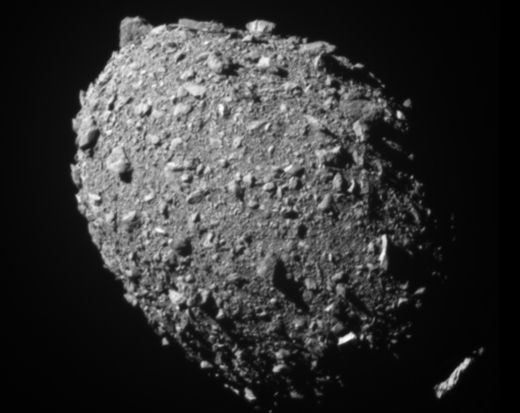
DART (Double Asteroid Redirection Test) Asteroid moonlet Dimorphos as seen by the DART spacecraft 11 seconds before impact.
Sep 26, 2022
RELEASE 22-100

NASA’s DART Mission Hits Asteroid in First-Ever Planetary Defense Test

After 10 months flying in space, NASA’s Double Asteroid Redirection Test (DART) – the world’s first planetary defense technology demonstration – successfully impacted its asteroid target on Monday, the agency’s first attempt to move an asteroid in space.

Mission control at the Johns Hopkins Applied Physics Laboratory (APL) in Laurel, Maryland, announced the successful impact at 7:14 p.m. EDT.

As a part of NASA’s overall planetary defense strategy, DART’s impact with the asteroid Dimorphos demonstrates a viable mitigation technique for protecting the planet from an Earth-bound asteroid or comet, if one were discovered.

“At its core, DART represents an unprecedented success for planetary defense, but it is also a mission of unity with a real benefit for all humanity,” said NASA Administrator Bill Nelson. “As NASA studies the cosmos and our home planet, we’re also working to protect that home, and this international collaboration turned science fiction into science fact, demonstrating one way to protect Earth.”

DART targeted the asteroid moonlet Dimorphos, a small body just 530 feet (160 meters) in diameter. It orbits a larger, 2,560-foot (780-meter) asteroid called Didymos. Neither asteroid poses a threat to Earth.

The mission’s one-way trip confirmed NASA can successfully navigate a spacecraft to intentionally collide with an asteroid to deflect it, a technique known as kinetic impact.

The investigation team will now observe Dimorphos using ground-based telescopes to confirm that DART’s impact altered the asteroid’s orbit around Didymos. Researchers expect the impact to shorten Dimorphos’ orbit by about 1%, or roughly 10 minutes; precisely measuring how much the asteroid was deflected is one of the primary purposes of the full-scale test. READ MORE FROM NASA’s PRESS RELEASE

https://spaceweather.com/ BULLSEYE! NASA STRIKES ASTEROID DEAD-CENTER: NASA’s DART spacecraft hit asteroid Dimorphos on Sept. 26th–an incredible, dramatic bullseye 11 million kilometers from Earth. DART took this picture of Dimorphos only 11 seconds before impact, reveaing it to be a boulder-strewn rubble pile:


See more images from DART’s approach and impact

Mission scientsts say DART hit the asteroid less than 17 meters off center. Think about that: 17 meters off at a distance of 11 million kilometers.NASA still has the right stuff.

Now more hard work begins. Astronomers on Earth have begun monitoring Dimorphos’s orbit to find out whether or not it has changed in response to DART’s impact. If so, it proves that human tech can alter an asteroid’s trajectory–a possible strategy for future Planetary Defense. Stay tuned.

Jupiter marks its closest opposition since 1963.

From Sky and Telescope:

Jupiter reaches opposition on September 26th just 591 million kilometers (367 million miles) from Earth, the closest they’ll pair for the year. Opposition distances vary depending on where the planet happens to be in its orbit when opposition comes around. The closer perihelion and opposition dates align, the closer the two planets will draw together and the brighter and larger the gas giant will shine.

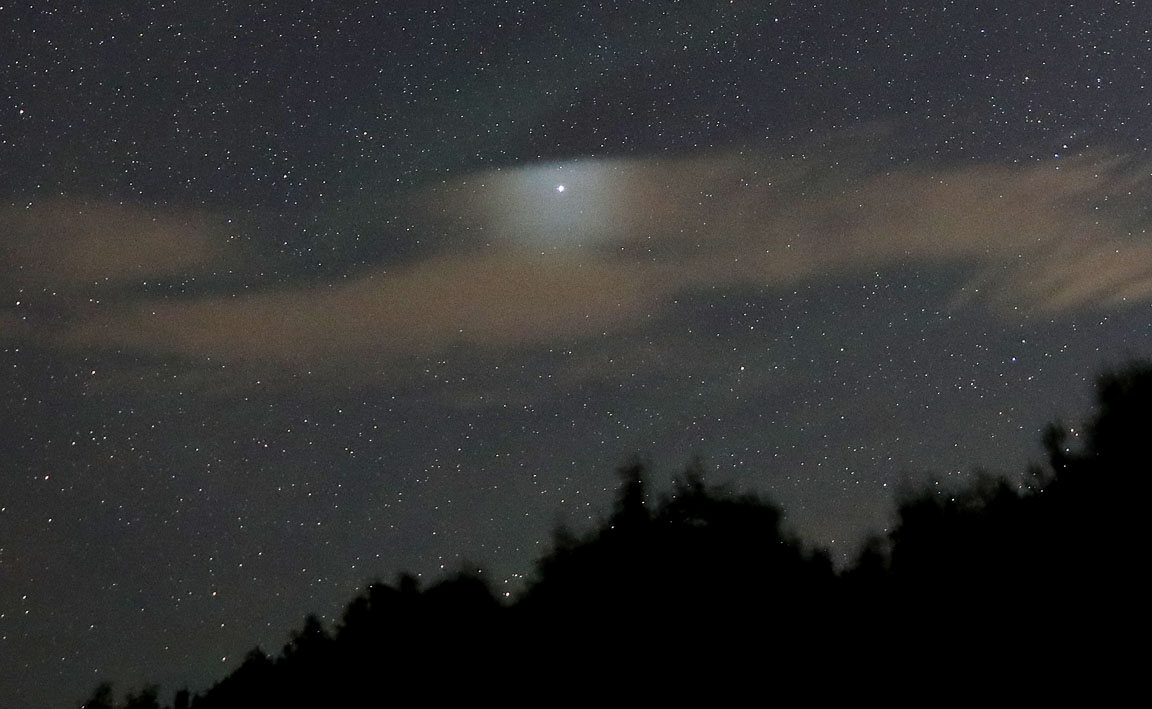
Jupiter corona
Jupiter is so bright it creates an aureole in a bank of passing clouds earlier this month. Bob King

This go-round, Jupiter lines up with Earth just four months shy of its January 21, 2023, perihelion. It hasn’t been this close since the October 1963 opposition and won’t be again until October 7, 2129. That’s why it appears exceptionally large (49.9″ across) and bright (magnitude –2.9). But that’s only half the story.

READ MORE

AURORAS ON JUPITER

Space Weather News for August 23, 2022
https://spaceweather.com
https://www.spaceweatheralerts.com

AURORAS ON JUPITER: Yesterday, NASA released gorgeous new photos of auroras on Jupiter taken by the James Webb Space Telescope. Today’s edition of Spaceweather.com takes a deeper dive into the photos, explaining why Jupiter’s auroras are so much more than just oversized versions of our own. Spoiler alert: Volcanoes are involved. Full story @ Spaceweather.com.

Don’t miss the next solar flare: Subscribers to our Space Weather Alert Service receive instant text messages when strong solar flares are underway.
[] 
Above: Infrared auroras on Jupiter. Image credit: NASA/JWST

Surface Mass Ejection (SME) on Betelgeuse


Astronomers believe a chuck of matter ripped itself away from the surface of the star

Space Weather News for August 12, 2022
https://spaceweather.com
https://www.spaceweatheralerts.com

WHAT JUST HAPPENED TO BETELGEUSE? Astronomers have identified a new type of stellar explosion: An SME or “Surface Mass Ejection.” Think of it as a CME on steroids; SMEs outmass CMEs by 400 billion to one. An SME on Betelgeuse may be responsible for the red supergiant’s recent dimming. Full story @ Spaceweather.com.

Don’t miss the next CME: Subscribers to our Space Weather Alert Service receive instant text messages when CMEs are about to hit Earth.
[] 
Above: An artist’s concept of a Surface Mass Ejection (SME) on Betelgeuse.

Star discovered orbiting Milky Way’s supermassive black hole every 4 years

Star discovered orbiting Milky Way’s supermassive black hole every 4 years

The discovery should help astronomers better understand the extreme conditions at the center of our galaxy and what can survive there.
blackhole
SquareMotion/Shutterstock

Astronomers have discovered a star that orbits the supermassive black hole at the center of our galaxy every four years. That’s the shortest orbit ever observed around a supermassive black hole.

The newly discovered star, called S4716, is about four times more massive than our Sun and twice as hot. It survives extraordinary conditions, orbiting this black hole at a distance as close as 100 astronomical units, less than three times the distance of Pluto from the Sun.

The discovery should help astrophysicists better understand conditions near this gravitational behemoth at the center of the Milky Way and to better calculate its mass and radius.

READ MORE: https://astronomy.com/news/2022/07/star-discovered-orbiting-milky-ways-supermassive-black-hole-every-4-years

Micrometeoroid damage to James Webb Space Telescope imaged for first time

 The damage to NASA’s flagship observatory was significantly greater than pre-launch expectations.

JWSTillustration
Dotted Yeti/Shutterstock

The micrometeoroid that hit the James Webb Space Telescope in May caused significantly more damage than expected and will have a lasting impact on the telescope’s observations, according to a NASA report on the spacecraft’s performance. By contrast, other micrometeoroid impacts during the spacecraft’s first six months of operation have had a negligible effect.

The report contains an image showing the damage to one hexagonal segment of the observatory’s main mirror, called C3. “The single micrometeorite impact that occurred between 22—24 May 2022 exceeded prelaunch expectations of damage for a single micrometeoroid,” says the NASA report.

JWSTmirrordamage
Spot the difference: infrared images of the James Webb Space Telescope before launch (left) and after the micrometeoroid strike (right). The damaged C3 segment is to the bottom right of the mirror.
“Characterization of JWST science performance from commissioning” (July 12, 2022); NASA/ESA/CSA

The performance of the main mirror is determined by how much it deforms incoming starlight and measured by a quantity called wavefront error rms (root mean square). At the beginning the mission, the C3 segment had a wavefront error of 56 nanometers rms, a level similar to the main mirror’s other 17 segments. The impact increased C3’s wavefront error to 258 nm rms.

Spacecraft engineers can change the position and curvature of each segment and in this way were able to reduce the error to 178 nm rms. This has a measurable effect on the error of the main mirror as a whole. “However, the effect was small at the full telescope level because only a small portion of the telescope area was affected,” says the report.

The JWST team say the impact increased the error associated with entire main mirror to about 59 nm rms. “About 5-10 nm rms above the previous best wavefront error rms values.” That’s well within the performance limits the team were hoping for.

Nevertheless, the impact raises questions about the nature of the space environment where the JWST operates. This is a point in space about a million kilometers from Earth where the gravitational fields of the Sun, Moon and Earth are in balance and so provide a relatively stable location.

READ MORE https://astronomy.com/news/2022/07/micrometeoroid-damage-to-james-webb-space-telescope-imaged-for-first-time?

How artificial intelligence is changing astronomy

 How artificial intelligence is changing astronomy

Machine learning has become an essential piece of astronomers’ toolkits.
An android cups its hand over one ear of a pair of premium headphones, looking at a screen of data from a radio telescope in the background under a starry night sky

When most people picture an astronomer, they think of a lone person sitting on top of a mountain, peering into a massive telescope. Of course, that image is out of date: Digital cameras have long since done away with the need to actually look though a telescope.

But now the face of astronomy is changing again. With the advent of more powerful computers and sky surveys that generate unimaginable quantities of data, artificial intelligence is the go-to tool for the keen researcher of space. But where is all of this data coming from? And how can computers help us learn about the universe?

AI’s appetite for data

Chances are you’ve heard the terms “artificial intelligence” and “machine learning” thrown around recently, and while they are often used together, they actually refer to different things. Artificial intelligence (AI) is a term used to describe any kind of computational behavior that mimics the way humans think and perform tasks. Machine learning (ML) is a little more specific: It’s a family of technologies that learn to make predictions and decisions based on vast quantities of historical data. Crucially, ML creates models which exhibit behavior that is not pre-programmed, but learned from the data used to train it.

The facial recognition in your smartphone, the spam filter in your emails, and the ability of digital assistants like Siri or Alexa to understand speech are all examples of machine learning being used in the real world. Many of these technologies are now being used by astronomers to investigate the mysteries of space and time. Astronomy and machine learning are a match made in the heavens, because if there’s one thing astronomers have too much of — and ML models can’t get enough of — it’s data.

We’re all familiar with megabytes (MB), gigabytes (GB), and terabytes (TB), but data at that scale is old news in astronomy. These days, we’re interested in petabytes (PB). A petabyte is about one thousand TB, a million GB, or a billion MB. It would take around 10 PB of storage to hold every single feature-length movie ever made in 4K resolution — and it would take over a hundred years to watch them all.

READ MOREhttps://astronomy.com/news/2022/07/how-artificial-intelligence-is-changing-astronomy

Montreal Science Fiction and Fantasy Association