MonSFFA is excited to host guest speakers from the RASC David Shuman and Paul Simard.
In April of 2024, weather permitting, Montreal will experience one of the most exciting astronomical events–a total solar eclipse!
We have invited David Shuman and Paul Simard to talk about their adventures chasing shadows. They will also explain how best to safely view the eclipse. We will also get to watch their mini-documentary, “Shadowchasers”.
David, a graphic designer by trade & avid amateur astronomer and photographer, is a longstanding member and Board member of the RASC Montreal Centre.
He has had many experiences from NASA press credentials, photographing the Space Shuttle in 1994, to visiting the Keck, Gemini & Subaru telescopes in 2001.
My fascination with spaceflight has also allowed me to witness several unmanned launches from KSC in Florida to extensive knowledge of spaceflight & launch vehicles.
Along wih Paul Simard, he is co-creator of the Eclipse mini-documentary “Shadowchasers: The Great American Total Solar Eclipse” in 2017 shown at the 2019 RASC AGM.
Dave and Paul have given numerous public talks & 3-D film presentations at NEAF & in California.
Long time members will remember their previous presentations at Con*Cept and MonSFFA.
CRYO-VOLCANIC OUTBURST: Comet 12P/Pons-Brooks just experienced its biggest outburst yet. On Nov. 14th, the cryo-volcanic comet abruptly brightened more than 100-fold, putting it well within range of backyard telescopes. Dubbed ‘the Devil Comet’ by mainstream media, 12P might not be sprouting horns this time, indicating a new form of debris. Updates and observing tips @ Spaceweather.com.
Above: A previous cryo-volcanic outburst on Comet 12P/Pons-Brooks in July 2023 produced a pair of “horns.” Photo credit: Igor Smolić
Bennu is an asteroid that could threaten the Earth, though the possibility is a narrow one. Still, a wise move to find out what it is made of, just in case we need to eliminate it sometime in the future. Besides that, the always important question: what are WE made of, what are the prime building blocks of our solar system? Asteroids are untouched remnants of the solar system’s formation.
But this isn’t the end of the story! OSIRIS-REx is now headed back out toward another asteroid. The spacecraft will arrive at Apophis in April 2029, around when the asteroid is expected to encounter Earth. A few years ago, Apophis was discovered to be on an actual collision course, which was the cause of a lot of excitement, but follow-up studies have it narrowly missing us. Whew! Good idea to learn about its composition. —Cathy
After a seven-year mission to the asteroid Bennu, seen here, NASA’s OSIRIS-REx spacecraft is set to drop off its samples on Sunday. (NASA/Goddard/University of Arizona/CSA/York/MDA/The Associated Press)
A spacecraft that has travelled more than 950 million kilometres is dropping off a care package on Sunday: samples from an asteroid that lies more than 100 million kilometres from Earth.
NASA’s OSIRIS-REx (Origins, Spectral Interpretation, Resource Identification, Security-Regolith Explorer) launched in 2016 destined for an asteroid named Bennu. Its main mission: to stick an arm out, “high-five” the asteroid and then vacuum up some of the debris, referred to as “touch and go.”
It successfully did so in 2020. Now, the rocky samples — roughly 250 grams in total, the largest ever to return to Earth — are on their way to be studied by science teams, including those from Canada.
A COMET SHAPED LIKE THE MILLENNIUM FALCON: Astronomers are monitoring a very unusual comet. A few days ago, Comet 12P/Pons-Brooks explosively brightened, spewing plumes of debris into space that now resemble a famous spaceship. No one knows for sure what happened, but it could be the eruption of an ice volcano on the comet’s surface. Full story @ Spaceweather.com.
Above: A backyard telescope image of Comet 12P/Pons-Brooks on July 24, 2023. Credit: David Strange of Salcombe Regis, East Devon, UK
A SIGNIFICANT EXPLOSION ON THE SUN: Giant sunspot AR3363 finally blew its top. An hours-long explosion on July 18th hurled a massive CME into space and triggered a radiation storm around Earth. The CME might graze our planet later this week. Full story @ Spaceweather.com.
Solar Flare alerts: Sign up for Space Weather Alerts to receive instant text messages when strong flares are underway. Above: Debris from today’s M6-class explosion. Credit: NASA/Solar Dynamics Observatory.
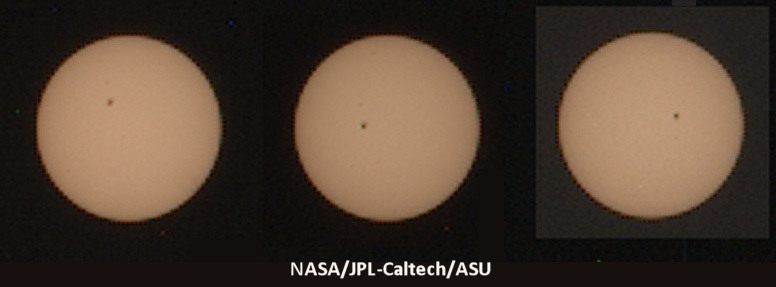
A SUNSPOT SO BIG YOU CAN SEE IT FROM MARS: A huge sunspot (AR3363) just emerged over the sun’s southeastern limb. Mars rover Perseverance saw it before we did. On July 2nd, the rover’s mast-mounted stereo camera (MASTCAM-Z) tilted up to the sky above Jezaro crater and photographed a deep-black dot on the solar disk:
Perseverance does this all the time. Using a solar filter, the rover looks at the sun almost every day to check its brightness. When the sun dims, researchers know a dust storm is brewing–one of the most important forms of weather on the Red Planet.
Sunspots are just a bonus. A recent study shows that Perseverance sees more than 40% of all sunspots despite the fact that Mars is 78 million km farther from the sun than Earth and the rover’s camera doesn’t put many pixels across the solar disk. It is able to resolve about 10% of the biggest sunspots into multiple pixels.
Perseverance has one big advantage. It can see parts of the sun we cannot. From where Mars is currently located, Perseverance views more than half the sun’s farside, giving it a preview of sunspots still hidden from Earth. That’s how the rover spotted AR3363 days in advance.
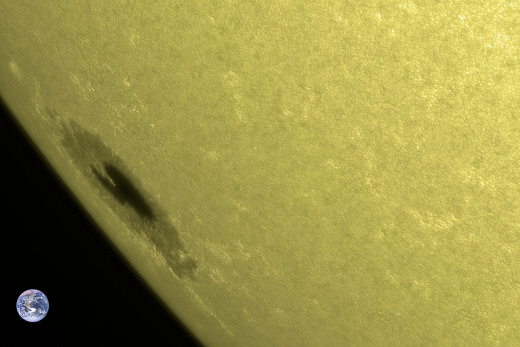
People on Earth saw the sunspot for the first time on July 5th:
“A very big sunspot is coming!” says photographer Philippe Tosi of Nîmes, France, who inserted an image of Earth for scale.
Just don’t forget, Perseverance saw it first. Daily photos from Perseverance are available here. Select the date and camera (MASTCAM-Z), then start looking for sunspots.
A scene from 1977’s Star Wars: Episode IV – A New Hope, where Luke Skywalker stares out at a sunset of two stars from his home planet of Tatooine. (Lucasfilm/Disney)
A new discovery of a faraway planet, published today in the journal Nature Astronomy, is bringing more science to what was once the realm of science fiction.
The new exoplanet, TOI-1338/BEBOP-1c, is a gas giant 65 times the size of Earth and more than 1,300 light years away in a binary star system — where two suns revolve around each other.
For some, it might recall a powerful scene from the original Star Wars movie — Luke Skywalker staring at the horizon, pining for a greater destiny than on the dustball of Tatooine, as the aptly named John Williams theme Binary Sunset plays in the background.
While the fictional Tatooine was alone, BEBOP-1c is the second planet discovered in the real TOI-1338 system.
“It’s quite an exciting discovery,” said Matthew Standing, post-doctoral researcher at The Open University in Milton Keynes, England, and first author of the study.
“It’s only the second multi-planetary, circumbinary system and the first-ever circumbinary planet discovered with radial velocity.”
Unpacking those terms is key to why experts think this could lay the groundwork for finding similar hidden exoplanets. But it requires understanding the chaos of such cosmic neighbourhoods and the methods used to detect exoplanets.
A ‘MEGA-BUBBLE’ ON THE SUN: NOAA has just released a list of highlights from young Solar Cycle 25. One of them must be seen to be believed: An X-class flare blowing a “mega-bubble” in the sun’s atmosphere. Full story and movie @ Spaceweather.com.
Above: The sun, blowing bubbles. Image credit: NOAA/GOES-16/SUVI
NOCTILUCENT CLOUDS ARE BACK: Last night, bright clouds of frosted meteor smoke drifted over Europe, signalling the start of the summer season for noctilucent clouds. The electric-blue forms were sighted in at least 7 countries, a number that could grow in the nights ahead as the clouds continue to spill across the Arctic Circle. Full story @ Spaceweather.com.
Solar Flare alerts: Sign up for Space Weather Alerts to receive instant text messages when strong flares are underway. Above: Noctilucent clouds (NLCs) over Denmark on June 5, 2023. Photo credit: Valther Jørgensen



![[]](https://mcusercontent.com/0c5fce34d5ca05f64a13d085d/images/3869c982-a742-7892-8e75-f081f925049f.jpg)
![[]](https://mcusercontent.com/0c5fce34d5ca05f64a13d085d/images/6d664eb2-b09e-3f69-314f-6d7cb37caeef.jpg)

![[]](https://mcusercontent.com/0c5fce34d5ca05f64a13d085d/images/5fe827f9-f25a-d08a-5e43-1592040250c1.jpg)
![[]](https://mcusercontent.com/0c5fce34d5ca05f64a13d085d/images/fa54c414-f1c6-e8fc-7c04-3dae13a0b302.jpg)