STRONG GEOMAGNETIC STORM WATCH Space Weather News for March 22, 2025
NOAA forecasters have issued a watch for strong G3-class geomagnetic storms on March 23rd when a CME is expected to hit Earth. The Russell-McPherron effect could amplify the effectiveness of the impact, producing widespread equinox auroras. Full story @ Spaceweather.com.
CME impact alerts: Sign up for Space Weather Alerts to receive instant text messages when CMEs strike Earth.
Above: Equinox auroras over Luosto, Finland, on March 20th. “Thanks to the Russell-McPherron effect, the aurora showed up nicely,” reports photographer Zoltán Kolláth.
COSMIC RAY SHOWERS CAUSE LIGHTNING: A new study by researchers at the Los Alamos National Laboratory links lightning to antimatter in cosmic ray showers. This could solve a centuries-old mystery of what causes electrical outbursts in thunderstorms. Full story @ Spaceweather.com
Above: 3D images of lightning over New Mexico. Researchers at Los Alamos National Laboratory used these data to link lightning to cosmic rays.
LUNAR ECLIPSE OBSERVED FROM THE MOON: For the first time in almost 60 years, a lunar lander has photographed an eclipse from the surface of the Moon. During last night’s lunar eclipse, Firefly Aerospace’s Blue Ghost recorded the sky show from Mare Crisium. Full story with photos @ Spaceweather.com.
Above: A two-planet view of last night’s lunar eclipse. Credit: Eric Allen and Firefly Aerospace.
Good morning, Moon! This image captured by Firefly Aerospace’s Blue Ghost lander on March 3 shows sunrise on the lunar surface. This marked the beginning of the lunar day and the start of Blue Ghost’s surface operations, which will last throughout one lunar day (about 14 Earth days). Image credit: Firefly Aerospace.
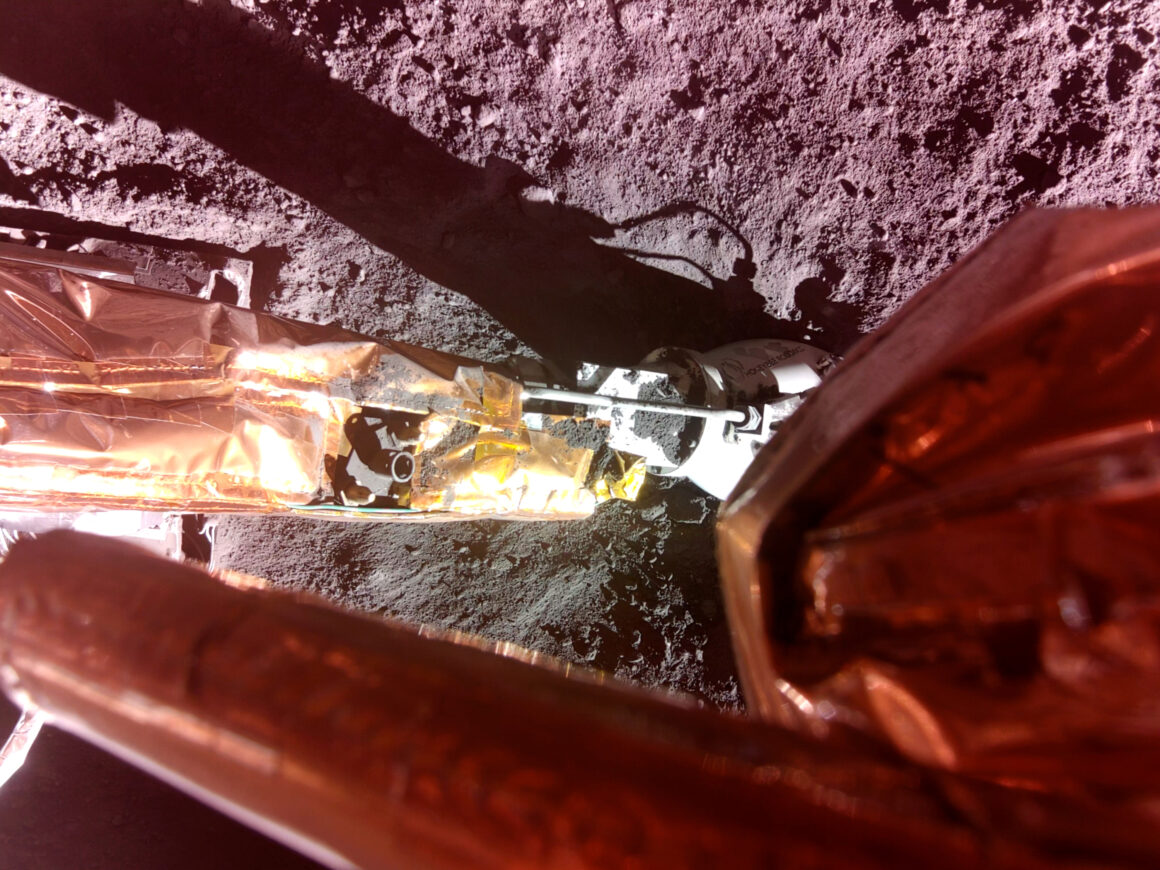
PlanetVac is sampling the Moon! Firefly Aerospace’s Blue Ghost successfully landed on the Moon on March 2, carrying with it 10 NASA science and technology instruments, including Lunar PlanetVac. This sample collection technology was developed and tested by Honeybee Robotics, with key tests funded by Planetary Society members and donors. Firefly Aerospace confirmed this week that Lunar PlanetVac has been deployed to begin collecting samples of lunar regolith.
Without an atmosphere, the temperature on the surface of the Moon depends almost entirely on direct sunlight. Near the Moon’s equator, temperatures can reach around 120 degrees Celsius (250 degrees Fahrenheit) in the daytime and ten drop to -130 degrees Celsius (-208 degrees Fahrenheit) at night.
The Lunar PlanetVac instrument on the end of Blue Ghost’s Surface Access Arm. Image credit: Firefly Aerospace.
PlanetVac is sampling the Moon! Firefly Aerospace’s Blue Ghost successfully landed on the Moon on March 2, carrying with it 10 NASA science and technology instruments, including Lunar PlanetVac. This sample collection technology was developed and tested by Honeybee Robotics, with key tests funded by Planetary Society members and donors. Firefly Aerospace confirmed this week that Lunar PlanetVac has been deployed to begin collecting samples of lunar regolith.
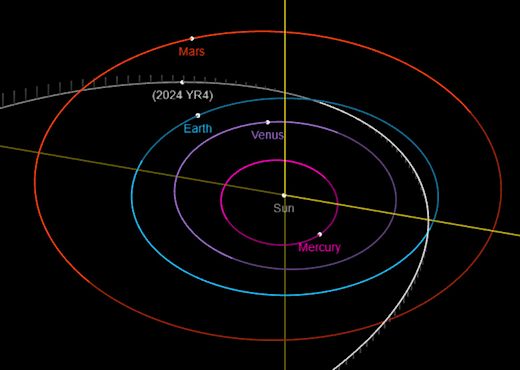
ASTEROID 2024 YR4 UPDATE: The odds just increased again. Asteroid 2024 YR4 now has a 2.6% chance of hitting Earth on Dec. 22, 2032, up from 2.2% a week ago, and 1.3% in January. Current probabilities are based on 368 observations spanning 54 days. This growing arc of data is improving our knowledge of the asteroid’s orbit and, so far, steadily increasing the odds of a strike.
That was the bad news. The good news is, even if it hits, 2024 YR4 will not wipe us out. With an estimated diameter of 40 to 70 meters, it is only a few times larger than the Chelyabinsk meteor that hit Russia in 2013. That space rock exploded in the atmosphere, creating shock waves that shattered glass windows and injured hundreds of people (mainly from broken glass). The estimated size of 2024 YR4 reminds researchers even more of the Tunguska impactor, which leveled a forest in Russia in 1908. You wouldn’t want to be at ground zero, but Earth would survive.
The risk profile of 2024 YR4 is unusual. Often we see sensational headlines predicting some newly-discovered asteroid might hit Earth. These are space rocks with huge error bars on their orbits because they haven’t been tracked for very long. As soon as more data are collected, the odds of impact go down. For 2024 YR4, however, the odds are still going up, which makes it interesting.
Reminder: There’s still a 97.4% chance of a miss. Stay tuned for updates.
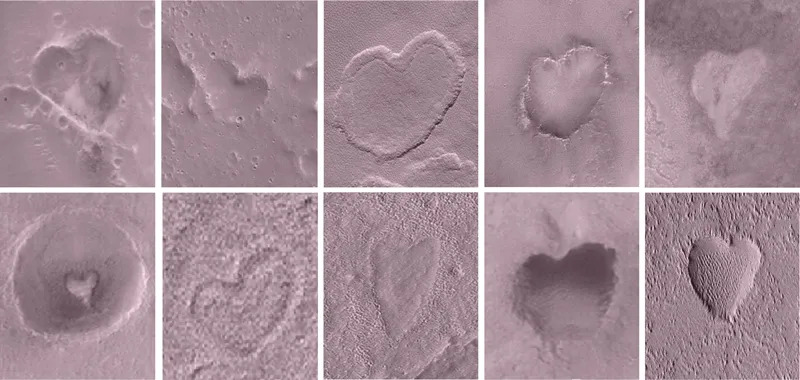
Mars may be named after the god of war, but it seems more like a sappy romantic. NASA’s Mars Global Surveyor spacecraft spotted these hearts on the Martian surface throughout its time in orbit. All of them are natural formations, but let’s just go ahead and interpret them as love notes from the red planet. Image credit. NASA/JPL/Malin Space Science Systems.
A recently discovered near-Earth asteroid, dubbed 2024 YR4, is making headlines because of the slim possibility that it could impact Earth on Dec. 22, 2032. Early observations suggest that it has about a 1% chance of colliding with our planet. So why all the fuss?
2024 YR4 is garnering so much attention because of more than 37,000 near-Earth asteroids already discovered, it is the only one with more than a 1 in 1,000 chance of impact. “It is rare to have an asteroid with a non-zero probability of hitting Earth,” said Heidi Hammel, Vice President for Science at the Association of Universities for Research in Astronomy and Vice President of the The Planetary Society’s board of directors.
To put it into context, 2024 YR4 has a Torino scale rating of as high as 3. The Torino Impact Hazard Scale ranges from 0 (no chance of impact) to 10 (certain impact likely to cause planetwide devastation). Ratings of 1 are fairly common among newly discovered asteroids, but follow-up observations have always reduced that rating to 0. Asteroid 2024 YR4’s rating of 3 is the second-highest an asteroid has ever reached. The only asteroid ranked higher was Apophis, discovered in 2004 and rated 4, but subsequently downgraded to 1 and then 0. We now know with certainty that Apophis will only pass close to Earth in 2029.
Right now, ESA estimates that 2024 YR4’s diameter is in the range of 40-100 meters (around 130-330 feet). If it did collide with Earth, an impactor of that size could cause an explosion in the atmosphere or even an impact crater, either of which could cause serious, even devastating, damage on the ground.
Asteroid danger by the numbers The risk, characteristics, and rarity of various kinds of asteroid impacts.Image: NASA
Fortuitously, the Planet of Love reaches greatest brilliancy on Valentine’s Day. At magnitude –4.9, it’s the equivalent of crushing a 1.4-day-old Moon into a point source. That’s bright! Bright enough to cast a shadow from a rural site on a moonless night. Count yourself lucky if you have snow cover. The added contrast makes it the perfect backdrop for shadow-spotting.
Venus casts shadows of the author and his tripod-mounted camera on a garage door on September 14, 2023, during the planet’s morning apparition. Shadows are crisp compared to those cast by the Sun because Venus is a point source, not an extended disk. If you try this experiment and have difficulty seeing your shadow, sway back and forth, and it should become more obvious. Bob King
If you’re wondering what to give your love for Valentine’s Day, consider the nearest planet. In the movie It’s a Wonderful Life, the fictional character George Bailey offers to lasso the Moon for his future wife Mary Hatch. Why not brandish your own imaginary lasso and “pull down” Venus for your sweetheart? (Don’t forget to have a box of specialty chocolates as a backup.)
WHAT ARE ‘MIYAKE EVENTS’? So you thought the Carrington Event was bad? Researchers have found evidence in tree rings of solar storms 10 times worse. The discovery of “Miyake Events” has placed dendrochronologists at the center of space weather research.
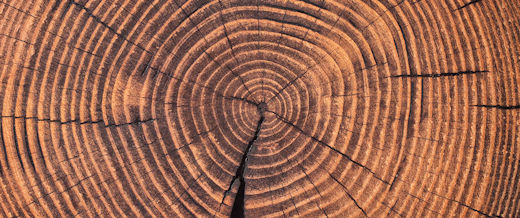
A WARNING FROM THE TREES: How bad can a solar storm be? Just ask a tree. Unlike human records, which go back hundreds of years, trees can remember solar storms for millennia.
Above: Rings in the stump of an Ancient Bristlecone Pine may reveal evidence of extreme solar storms dwarfing modern events.
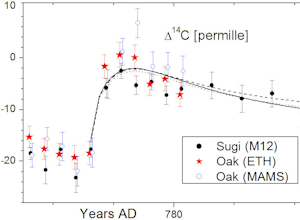
Nagoya University doctoral student Fusa Miyake made the discovery in 2012 while studying rings in the stump of a 1900-year-old Japanese cedar. One ring, in particular, drew her attention. Grown in the year 774–75 AD, it contained a 12% jump in carbon-14 (14C), an isotope created by cosmic radiation. The surge was 20 times greater than ordinary fluctuations in cosmic rays. Other teams confirmed the spike in wood from Germany, Russia, the United States, Finland, and New Zealand. Whatever happened, trees all over the world experienced it.
Most researchers think it was a solar storm—an extraordinary one. Often, we point to the Carrington Event of 1859 as the worst-case scenario for solar storms. The 774-75 AD storm was at least 10 times stronger; if it happened today, it would floor modern technology. Since Miyake’s initial discovery, she and others have confirmed four more examples (7176 BC, 5259 BC, 664-663 BC, 993 AD). Researchers call them “Miyake Events.”
It’s not clear that all Miyake Events are caused by the sun. Supernova explosions and gamma-ray bursts also produce carbon spikes. However, the evidence tilts toward solar storms. For each of the confirmed Miyake Events, researchers have found matching spikes of 10Be and/or 36Cl in ice cores. These isotopes are known to trace strong solar activity. Moreover, the 774-75 AD Miyake Event had eyewitnesses; historical reports of auroras in China and England suggest the sun was extremely active around that time.
Miyake Events have placed dendrochronologists (scientists who study tree rings) in the center of space weather research. After Miyake’s initial discovery in 2012, the international tree ring community began working together to look for evidence of solar superstorms. Their collaboration is called “the COSMIC initiative.” COSMIC results published in a 2018 edition of Nature confirm that Miyake Events in 774-75 AD and 993 AD were indeed global. Trees on five continents recorded carbon spikes.
“There could be additional Miyake Events throughout the Holocene” says Irina Panyushkina, a member of the COSMIC initiative from the University of Arizona’s Laboratory for Tree-Ring Research. “Finding them will be a slow and systematic process.”
Above: A global map of COSMIC tree ring and ice core measurements [more]
“An important new source for annual 14C measurements are floating tree-ring records from Europe and the Great Lakes,” says Panyushkina. “These are very old rings that could potentially capture 14C spikes as far back as 15,000 years. Eventually, I believe we will have a complete record of Miyake Events throughout that period.”
Four more candidates for Miyake Events have recently been identified (12,350 BC, 5410 BC, 1052 C, and 1279 C). The candidate in 12,350 BC, identified from tree rings the French Alps, may be more than twice the size of any other Miyake Event. Confirmation requires checking trees on many continents and finding matching spikes of 10Be and 36Cl in ice cores.
A complete survey of Miyake Events could tell us how often solar superstorms occur and how much peril the sun presents to a technological society. Stay tuned for updates from the trees.
AN X-CLASS DOUBLE SOLAR FLARE: Solar activity remains high with an X-class double solar flare on Oct. 26th. The explosion hurled an impressive CME into space, and it appears to have an Earth-directed component. Several big sunspots are turning toward Earth, so this could be the beginning of a week of stormy space weather. Full story @ Spaceweather.com.
Solar flare alerts: Sign up for Space Weather Alerts to receive instant text messages when strong solar flares are underway.
Click the picture to view the flare in action.
An M9.5-X1.8 class double flare on Oct. 26th. Extreme ultraviolet movie from NASA’s Solar Dynamics Observatory.



 Without an atmosphere, the temperature on the surface of the Moon depends almost entirely on direct sunlight. Near the Moon’s equator, temperatures can reach around 120 degrees Celsius (250 degrees Fahrenheit) in the daytime and ten drop to -130 degrees Celsius (-208 degrees Fahrenheit) at night.