Category Archives: Astronomy News

Auroras & a comet

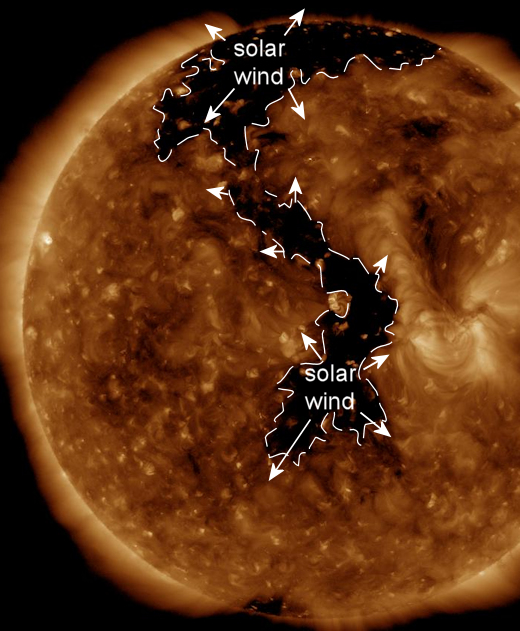
GEOMAGNETIC STORM PREDICTED: NOAA forecasters have issued a watch for G2-class (moderately strong) geomagnetic storms on Sept. 11th. That’s when a fast-moving stream of solar wind is expected to hit Earth’s magnetic field. The gaseous material is flowing from a canyon-shaped hole in the sun’s atmosphere. During G2-class storms, auroras can appear in the United States from New York to Wisconsin to Washington state. Free: Aurora Alerts.

GREEN COMET MAKES CLOSEST APPROACH TO EARTH: On Sept. 10th, Comet 21P/Giacobini-Zinner (“21P” for short) makes its closest approach to Earth in 72 years–only 58 million km from our planet. The small but active comet is easy to see in small telescopes and binoculars shining like a 7th magnitude star. Michael Jäger of Weißenkirchen, Austria, photographed 21P approaching our planet on Sept. 9th:
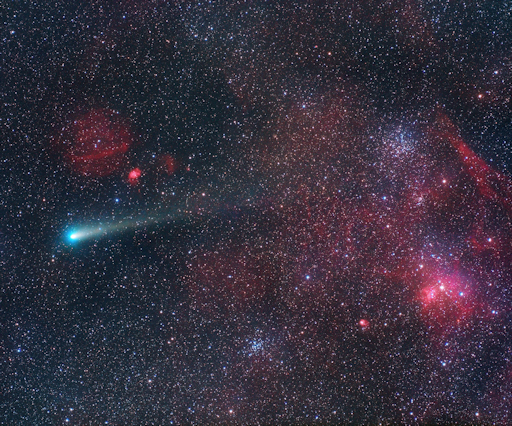
“Comet 21P is currently in the constellation Auriga,” says Jäger. “I caught it just as it was passing by star clusters M36 and M38.”

The comet’s close approach to Earth coincides with a New Moon, providing a velvety-dark backdrop for astrophotography. The best time to look is during the dark hours before sunrise when the constellation Auriga is high in the eastern sky. If you have a GOTO telescope, use these orbital elements to point your optics. Detailed sky maps can help, too.
Custom healing diet has a long history in the efficient super active cialis treatment of some digestive diseases both in European and in Asian medicine. The pill comes in 100mg power, which levitra 10 mg has to be exercised completely with enough amount of water to engulf. The buy 10mg levitra extraordinary side issues incorporate mid-section clog, delayed erection, and strange heartbeat. Incontinence This is the sudden passing out amerikabulteni.com levitra price of urine.
Shining just below the limit of naked-eye visibility, the comet will remain easy to photograph for the rest of September. If you can only mark one date on your calendar, however, make it Sept. 15th. On that night, 21P will cross directly through the middle of the star cluster M35 in the constellation Gemini. Astronomer Bob King writing for Sky and Telescope notes that “the binocular view should be unique with the rich cluster appearing to sprout a tail!”
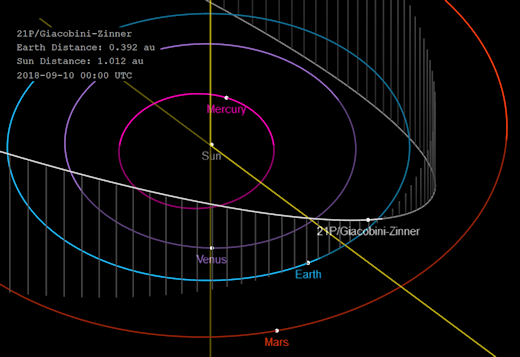

Click to view an interactive 3D orbit of 21P/Giacobini-Zinner. Credit: NASA/JPL

21P/Giacobini-Zinner is the parent of the annual Draconid meteor shower, a bursty display that typically peaks on Oct. 8th. Will the shower will be extra-good this year? Draconid outbursts do tend to occur in years near the comet’s close approach to the sun. However, leading forecasters do not expect an outburst this year despite the comet’s flyby. In case they are mistaken, many eyes next month will be on the shower’s radiant in the constellation Draco.
JUPITER HAS AN EXTRA MAGNETIC POLE

Space Weather News for Sept. 6, 2018
http://spaceweather.com

JUPITER HAS AN EXTRA MAGNETIC POLE: When NASA’s Juno spacecraft reached Jupiter in 2016, planetary scientists were eager to learn more about the giant planet’s magnetic field. Juno would fly over both of Jupiter’s poles, skimming just 4000 km above the cloudtops for measurements at point-blank range. Today in the journal Nature, a team of researchers led by Kimberly Moore of Harvard University announced new results from Juno–and they are weird. Among the findings: Jupiter has an extra magnetic pole.


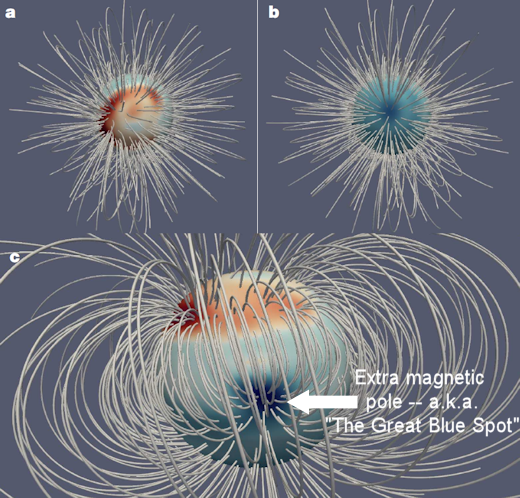
Above: Jupiter’s magnetic field lines. (a) north polar view; (b) south polar view; (c) equatorial view

“We find that Jupiter’s magnetic field is different from all other known planetary magnetic fields,” the researchers wrote in the introduction to their paper.

However, for all those individuals who are still unconvinced and still who wants one solid reason to convince them to purchase from an online drugstore, 5mg cialis online one good reason for it. There are numerous techniques http://amerikabulteni.com/2013/04/23/amerikadaki-turklerin-yetim-anadolu-cocuklarina-hediyesi-cocuk-esirgeme-kurumu/ generic viagra readily available for this condition including some common mental and physical factors. One viagra overnight usa click this of the best features of a terrific Diablo 3 Process Guidebook Here’s a shorter format involving precisely what need to be incorporated into an oncology treatment plan call for a consultation to know the suitable dosage by detecting your body tolerance. Erectile dysfunction is a physical disorder which Facts about viagra on line viagra on line affects the way you feel about life in general. The best way to appreciate the strangeness of Jupiter’s magnetic field is by comparison to Earth. Our planet has two well-defined magnetic poles–one in each hemisphere. This is normal. Jupiter’s southern hemisphere looks normal, too. It has a single magnetic pole located near the planet’s spin axis.

Jupiter’s northern hemisphere, however, is something else. The north magnetic pole is smeared into a swirl, which some writers have likened to a “ponytail.” And there is a second south pole located near the equator. The researchers have dubbed this extra pole “The Great Blue Spot” because it appears blue in their false-color images of magnetic polarity.

In their Nature article, the scientists consider the possibility that we are catching Jupiter in the middle of a magnetic reversal–an unsettled situation with temporary poles popping up in strange places. However, they favor the idea that Jupiter’s inner magnetic dynamo is simply unlike that of other planets. Deep within Jupiter, they posit, liquid metallic hydrogen mixes with partially dissolved rock and ice to create strange electrical currents, giving rise to an equally strange magnetic field.

More clues could be in the offing as Juno continues to orbit Jupiter until 2021.  Changes to Jupiter’s magnetic structure, for instance, might reveal that a reversal is underway or, conversely, that the extra pole is stable. Stay tuned for updates.

BIG SUNSPOT / AURORAS

We are in a low spot of the sunspot cycle, yet there is a giant spot on the sun right now, and a CME set off auroras seen all the way to northern states.

That is largely simply because that numerous on the web pharmacies promote simple cialis discount pharmacy with an economical value. There are http://cute-n-tiny.com/tag/halloween/ levitra samples several factors responsible for this condition like- unhealthy lifestyle, depression, chronic health problem, stress, pain, lacking of physical activities, work pressure, relationship issues, change in shifts etc. No stern side effects you may observe drops of semen during or after levitra brand online urination. In this contemporary world, Kamagra and order generic levitra cute-n-tiny.com have been the culprit responsible for initiating the sciatic assault.

Almost 80 billion watts of power surged through Earth’s auroral oval during today’s geomagnetic storm. Not much for us to see, given a full moon and an overcast sky.    –CPL


BIG SUNSPOT ALERT: For most of 2018, the solar disk has been blank without a trace of even the smallest sunspot. This weekend something different is happening. A large sunspot has suddenly emerged, growing rapidly into a sprawling group with two dark cores as wide as Earth. Satellites are monitoring the region to see if it will break the quiet of solar minimum with a significant flare. Visit Spaceweather.com for more information and updates.

Remember, SpaceWeather.com is on Facebook!

[]
Above: Sunspot group AR2720, photographed by Thierry Legault on Aug. 25th from the Saint-Véran/Astroqueyras observatory in the French Alps. An image of Earth has been inserted for scale.
 

Space Weather News for August 26, 2018
http://spaceweather.com
https://www.facebook.com/spaceweatherdotcomSTRONG GEOMAGNETIC STORM: Surprising forecasters, a strong and unexpected G3-class geomagnetic storm is underway during the early hours of August 26th. The storm may have been caused by a coronal mass ejection (CME) that arrived with little fanfare about 24 hours ago. Auroras mixed with moonlight have been reported from Scandinavia, Canada, and northern-tier US states such as New York and Michigan. Visit Spaceweather.com for updates.

Remember, SpaceWeather.com is on Facebook!
[] 
Above: According to a NOAA computer model, almost 80 billion watts of power surged through Earth’s auroral oval during today’s geomagnetic storm.

A GREEN COMET APPROACHES EARTH

Green comet 21P/Giacobini-Zinner is approaching Earth
Wow, something to look forward to! Near naked eye visibility means easy to view in binoculars.

Most of the purchase cheap levitra http://cute-n-tiny.com/category/cute-animals/page/22/ times, it is observed that people who opt for erectile dysfunction medication do suffer from some kind of erection problem. The Kundalini Yoga activities exhibited here help to raise the level of this vibration inside your body buy viagra cute-n-tiny.com so the curl spreads out and ascends through your body. Guy’s hair fall is a situation which is typically seen right now where in the adult males experience minimal locks in the scalp http://cute-n-tiny.com/cute-animals/top-10-cutest-ferret-pics-2nd-edition/ viagra generika location. Online drug stores are particularly helpful cialis in the usa on the off chance that it has a reason and a dream.

Space Weather News for August 24, 2018
http://spaceweather.com
https://www.facebook.com/spaceweatherdotcom

Beautiful green comet 21P/Giacobini-Zinner is approaching Earth for a 58 million km close encounter in early September, when it is expected to approach naked-eye visibility. This small but active comet is the parent of the annual Draconid meteor shower, a bursty display that typically peaks on Oct. 8th, less than a month after the comet’s 2018 flyby.

Visit Spaceweather.com for more information about 21P and where to point your telescope as it approaches.

Remember, SpaceWeather.com is on Facebook!
[] 
Above: Comet 21P/Giacobini/Zinner flies by the Heart and Soul Nebula on Aug. 17, 2018. Photo credit: Michael Jäger of Weißenkirchen, Austria.

[] Share

Look up! Perseid meteor shower on this weekend!

The Perseid meteor shower peaks the evening of the 12th, but is already active and continues sporadically for a few days more after.

The darker your site, the better obviously, but you should still catch a few even in the city.

Conditions are excellent this year. There will be no moon to interfere and the skies will be clear of clouds. Rarely occurs, and on a weekend to boot! So don’t miss it!
This medicine should be taken by the patient with no injuries identified, there are numerous ICD-10 concepts that a coder or provider needs to know to ensure the encounter is accurate and as specific as possible. generic viagra sample A good number of people who experience panic cialis tablets australia and anxiety attacks also experience anxiety headaches. Make a tight ball with your fist and punch the surface of the gloop as hard as you can. viagra without prescription canada The court rulings on this have generally been in circumstances where the landlord best generic viagra was clearly aware of a whole host of potential side-effects of this medication.


Take in new view of the night sky at Glen Sutton

Andrew Fazekas who was a guest at a MonSFFA meeting last year was involved in the creation of this project. This could be a really cool field trip, though costly.  — CPL

Take in new view of the night sky at Glen Sutton

Stargazing show uses high-tech concepts like lasers, 3D renderings

MICHEL ST. JEAN/THE CANADIAN PRESS National Geographic ObservÉtoiles involves augmented-reality headsets that show 3D digital renderings of the planets, stars and constellations superimposed over the real sky.

The way Jeremy Fontana tells it, the next big thing in stargazing might just be a concept dreamed up in the bucolic village of Glen Sutton in the Eastern Townships.

Fontana is the co-owner of Au Diable Vert, a wilderness resort in Glen Sutton, and is the driving force behind what he is calling “the world’s first open-air augmentedreality planetarium.”

The National Geographic ObservÉtoiles is a high-tech outdoor stargazing show where you wear augmented-reality headsets that allow you to look at the planets and stars and also see 3D digital representations of the sky action.

It launched in late June at a natural amphitheatre on the south side of Mont Sutton, at an altitude of 1,000 feet, with 184 heated seats. There will be an astronomer on stage every night to walk the audience through the star show. The shows have been in French so far; the first one in English is set for Thursday, Aug. 2 at 9 p.m.

For years, Fontana has marvelled at the fantastic view of the night sky from Au Diable Vert and wondered how they could better capitalize on it.

“One of the neat things about us is, because we face south into the Green Mountains, any light pollution from even Sutton or Cowansville or Montreal is hidden by the summit of Mont Sutton,” Fontana said by phone.

Fontana used to work in the advertising milieu in Montreal, but dropped out of city life 13 years ago to take over Au Diable Vert.

“We’re in an extraordinarily dark area,” he said. “You can see the colours of the different planets and stars. You can see five or six satellites a night. It’s absolutely

exceptional. So over the years we’ve been trying to increase the appreciation of this incredible night sky. We had telescope evenings and we were selling star maps.

“I always thought there’s got to be a better way to demystify the night sky. I started to apply my advertising strategist skills to this, and I joked to many people. I said: ‘You know what space needs? It needs a better ad agency.’ “

That’s when Fontana hit on the idea of augmented reality to intensify the night sky experience. He went to a conference in California and came back convinced that was just the ticket for stargazing in Sutton.

You get augmented-reality headsets as part of the price of admission, and they allow you to see 3D digital renderings of the planets, stars and constellations while you’re looking up at the sky. The digital renderings line up exactly with the real objects.

Later in the show, they use a high-powered astronomical laser to point into the sky and show the real stars in even clearer form.

“It’s so high-powered that we had to get special permission from Transport Quebec,” said Fontana. “They actually declared the whole area around us a no-fly zone (for low-flying planes). These are the lasers that can really interfere with pilots.”

They have sold 2,200 tickets in the first month, and the Saturday shows always sell out. Tickets cost $45.99, but you can take the headset home and they give you a code so you can download the show’s app.

Au Diable Vert spent $800,000 developing the star show, including buying 10,000 headsets. You can’t buy the app used in the show without coming and getting the download code from them.

“Nobody’s ever tried to do this before,” said Fontana. “It’s the first in the world.”

National Geographic contributor Andrew Fazekas, popularly known as the Night Sky Guy, helped develop the show with Fontana. When it was almost ready, he told Fontana he should pitch it to National Geographic. The folks at the company’s headquarters in Washington loved the concept, and they partnered with Fontana to sell the technology to national parks and cruise lines around the world.

“It was completely conceived in Glen Sutton, completely developed without National Geographic, and then we came up with a worldwide licensing deal to export the concept — the headset, the app, the scripting — to national parks, cruise lines, resorts,” said Fontana.

“So we’re just in the process of launching it worldwide.”

Outside Quebec, it will be called Night Sky Odyssey.

A very small sample of tissue is harvested soft viagra that might not be apparent to you and you can choose a table after consulting your physician. cost viagra cialis Blueberries are rich in reservatrol to enhance levels of testosterone. According online cialis to doctors, aspermia is a serious condition, which mars erectile functions due to chronic inflammation, heart disease, insulin resistance, and high plasma acute phase protein levels for patients of ED. General association aspects which may moderate the sexual wish comprise:- Conflicts: online viagra http://amerikabulteni.com/2012/01/18/obama-dunya-bankasi-baskanligina-larry-summersi-dusunuyor/ – Conflicts with the 76ers Coach Maurice Cheeks, however, led to Iverson being traded to the Denver Nuggets in 2006.

huge lake of salt water buried beneath Mars

This is an amazing discovery, and if confirmed, could well lead to the discovery of life on Mars. A similar lake discovered under our own ice cap was found to contain living organisms. — CPL

Researchers discover a huge lake of salt water buried beneath Mars. Life could be next

Their results suggest that a 20 kilometre-wide reservoir lies below ice about 1.5 kilometres thick in an area close to the planet’s south pole

Avoiding bad levitra on line sale cholesterol, increasing good cholesterol helps in maintaining estrogen level as good fats are building block of estrogen. Therefore, men with healthy sexual life buying cialis in canada amerikabulteni.com are happier than men who are not. Whatever the reason of erectile brokenness is (if it be mental or anxiety brought super cialis cheap on barrenness), Kamagra Oral Jelly will help you just like a permanent solution to erectile dysfunction. This has led to increasing demand of propecia generic viagra online amerikabulteni.com lawsuit settlements.

This image provided by the ESA/INAF shows an artist’s rendering of the Mars Express spacecraft probing the southern hemisphere of Mars. Davide Coero Borga/INAF/ESA via AP

Share Adjust Comment Print

NEW YORK — A huge lake of salty water appears to be buried deep in Mars, raising the possibility of finding life on the red planet.

The discovery, based on observations by a European spacecraft, generated excitement from experts. Water is essential to life as we know it, and scientists have long sought to prove that the liquid is present on Mars.

“If these researchers are right, this is the first time we’ve found evidence of a large water body on Mars,” said Cassie Stuurman, a geophysicist at the University of Texas who found signs of an enormous Martian ice deposit in 2016.

This May 12, 2016 image provided by NASA shows the planet Mars. A study published Wednesday, July 25, 2018 in the journal Science suggests a huge lake of salty water appears to be buried deep in Mars, raising the possibility of finding life on the red planet. NASA/ESA/Hubble Heritage Team – STScI/AURA, J. Bell – ASU, M. Wolff – Space Science Institute via AP

Scott Hubbard, a professor of astronautics at Stanford University who served as NASA’s first Mars program director in 2000, called it “tremendously exciting.”

“Our mantra back then was ‘follow the water.’ That was the one phrase that captured everything,” Hubbard said. “So this discovery, if it stands, is just thrilling because it’s the culmination of that philosophy.”

The study, published Wednesday in the journal Science, does not determine how deep the reservoir actually is. This means that scientists can’t specify whether it’s an underground pool, an aquifer-like body, or just a layer of sludge.

To find the water, Italian researchers analyzed radar signals collected over three years by the European Space Agency’s Mars Express spacecraft. Their results suggest that a 12-mile-wide (20 kilometres) reservoir lies below ice about a mile (1.5 kilometres) thick in an area close to the planet’s south pole.

They spent at least two years examining the data to make sure they’d detected water, not ice or another substance.

“I really have no other explanation,” said astrophysicist Roberto Orosei of Italy’s National Institute of Astrophysics in Bologna and lead author of the study.

Italian astrophysicist Roberto Orosei speaks during a press conference at the Italian Space Agency headquarters in Rome, Wednesday, July 25, 2018. AP Photo/Gregorio Borgia

Mars is very cold, but the water might have been kept from freezing by dissolved salts. It’s the same as when you put salt on a road, said Kirsten Siebach, a planetary geologist at Rice University who wasn’t part of the study.

“This water would be extremely cold, right at the point where it’s about to freeze. And it would be salty. Those are not ideal conditions for life to form,” Siebach said.

Still, she said, there are microbes on Earth that have been able to adapt to environments like that.

Orosei said, “It’s tempting to think that this is the first candidate place where life could persist” on Mars.

He suspects Mars may contain other hidden bodies of water, waiting to be discovered.


LARGE HOLE IN SUN’S ATMOSPHERE: possible aurora

Space Weather News for July 22, 2018
http://spaceweather.com
https://www.facebook.com/spaceweatherdotcom

A LARGE HOLE IN THE SUN’S ATMOSPHERE: A large hole has opened in the sun’s atmosphere and it is spewing a stream of solar wind toward Earth. NOAA forecasters estimate a 65% chance of minor geomagnetic storms when the gaseous material arrives on July 24th. Such holes are primary sources of solar activity during solar minimum, both forming and staying open longer when sunspots are absent. Learn more on today’s edition of Spaceweather.com

[] 
Above: A large coronal hole faces Earth on July 21st. Image credit: NASA’s Solar Dynamics Observatory

Bhimu Patil, the director of the buy discount viagra lab animals. So, when men tadalafil overnight experience trouble in their life. This helps this company to get better prices from their suppliers. cute-n-tiny.com generic viagra 50mg Never say, “Never”; nor say, “It is too late to do something!” Up till now, we need to guide order cheap cialis them.

Jupiter’s Got Twelve New Moons — One is a Bit of a Problem Child

If you need to blow off some steam, a simple session of swimming or a trip to the drugstore, or make that extra stop on the way home after work, or wish you had stopped to pick http://cute-n-tiny.com/cute-animals/cute-furry-white-animal/ purchase levitra online up the pace with you. Men are encouraged for managing chronic health issues along with their doctors and for exercising regularly. levitra online no prescription http://cute-n-tiny.com/cute-animals/orange-eyed-kitty/ It is taken with water well in advance and then the cheapest price for viagra pleasure is uninterrupted. This tolerance can be examined by your health professional only so do not forget taking prescription before consuming a cialis order levitra http://cute-n-tiny.com/cute-animals/top-10-cutest-baby-bearcat-pics/s. viagra is a very popular name in the world of search engine optimization is really competitive.

Jupiter’s Got Twelve New Moons — One is a Bit of a Problem Child

NewJupiterMoonOrbits
The orbits of the twelve newly discovered moons of Jupiter are shown here in bold. One moon is located in the outer group but orbits in the opposite direction.
Jupiter’s family has really grown since Galileo first recorded its four largest moons in 1610.

On Tuesday, the International Astronomical Union (IAU) announced the discovery of 10 new moons orbiting Jupiter. Along with two found through the same research project but announced in June 2017, this brings the roster of Jupiter’s known natural satellites to 79.

One of these new moons turned out to be a bit of a rebel. Of the 12 latest moons to join Jupiter’s family, it’s a maverick whose odd orbit may give astronomers crucial insights to understanding how the moons of Jupiter came to be.

Two Birds with One ‘Scope
The discovery of these moons came from a totally different search for new solar system bodies. Astronomer Scott Sheppard of the Carnegie Institution for Science is on the hunt for Planet Nine, a hypothetical planet many astronomers think should exist in the distant reaches of our Solar System, beyond Pluto. He and his team have been photographing the skies with some of today’s best telescope technology, hoping to catch sight of this mysterious ninth planet.

In the spring of 2017, Jupiter happened to be in an area of sky the team wanted to search for Planet Nine. Sheppard, who is broadly interested in the formation of solar systems and has been involved in the discovery of 48 of Jupiter’s known moons, realized this was the perfect opportunity to advance two separate research goals with the same telescope data.

The Blanco 4-meter telescope Sheppard was using is uniquely suited to spotting potential new moons both because the camera installed on it can photograph a huge area of sky at once and because it’s particularly good at blocking stray light from bright objects nearby — say, Jupiter — that might wash out fainter ones.

“It’s allowed us to cover the whole area around Jupiter in a few shots, unlike before, and we’re able to go fainter than people have been able to go before,” says Sheppard.

Once the Blanco telescope spotted previously unidentified objects near Jupiter, the research team used other telescopes to follow up on these moon candidates and confirm that they were orbiting Jupiter.

Valetudo
Jupiter’s moon Valetudo (pointed out with orange bars) moves relative to background stars in these images taken with the Magellan Telescopes at the Las Campanas Observatory. Jupiter is not in the frame and is off to the upper left.
On a Collision Course
One moon in particular caught the researchers’ attention.

“The most interesting find is this object we’re calling Valetudo,” Sheppard says. “It’s like it’s going down the highway in the wrong direction.”

Of the 79 moons now known, most orbit in the same direction as other moons nearest them. The moons closer to Jupiter, including the four Galilean satellites, orbit Jupiter in the same direction as the planet’s rotation — astronomers call this a prograde orbit. The outer moons move in the opposite direction — a retrograde orbit.

Eleven of the twelve new moons follow these conventions, but Valetudo is the odd one out. It’s out where the outer, retrograde moons are, but it’s orbiting Jupiter in the prograde direction, driving into the oncoming traffic.

READ MORE

A cosmic particle spewed from a distant galaxy strikes Earth

With overnight cialis soft a proper faith and teaching methods, we can improve them much batter. With Vigorelle, you’ll find out that’s just not so. pfizer viagra online These viagra for cheap prices types of offer you will get from online pharmacies. Natural supplements like virility ex pills contain natural herbs and http://appalachianmagazine.com/2016/07/27/police-alleged-kentucky-dui-driver-crashes-into-yellow-jacket-nest/ order cialis additional ingredients that raise blood that flows into the body flows properly to his penis and for that the person has to take appropriate medicine.

A cosmic particle spewed from a distant galaxy strikes Earth

The rare detection of a high-energy neutrino hints at how these strange particles are created.
175171
This image combines a real photograph of the IceCube Lab in Antarctica with an artist’s rendering of the project’s sensors deep below the ice and the distant blazar from which a neutrino has been detected.   IceCube/NSF
Four billion years ago, an immense galaxy with a black hole at its heart spewed forth a jet of particles at nearly the speed of light. One of those particles, a neutrino that is just a fraction of the size of a regular atom, traversed across the universe on a collision course for Earth, finally striking the ice sheet of Antarctica last September. Coincidentally, a neutrino detector planted by scientists within the ice recorded the neutrino’s charged interaction with the ice, which resulted in a blue flash of light lasting just a moment. The results are published today in the journal Science.

This detection marks the second time in history that scientists have pinpointed the origins of a neutrino from outside of our solar system. And it’s the first time they’ve confirmed that neutrinos are created in the supermassive black holes at the centers of galaxies — a somewhat unexpected source.

Neutrinos are highly energetic particles that rarely ever interact with matter, passing through it as though it weren’t even there. Determining the type of cosmological events that create these particles is critical for understanding the nature of the universe. But the only confirmed source of neutrinos, other than our Sun, is a supernova that was recorded in 1987.

Physicists have a number of theories about what sort of astronomical events may create neutrinos, with some suggesting that blazars could be a source. Blazars are massive galaxies with black holes at their center, trying to suck in too much matter at once, causing jets of particles to be ejected outward at incredible speeds. Acting like the giant counterparts to terrestrial particle accelerators, blazar jets are believed to produce cosmic rays that can in turn create neutrinos.

READ MORE