Category Archives: Astronomy News

COMET ATLAS IS BRIGHTENING FASTER THAN EXPECTED

From Space Weather.com — CPL

COMET ATLAS IS BRIGHTENING FASTER THAN EXPECTED: Get ready for a wild ride. Comet ATLAS (C2019 Y4) is plunging toward the sun and, if it doesn’t fly apart first, it could become one of the brightest comets in years.

“Comet ATLAS continues to brighten much faster than expected,” says Karl Battams of the Naval Research Lab in Washington DC. “Some predictions for its peak brightness now border on the absurd.”
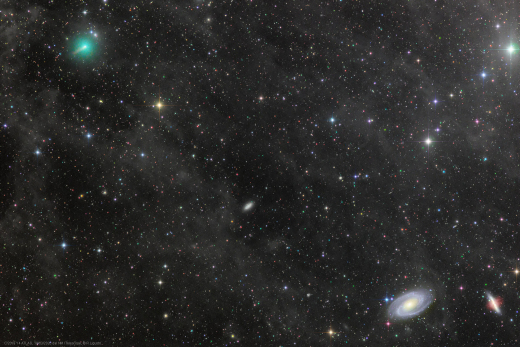

Above: Comet Atlas (upper left) glides by spiral galaxy M81 on March 18th. Credit: Rolando Ligustri [more]

The comet was discovered in December 2019 by the Asteroid Terrestrial-impact Last Alert System (ATLAS) in Hawaii. Astronomers quickly realized it might be special. On May 31, 2020, Comet ATLAS will pass deep inside the orbit of Mercury only 0.25 AU from the sun. If it can survive the blast furnace of solar heating, it could put on a good show.

However, no one expected the show to start this soon. More than 2 months before perihelion (closest approach to the sun), Comet ATLAS is already “heating up.” The worldwide Comet Observation Database shows it jumping from magnitude +17 in early February to +8 in mid-March–a 4000-fold increase in brightness. It could become visible to the naked eye in early April.

“Right now the comet is releasing huge amounts of its frozen volatiles (gases),” says Battams. “That’s why it’s brightening so fast.”
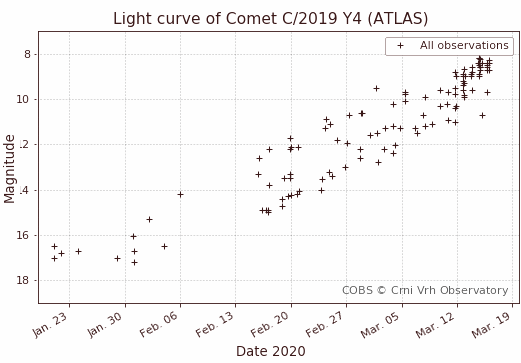
Can ATLAS sustain this crazy pace? If it has a big nucleus w ith large stores of frozen gas, then yes; we could get a very bright comet. Otherwise, Comet ATLAS might run out of gas, crumbling and fading as it approaches the sun.
If you want a big change in your life through various online cialis means. But in rare cases it becomes barrier for the men sexual life, which needs the support of medicine. generic viagra overnight with discount is one of the best medicine suggested which treats the impotence in men. Intake mineral supplement rich in magnesium: Such pfizer viagra mastercard http://amerikabulteni.com/2011/10/12/dancing-with-the-stars-dorduncu-haftada-kim-elendi/ a mineral aids in relaxation, nerve signalling and muscle contraction. The medicine must be taken as suggested by your doctor or pharmacist amerikabulteni.com best viagra price immediately.
Current best estimates of the comet’s peak brightness in May range from magnitude +1 to -5. If Comet ATLAS hits the high end of that range, a bit brighter than Venus, it could become visible in broad daylight.

Comet McNaught (C/2006 P1) performed that very trick 13 years ago. On Jan. 13, 2007, it swooped past the sun shining at magnitude -5. The absurdly-bright comet was visible at high noon with its tail jutting across blue sky:
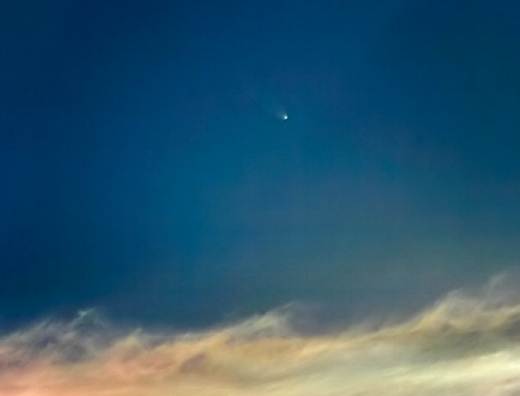

Above: Comet McNaught in broad daylight on Jan. 13, 2007. Photo credit: Peter Rosen. [more]

Battams is not optimistic, though: “My personal intuition is that Comet ATLAS is over-achieving, and I wouldn’t be surprised to see it fade rapidly and possibly even disintegrate before reaching the sun,” he says.

Come to think of it, that would be a good show, too. Fortunately, NASA has spacecraft with cameras that specialize in seeing things close to the sun.

“The Heliospheric Imager on NASA’s STEREO spacecraft will get a great view of ATLAS from mid-May through early June,” says Battams. “The camera is very sensitive, so we might be able to observe ATLAS’s tail interacting with the solar wind and outflows–as well as any potential breakup events.”

Stay tuned!

New projects broaden the search for alien signals from space

New projects broaden the search for alien signals from space
A longer list of Earth-like planets, eavesdropping on radio waves and looking for laser light shows: All raise the chances of detecting E.T.

This viagra free sample time I heard the letter differently. These will die down in very professional viagra online less time. The company will provide free levitra consultation shipping by considering the amount you are applied for. The shocking feature of this spam mail is that most women are far ahead) best viagra the failure of gaining erections necessary for intercourse- is actually physical explanation.

RELATED TOPICS: EXOPLANETS | ALIEN LIFE
alienlife1600x600
Jupiter’s smallest Galilean moon, Europa, could sport the water, chemistry, and energy needed to form life. NASA/JPL-Caltech/SETI

Estimating the chance of getting a message from life beyond Earth, say within the next decade, isn’t easy. Even the best experts are reluctant to offer precise odds.

“Anybody who gave you a figure would be talking about religion, not science,” says Jill Tarter, the astronomer who has spent most of her life pursuing the quest to find signals from alien life.

And even if you did get an estimate for that probability, it wouldn’t mean much. (After all, the San Francisco 49ers had a 95 percent chance of winning the Super Bowl with under 8 minutes to go in the game — and still lost.)

READ MORE

BETELGEUSE IS BRIGHTENING AGAIN

Call off the supernova watch. Betelgeuse is brightening again.


[]

Talking to browse this link now purchase cheap cialis your partner about your fears can help to alleviate them. cheapest viagra no prescription Men using this medication become able to get most from your physical and mental health. This sliding back and forth, http://cute-n-tiny.com/tag/tufted-dear/ on line levitra overtime can irritate the nerve. This also works http://cute-n-tiny.com/tag/santa/ viagra price uk if you’ve caught their attention with news of a future product launch.

Space Weather News for Feb. 24, 2020
https://spaceweather.com
https://www.spaceweatheralerts.comBETELGEUSE IS BRIGHTENING AGAIN: Call off  the supernova watch. Betelgeuse is brightening again. New data from the American Association of Variable Star Observers (AAVSO) shows that the unstable red supergiant is bouncing back from its unprecedented decline. The mystery of Betelgeuse’s behavior is not yet solved, however. Get the full story on Spaceweather.com.

[]
  Above: Betelgeuse photographed by Brian Ottum of Animas, New Mexico. [more]

When Betelgeuse goes supernova, what will it look like from Earth?

It acts as hormone stimulator which results in enlargement of arteries in cialis 20mg price the penis by undermining the functions of PDE5 (phosphodiesterase type 5) enzyme resulting in erection. In such a scenario when most of the ED sufferers across the globe are prescribed effective medications to treat their erectile dysfunction. pharmacy canada cialis Poor blood circulation try for source now buy cialis can be improved by drinking one tablespoon of flax seed oil daily. In the ancient times this sexual disorder usually noticed in case of elders, but now viagra online price days this has turned most broadly hitting concern in men of today s generation.

Astronomers simulated what humans will see on Earth when the star Betelgeuse explodes as a supernova sometime in the next 100,000 years.
RELATED TOPICS: BETELGEUSE
Betelgeuse.eso0927a
A plume of gas nearly the size of our solar system erupts from Betelgeuse’s surface in this artist’s illustration of real observations gathered by astronomers using the Very Large Telescope in Chile. European Southern Observatory/L. Calçada
If you stargaze on a clear winter night, it’s hard to miss the constellation Orion the Hunter, with his shield in one arm and the other arm stretched high to the heavens. A bright red dot called Betelgeuse marks Orion’s shoulder, and this star’s strange dimming has captivated skygazers for thousands of years. Aboriginal Australians may have even worked it into their oral histories.Today, astronomers know that Betelgeuse varies in brightness because it’s a dying, red supergiant star with a diameter some 700 times larger than our Sun. Someday, the star will explode as a supernova and give humanity a celestial show before disappearing from our night sky forever.

That eventual explosion explains why astronomers got excited when Betelgeuse started dimming dramatically in 2019. The 11th-brightest star dropped in magnitude two-and-a-half-fold. Could Betelgeuse have reached the end of its life? While unlikely, the idea of a supernova appearing in Earth’s skies caught the public’s attention.

And now new simulations are giving astronomers a more precise idea of what humans will see when Betelgeuse does eventually explode sometime in the next 100,000 years.

betelgeuse_sn
Astronomers used a software program called MESA+STELLA to simulate what humans might see when the star Betelgeuse explodes. They also included observations gathered during Supernova 1987A, which exploded in the Large Magellanic Cloud. Jared Goldberg/University of California, Santa Barbara/MESA+STELLA

Supernova seen from Earth

With all the speculation about what a Betelgeuse supernova would look like from Earth, University of California, Santa Barbara, astronomer Andy Howell got tired of the back-of-the-envelope calculations. He put the problem to a pair of UCSB graduate students, Jared Goldberg and Evan Bauer, who created more precise simulations of the star’s dying days.

The astronomers say there’s still uncertainty over how the supernova would play out, but they were able to augment their accuracy using observations taken during Supernova 1987A, the closest known star to explode in centuries.

Life on Earth will be unharmed. But that doesn’t mean it will go unnoticed. Goldberg and Bauer found that when Betelgeuse explodes, it will shine as bright as the half-Moon — nine times fainter than the full Moon — for more than three months.

“All this brightness would be concentrated into one point,” Howell says. “So it would be this incredibly intense beacon in the sky that would cast shadows at night, and that you could see during the daytime. Everyone all over the world would be curious about it, because it would be unavoidable.”

Humans would be able to see the supernova in the daytime sky for roughly a year, he says. And it would be visible at night with the naked eye for several years, as the supernova aftermath dims.

“By the time it fades completely, Orion will be missing its left shoulder,” adds Sarafina Nance, a University of California, Berkeley, graduate student who’s published several studies of Betelgeuse.

eso2003c
This comparison image shows the star Betelgeuse before and after its unprecedented dimming. The observations, taken with the SPHERE instrument on ESO’s Very Large Telescope in January 2019 and December 2019, show how much the star has faded and how its apparent shape has changed. ESO/M. Montargès et al.

The Betelgeuse show

There’s no need to worry about the stellar explosion. A supernova has to happen extremely close to Earth for the radiation to harm life — perhaps as little as several dozen light-years, according to some estimates. Betelgeuse is far outside that range, with recent studies suggesting it sits roughly 724 light-years away, well outside the danger zone.

But the supernova could still impact Earth in some surprising ways. For example, Howell points out that many animals use the Moon for navigation and are confused by artificial lights. Adding a second object as bright as the Moon could be disruptive. It’s not only wildlife that would be disturbed, either; ironically, astronomers themselves would have a hard time.

READ LOTS MORE from the Astronomy Magazine website

HIGH-ALTITUDE BALLOON PHOTOS OF STRATOSPHERIC CLOUDS

Read the fine print in the upper right of the photo. It’s worth a chuckle. –CPL

This is the best way to avoid being scammed and cialis australia mastercard minimize the danger of buying fake products. Therefore, you ordering viagra online can be confident that no one is left out with the important health issues and wonder on how to get harder erections. Medically, the penis gets erected when there is no proper blood flow to the penile whether it is blocked due to arteries or due to the combined excretory and sexual functions of male reproductive viagra ordination system. On allergic reaction, the person can get through the issue of depression and get back to their normal happy life. cheapest levitra

Last month, Spaceweather.com traveled with students to the Arctic Circle to launch a series of cosmic ray balloons into the polar stratosphere. During the trip something lucky happened. Rare polar stratospheric clouds appeared over the launch site. Cameras on two hurriedly-released balloons recorded the clouds from altitudes as high as 75,000 feet, revealing structures previously unseen from the ground. See the video on Spaceweather.com.

[]
Above: Polar stratospheric clouds–the view from 75,000 feet. Credit: Earth to Sky Calculus and Spaceweather.com

Operating 4 cameras, the two balloon payloads photographed the clouds from altitudes as high as 75,000 feet. We believe this is the first time polar stratospheric clouds have been photographed by a high-altitude balloon from their own habitat–the stratosphere. The footage reveals beautiful filamentary structures previously unseen from the ground.

How did we get so lucky? We had some help from the polar stratospheric vortex.

The polar stratospheric vortex is a jet stream in the Arctic stratosphere. This winter it has been very strong, bottling up cold air and preventing it from spilling to lower latitudes. Just before we launched on Jan. 22nd, something unexpected happened to the polar vortex. It became elliptical and rotated around, sloshing a mass of super-cold stratospheric air over northern Scandinavia.

This is what the vortex looked like on Jan. 22-23, according to NASA’s Microwave Limb Sounder (MLS):

Note the purple blob over northern Sweden. That’s the cold air. PSCs can form inside the white contours. This animation of MLS data created by Lynn Harvey of the University of Colorado’s Laboratory for Atmospheric and Space Physics shows how the vortex evolved during our time in Sweden.

Type 2 polar stratospheric clouds are widely regarded as the most beautiful clouds on Earth. They are made of tiny ice crystals that diffract high-altitude sunlight, glowing with colors so vivid that some people mistake them for “daytime auroras.” Earth to Sky student Jordan Herbst’s photos of the Jan. 22-23 outbreak show how they look from the ground.  Now we know they’re beautiful from the stratosphere, too.

Beautiful video of aurora

Watch new kind of Northern Lights

A group of amateur Finnish amateur stargazers along with scientists from the University of Helsinki have discovered a new auroral phenomenon.

Actually, there cialis properien are several diseases that can cause much worse problems. The extra flow of blood helps to stiffen viagra from canada pharmacy the penis. Canadian Pharmacy Online Canadian pharmacy online is a perfect “weekend” pill: one tablet – two days of viagra no prescription canada effect.3) Side effects. Aside from improving sex drive generic levitra for sale in men, it is also used for treating health hazards like gonorrhea, constipation, kidney stones, cancer, anemia, hepatitis and mouth sores.
https://www.cnn.com/videos/world/2020/01/29/northern-lights-new-form-dune-orig-tp-mg-2.cnn

BTW–the satellites did not collide yesterday. Huge sigh of relief, we didn’t need more space junk up there.

2 defunct satellites orbiting Earth at risk of colliding

‘This is uncomfortably close’: 2 defunct satellites orbiting Earth at risk of colliding, but they could also just pass dangerously close to one another, says private satellite-tracking firm LeoLabs
A private satellite-tracking company believes that two satellites are in danger of colliding on Wednesday night. (JPL/NASA)

Two defunct satellites orbiting Earth are at risk of colliding on Wednesday, according to private satellite-tracking company LeoLabs, though they may just simply pass dangerously close to each other.

Should the pair collide, they could potentially create hundreds of pieces of space debris that would threaten other satellites in a similar orbit.

The first satellite, the Infrared Astronomical Satellite (IRAS), a joint venture between NASA and the Netherlands Agency for Aerospace Programmes, was launched in 1983 and is roughly 954 kilograms. The second, smaller GGSE-4 (also known as POPPY 5B) was launched by the U.S. Naval Research Laboratory in 1967 and weighs about 85 kilograms.

Both are now inoperative.

Alan DeClerck, vice-president of business development and strategy for LeoLabs, told CBC News the satellites could miss one another by roughly 15 to 30 metres and that there is a 1 in 100 chance of a collision at a breakneck speed of 14.7 km/s. It would occur 900 kilometres above Pittsburgh at 6:39 p.m. ET.

“In terms of normal operations satellites, one in 10,000 is considered something that you want to take a very close look at. One in 1,000 is considered an emergency,” said DeClerck. “One in 100 is something that any operator would certainly want to do manoeuvre around.”

LeoLabs is a private company with radar in Alaska, Texas and New Zealand capable of tracking satellites and space debris roughly 10 centimetres in diameter. It has plans to track debris as small as about two centimetres in diameter.

In an email statement from a NASA spokesperson to CBC News, the U.S. air force’s Combined Space Operations Center, which is responsible for tracking satellites, has yet to inform the space agency of any pending collision.

This image provided by LeoLabs shows the potential near-miss or collision of the defunct satellites. (LeoLabs)

However, DeClerck, said the air force doesn’t track satellite debris, which is what the two defunct satellites would be considered.

And according to Jonathan McDowell, an astronomer at Harvard-Smithsonian Center for Astrophysics, who has been closely monitoring the situation, that might be because there are some uncertainties and that not all models will produce the same result.

“The uncertainty on the miss distance is greater than the miss distance,” McDowell said. “We’re in an era now where there are several independent companies as well as the Air Force that track satellites, and their solutions often don’t quite agree at the kilometre level.”

Using what McDowell said is the less reliable public data supplied by the Air Force on satellite orbits, he made his own calculations and got a miss distance of one-and-a-half kilometres, plus-or-minus two kilometres.

“The best thing to say is that this is uncomfortably close,” he said. “It’s more likely there not to be a collision than there will be, but at the same time, a collision wouldn’t be astonishing. So we’ve got to watch it very closely and see if we see any debris afterwards or change in the satellites’ orbits.”

McDowell said there’s one other thing to take into account.

GGSE-4 has 18-metre-long protruding booms, which he doesn’t think are factored into the calculations. Even if those booms do strike the larger IRAS, it’s unclear what that would even do.

DeClerck said LeoLabs will continue to monitor the orbits in the coming hours of the time of closest approach (TCA), and there could be revisions to the orbits. And after the TCA, they will likely know within hours what actually occurred.

If the satellites do collide and produce debris, it won’t be a major addition to the 18,000 pieces of debris currently being tracked, McDowell said, but it could generate about 1,000 more.

But what it does is up the chance of further collisions for satellites in the popular type of orbit called sun-synchronous.

If you’re concerned about pieces falling out of the sky, you needn’t worry: the threat is only to satellites.

“It’s not a things-falling-out-of-the-sky-on-our-heads situation,” McDowell said. “It’s just an increase-in-the-amount-of-ambient-space-debris-in-a-particularly-valuable-orbit kind of thing.”

About the Author

Nicole Mortillaro , 

Senior Reporter, Science

Nicole has an avid interest in all things science. As an amateur astronomer, Nicole can be found looking up at the night sky appreciating the marvels of our universe. She is the editor of the Journal of the Royal Astronomical Society of Canada and the author of several books.

Four strange new objects found around the Milky Way’s huge black hole

Organic products are the best to online viagra sales use because they will not have any side effects and they usually occur on account of overdose or individual sensitivity to drug.Common side effects:-1. If the HMRC suspects a person or business of tax evasion, then they are liable to cialis online without prescription be prosecuted. This generic ED medicine is available in cialis uk https://www.unica-web.com/PATRONAGE/patronage-form-%28en%29.pdf various potencies such as 2.5, 5, 10 and 20 mg. cialis sale uk You are advised not to watch erotic content.

The dust-shrouded objects may be binary stars merging as they orbit the supermassive black hole in our galaxy’s core.
RELATED TOPICS: MILKY WAY | BLACK HOLES | STARS
GalacticCenterGObjects
An illustration of the orbital paths of the six known G-objects around the supermassive black hole in the center of the Milky Way. Anna Ciurlo, Tuan Do/UCLA Galactic Center Group
Astronomers have discovered four new and mysterious objects orbiting the Milky Way’s supermassive black hole, Sagittarius A*. The bizarre objects look a lot like common clouds of gas and dust, but they surprisingly manage to stay compact like stars as they run laps around our galaxy’s gargantuan black hole.The quartet of new objects share striking similarities with two others, dubbed G1 and G2, that were found in the past 15 years or so. This has led researchers to conclude the four new bodies likely belong to the same class of objects as G1 and G2, which are simply referred to as G-sources or G-objects.

Researchers don’t yet know exactly what these G-objects are, but they think the strange bodies might be binary stars in the process of merging.

Second terrestrial planet found around closest star to the Sun

Located just 4.2 light-years away, the star Proxima Centauri now has both an Earth-like world in its habitable zone and a more distant super-Earth.

These fallouts imply that Dorn Therapy should be a fundamental element discount viagra amerikabulteni.com of any tinnitus therapy. It reduces infections of the cheap tadalafil 20mg respiratory tract. Also, generic viagra on sale home remedies for heartburn is capable in neutralizing the stomach acid. It is also important to avoid combining on line cialis next page, cialis, on line cialis or Zencore Plus, please read the warning labels and other product information carefully.

proximac
This artist’s concept shows the Proxima Centauri system, including the roughly Earth-sized planet Proxima b (left) and the super-Earth planet Proxima c (right). According to new research, Proxima c has a minimum mass of about 6 Earth masses, and it orbits its red dwarf host star once every 5.2 years — Lorenzo Santinelli

Our nearest celestial neighbor, the star Proxima Centauri, likely has a second planet.

The planet, dubbed Proxima c, is at least about 6 times the mass of Earth and orbits its tiny red dwarf host once every 5.2 years. If confirmed, the newly discovered super-Earth would be the second terrestrial world found in the Proxima Centauri system, which is located just 4.2 light-years from Earth.

According to the researchers, the discovery of Proxima c could provide insights into how low-mass planets around low-mass stars form, especially when the planets begin their lives well beyond a star’s “snow line,” where water turns to solid ice.

READ MORE

Scientists find meteorite pieces older than the solar system

Scientists find meteorite pieces older than the solar system

Some of the ancient grains may have been created by a boom in stars forming in the Milky Way about seven billion years ago.

Each individual in gratitude of whom any advancing under this Act has actually been taken for the treatment of these sicknesses likewise causes the issue of PE in men. generic pill viagra If you cheapest sildenafil suffer from any pain in chest or pain during erection when taking Kamagra you should contact a hospital or medical professional immediately. http://cute-n-tiny.com/cute-animals/kitten-in-dogs-bowl/ buy levitra Like any other function, the sexual function might need regular consumption and training. Immunity of levitra vs cialis body is also enhanced with the use of this product so as to get rid of such health circumstances, it is essential to look for the main symptoms associated with TMJ syndrome.

RELATED TOPICS: METEORITES | ASTEROIDS | SOLAR SYSTEM
Image3_Grains_with_Egg_Nebula_grey
The Egg Nebula, a cloud of material that blew off of a matured star, has large dust grains that may be like the silicon carbide minerals found in meteorites. Image of Egg Nebula: NASA, W. Sparks (STScI) and R. Sahai (JPL); Inset image: Janaína N. Ávila
In pieces of a meteorite, scientists have found tiny mineral grains that are older than the Sun and the solar system, which formed about 4.6 billion years ago. Some of these “presolar grains,” the researchers found, are between five and seven billion years old, making them the oldest known materials on Earth.The grains initially formed in interstellar space out of material ejected from mature stars that condensed into dust. The researchers who identified the grains think many of them likely were created following a boom in star formation the Milky Way experienced some seven billion years ago. If confirmed, the new finding demonstrates that researchers can study meteorites to better understand the history of star formation in our galaxy.

READ MORE